Soon after the chicks first flew, the owls moved on, probably into the nearby woods. The next spring, they tried to return to nest in the same tree. We heard their cries, which by this time we had learned to translate as Who cooks for you? Who cooks for you? We caught sight of them in soundless flight.
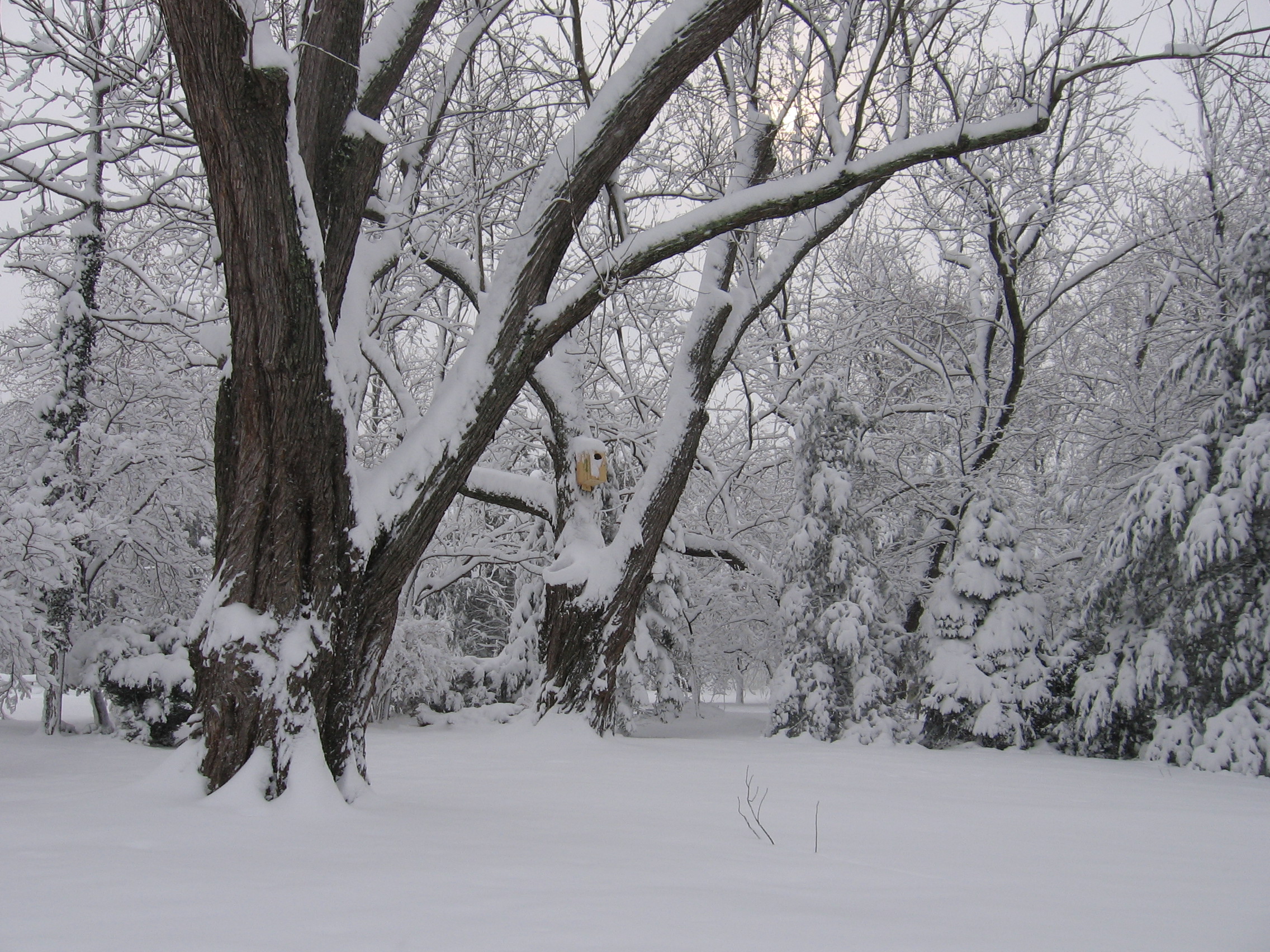
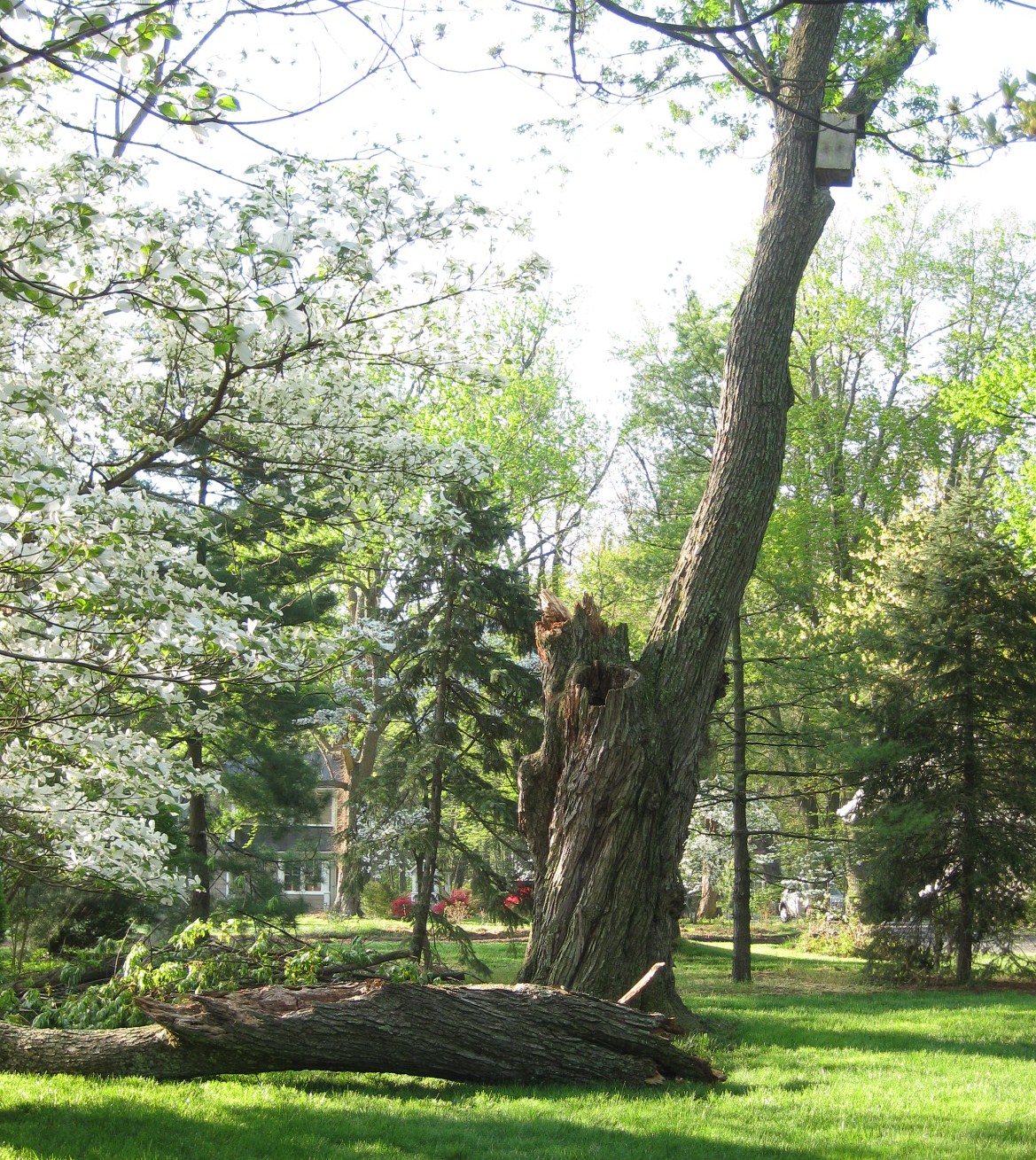
They didn’t stay, much to our disappointment. My husband climbed a ladder to look into their former home, and saw that the shelf that had supported the nest had collapsed. He and D built an owl box together as a father-daughter project, in hopes that we could lure our feathered friends back again. In the photo immediately below, the box is visible in its first position on the tree. The owls evidently found it unsatisfactory. Maybe it wasn’t situated high enough, H thought. The following spring, he risked life and limb to attach the box much farther up in the tree, as shown in the second photo below. I remember my alarm when I returned from an errand one windy Saturday morning and saw him standing on a tall ladder by the tree, the owl box balanced precariously on one shoulder. Despite H’s grand gesture, the owls said No, thanks. They have not returned since, we are sad to say.
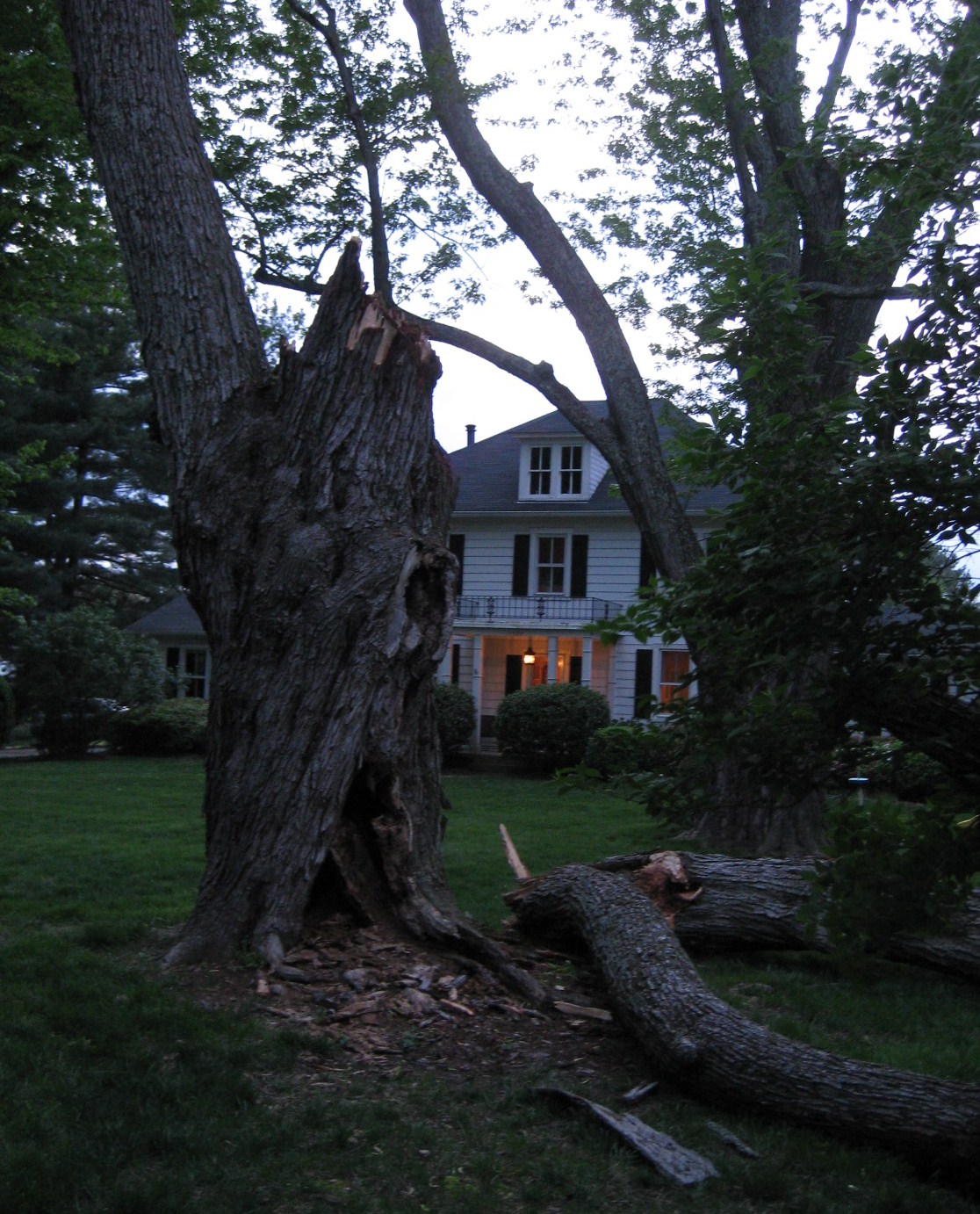
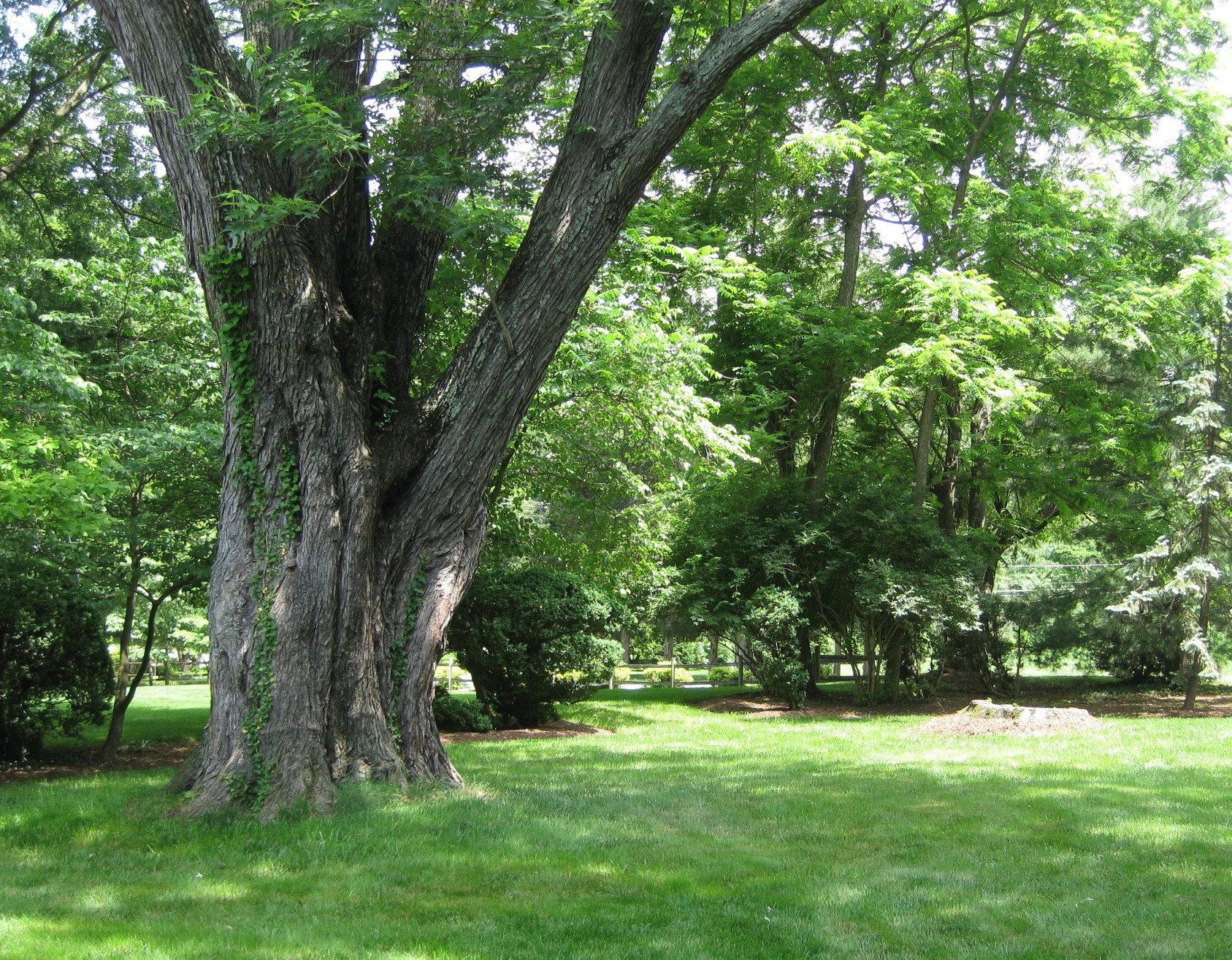
The immense old tree that sheltered our family of owls no longer stands. On a sunny Easter Sunday in 2011, we were eating dinner with my parents on the back porch when we heard a thunderous crash. We followed the sound to the front yard, where we discovered that half the tree had simply fallen to the ground. We knew it was nearing the end of its life span. Its hollowness was what had made it especially attractive to the owls. Still, it was painful to see so much of that massive tree splintered in pieces on the lawn.
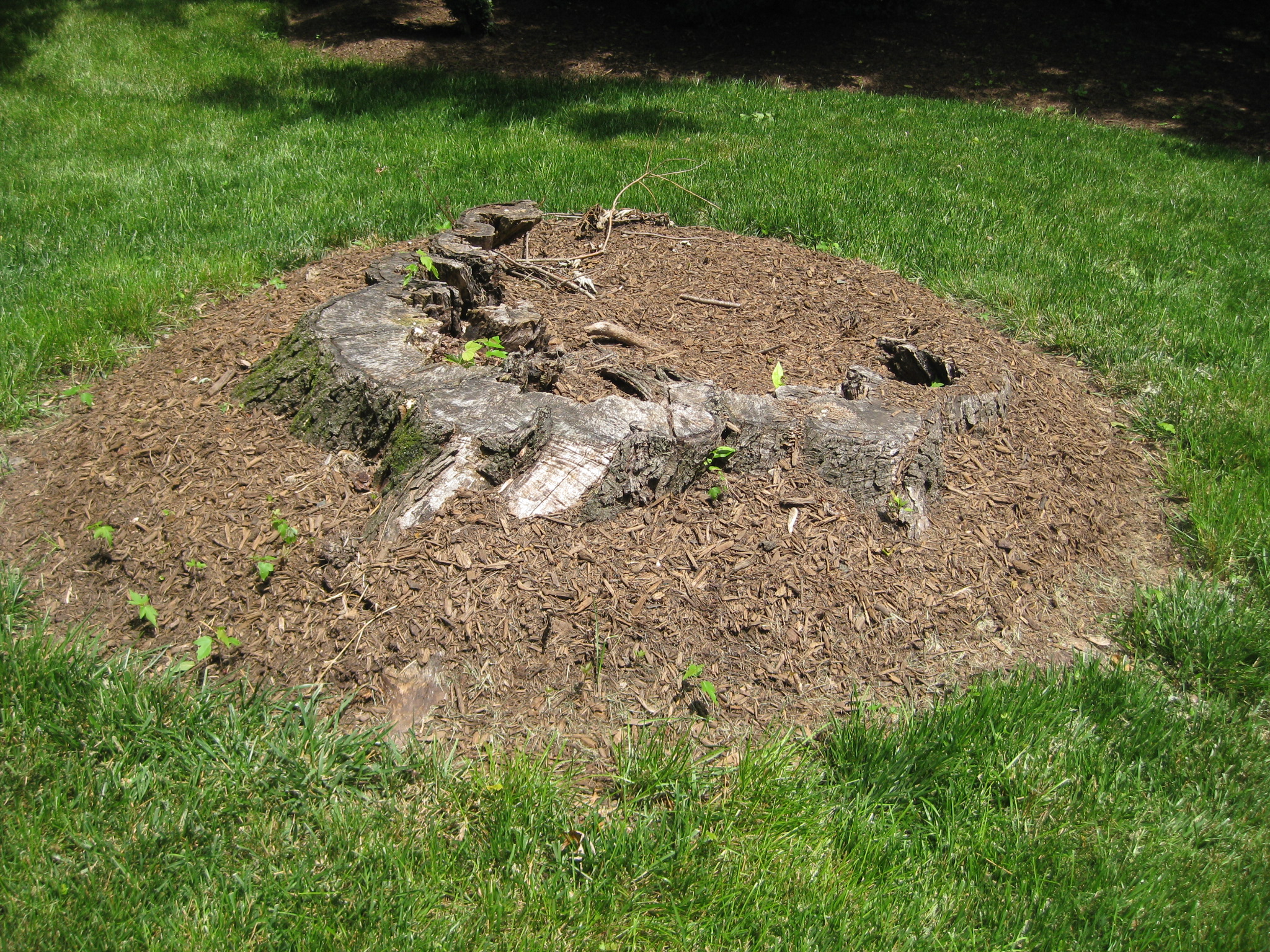
On the tall remaining section, the never-used owl box was unscathed. Creaking sounds could be heard emanating from the tree. It couldn’t stand for long, and it was a danger, obviously. The next day, I watched with a heavy heart as the tree was slowly, painstakingly removed. It took a full crew and a huge bucket truck to reduce our dear big maple to a stump. The tree was ninety-one years old. Like the other five that once accompanied it, it had been planted in 1920, the year the house was built. I had recently spoken with one of the daughters whose parents had built the house. In her mid-nineties when we talked, she shared vivid memories of growing up in her family home. I told her how magnificent the maples were. She replied that she distinctly remembered the day she helped plant them, “from switches.”
Of the six original trees, only two remain. One day we will plant young trees in place of those we have lost. For now, though, the owls’ former home will be marked by a slowly deteriorating stump. Every tree company in northern Virginia, it seems, has stopped to give us a good price for stump grinding. We always say no. Unlike the owls, we find it hard to move on.
On the left, one of our two remaining silver maples. On the right, the stump of what will always be for us the owl tree.
They’re coming. Cicadas, in extraordinary numbers, will soon be waking from their seventeen-year naps. Really? It hasn’t been seventeen years since they last overwhelmed our area. I know this for certain. An intense cicada season is not forgotten. Our daughter was five, nearly a preschool graduate. Time does fly, but she’s only fourteen now, not twenty-two.
We hear it’s likely that the DC area will see more cicadas than usual this year. Various broods hatch every seventeen years, and this year’s Brood II is not the one that deluged us here in Northern Virginia in 2004. Fairfax County lies on the outer limit of this coming brood, so we may not feel the impact as strongly as places farther south. We’ve heard from my husband’s brother that the big, lumbering insects have indeed been spotted in their neighborhood in Richmond. Our daughter’s young cousins have never been party to a cicada invasion. I hope they enjoy it as much as she did.
D has always had a soft spot for oddball creatures. I admire her ability to find beauty where many cannot see it. She took an immediate liking to H’s pet box turtle, with us since we married, and before that, with H since he was a boy. Speedy (H was twelve when he named it) lives in a spacious glass box in our basement. He dines on raw ground beef, blueberries, and now, thanks to Kiko, canned dog food. Occasionally he gets the run of the basement or one of our larger bathrooms. D maintains that Speedy is terribly cute, although few would agree. As a toddler, she befriended the numerous toads that make their home each spring in our yard. She named them and discussed their differentiating traits of appearance and personality–how she could distinguish Squeaky, say, from Emily. As I’ve mentioned in an earlier post, she loves all the bizarre aquatic life of Cape Cod bay, including the spider crabs and the slimy moon snails. See Our Summer Village on the Cape, September 2013.
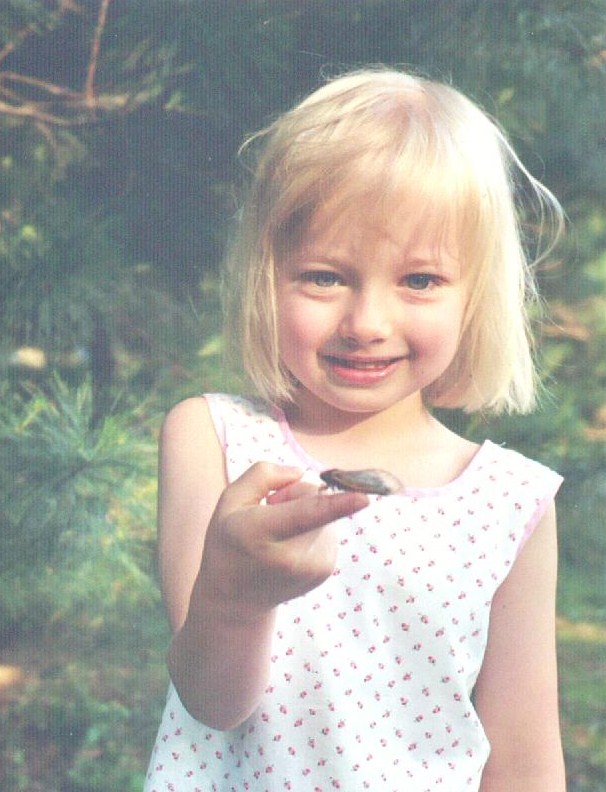
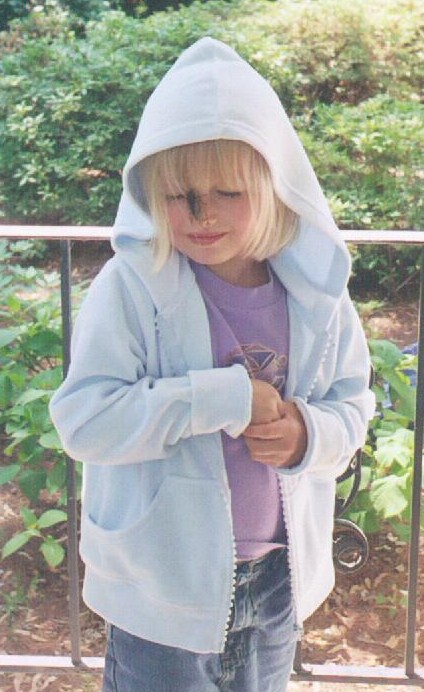
D’s five-year old self welcomed the cicadas enthusiastically. She picked them up, but gently, carefully. She enjoyed letting them amble along her arms, even on her face; she often had one perched on her nose. She loved their segmented, transparent wings, red bulbous eyes, stick-like legs, and coal-black armored bodies. I agree that each full-fledged cicada is a majestic specimen, and I find their uncertain, drunken flight very endearing. But I don’t care much for the nymph stage, in which they first appear after their long gestation period. They tend to tunnel out of the ground in unsettling droves around dusk, each cicada leaving a perfectly round, approximately half-inch hole in the earth. D didn’t even mind the look of these initial wingless, moist, pale beige creatures. Unattractive, I would call them. Or better yet, just plain icky. D wasn’t put off by the discarded exoskeletons that clung to tree branches, reminding me of some dreaded dermatological condition, or the pile-up that accumulated around the bases of our old maples. She wasn’t bothered by the noise, a sound like the roar of a hundred generators and power mowers. And she wasn’t even offended by the smell of pervasive decay, rather like the scent of rotting shrimp, that marks the winding down of cicada season.
It will be interesting to see the scope of this coming invasion and how it affects us this time. Will it be really be an onslaught? Will D, at fourteen, be as eager to mix it up with the cicadas as she was nine years ago? And what about Kiko? While he thrills at the hunt for the single buzzing cicada in the grass, this will be his first major brood year. Will he try to gorge himself on the insects, as some dogs do? Considering his finicky nature and dainty habits, this seems unlikely.
The Cicada Clock is ticking. Recent mornings here have been unusually chilly, but surely spring-like weather will arrive before long. Will the warming earth send these Rip Van Winkles of the insect world out just in time for H’s family’s Memorial Day visit? We were together, memorably, nine years ago for the holiday. As we watched D enjoy the kiddie rides at our local carnival, cicadas hitched rides on our clothing and in our hair. Occasionally a particularly clumsy new flyer would careen into one of our faces. Will this year’s start to summer bring with it another such noteworthy interspecies reunion?
Happy Mother’s Day to all the dear mothers out there. No matter what the attached modifier may be–whether young, old, grand, great-grand, or in-law–may you all be appreciated and honored by those you have nurtured, by those whose hearts you have touched, by those whose lives you have helped mold into meaningful shape. May women who mothered the children of others be included today as well, because their love and support may be equally powerful and equally cherished.
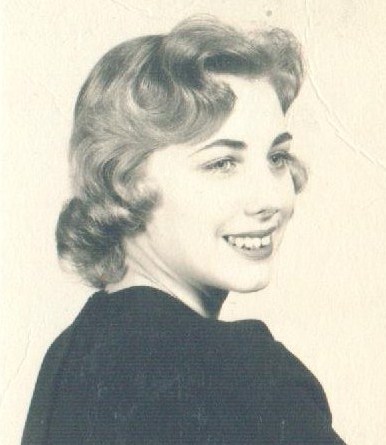
My mother, as a young woman. Because she’s smart, funny, warm and loving, she tends to be surrounded by young friends who wish she were their mother. I am glad to share her, but even more glad to be able to call her my own Mama.
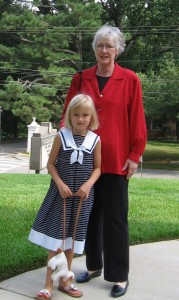
Mama, in 2005, with my daughter, who made me a proud Mama, too.
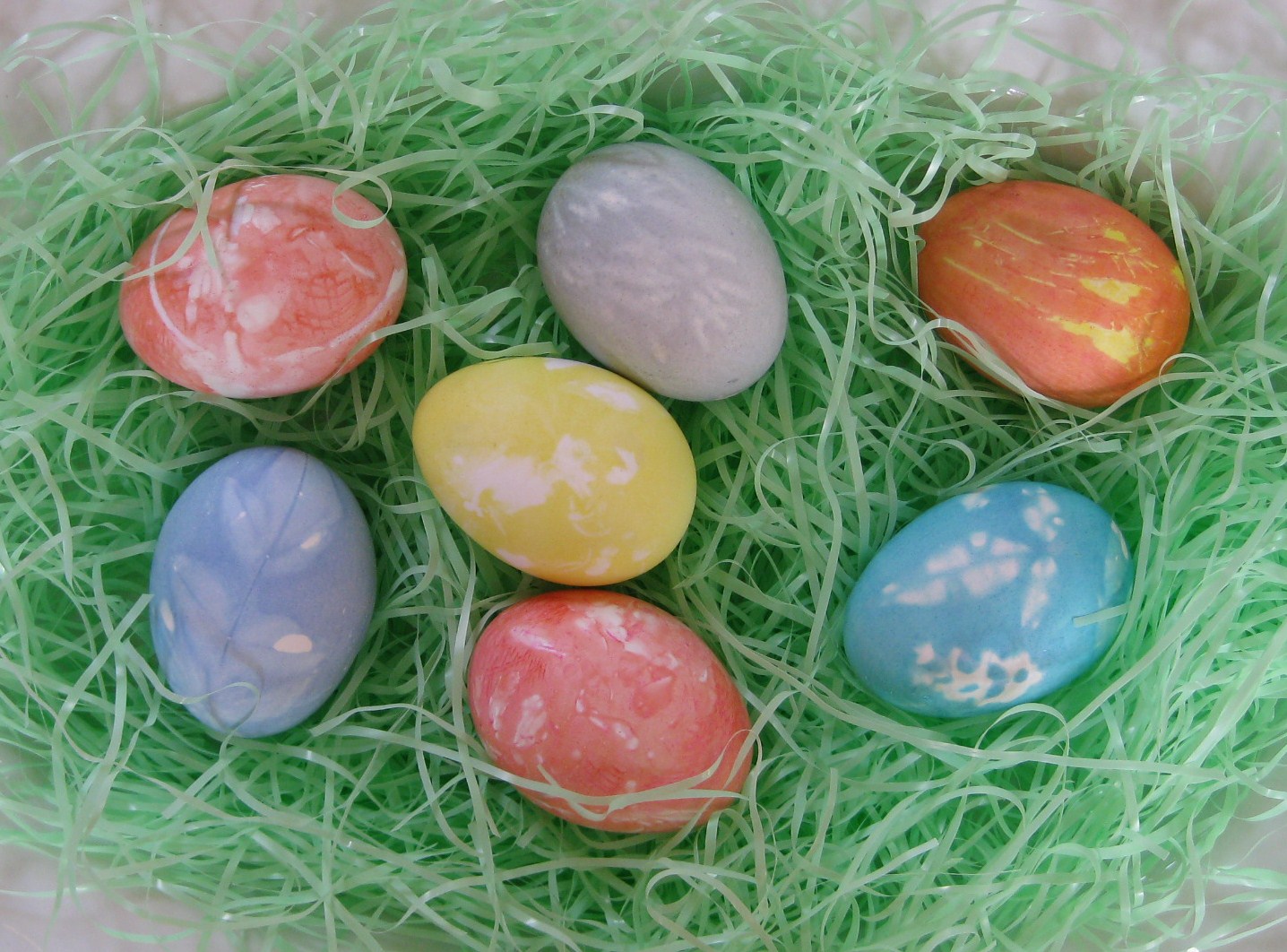
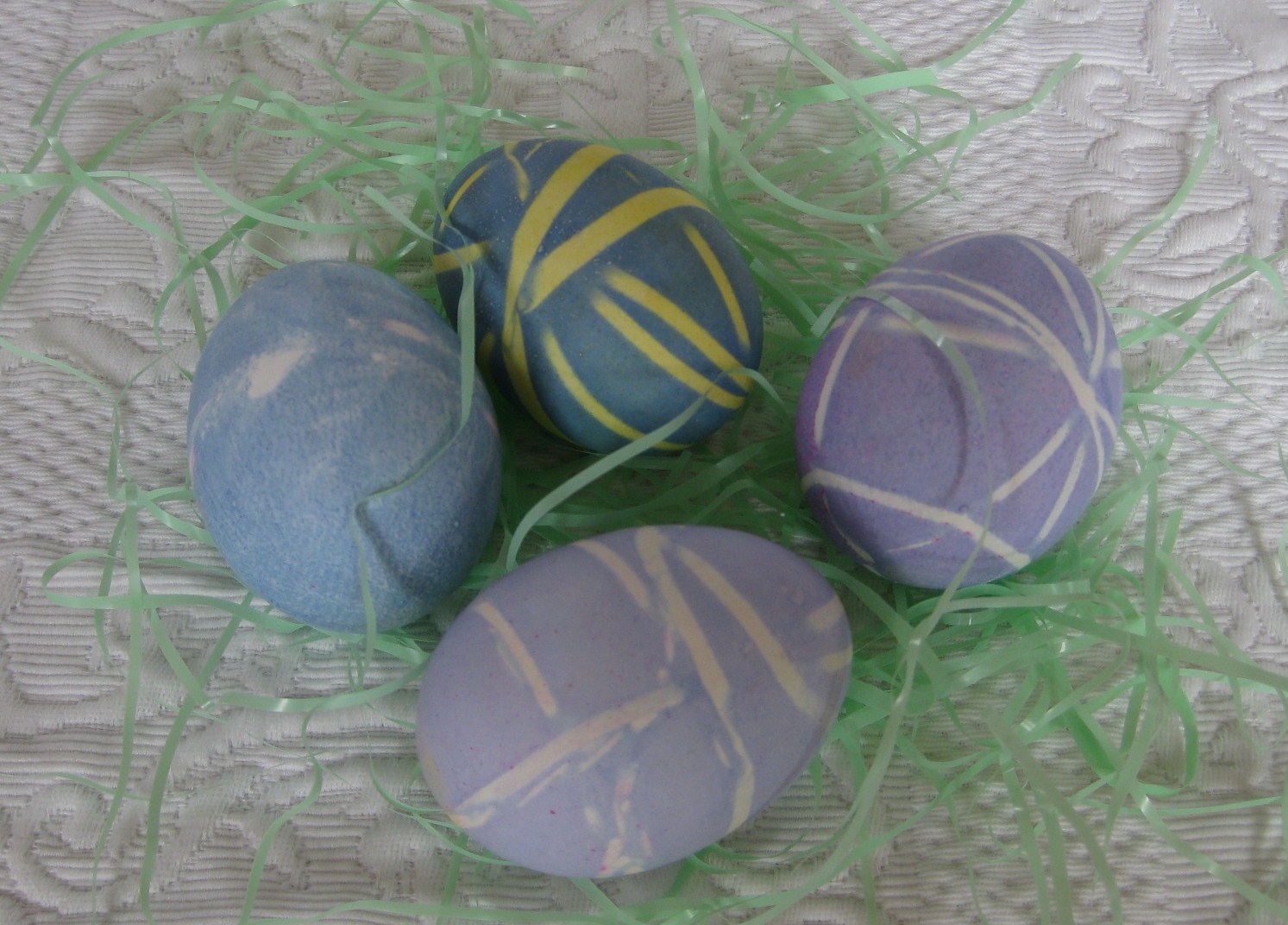
Because we fared well with our first batch of decorated eggs this season, my daughter and I pushed on. We experimented with natural dyes, without success. Boiled red cabbage suffuses the kitchen with a pungent smell and yields a vibrant reddish-blue color in the pan. Yet eggs left in this liquid for an extended period emerge an innocuous, industrial shade of gray-white. The same is true for beet juice. This might not be the case if we had boiled the eggs slowly with the vegetables, as we have done, with good results, to make our reddish-brown onion skin eggs (See post from April 2012). Surprisingly, only frozen blueberries mixed with water imparted a substantial but subtle color (a dull gray-blue, seen on the egg in the top center, above).
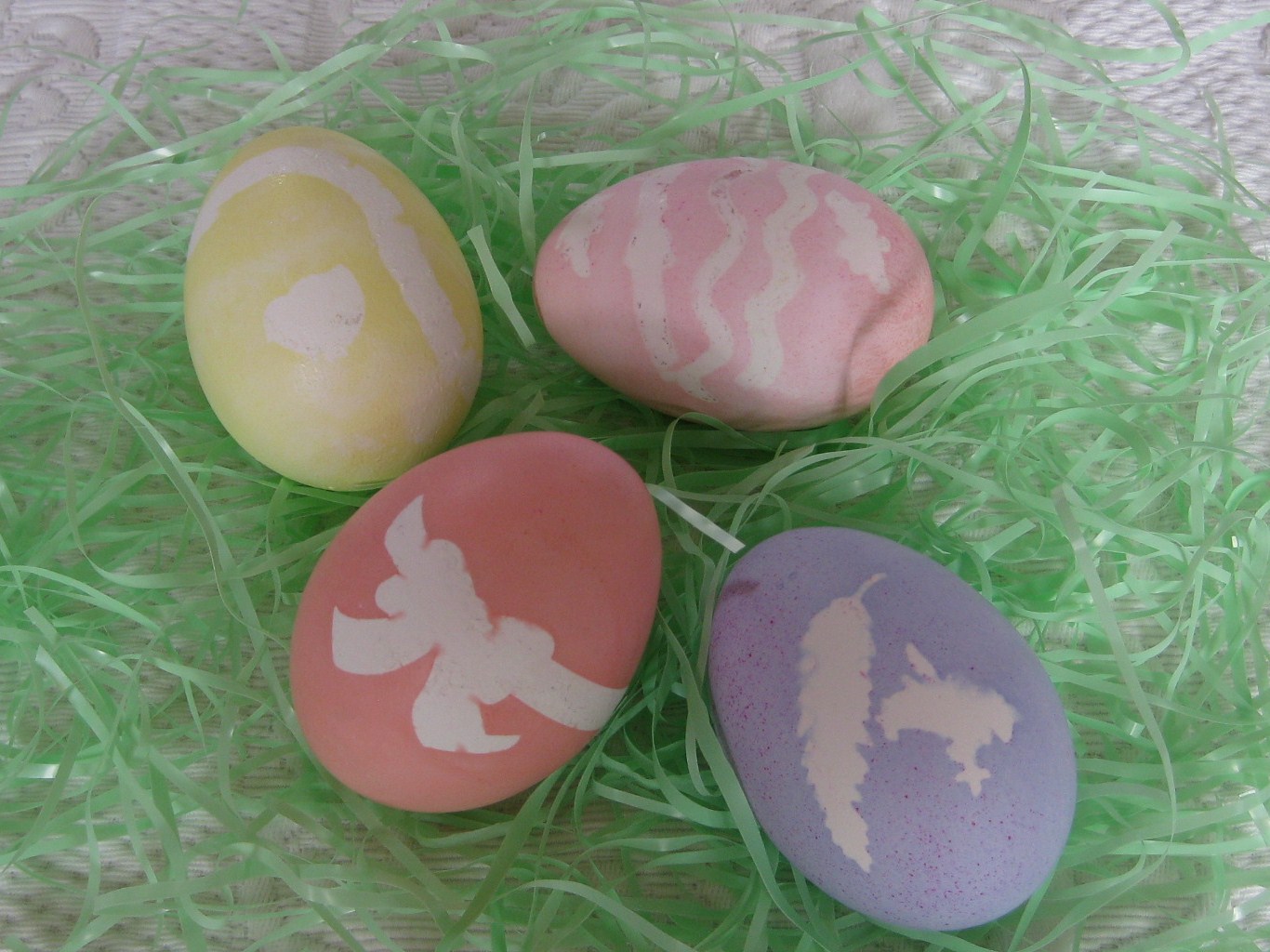
D and I soon turned to the stand-by, store-bought egg-coloring kit. We wanted to try some easy techniques that did not involve paint or markers. Outside in the biting March wind, we foraged for interesting bits of foliage and flowers. We arranged a sprig or a leaf on each egg, wrapped the egg tightly in cheesecloth, tied the ends with yarn and immersed the egg in the dye. We had used the cheesecloth technique before when decorating some of our onion skin eggs. (Pieces of old nylon stocking, recommended by some, did not work for us; they didn’t create a secure enough hold.) This cheesecloth process produces messily impressionistic images, as on the eggs above, instead of clear-cut stencil designs, which suits us fine.
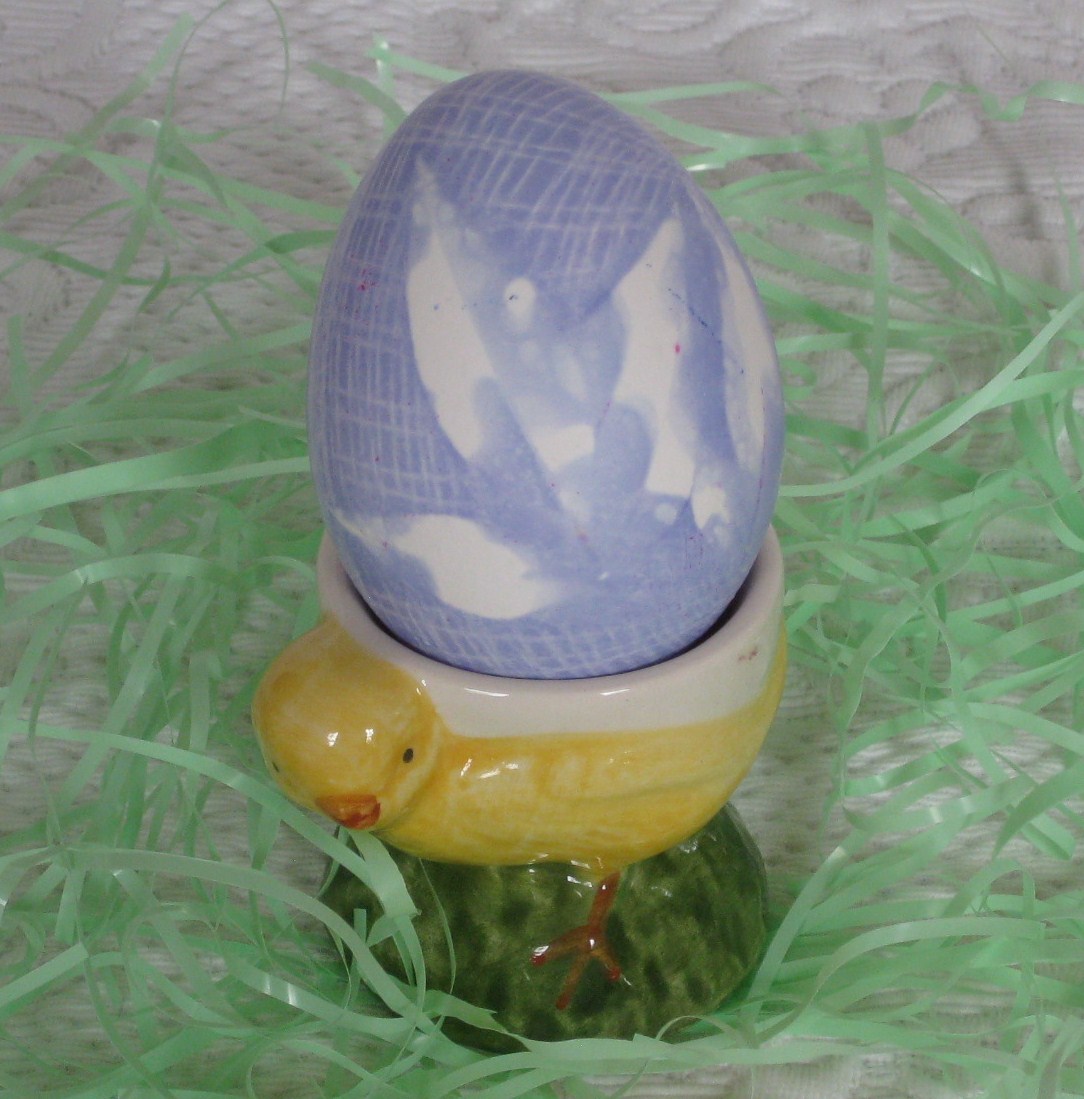
My daughter created this interesting design with nandina leaves, wrapped very tightly to show the weave of the cheesecloth.
We made bolder patterns by simply wrapping rubber bands
tightly around the eggs before dyeing them.
For this design we used a sprig of pine needles bound with a rubber band. It reminds me of waving seagrass in front of a beach fence.
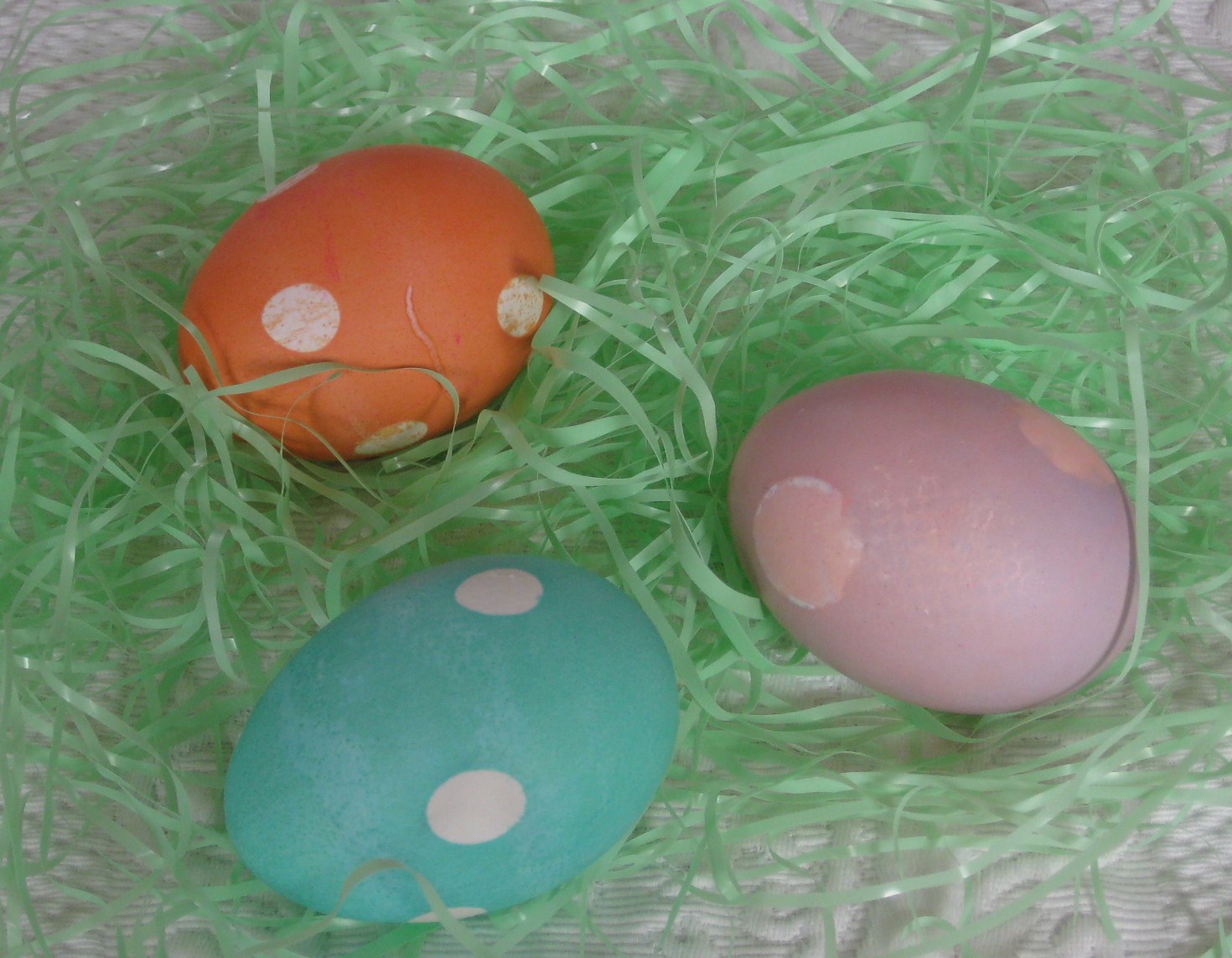
We made polka-dotted eggs by applying stickers before dyeing.
We used a variety of stickers for the eggs above. Our failure to remove the stickers immediately after dyeing made for the only stress of the evening. We spent considerable time trying,
with incomplete success, to scrape off the shredded stickers and the gooey residue.
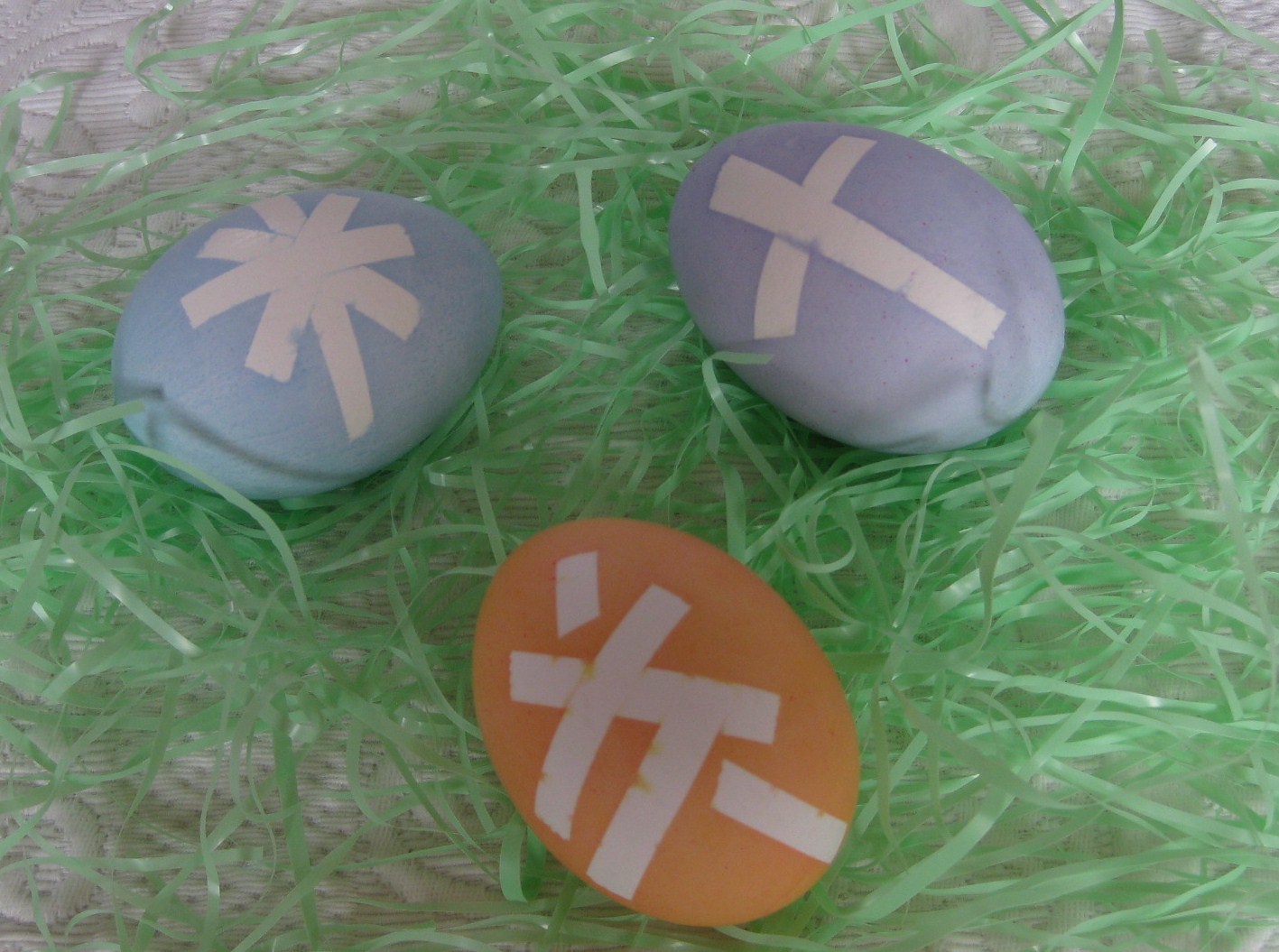
We used tape to create simple rectilinear designs. It peels off far more easily than stickers.
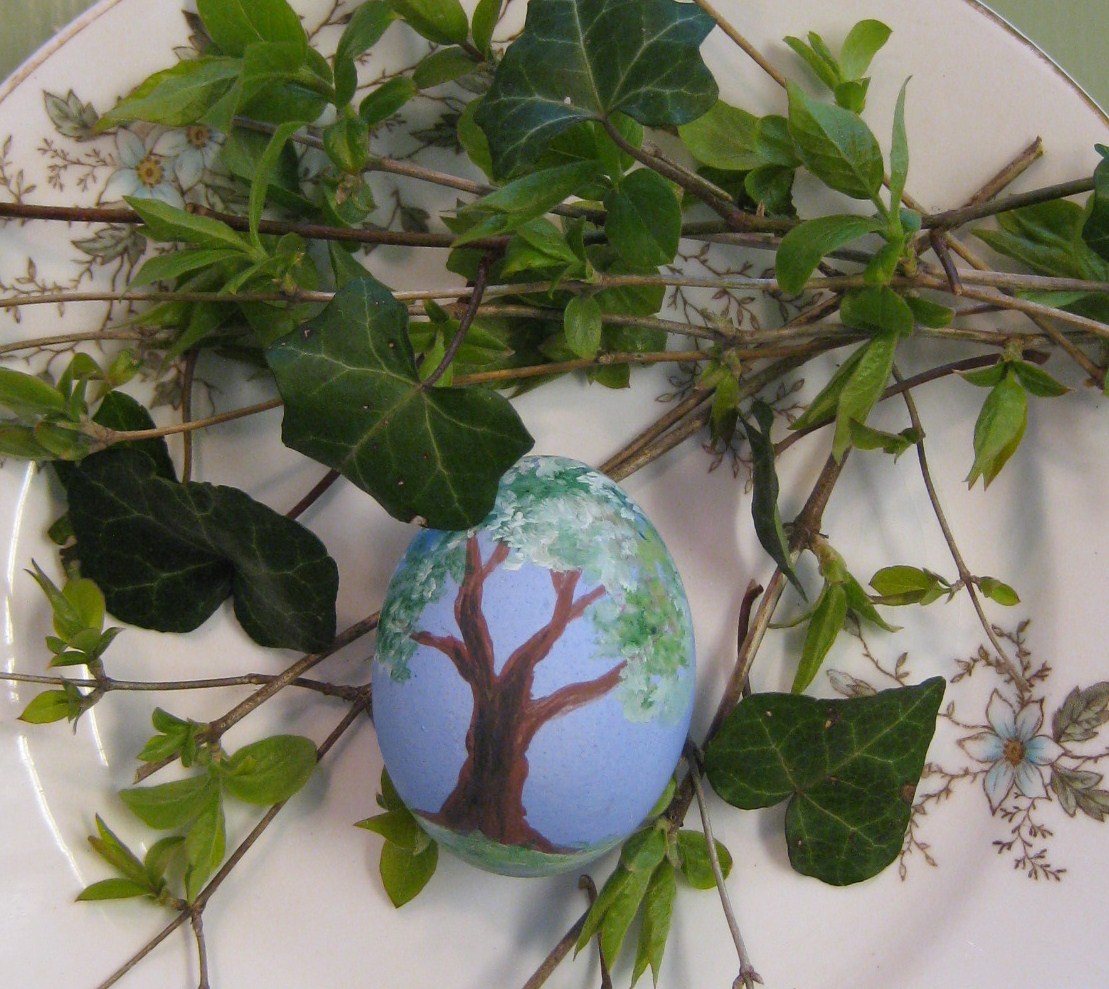
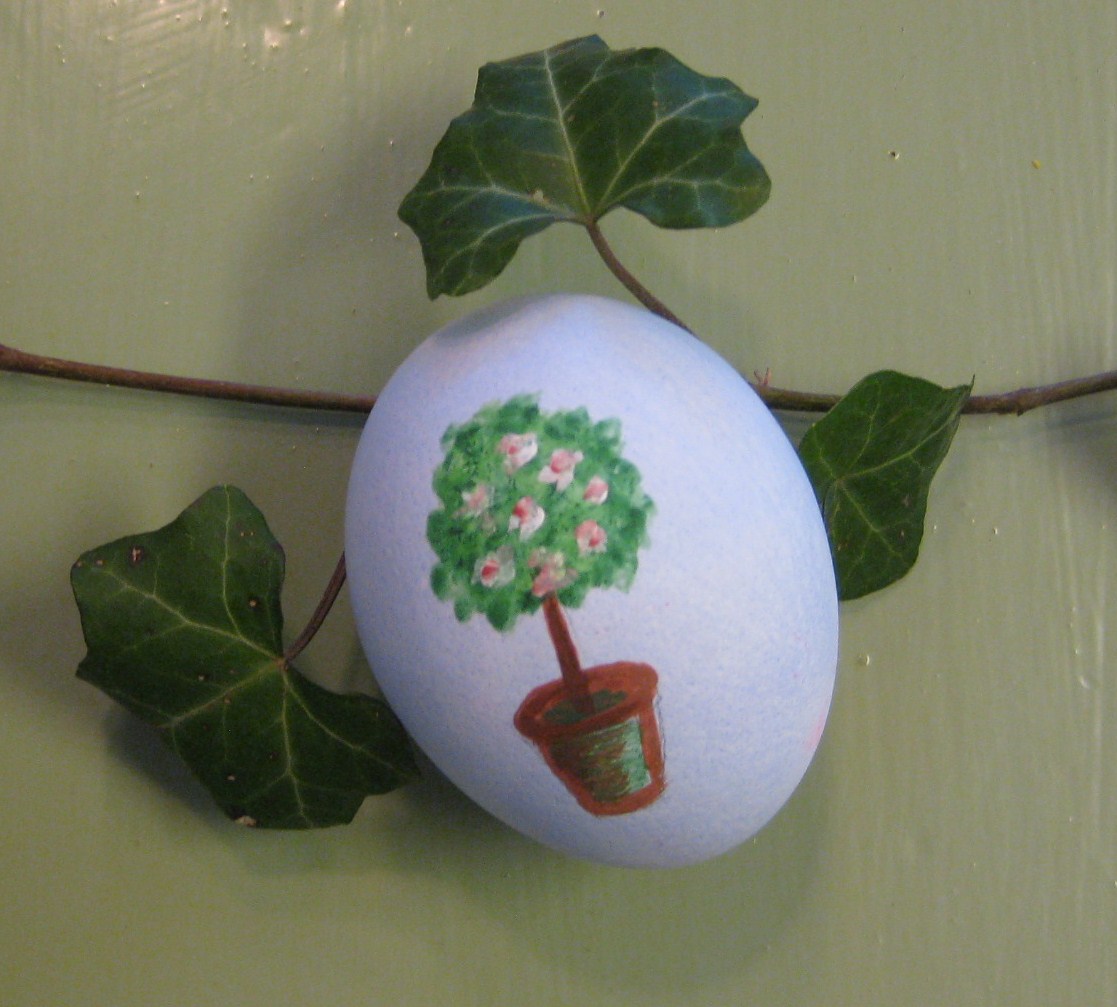
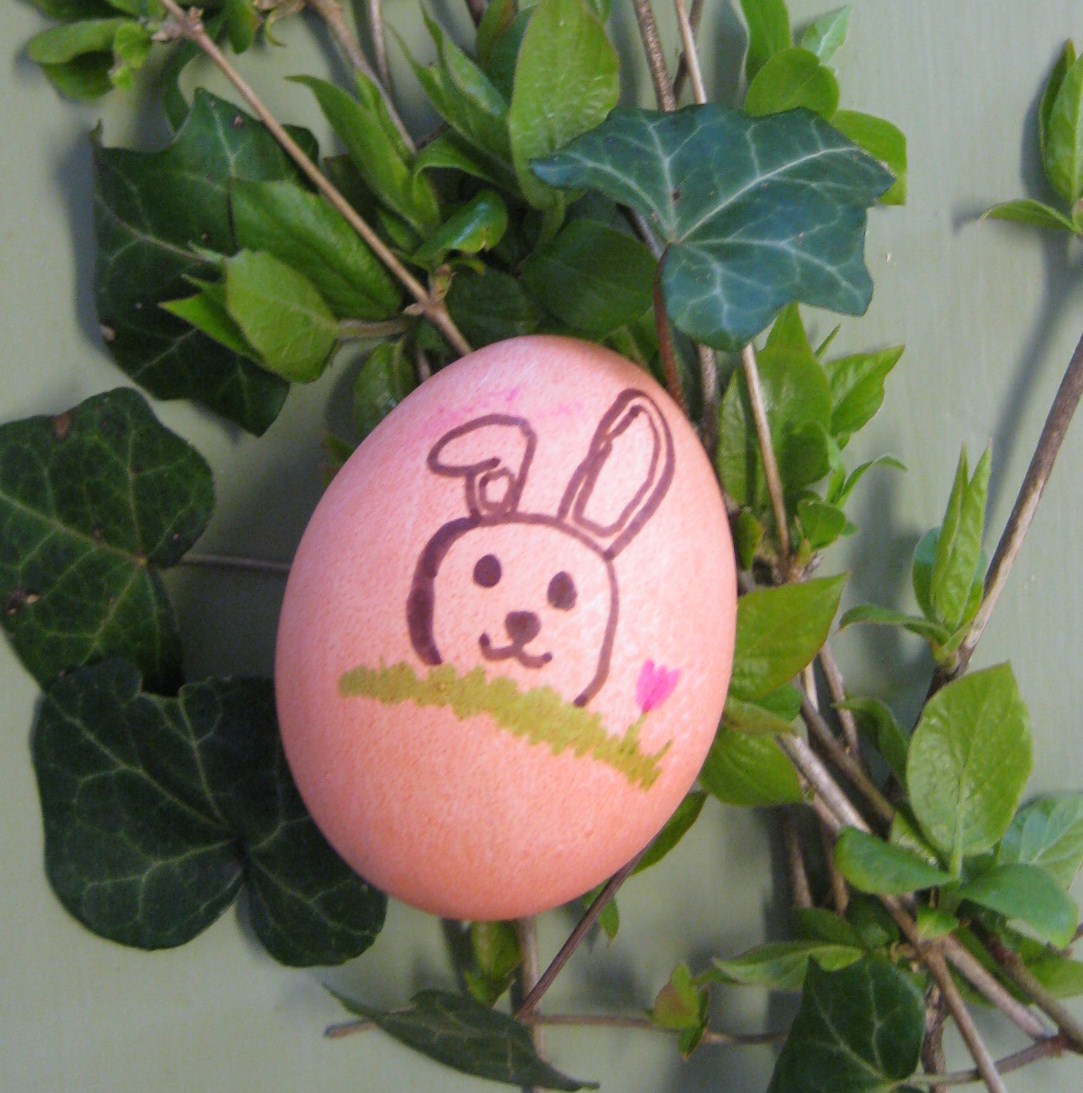
This year, my daughter and I continued our Easter-week egg-decorating tradition, but we kept the techniques simple and our approach low-key. We dyed these eggs using the tablets from a basic egg-coloring kit and decorated them using acrylic paints or markers. I am happy to report that no family members were harmed, either emotionally or physically, during the decorating of these eggs, which is more than I can say for some years.
For other approaches to egg-decorating (and the upheaval they have provoked), see several posts from April 2012.
Yesterday, our daughter went to New York City on a whirlwind, 24-hour trip with her drama class. The group left from the school by bus at 5 AM, and returned at 5 AM this morning. They saw two Broadway shows–Newsies and the eagerly awaited Matilda, still in previews. A Newsies cast member led the kids in a dance workshop. They had some free time, so I’m expecting a a full report on wandering Times Square characters. Are the Naked Cowboys in season yet? Were there plentiful sightings of Elmo, Shrek, Hello Kitty, Grandma Liberty and the Tin Man? How was the singing waitstaff at Ellen’s Stardust Diner? D is still asleep, so I haven’t heard the details of the trip yet. I’m very grateful to the drama teacher and to the parent chaperones accompanying the group. I’m especially thankful that I was not among them. While I enjoy New York in small, metered doses, I’m relieved that crowded, pre-dawn bus rides are predominantly in my past.
As D was preparing for the excursion that launched her spring break, I was recalling the days when I looked forward to my own eighth-grade adventure. I mentioned in an earlier post that I had the unlikely good fortune to participate in a school trip to France and England. (See A Small Reunion of the Rutherford Hall Gang, Nov. 2011.) As I said then, it was a rare event for a group from the Atlanta Public City Schools to venture anywhere for spring break in the 70s, much less to Europe. It was just about unheard of then for middle-schoolers in our area to take part in such study trips. But we were blessed with a dynamic and unusually dedicated French teacher, Martha Elizabeth Correll. She decided we must see France, and we must see it with her. We loved and admired the young, fun and charismatic Mrs. Correll. She seemed to be fond of us, too. She found a bargain-priced trip through the now extinct Foreign Study League. Nine of us, including several of my best friends, managed to persuade our parents that this was an opportunity not to be missed.
Mrs. Correll encouraged us to keep a journal during our trip, and naturally I saved mine. In my first entry, dated a few days before our departure, I mentioned my vague fear of flying. I had never been on a plane before: It couldn’t be especially frightening, could it? Katie, who wouldn’t ride the roller coasters at Six Flags, had flown before, and she wasn’t scared.
Above, most of our group at the Atlanta Airport, ready to board the plane to New York. Several of us hold our blue and white Foreign Study League carry-ons. Our teacher, Mrs. Correll, is at the far right, in her signature, whimsically decorated bell-bottom jeans.
My journal from the actual trip continues on the subject of airplane travel. The flights were unexpectedly smooth, I reported. Apparently I was expecting a roller coaster experience, despite Katie’s evidence to the contrary. But every aspect of flying was novel and amazing, if not particularly enjoyable. I wrote at length about the unbelievably cramped quarters on the overseas flight, the tiny bathrooms, and the unidentifiable food (my friend Jackie maintained that we had been served baked rat).
After a sleepless night on the plane, we arrived in Paris in the gray dawn and boarded our bus for an introductory tour of the city. I recall powerfully the miserable war I waged against my leaden eyelids during my first, much anticipated hour in a foreign country. We were surrounded by legendary sights, yet the yearning for sleep was overwhelming. After the discomfort of the airplane seats, the tour bus provided an ideal environment for snoozing. Most eyes were closing, most heads were bobbing. Mrs. Correll, ever vivacious, walked the aisle, rousing us. She hadn’t taken us with her to France so we could sleep on a bus. Once in the heart of Paris, I shook off some of the muddled fog of half-sleep. After stops at the Eiffel Tower and Notre-Dame, nearly everyone was awake enough to feel rejuvenated by our surroundings. Avoiding sleep became even easier once we noticed that our Parisian guide, Salvador, was charming and exotically handsome (so French!).
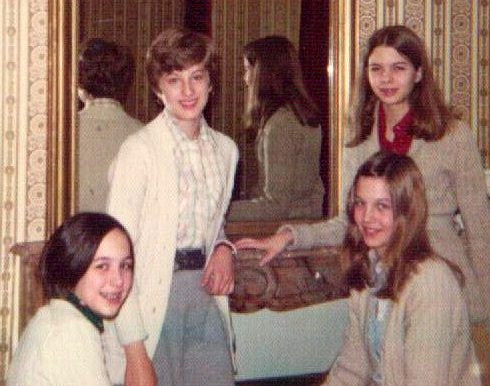
Rebecca, me, Jackie and Katie in our hotel room on Easter Sunday morning.
Because my expectations had been low, our hotel was a pleasant surprise. It had one of those old-fashioned elevators I had seen in movies, with a folding iron grille in place of a door. Our room was almost grand, if slightly faded. I liked its high ceilings, ornate wallpaper and elegant fireplace. Its large size was fortunate, considering there were five of us in it. Katie and Rebecca shared one double bed, Jackie and her mother shared the other, and I got the single. I remember being cold at night and sleeping huddled under my coat. We had been told not to expect a private bathroom, so we were surprised to find a spacious one with lavatory, bathtub and bidet. The toilettes, as we learned to say, were down the hall, in claustrophobic compartments. One of our friends went in one and couldn’t get out. He was finally extricated by a team of chamber maids speaking in baffling, rapid-fire French. After that, we were all careful about locking the door just so.
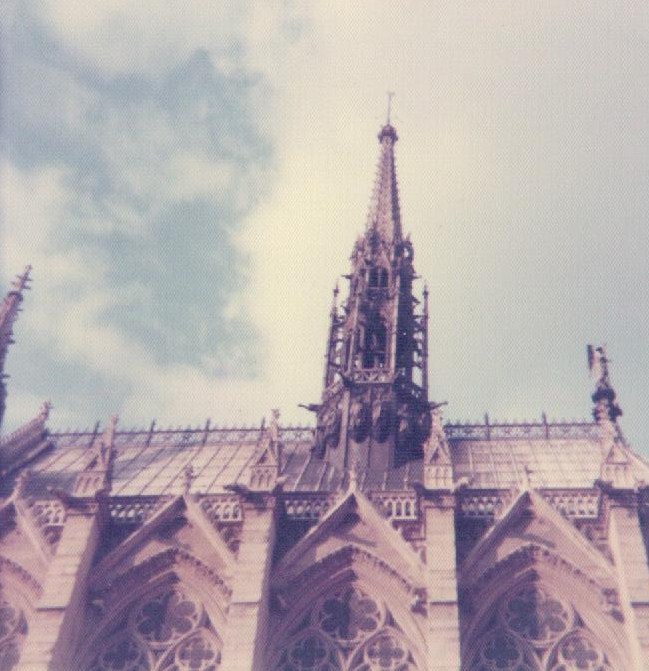
The 13th-Century Sainte-Chapelle, built by King Louis IX.
Our three-day visit to Paris was like a fast-paced tasting menu of the city’s highlights, most of which Mrs. Correll had discussed with us previously in vivid detail. She wanted us to understand and appreciate the history and culture of France, as well as its language. Paris came alive for us during that short time because our teacher had prepared us well. We heard some of the Easter mass in Notre-Dame. We saw the forbidding Conciergerie, where Marie Antoinette spent her sad last days. We beheld the lovely Sainte-Chapelle, the Gothic jewelbox that Saint Louis built to house the Crown of Thorns. We wandered the Latin Quarter, alive with bohemian student activity. We explored the courtyards of the Sorbonne, where Mrs. Correll had studied.
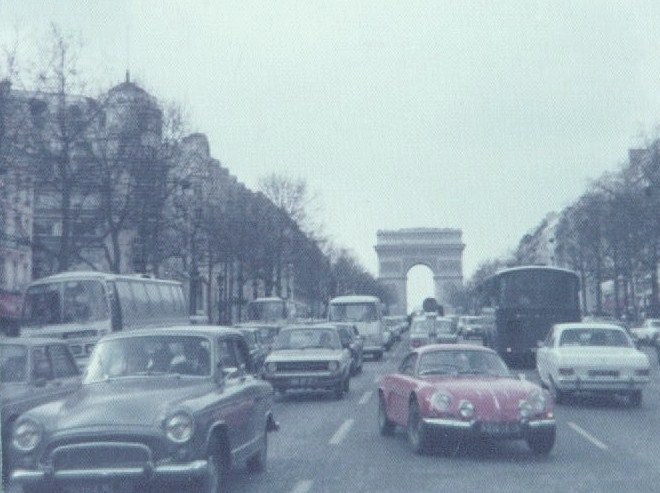
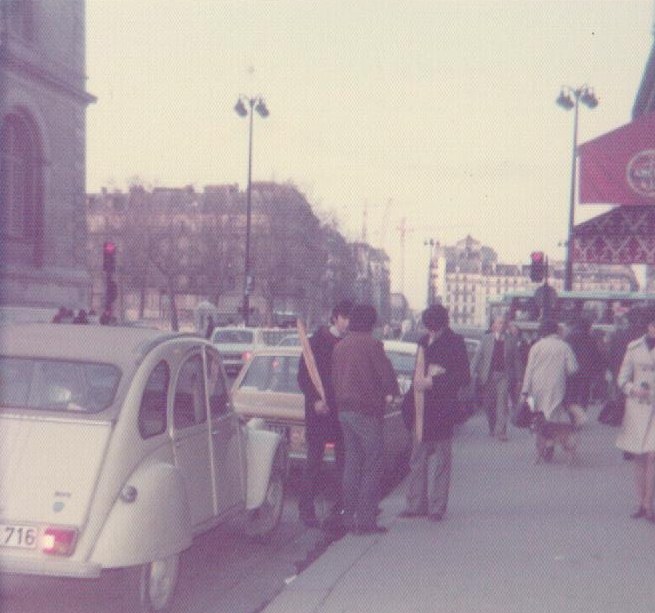
We watched old soldiers playing boules outside Les Invalides, fishermen casting their nets from the Pont Neuf, and children sailing paper boats in the Luxembourg Gardens. Everywhere there were Frenchmen carrying baguettes and wearing actual berets. We spent some time (not nearly enough for me) in the Louvre. Of course we walked the Champs-Elysees. We cruised the Seine at night in a Bateau Mouche. I got to witness first-hand the view I had most anticipated–the tip of the Île de la Cité with the lacy spires and flying buttresses of Notre-Dame just behind.
I loved the wealth of intricately decorated Easter candies and pastries that beckoned from the windows of small shops on narrow streets. Never before had fruit and vegetables looked so beguiling as they did in the city’s outdoor markets. Even displays in butcher shop windows were strangely beautiful, recalling old-master still lifes. We ate in cafés and brasseries, and learned that a croque-monsier, an omelette, or anything with frîtes was a good choice. We learned that French ice cream is served in minuscule metal dishes. And we found that paying for our meals and managing francs and centîmes was as difficult as we had feared.
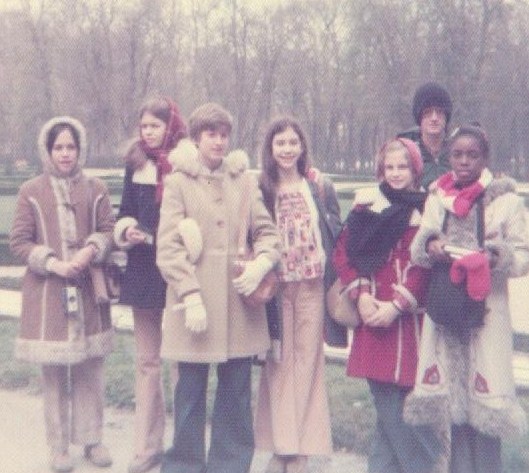
Real Frenchmen, real baguettes, and real berets.Some of our group (dressed in the height of 70s middle-school style), in the gardens at Versailles.
We were busy during our three days in Paris. But we weren’t so busy that we missed getting a sense of the city’s unique, ebullient, quirky atmosphere. Sooner than we would have liked, it was time to head to Normandy, to Mont-St-Michel, and on across the Channel to England.
I find it a little alarming that my daughter is fourteen, and half-way througheighth grade. It’s alarming because my memory of being a fourteen-year-old eighth-grader is fairly clear. I remember many of my eighth-grade thoughts, and they weren’t so very different from my current middle-aged thoughts. This brings me face-to-face with the uncomfortable realization that my baby is no longer my baby. She’s my only child, so in a sense she’ll always be my baby. But from here on out she will be traversing the continuum from nearly grown-up to nearly completely grown-up. Can anyone ever claim to be truly grown-up? Maybe after the death of one or both of our parents? Or does this make us feel like old, lost children? More alarming thoughts, which I won’t dwell on now. Today I want to think about our movie.
I loved 8th grade. The snags of our newly-formed middle school were working themselves out. (See Middle-School Memorabilia, February 2012.) Once again, we were in classes with many of our old elementary school buddies, and we had the added bonus of meeting new friends. Some of these friendships took root thanks to an experimental, unstructured class that replaced language arts and social studies. As our independent project, my friend Katie and I made a movie.
She and I loved the movies. We dreamed of writing, directing, and perhaps starring in our own films one day. The logical starting point was our own Super 8 short film. Of course it was Katie’s family that had the camera, not mine. They had real cameras, ones with complicated knobs for focusing, as well as movie cameras, film projecters, even special movie lights. The were high-tech. I was wowed. I come from an anti-camera, anti-tech family. On Christmas morning, we would look around for the Kodak Instamatic. If it could be located, it often lacked film, flash bulbs, or both. One Christmas, our only pictures were taken by our next-door neighbor. Old photos from the 1940s on were tossed at random in the drawer of the coffee table, undated and unlabeled, a practice that inspired me to take the opposite approach, to document, organize and archive.
Katie and I favored the genres of comedy and horror. (See Movies with Friends: From Frogs to Rocky Horror to Toco Hill, and other posts from March 2012.) Our movie, we quickly decided, would be a campy, silly horror film, set in the 50s. As kids growing up in the 70s, we were fascinated by that Happy Days era, which seemed so distant. Because Katie’s mother and mine had saved most of their clothes from that time period, our costumes were immediately at hand. We also had lots of comical wigs and odd accessories that begged to be modeled.
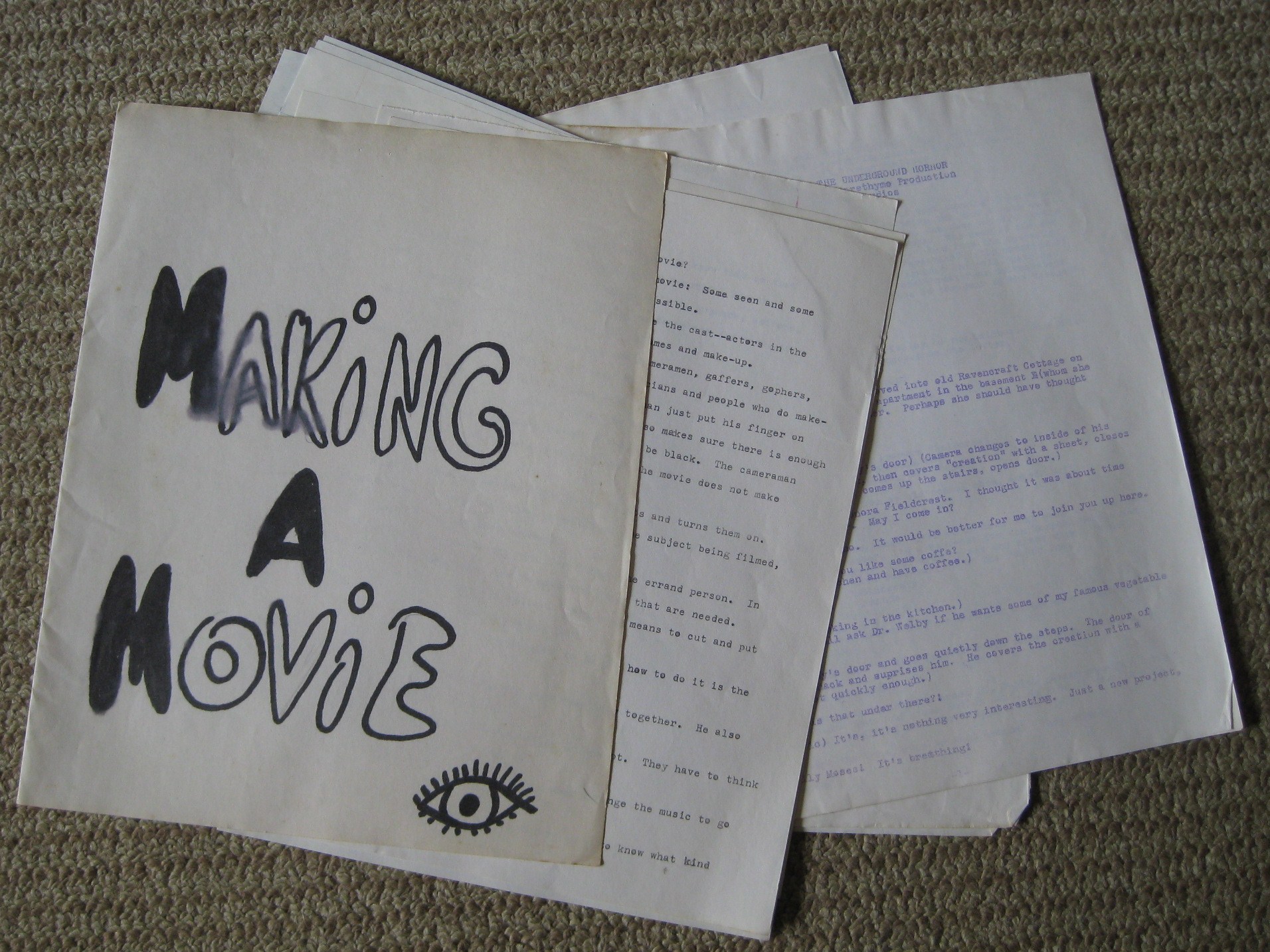
We spent Saturdays and school-day afternoons writing the script. To us, it was side-splittingly hilarious. I have several copies of the final four-page script, typed by Katie and mimeographed at school. It was a silent film, so the narration and dialogue were hand-written in a flowery cursive and filmed, panel by panel. Our working title was The Underground Horror, later finalized as Dark Secrets. It began promisely enough:
The date is 1957. Leonora Fieldcrest had just moved into old Ravencroft Cottage on Shepherd Lane. Knowing that the apartment in the basement was rented to a certain Dr. Marc Welby (whom she had never met), did not hinder her. Perhaps
she should have thought more carefully.
Our set was the home of our friend Rebecca, who would play Leonora’s “old school chum” and spunky gal reporter, Amanda Duff. Not surprisingly, Dr. Welby (we considered this name choice an example of our use of sophisticated irony) was up to no good. He was building a creature. His laboratory was a squalid subterranean room, the door of which had been painted, years before, by previous homeowners, with the ominous warning: Operations Shack! Scram! Rebecca’s basement (really a cellar, rudimentarily finished and typical of the 1930s-era homes in our neighborhood) simply cried out for us to film a horror movie in it.
Katie took the role of the creature, and I played Leonora. We recruited two boys from our class for the male roles: Dr. Welby and Leonora’s butler. Everyone in old 50s movies had a butler, it seemed, and we needed another guy. Katie filmed the scenes she wasn’t in. Her older sister took care of the others. Rebecca’s younger sister and her friend served as gaffers and gophers. We relished tossing around such film jargon. Because the next-door neighbors had a cute little dog named Buster who was always underfoot, he was granted a role as Leonora’s puppy.
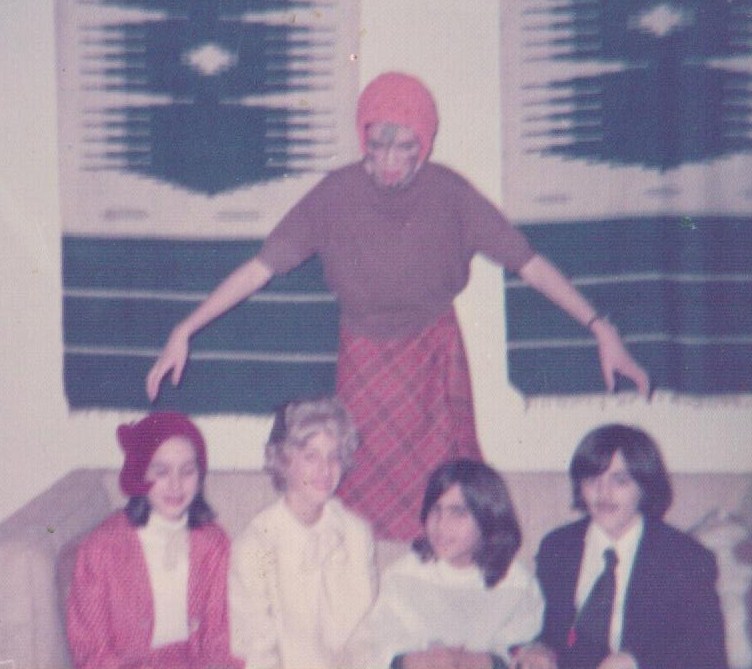
The entire cast, pictured above, from left to right: Amanda, Leonora, the Creation, standing menacingly, Dr. Welby, and the butler. It’s unfortunate that not a single still photo related to our film was in focus. I haven’t seen the movie in years, but I’m sure it’s not this blurry. I’m uncertain of the source of these pictures. Evidently they were taken before Katie got her very own good camera; at which point she became the primary photographer of our collective youth, known for her creative (and clear) photos. She has enjoyed a successful career as a photo-journalist for the Indianapolis Star newspaper.
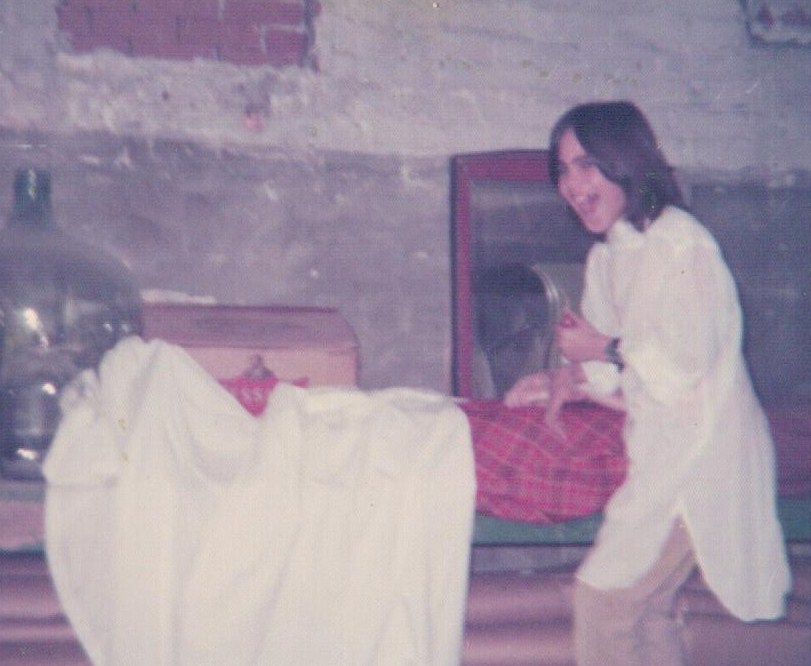
Dr. Welby, at work in his Operations Shack. He laughs in a villainous manner as he puts the finishing touches on his Creation, whose red plaid skirt is visible.
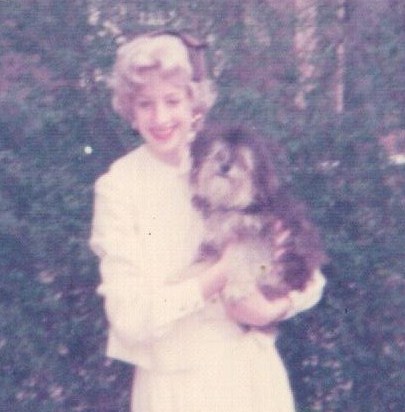
Me, as Leonora, with Buster the dog.
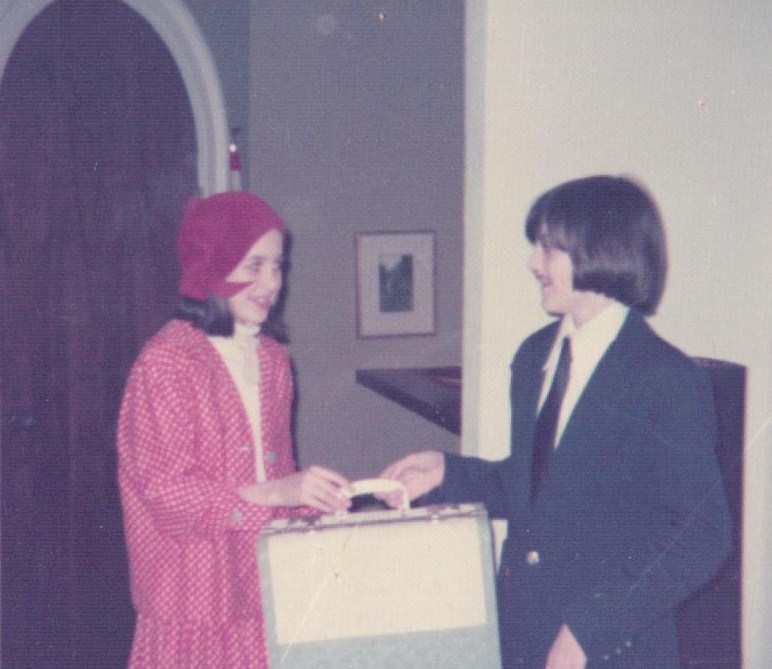
Amanda, just arrived from Kansas (on her bicycle),
hands her little suitcase to the butler.
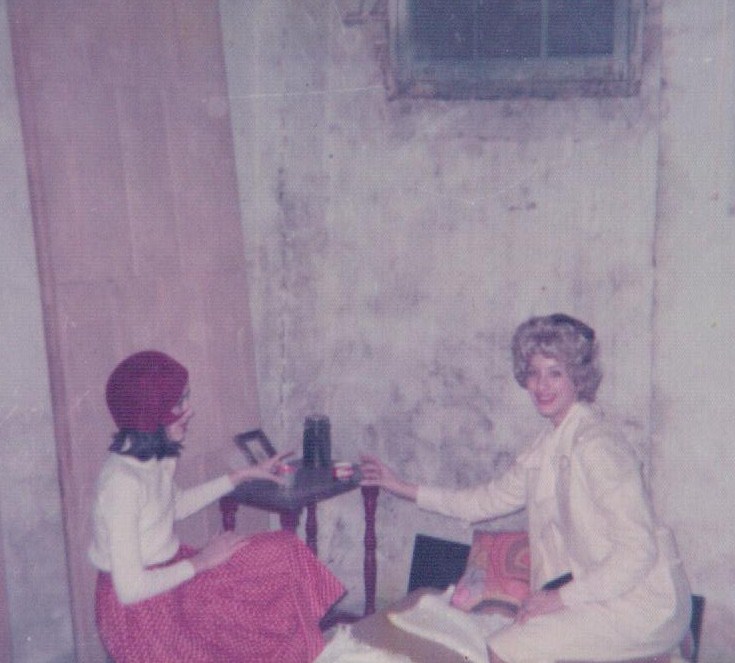
One of our funniest jokes (we thought), was the awfulness of Dr. Welby’s basement “apartment.” Here, Amanda and Leonora snoop around while the doc is out, observing personal mementos on the table beside his bare foam-rubber mattress on the floor.
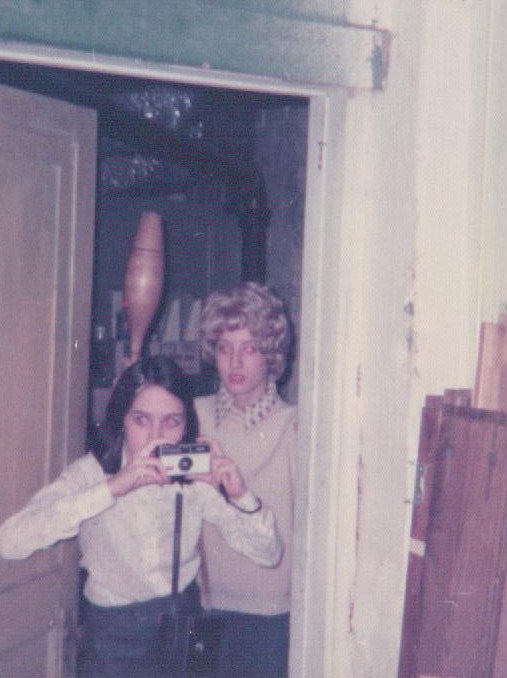
At Amanda’s insistence, the two friends sneak into Welby’s inner sanctum. Leonora brandishes an Indian juggling club. Ace Reporter Amanda wields her trusty, if anachronistic camera, perhaps the source of some of these blurry photos.
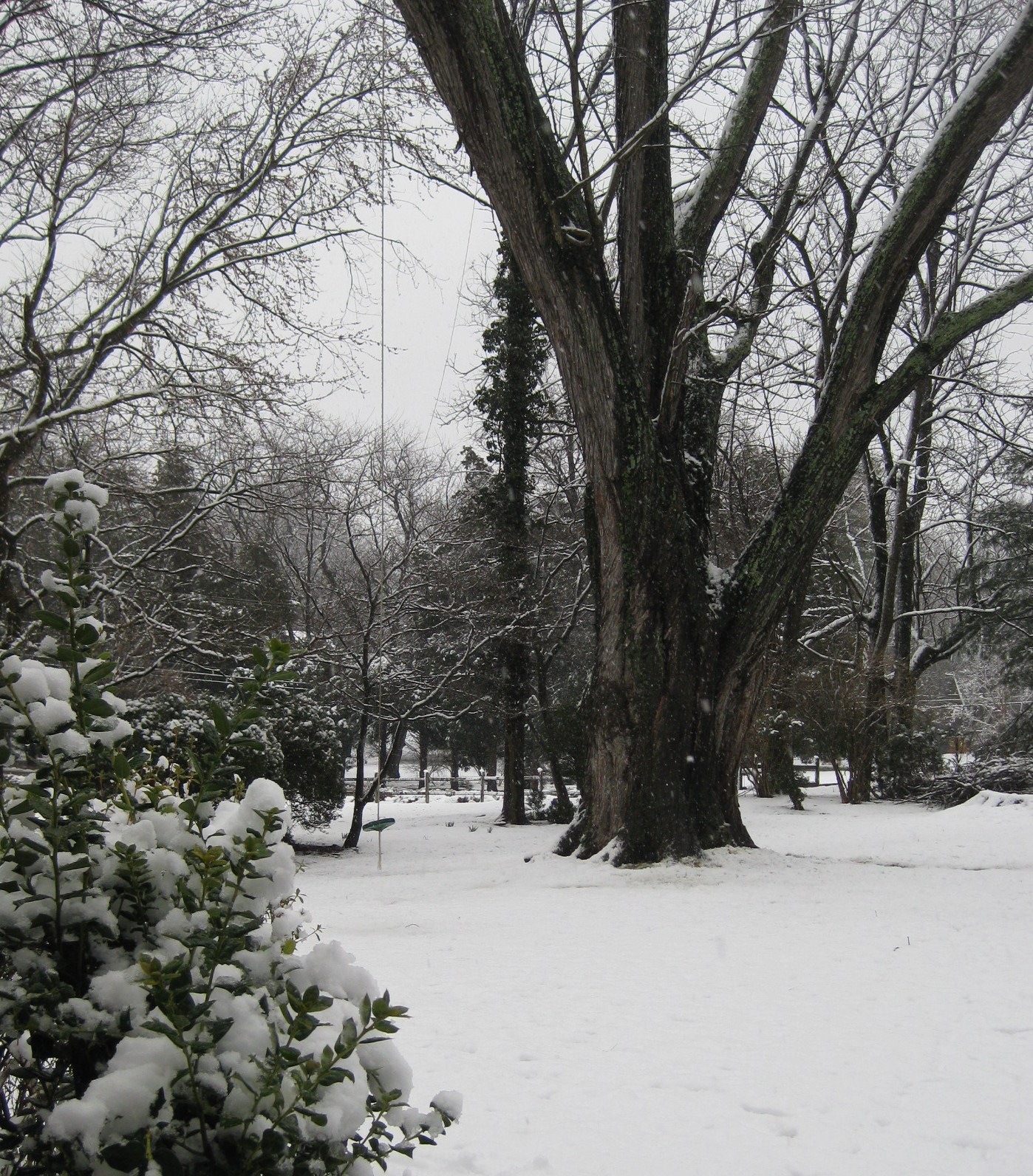
The snow that my daughter has yearned for all winter here in Virginia finally arrived early this morning.Understandably, this first significant, inordinately late snow of the season is a much-anticipated weather event. All week long every local TV station has had their Storm Watch coverage going full force. Giddy newscasters reported from points as yet untouched by snow, assuring us that the flakes were on their way. Usually, when this happens, it’s either a huge deal, like the blizzard of December 2009 that shut down the DC area for a week, or it’s a complete and utter bust. This was different; it fell somewhere in between.
Not a flake had descended at midnight last night. When we awoke this morning, it didn’t look like much, just a minimal coating on the ground and a fine snow floating down. But more was emphatically promised. Forecasts called for heavy snow all day and into the night. Schools, the Federal government, and many offices were closed. Even H’s office was closed, which is very rare indeed.
Once D and I went out to walk Kiko, enormous, sloppy flakes the size of mini-snowballs began pelting, and quickly drenching us. It was like walking in a heavy, thick, wet rain. It was not especially pleasant.
The snow continues to fall thickly now. D is at a friend’s house sledding, and H is out on the driveway with his never-before-used snow blower. He knew the snow was probably too wet, but he had to give the new toy a try. It’s kicking up an impressively wide spray of white slush. I hope both D and H are happy. Kiko and I are. We’re inside, warm and dry, and we plan to stay that way.
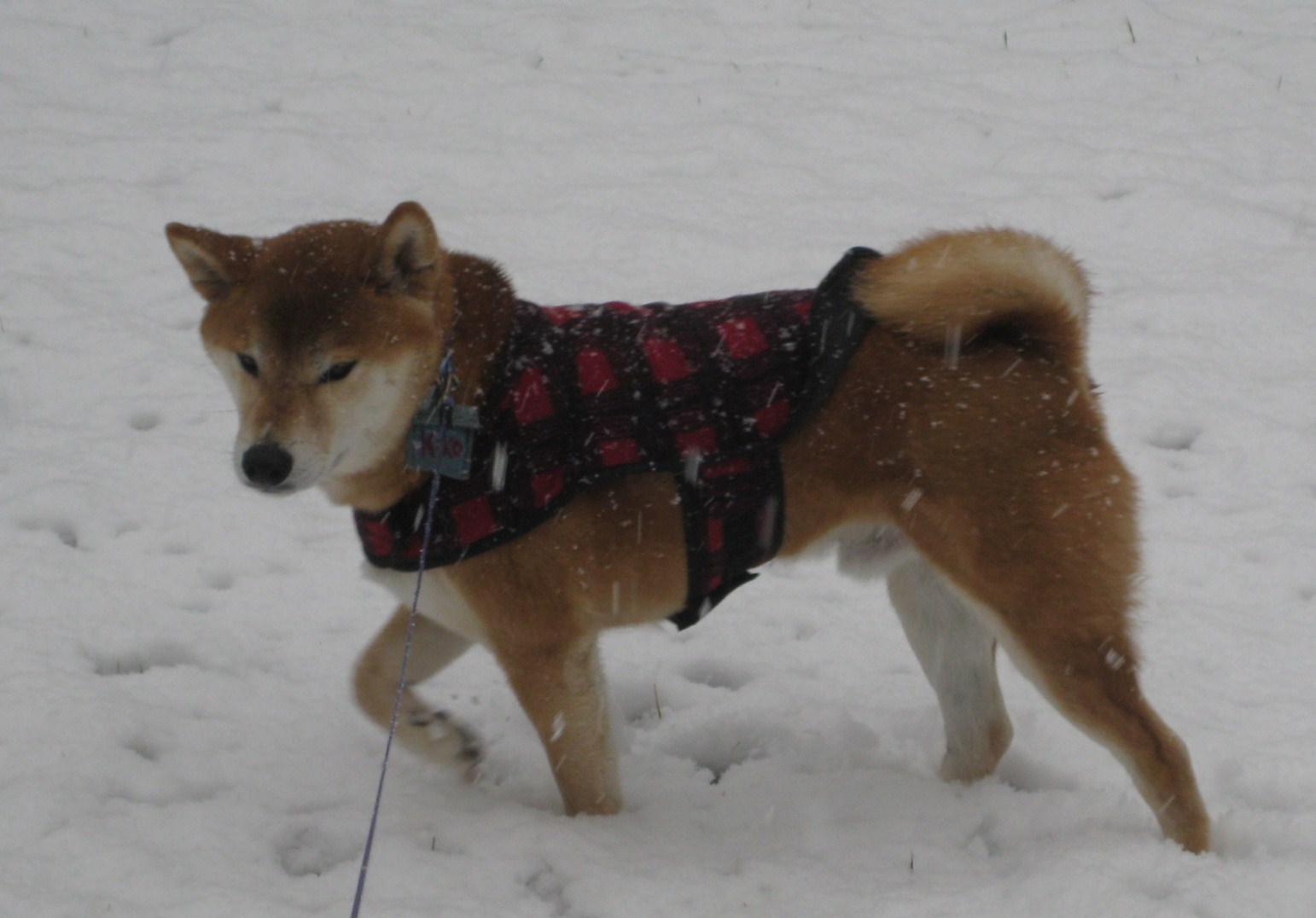
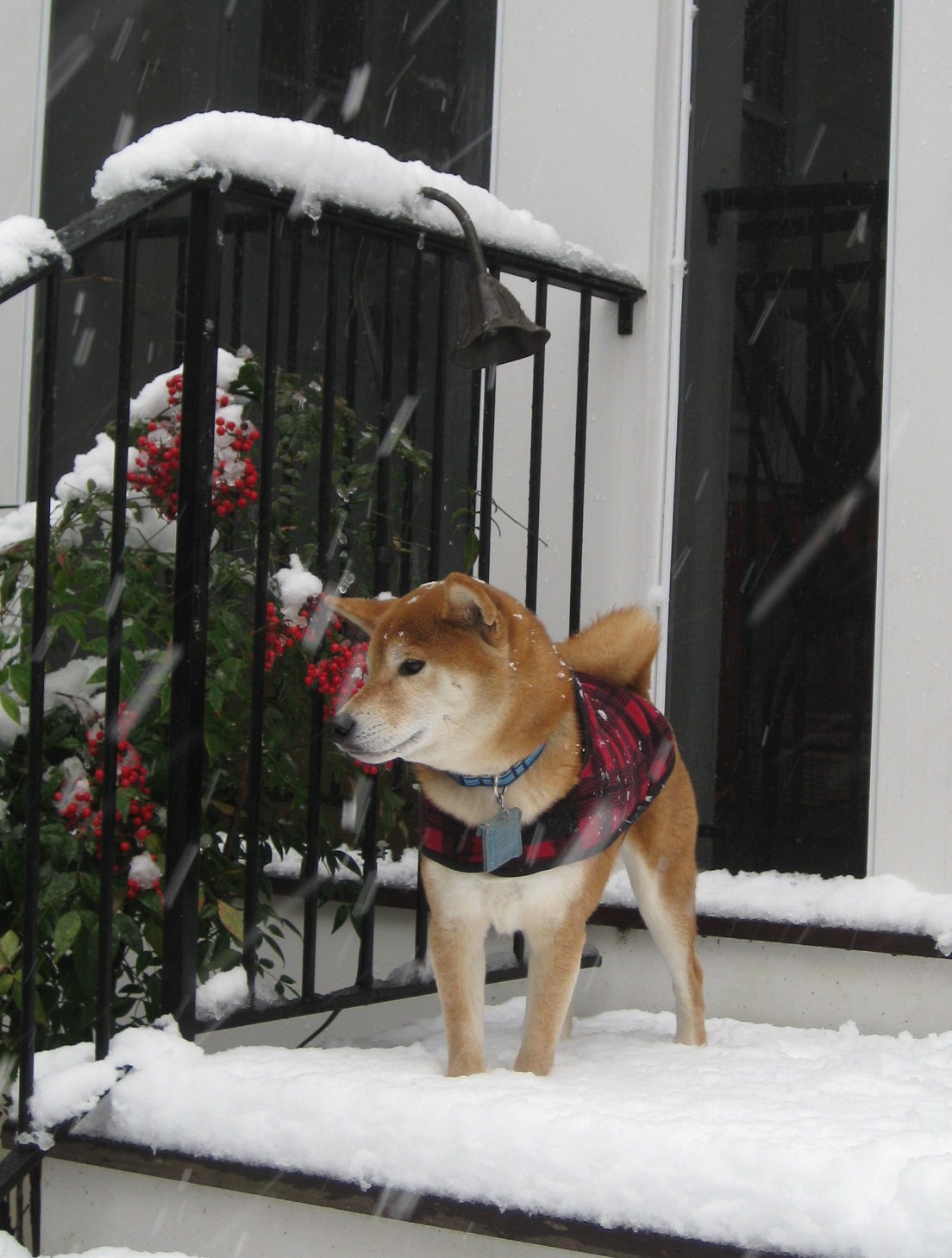
Kiko doesn’t seem to mind wearing his coat, which keeps him somewhat dry. He doesn’t like rain, and this snow bears a strong resemblance to rain.
Kiko has had enough of the fat white rain. Time to go in and dry off.
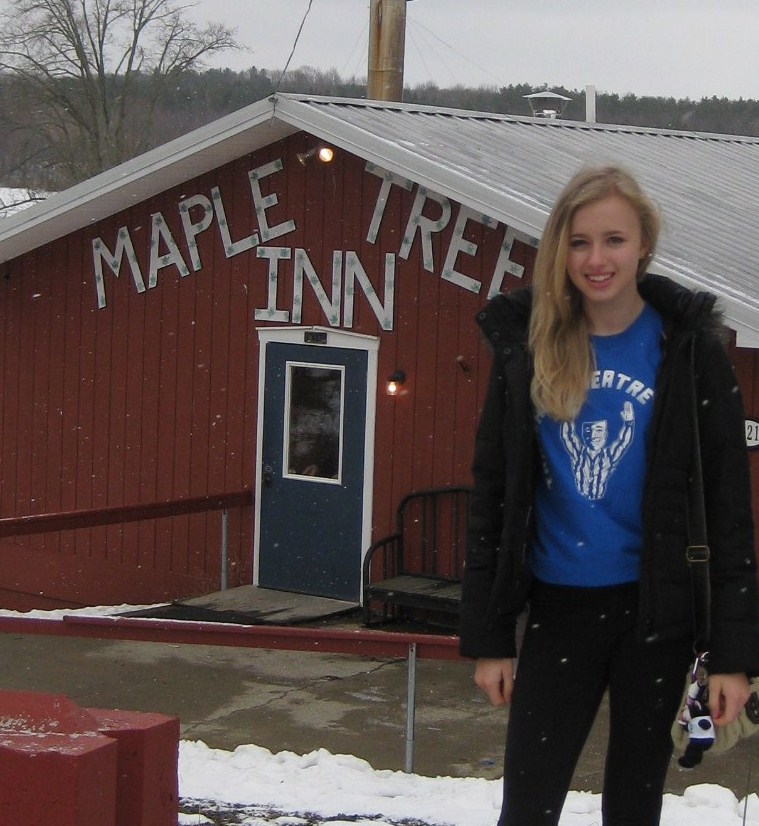
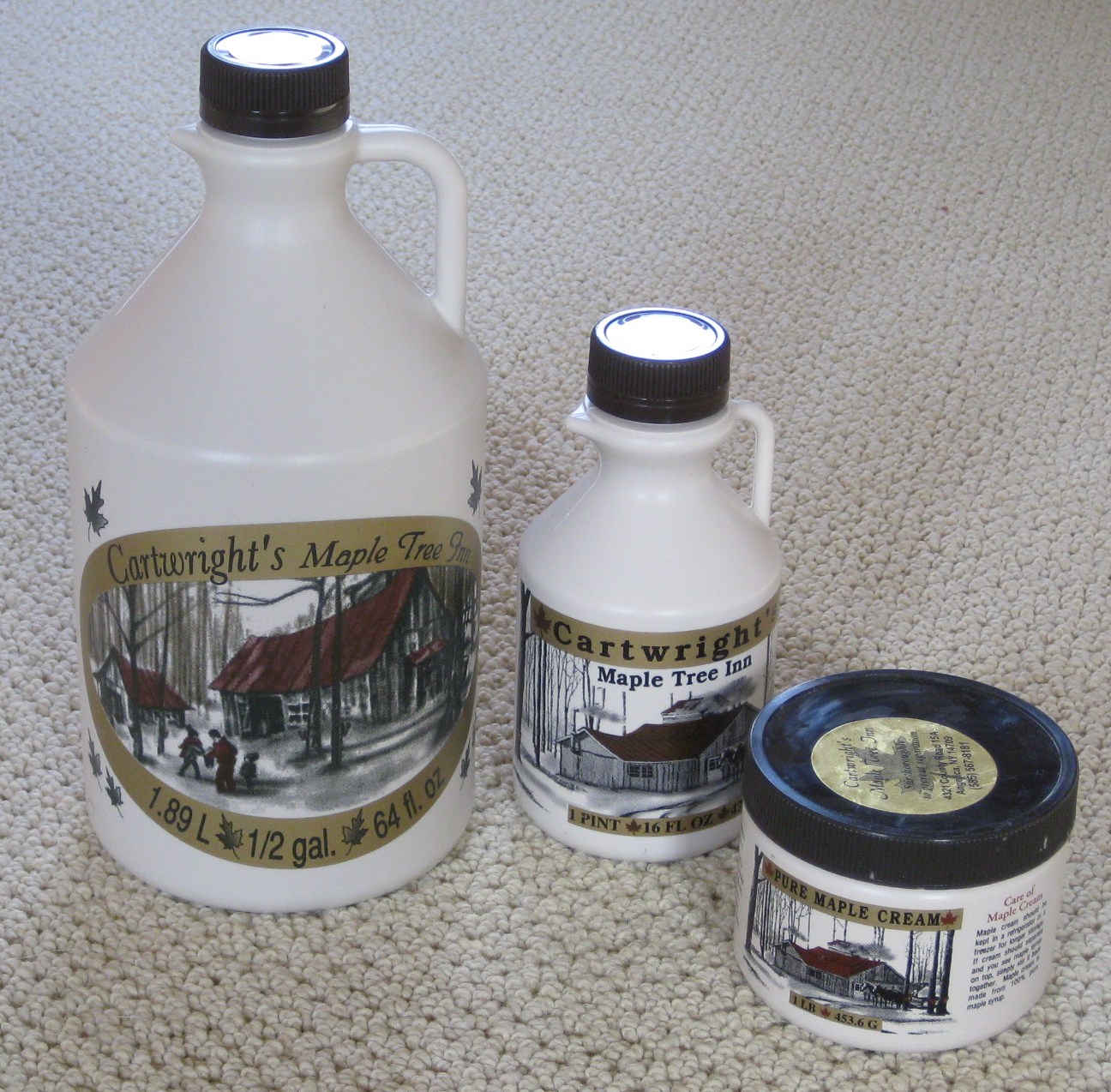
Last weekend, we drove to upstate New York for pancakes. Not just for pancakes. Pancakes and maple syrup. We met H’s family at Cartwright’s Maple Tree Inn, a glorified sugar shack located, really, in the middle of nowhere. Its actual address is County Road 15A, Angelica, NY (2 miles from Short Tract), which, in the language of our GPS system, is “not on any digitized road.” Despite its truly out-of-the-way location in the midst of snow-covered fields, it’s a popular spot, with big crowds on weekends. It’s only open during the maple sugar season, which typically runs from mid-February through March or mid-April, depending on the weather. H’s family has been trekking out to Cartwright’s for decades, and now it’s among our winter traditions, even though our drive is far longer. Of course, we don’t return directly to Virginia, but spend the weekend visiting H’s family in Rochester.
The Cartwrights began producing maple syrup on their farm in the 1850s. The Maple Tree Inn dates from 1963, when the family decided to build a restaurant specializing in Grandma’s buckwheat pancakes served with their own maple syrup. In the adjacent shop, the syrup, maple butter and maple sugar cakes became available directly to the public. The somewhat ramshackle building has been expanded over the years and is now fairly large. It will win no awards for architectural style, but that’s not the point. In the chain-store sameness that dominates so much of our country today, the Maple Tree Inn offers a unique, quirky, authentic experience. It’s living history, and it’s worth a visit.
Before I met my husband, I had never tasted true maple syrup. The first time we ate together at PJ’s Pancake House in Princeton, I was surprised to see him pull a small container of pure maple syrup from his pocket. At the time, PJ’s didn’t serve the real stuff, although that has since changed. I didn’t understand what the big deal was. Growing up, when Daddy made pancakes on Saturday mornings, we used the typical supermarket syrup–Log Cabin, Aunt Jemima–whatever. H was no food snob, so I found his insistence on unadulterated maple syrup mystifying. That is, until that day at PJ’s, when I tasted the liquid from that little jar. H was right. There is no topping the perfection of the stuff that comes straight from the tree.
Visitors to the Maple Tree Inn are welcome to descend into the building’s lower level to learn how the sap is boiled down, in huge wood-fired evaporators, to its golden maple essence. Several years ago, a Cartwright grandson, no more than twelve or so, gave us a comprehensive tour that began in the frozen fields where we could examine the taps on the trees and see the liquid running into the buckets. As far as I know, this is not an option at IHOP.
These days, the rarified nuances of maple syrup, like those of chocolate, coffee and small-batch whiskies, are earnestly discussed at considerable length, using wine-lingo terms such as terroir. H doesn’t do this, although he can and does enjoy discerning, in blind taste tests, the variations between light, medium, and dark amber syrups. My palette will never attain such a degree of sophistication, but I can say this: a little true maple syrup makes life sweeter.
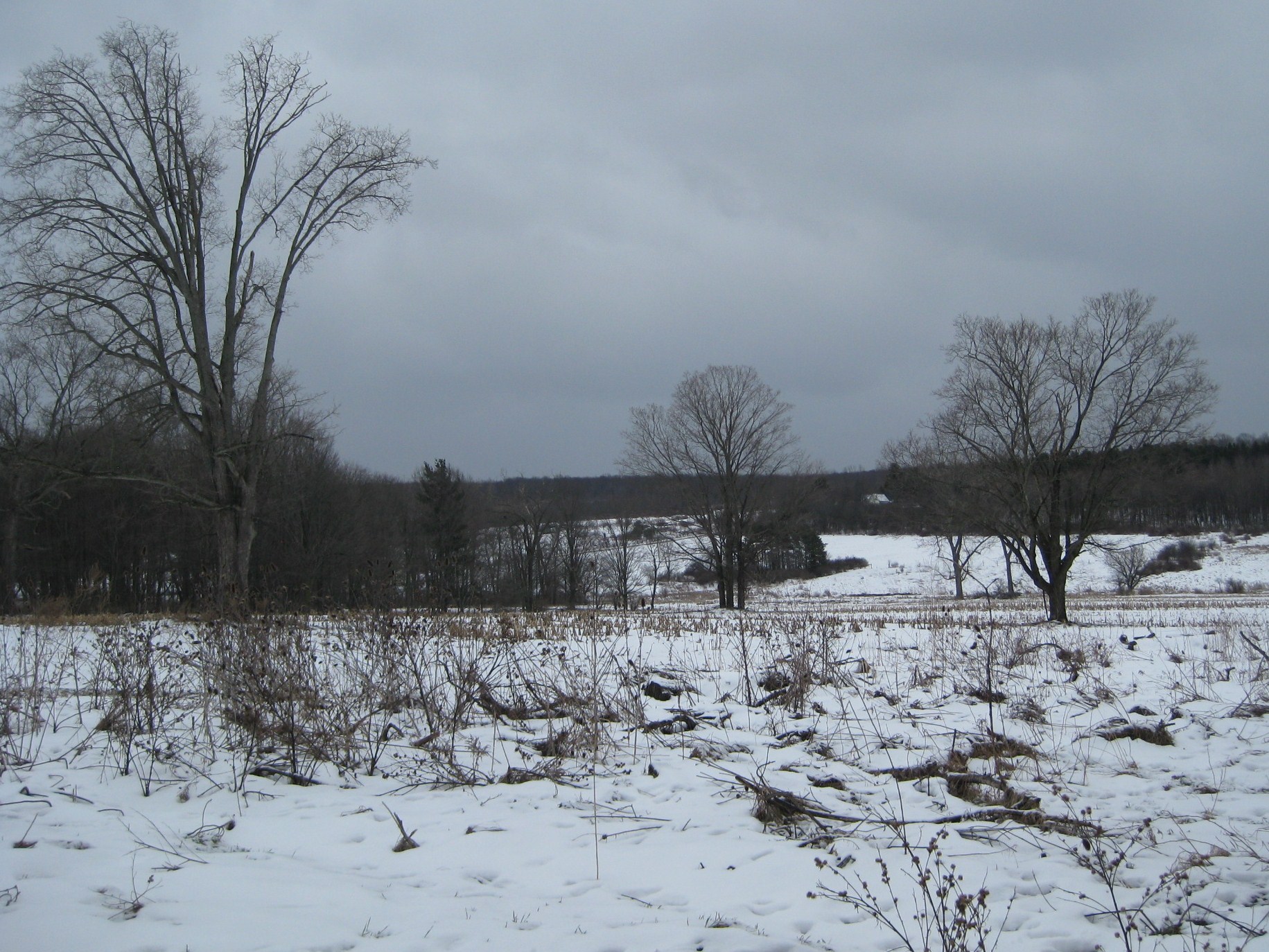
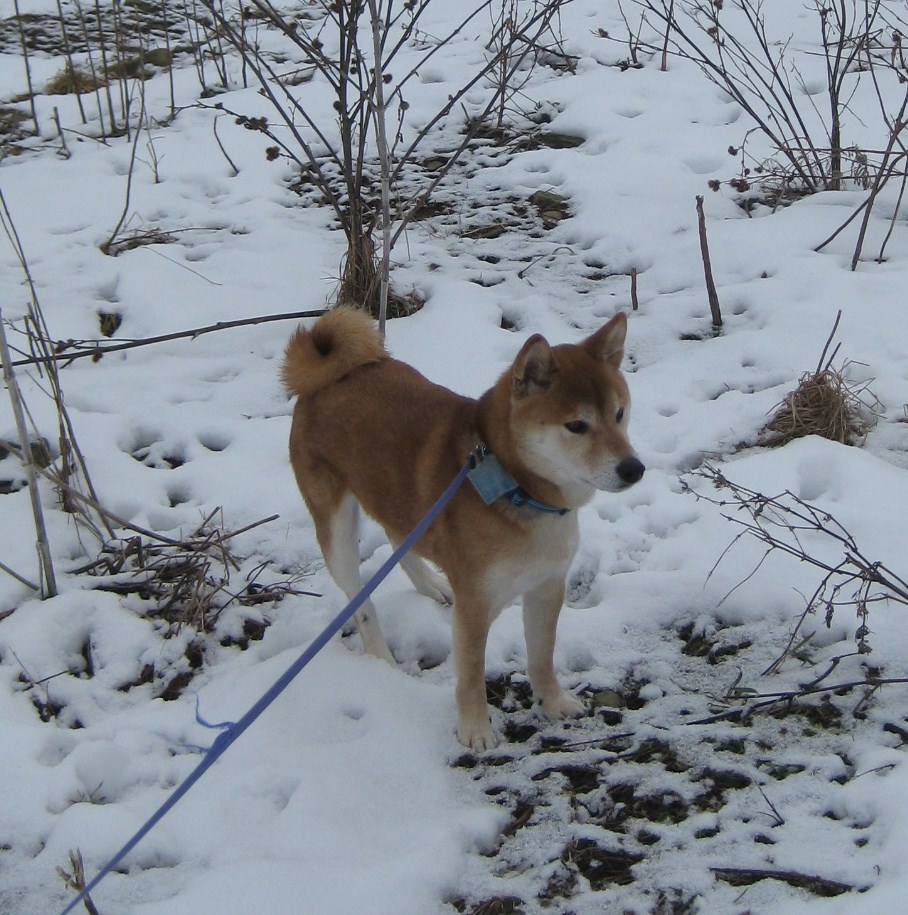
The snowy landscape behind the Maple Tree Inn.Kiko and I walk through the surrounding fields before I join the others for lunch.
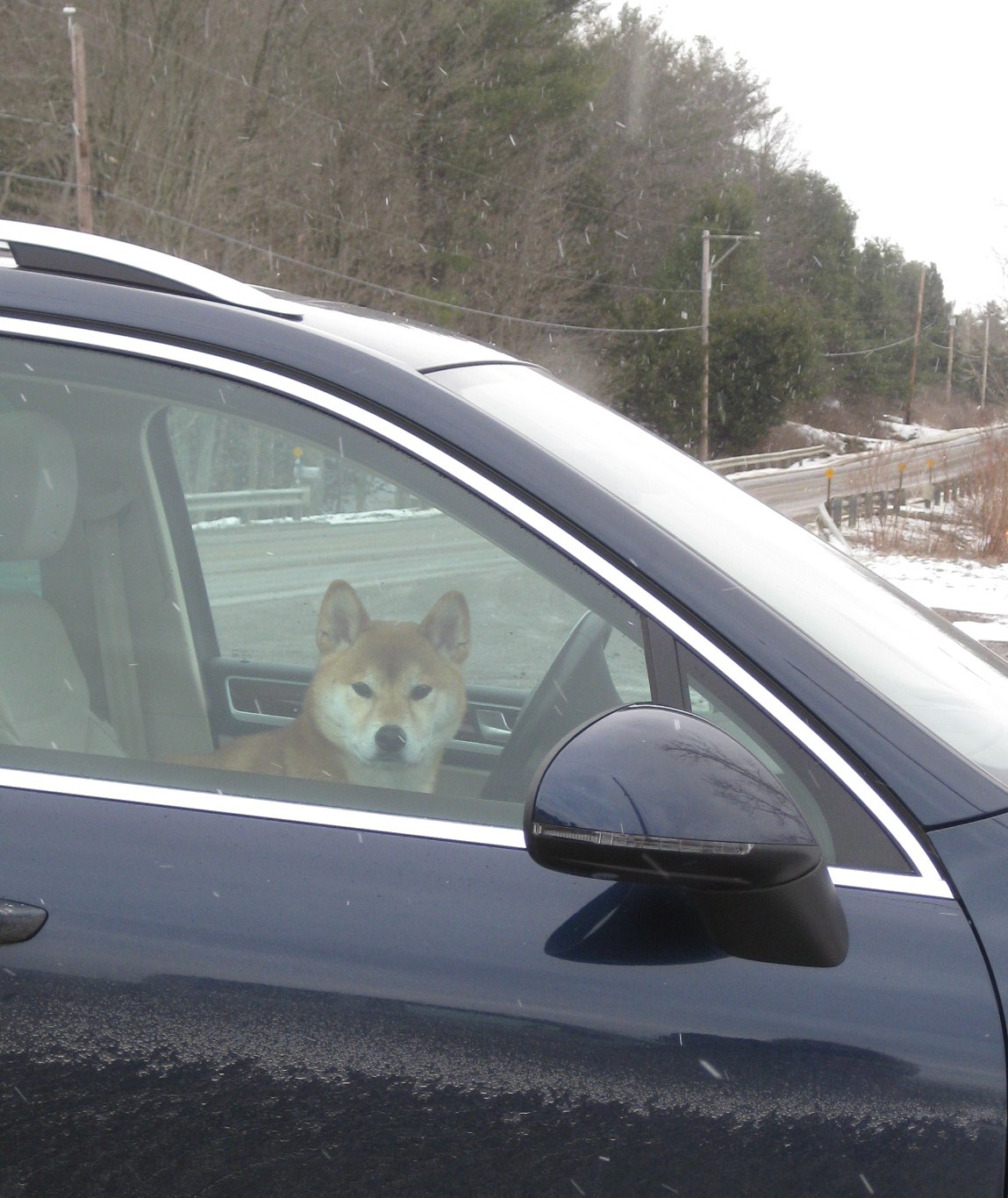
Kiko keeps vigil in the car during our meal. Animal advocates need not be alarmed–he has his sheepskin bed and blanket if he needs to hunker down for warmth. Before this trip, in case it was particularly cold, we bought him a red plaid fleece coat. The temperature wasn’t low enough to warrant it, and he appeared perfectly comfortable, peering out from the front seat, when we returned. For his wait, he was rewarded with an extra sausage patty H’s grandmother had carefully saved for him.
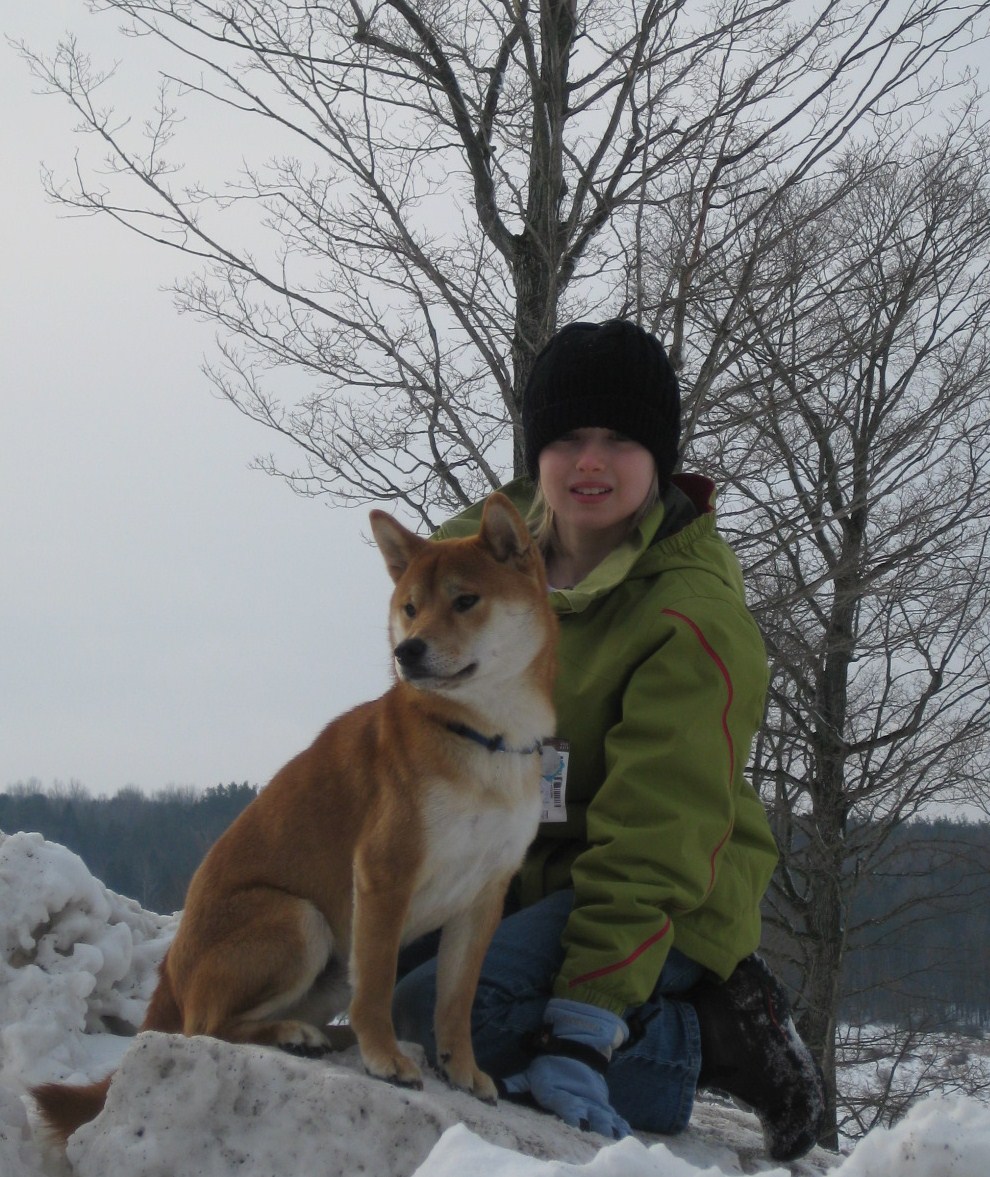
Kiko and D atop a tall snowpile on an earlier visit to Cartwright’s, in 2009. Kiko looks almost exactly the same as he did four years ago, when he was two. D, on the other hand, has changed.
As my last post attests, my family and I tend to be a touchy bunch around each other. We are polite and well-behaved when we mix in society at large. We don’t pick fights; we don’t brood over perceived insults dealt out by acquaintances or the general public. But when we’re at home together, just the three of us, it may be a different story. We are not an unhappy family. Nor are we always indignant or incensed. We have many moments of placid, content complacency, substantial periods of harmony. But when something sets one of us off, we’re all going over the edge, and quickly. Watch out. (See, for example, An Evening of Discontent, Part II: The Big Family Dog-Walking Fight, October 2011.)
At home, our finely tuned radar is on near-constant alert for the slightest hint of sarcasm, negativity, discourtesy of tone or, heaven help us, an ill-chosen word. The faintest traces of insult or anger, whether real, or more typically, imagined, rarely elude us. With the barest minimum of words exchanged, we may be suddenly engulfed in a family-wide conflagration. When this happens, nothing helps but time, and time apart. With some stomping and huffing, we retreat to our own respective areas in the house. Sometimes, from my husband and daughter, the stomping is accompanied by loud whistling. Speech is pointless for a while, because we will be certainly be misunderstood.
But one member of our family maintains an admirably even keel. Our dog is either above, or beneath all this drama. Kiko never reacts badly, never acknowledges an insult, and he never makes a cutting remark.
I talk to Kiko a lot.
When he and I are home alone during the day, I keep up a running, one-sided conversation, heavy on the exclamation points. It’s typical, mindless doggie talk: Hello sweet baby! Are you the sweetest little fella? Of course you’re the sweetest fella! You’re such a velvety baby! You have the best fur! Are you the best old angel? Of course you’re the best old angel! You’re my angel! I love you so much! I just love you! Sometimes I tell him, very nicely, of course, that he’s a terrible boy, a very bad sweetie, just because I can, and it doesn’t matter one whit to Kiko. I think it’s to my credit, at least, that I don’t speak in a high-pitched, artificial tone often preferred when addressing babies and dogs. I use my normal voice to repeat my plodding menu of banalities.
As dogs go, Kiko is not particularly expressive. He does not gaze into my eyes with love and admiration. If I want that, I go down the street to see George, the big-hearted golden retriever. Kiko’s response to my ongoing chatter is subtle. My first words may be greeted with the raise of a doggie eyebrow. I’m reminded of Chad Everett, on whom I had a middle school crush when he starred as the charming, handsome Dr. Joe Gannon on TV’s Medical Center. While Dr. Gannon’s lifted brow indicated kindness and concern, Kiko’s indicates an openness to any words of consequence, such as Wanna take a walk? Wanna go for a ride?Want some cheese? To these questions he responds with a head tilt, perhaps followed by a stretch and a vigorous full-body shake. Barring these welcome phrases, he remains largely inert, with the possible exception of his ears. Unlike Chad Everett, Kiko has a wide range of motion in his ears, which may move independently of one another as though in vague reply. Otherwise, he’s utterly, quietly motionless. If I hover or confine him too long in a hug, he may sigh. I take this as a signal to back off and shut up. But that mild protest is as close to a rebuke as he ever makes.
You fellow dog owners understand the benefits of talking to your dog. As you know, we converse with our dogs not for their sake, but for our own. It makes us feel better. For me, there is hardly a situation that cannot be eased, at least a little, by making ridiculous remarks to my dog. Considering the atmosphere of irascibility that may reign in our household, it’s wonderful to know that no matter what I say to Kiko, peace and equanimity will prevail.
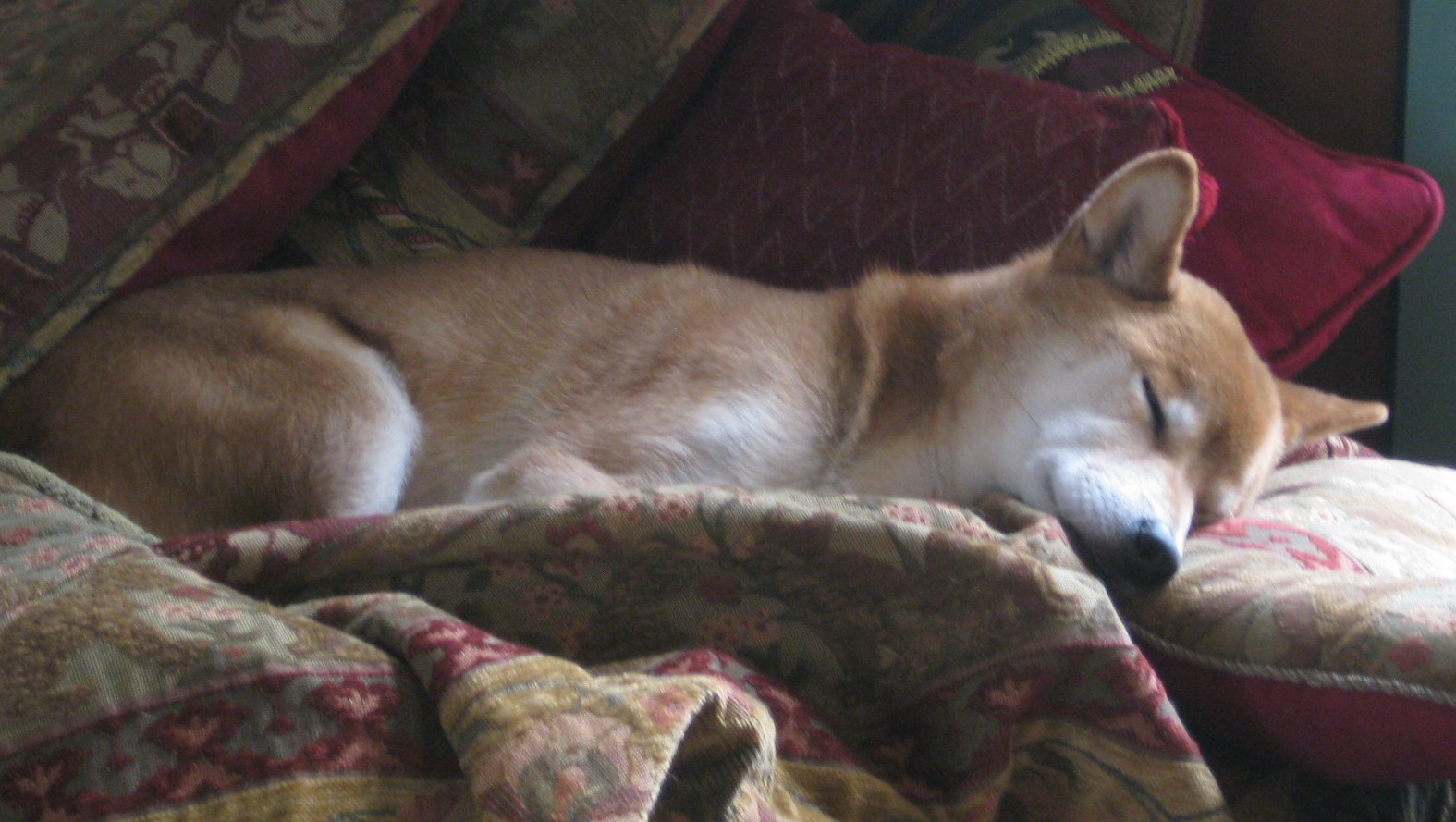
A typical response from Kiko to my ongoing chatter.
A blog about motherhood, marriage and life: the joys and frustrations, beauty and absurdity, blessings and pain. It's about looking back, looking ahead, and walking the dog.