Category Archives: Friendship

Our Summer Village on the Cape

IMG1357

This year, H’s sister and her husband brought their three-month old baby to Cape Cod. We were not so brave. We waited until our daughter was two and a half. The year before, we had attempted our first family beach trip, to the Outer Banks, just the three of us. While it was a joy to experience the sun and sand from D’s fresh perspective, it was not a vacation. The demands of our beautiful child, limitless as always in those early years, were more difficult to satisfy, being away from home. We were simply caregivers in an alien setting, and there was minimal opportunity for relaxation or enjoyment. When D was awake in the hotel, which was most of the time, H worried she would awaken or annoy our neighbors.  On the rare occasions when she finally succumbed to sleep, these same neighbors typically awakened her and annoyed me. There was great collective frustration all around.

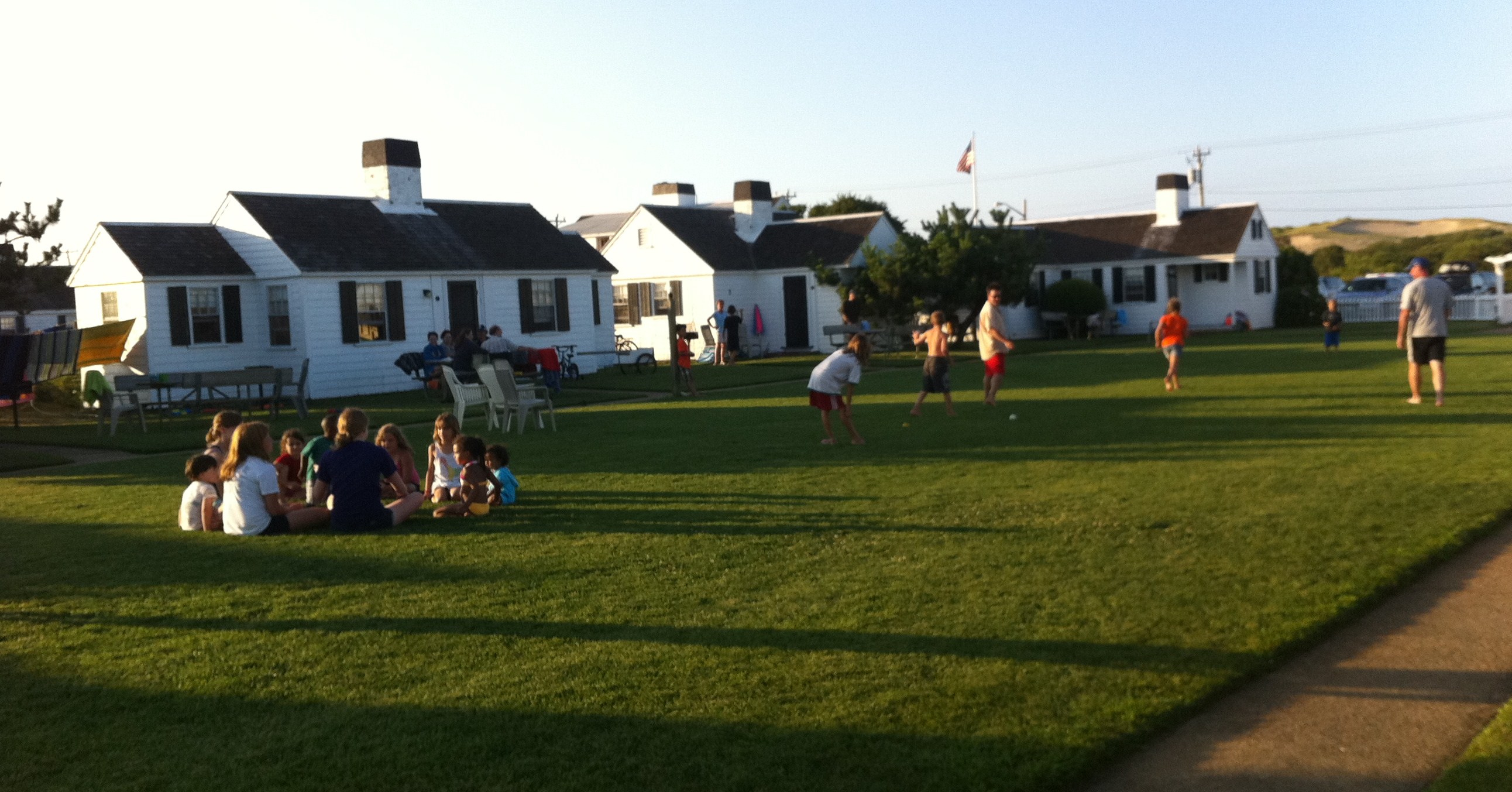
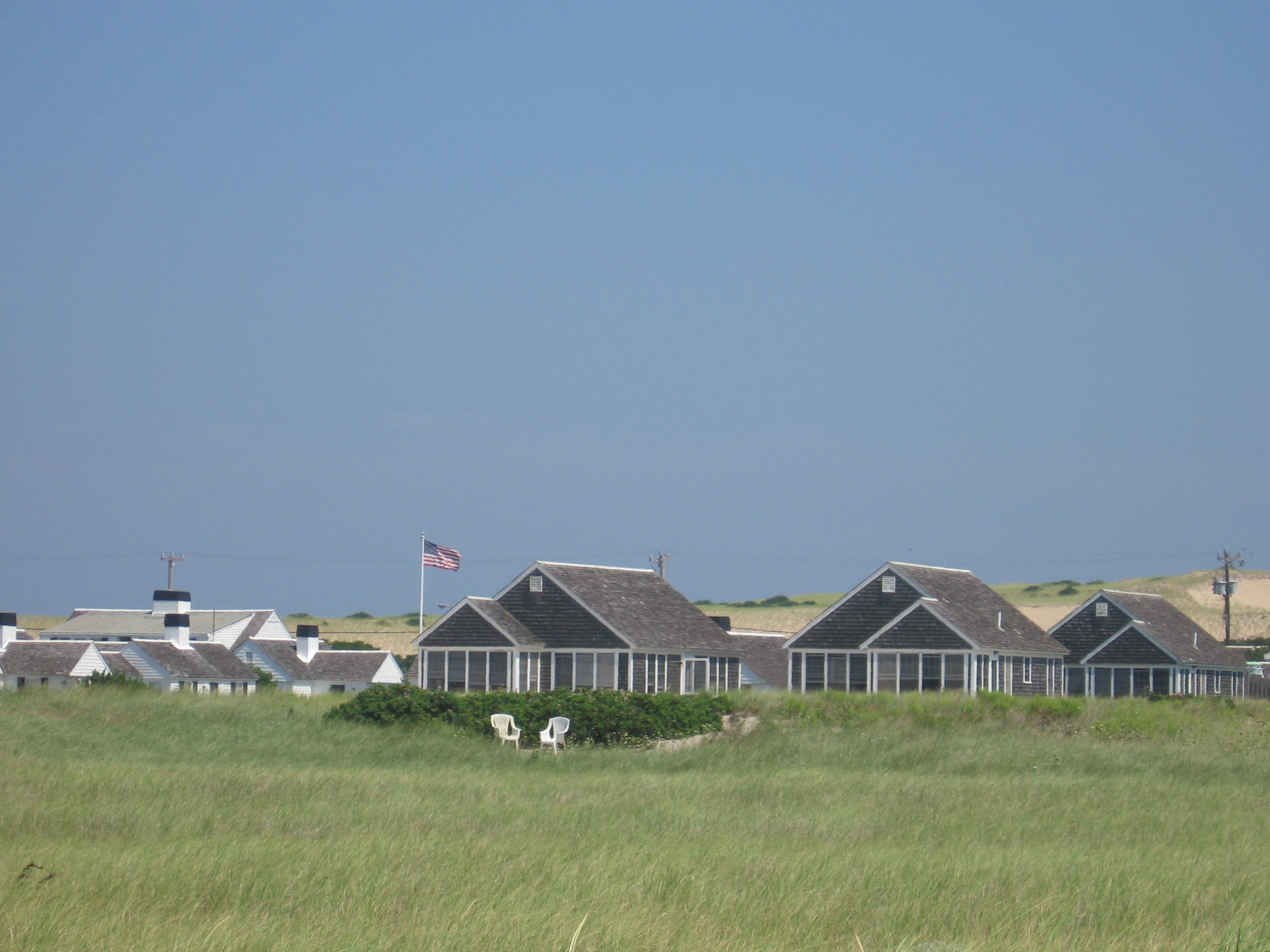
That trip made me reassess the Cape Cod complex that H’s family has visited for over thirty years.  Some cottages are covered in white clapboard, others in weathered cedar shakes.  All are small but charming.  They cluster, like the homes of a compact village, around two spacious central greens and a pool. It’s timeless, quintessential Old Cape Cod, exactly the picture conjured by that 1950s Patti Page song of the same name.  An immensely wide beach, unusual for Truro, provides a  buffer zone from the water.  Rather than the pounding surf of the Atlantic, there is the relative tranquility of the bay.  It suddenly hit me that this was a decidedly welcoming environment for small children and their parents.

CapeCod2010037
One of the greens, empty in the early morning, but soon to fill with friends.


CapeCod2011252
Before the narrow boardwalk was built, about ten years ago, the trek to the bay was rather daunting.

I realized that at the Cape there would be willing, helping hands, certainly those of Grandma and Grandpa, perhaps those of H’s sister and her husband. I wasn’t hoping to hand my child over completely, only grateful for any assistance that might be offered. I also knew by this time that our daughter tended to behave better when she knew there were other eyes on her besides those of Mama and Daddy.
0035
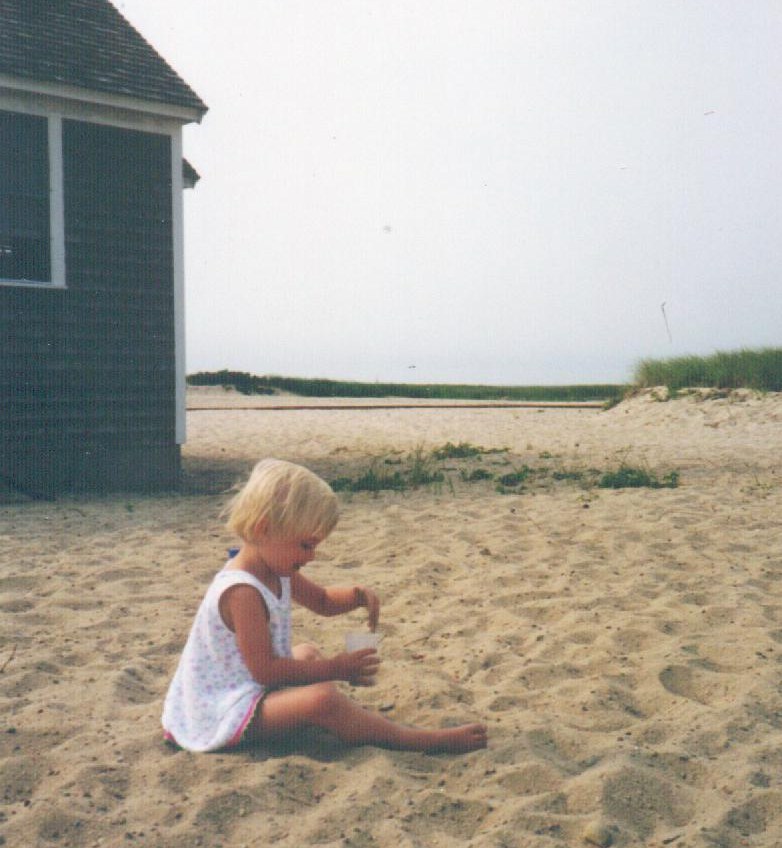
D, at two and a half, happily at work on her sand-pouring skills.

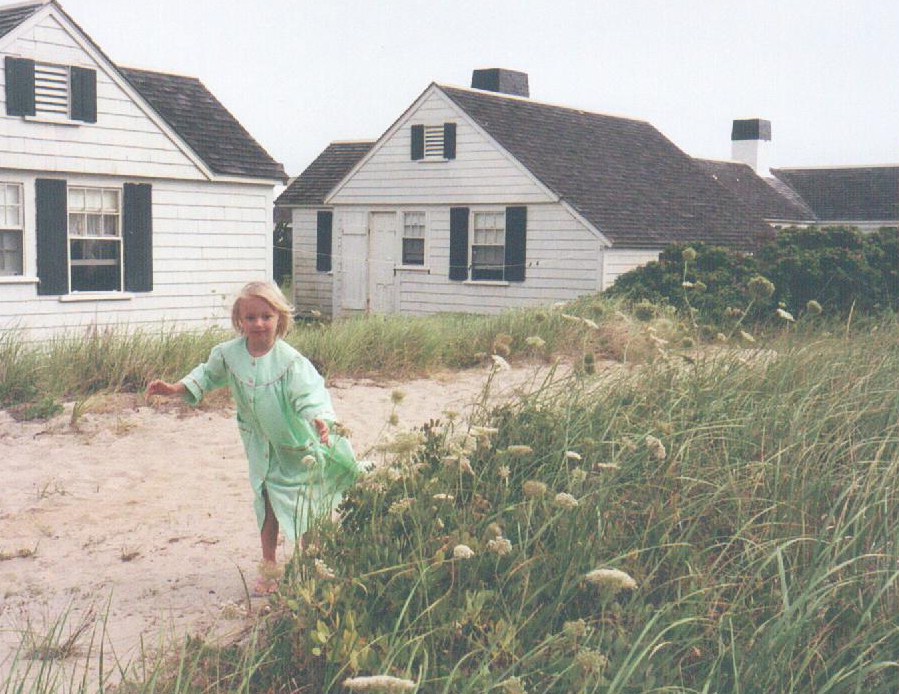
H’s family’s adopted Cape Cod village opened its arms to welcome our daughter, and for her it was love at first sight.  As children sometimes do, she appreciated the simplest things.  She found it supremely entertaining to sit outside our cottage, pouring sand into a cup; she didn’t even need a pail or shovel.  We would send her over to her grandparents’ cottage for cooking oil or butter, and she relished the responsibility.  H would use the walkie-talkie to tell his parents D was on her way, and we’d keep her in our sights during her short journey.  (There are no phones in the cottages, and before we were all so fiercely entangled in the web of technology, this meant an actual break from the typical work-a-day world.) Grandpa would signal D’s return, and she would arrive flushed and happy, more mature than when she had left.
00127
D returns triumphantly from an errand.

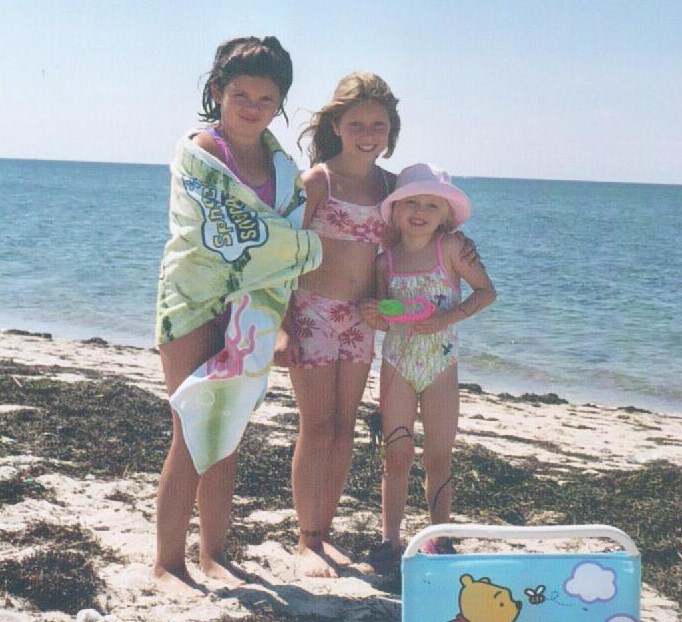
There is a real sense of community in our vacation village, because families tend to return for the same week every year, and friendships are nourished.  Most of the parents who are now H’s and my age grew up vacationing here with their families.  Two sweet and thoughtful sisters, four and five years older than D, took her under their wings on our first visit.  Through these girls, D became acquainted with kids of all ages.  Even now, with one sister in college and the other a senior in high school, they remain close.  All the kids look forward to their annual reunion.  Friendships pick up seamlessly, as though no time has passed.
0053
D with her best Cape friends. All teenagers now, the girls are still close.


IMG1340

Above, D and her friends float in the calm shallows of the bay, a pastime that never gets old.  Sometimes the waves kick up and boogie boards come in handy, but the water is never as rough as the ocean. Having grown up with the Cape’s prodigious seaweed, none of the girls finds it objectionable (as I did, at first).  Neither are they squeamish about the amazing variety of life in the water, which includes tiny shrimp, eels, sea worms, insects we refer to as potato bugs, and a vast number of unidentifiable, speedily swimming slimy things.  Some years there are hosts of jelly fish, but typically these are the small non-stinging kind, drifting in the water like blobs of translucent white paste.  D and her friends have always collected these in buckets, examined them, and returned them to the water.  The blue crabs that lurk in the sand are ready to rumble, pincers poised for an unsuspecting, intrusive toe.  Occasionally we see multitudes of horseshoe crabs, the dinosaurs of the crustacean world.  And there are the furry-looking spider crabs, of which D is inexplicably fond, despite her distaste for true arachnids.

At low tide, the water of the bay empties out nearly completely, so it’s almost possible to walk across to Provincetown.  Starfish, sand dollars and scallop shells are revealed among the reeds.  It’s time for D and her friends to build expansive sand compounds, which they populate with feisty hermit crabs and slow-moving moon snails.  Before long, the tide turns and begins to inch back in.  Islands of sand appear and gradually diminish.  Soon the bountiful and diverse life of the bay is submerged once again.

CapeCod2012111
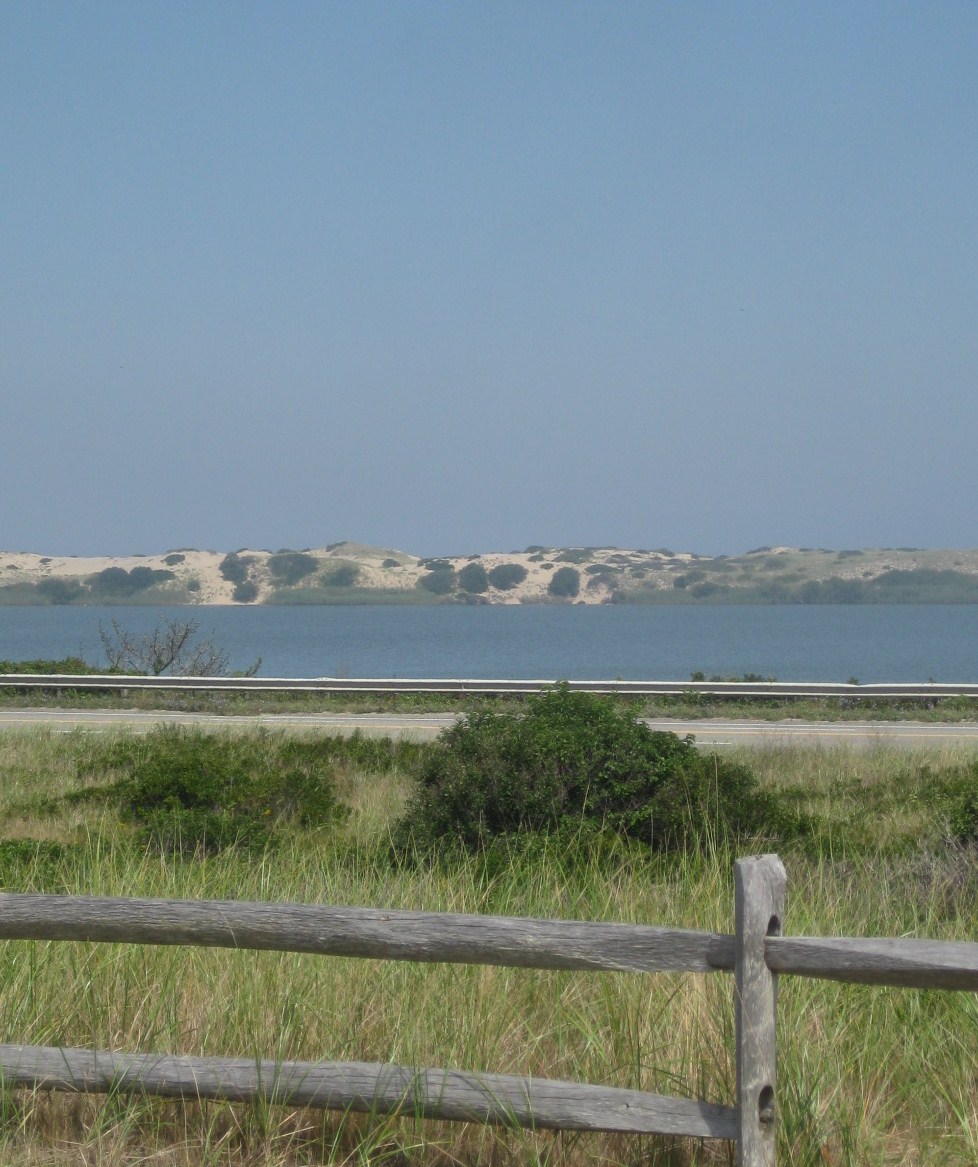
A view across the bay at low tide.


IMG1337
D and her friends congregate on the last remaining island as the tide rushes in.


KikoCCFriendsDC094
In the warmth of the late afternoon sun, the green beckons to villagers of all ages.


KikoCCFriendsDC132
A reed city in the sand, one of D’s ephemeral beach creations.


CapeCod2012119
Our little nephew examines his tummy in the shade of his peapod.

This year, it was a blessing to welcome the new baby on the beach.  It was also a blessing, at this stage of my life, to be the baby’s aunt rather than mother.  D’s newest cousin looked out on the summer landscape from the shade of his peapod tent.  When it appeared that even from that sheltered vantage point, the bright light made him cranky, Grandma and Grandpa went on a mission to Provincetown.  They returned with infant sunglasses that strapped around the head with an elastic ribbon.  This made their grandson, and all of us, much happier.

I had almost forgotten that magical essence of Baby.  What a gift is a baby’s smile!  How rewarding it is to share in his squeals of delight! Our darling nephew was just discovering his unique voice, and his vocal experiments were enchanting and enthusiastic. I had nearly forgotten the incomparable warmth and sweetness of a baby in my arms.

D treasured the time she spent with her cousin.  For one week a year at least, he was, and will be, a substitute for the brother she never had.  And I like to think that next year, when he’s old enough to walk, he will follow in our girl’s sandy footprints.  I can see the two of them now, wandering through the sea grass, making their way down to the bay.

CapeCod2012120
Still checking on the tummy, which is looking good.


Shore Road Scenes in Cape Cod


CapeCod2012390

One of the nicest things about returning to the same place year after year is having the time to take note of the small details, those that change, and those that stay the same. My favorite early-morning activity is a breezy walk along Shore Road. It hugs a narrow strip of land, bordered on one side by the bay, and on the other, by marshy ponds, dunes, and the Atlantic Ocean.  After years of making this walk, I have committed most of its imagery to memory.

CapeCod2012371

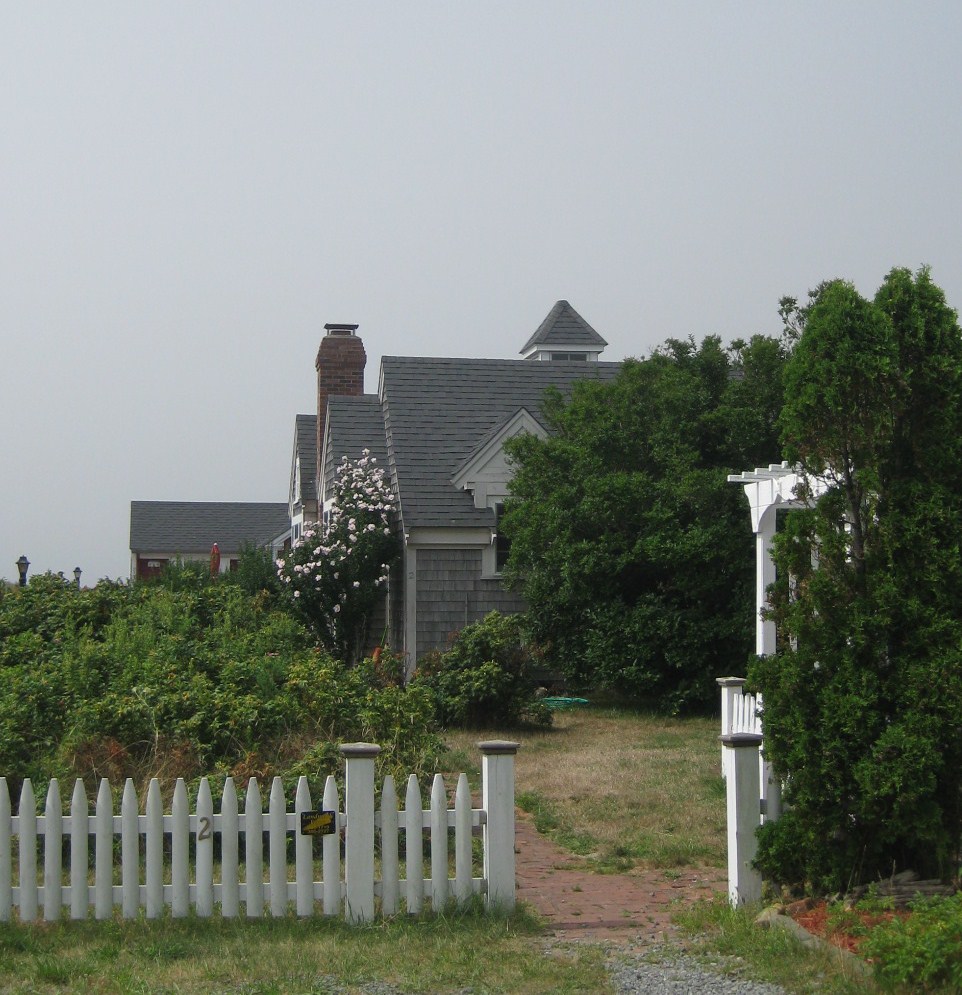
Quaint, lovingly maintained cottages, surrounded by lush flowers and foliage, abound on Shore Road. Scrubby, tenacious Cape Cod roses (Rosa rugosa), thrive in the sandy soil and salt air.

CapeCod2011099

This iconic Cape Cod cottage is as forthright as a child’s drawing, surrounded by hydrangeas  and set on a neat green lawn.

CapeCod2011018

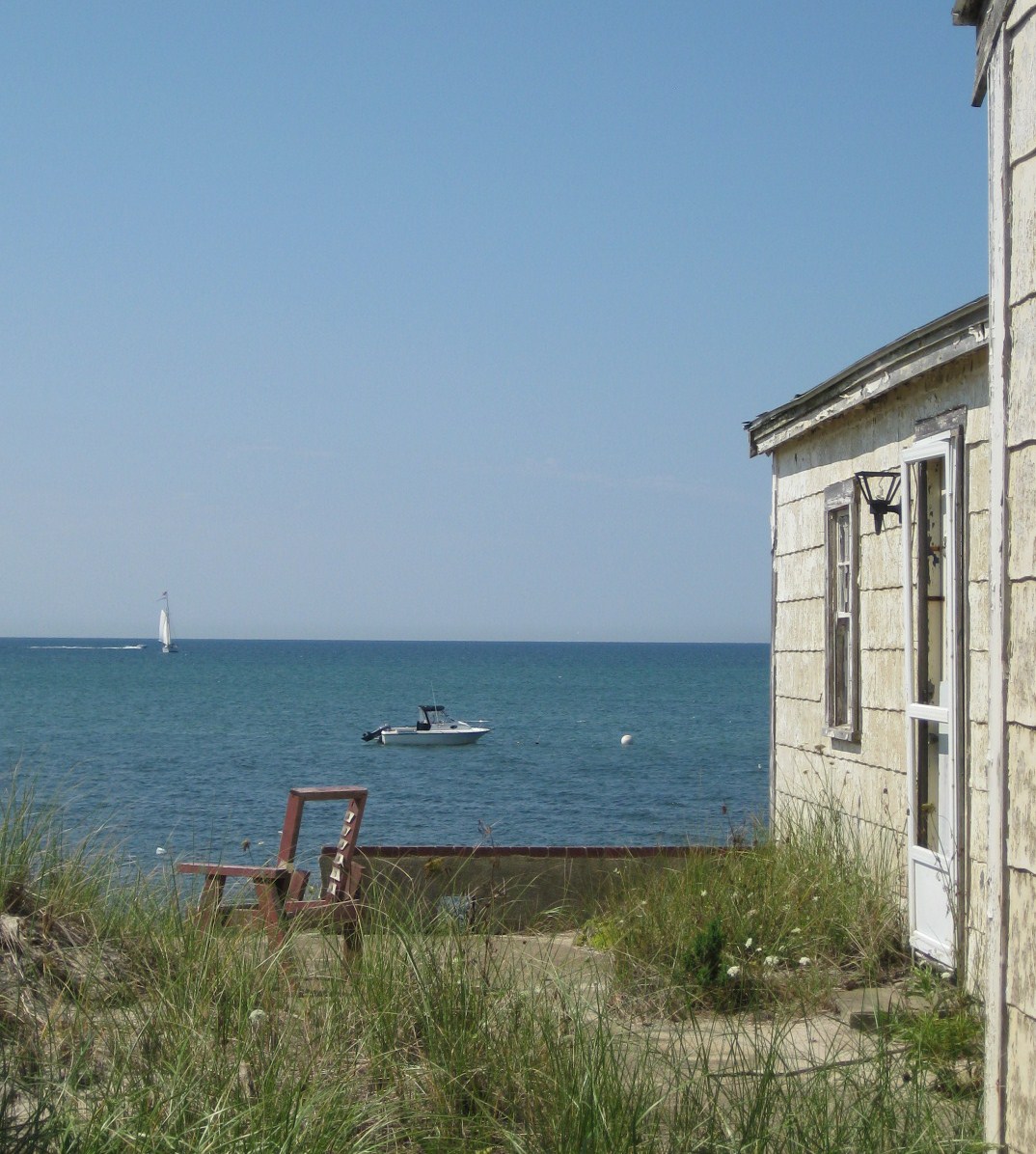
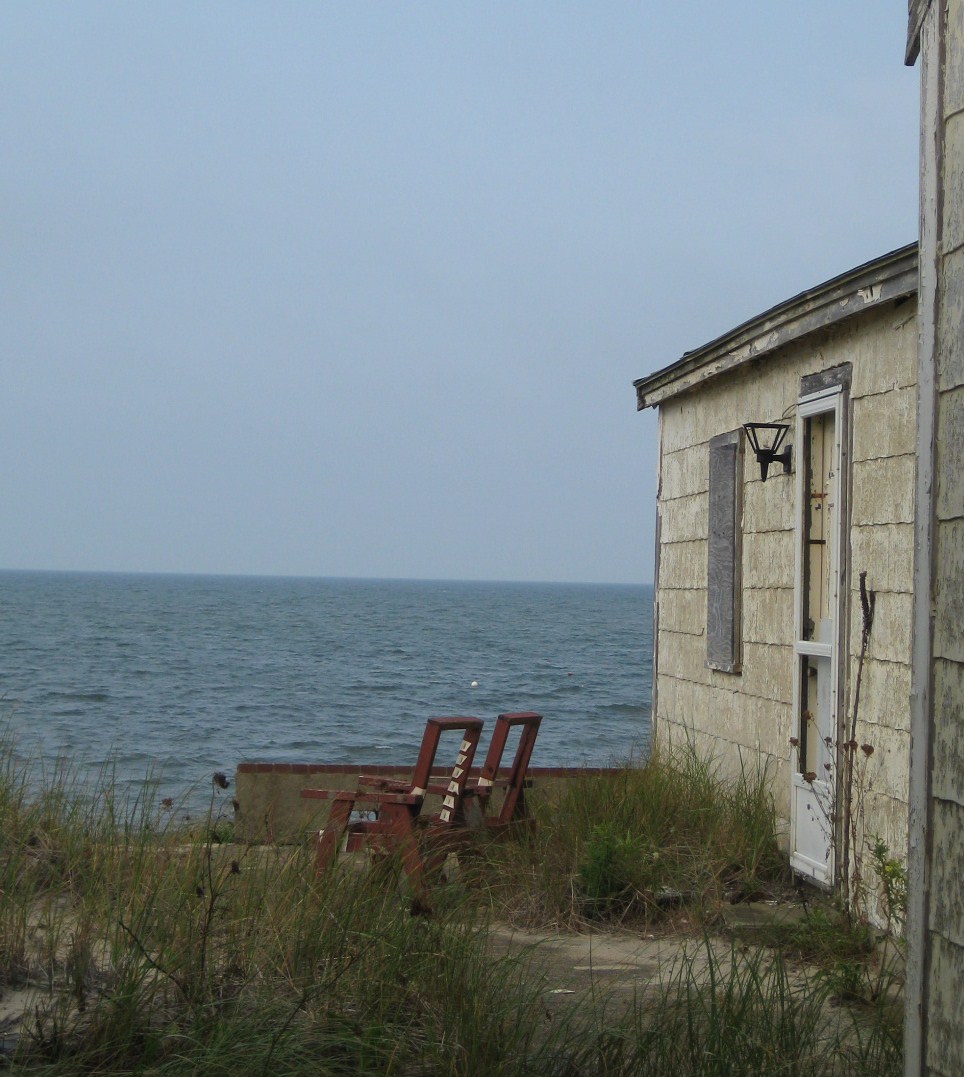
Not everything on Shore Road is postcard-perfect, I’m happy to say.  The picturesquely scruffy makes a showing, as well.  This small dilapidated motel property is perpetually for sale.  I photograph it every year, and its changes are minimal.  One or two decaying beach chairs always keep watch on the bay.  The above photo dates from August 2012.
CapeCod2010055

My photo of the same spot, from August 2010.

CapeCod2012382

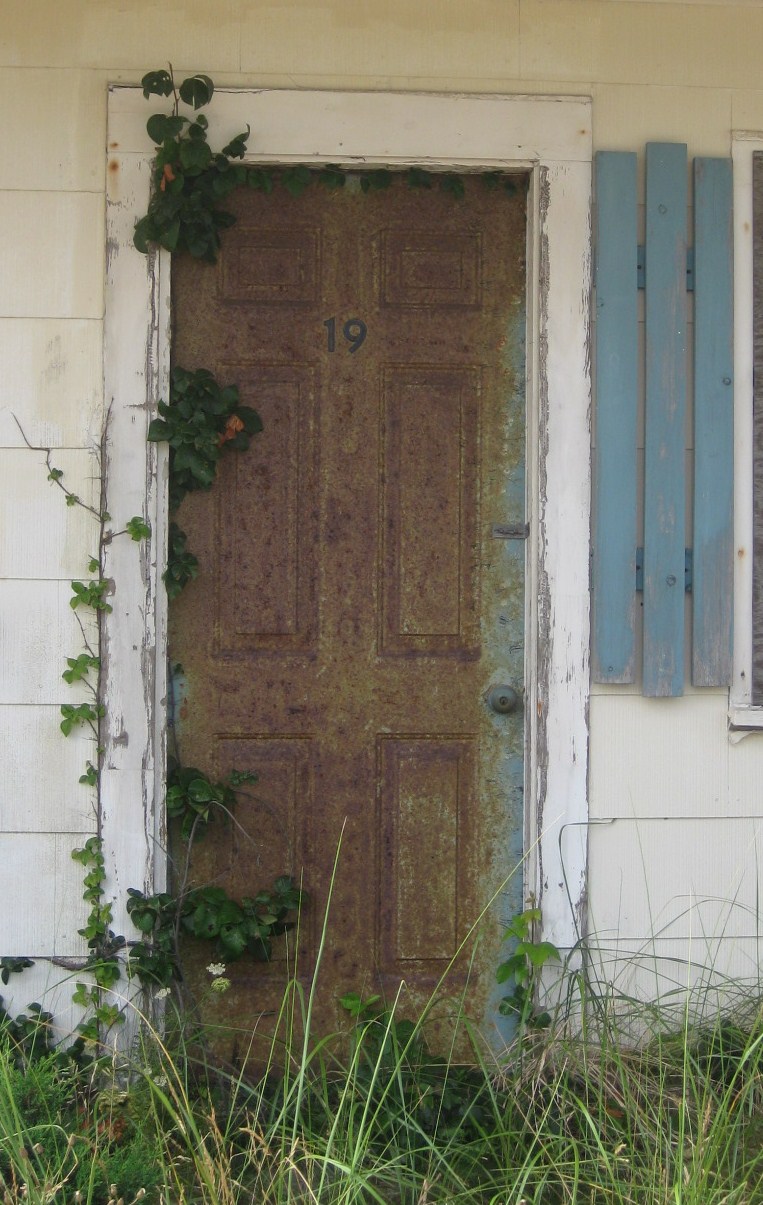
I document Door #19 of the old motel every year.  It varies only in the amount and configuration of its greenery.  Above is this year’s photo.

CapeCod2011017

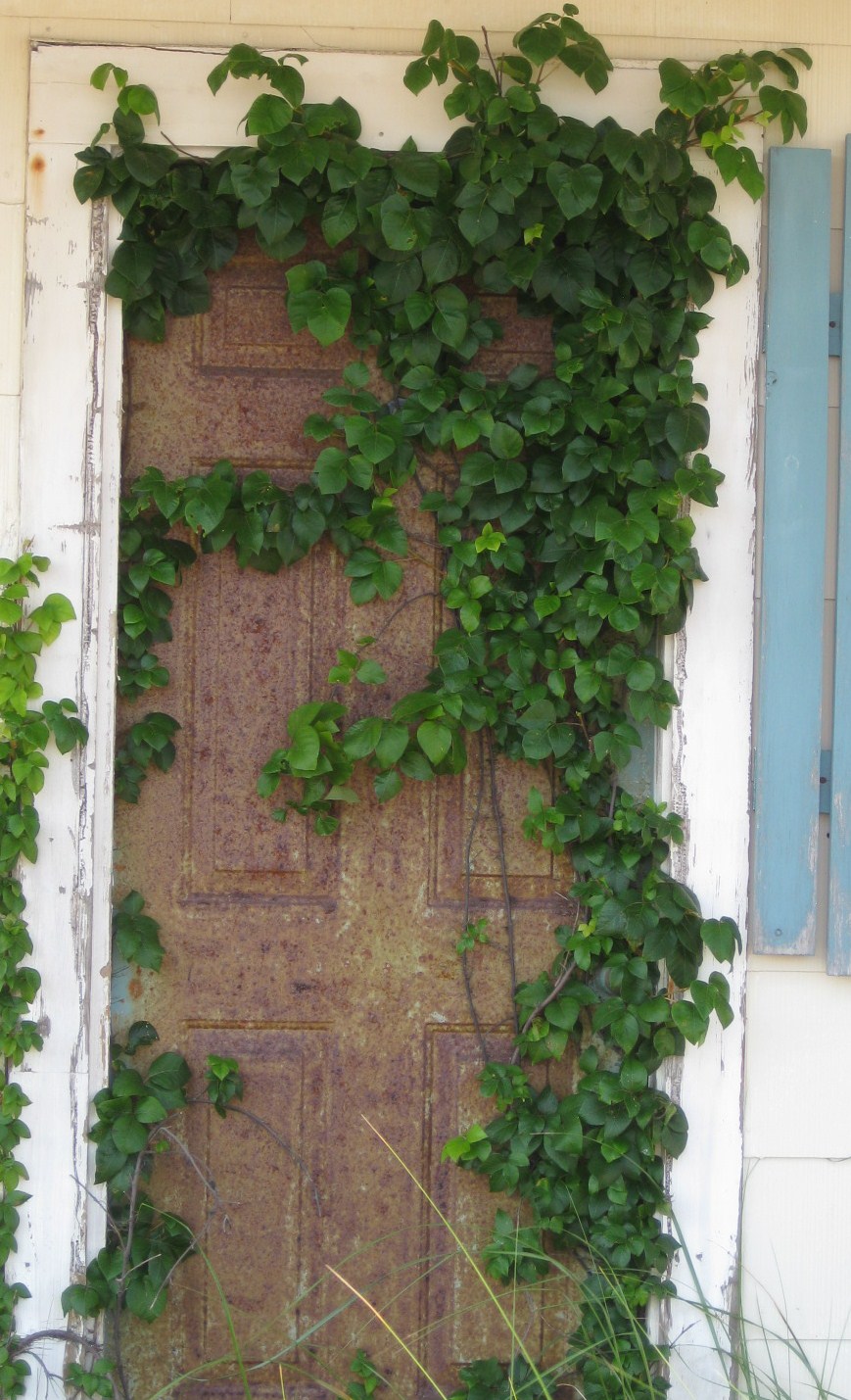
Last year’s photo, with a greater abundance of vines.

CapeCod2012377

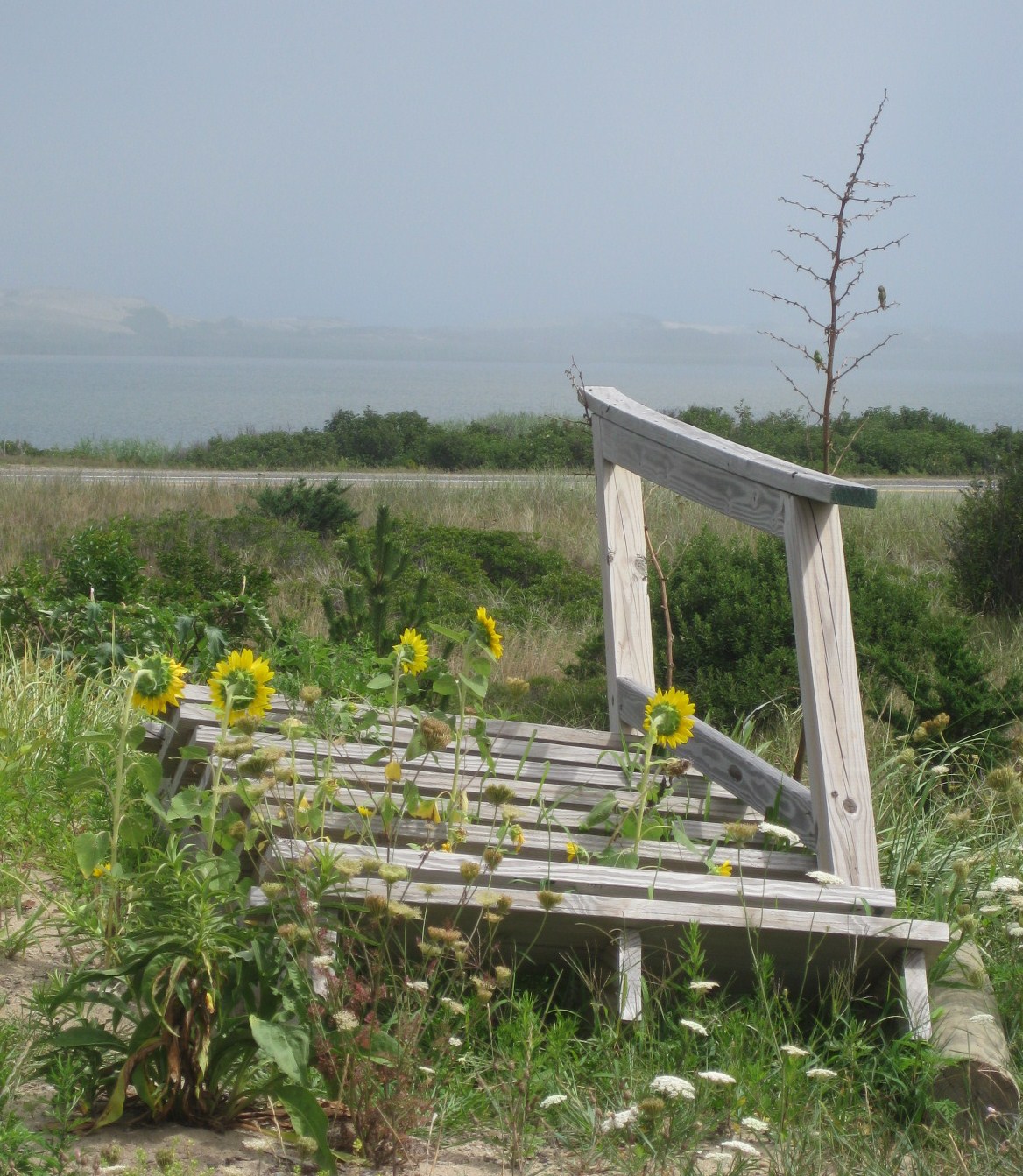
Sunflowers and Queen Anne’s Lace stake their claim to this forgotten fragment of a wooden porch.

CapeCod2012386

Two crows pose next to  a cross-like clothesline support.

CapeCod2011040

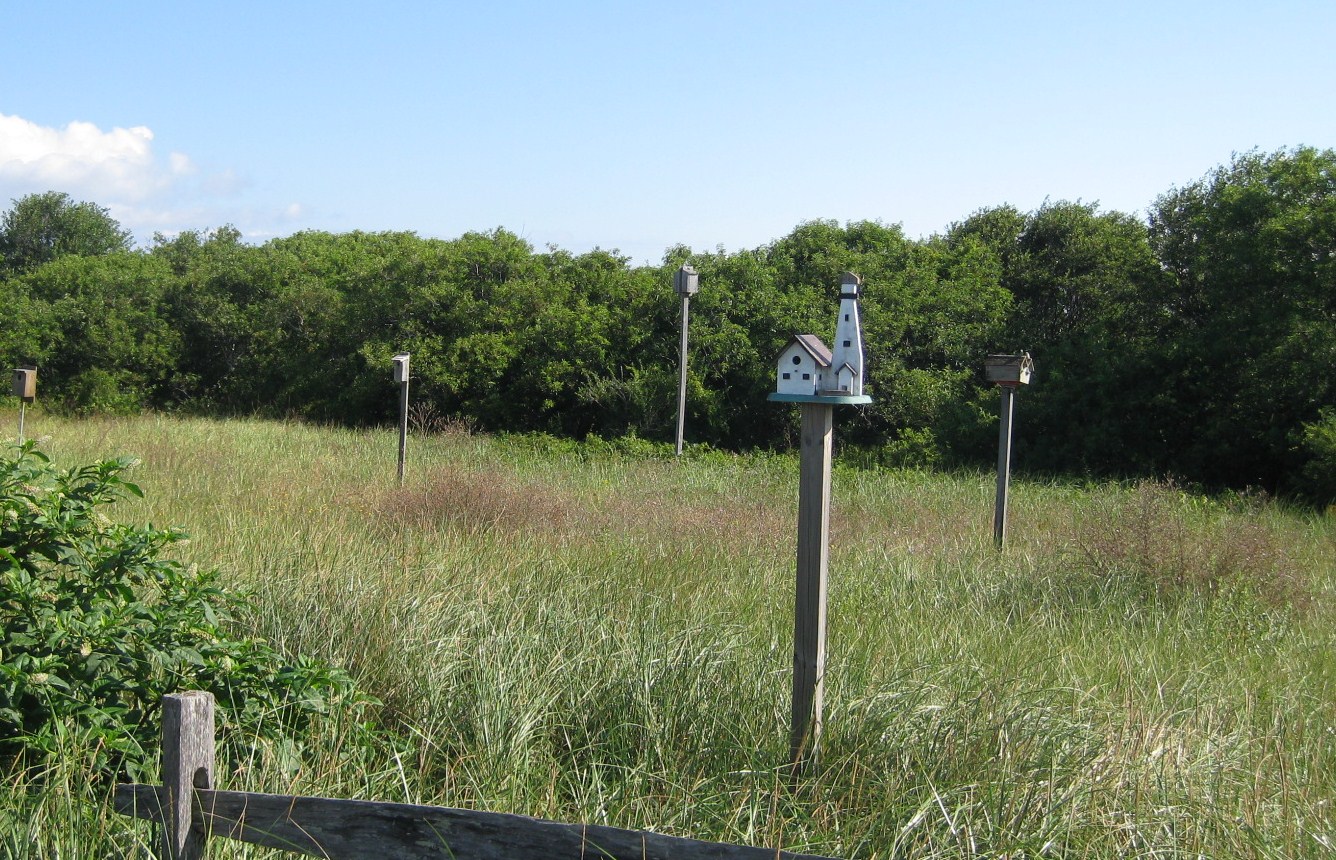
This vacant lot is home to a community of birdhouses, including a central caboose.

CapeCod2011040

Last year’s Birdland centerpiece was a lighthouse.


CapeCod20121231The neat white and green boxes of Days’ Cottages, set in a line against the bay, date from 1931.  Each structure bears the name of a flower, such as Freesia, Dahlia and Petunia.  This long-lived
and virtually unchanged cottage colony has a loyal clientele.  It is a popular subject for local artists.

CapeCod2011021

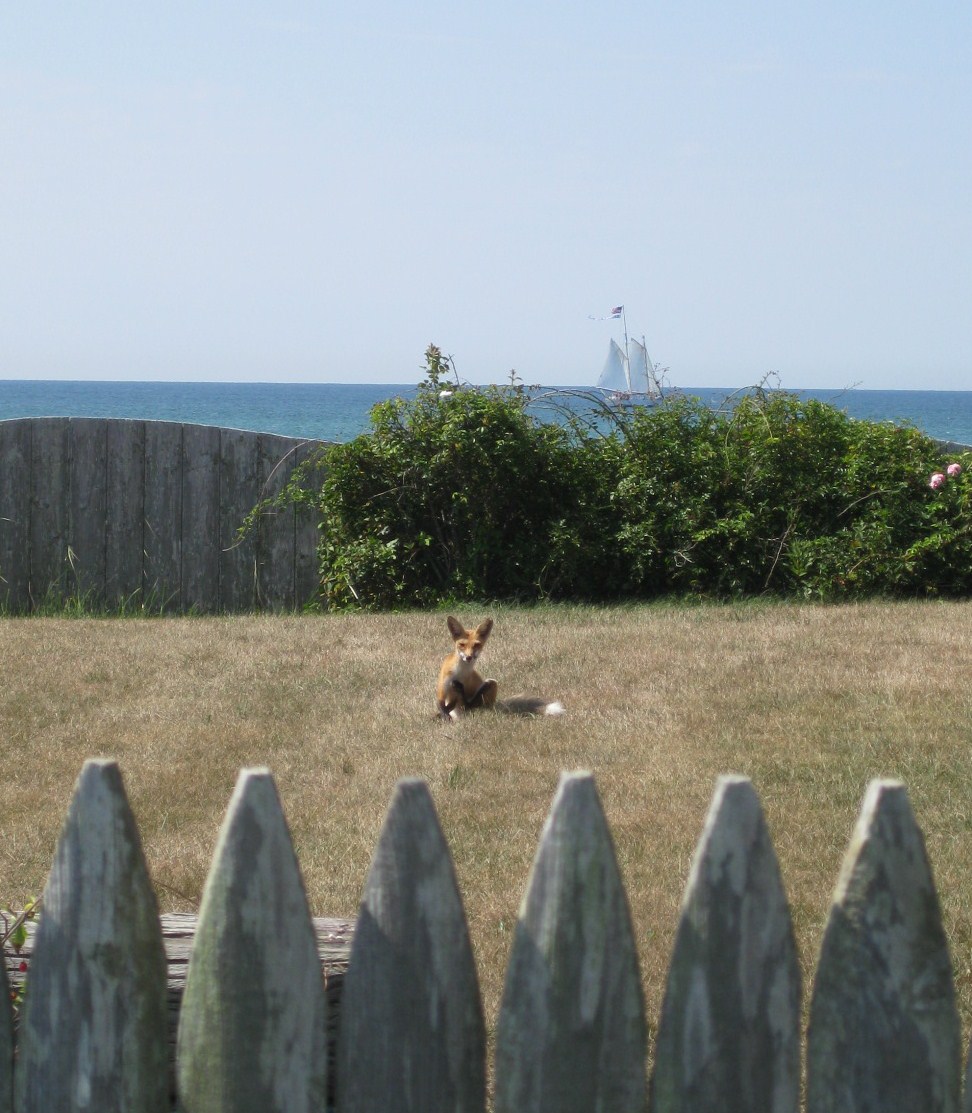
Last year I spotted this red fox enjoying the quiet of an enclosed yard.  He kept a keen eye on me as he scratched repeatedly, shook, and then trotted off unhurriedly toward the sand.  Of course he
reminded me of Kiko. On every walk along Shore Road, I somehow end up thinking about Kiko, and I wish he were walking with me.   

What if We Hadn’t Stopped the Road?

AtlantaJuly2011053
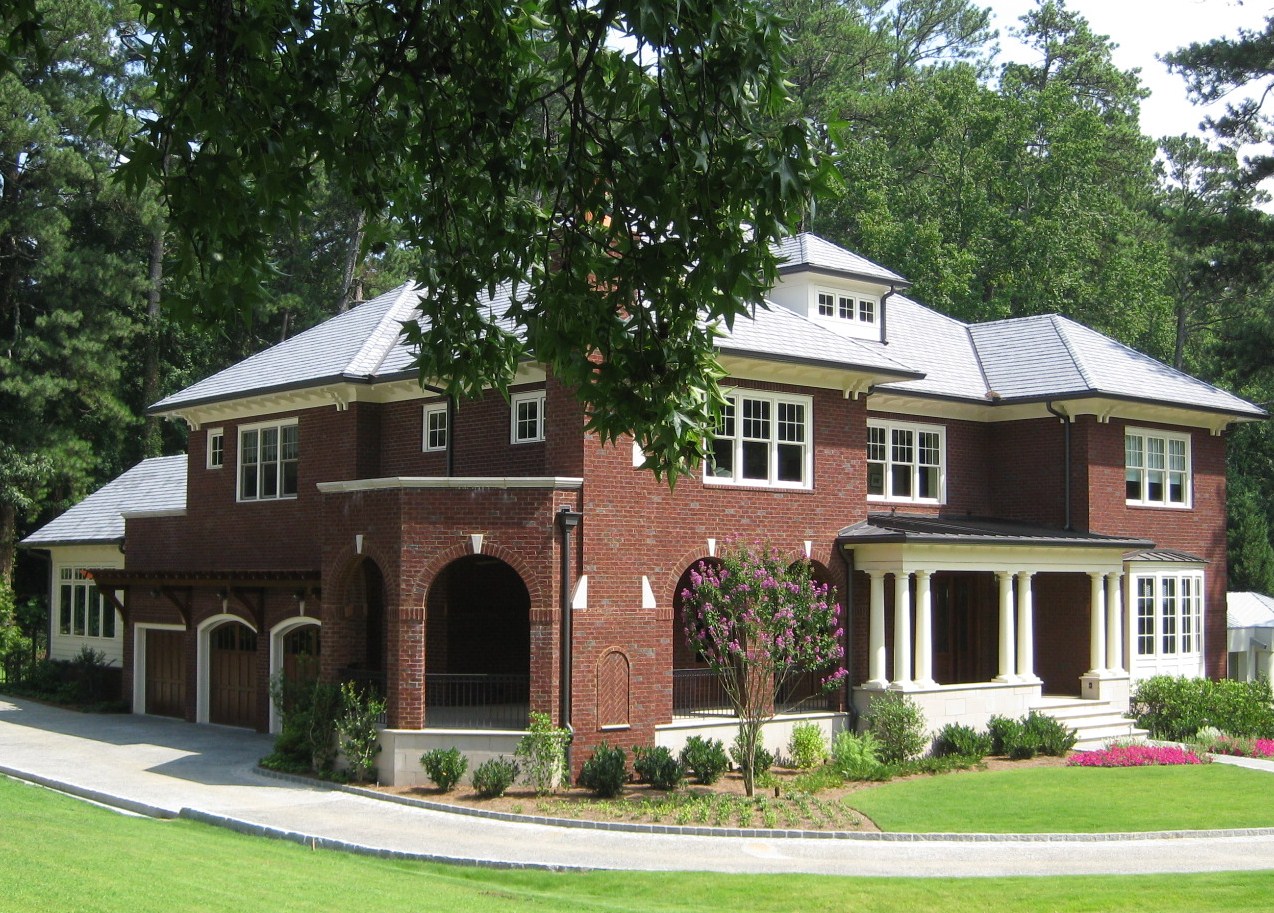
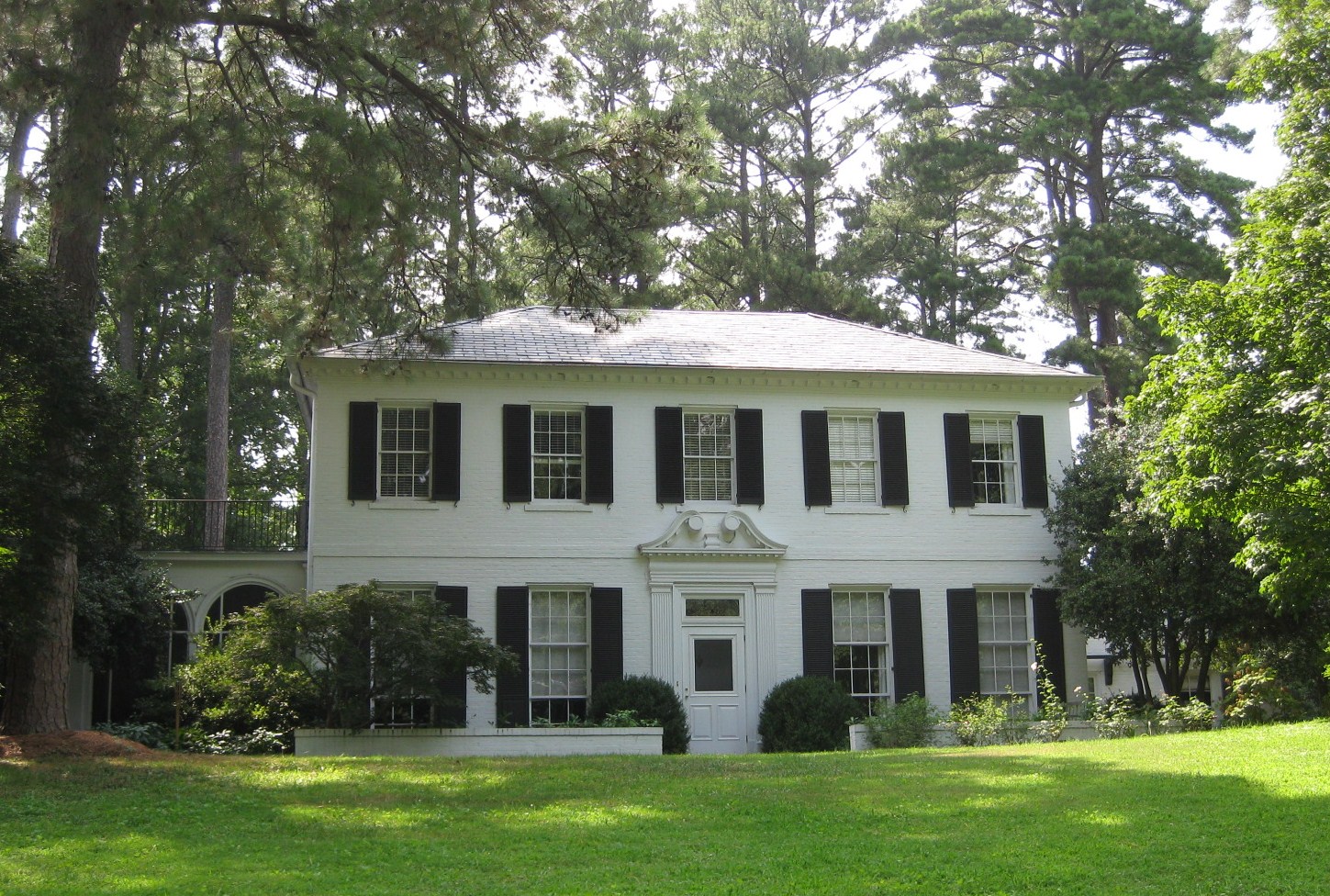
A large new Morningside home in the Druid Hills tradition.

Today’s residents of Atlanta can be proud that their city didn’t give up on the possibility of safe and pleasant neighborhoods flourishing near the heart of the city. The old was not sacrificed for the new simply because it fell briefly on hard times. I hate to think of how very different Atlanta might have been if the protests had been less robust, if I-485 had been built. It was a close call; it had been a sure thing, a project supported by the State of Georgia and City of Atlanta officials. By everyone, essentially, except those who lived in Morningside and Virginia-Highland.

Had a freeway been allowed to snake its way through these two historic neighborhoods, so much character would have been lost. Neighbors would be physically separated by concrete and steel. Trees and green space would be considerably diminished. Had I-485 been realized, there were plans for further widening of many area roads, as well as the demolition of Morningside and Inman elementary schools, both dating from the 20s. Today, both schools have been enlarged and beautifully restored, their architectural style of a piece with that of their neighborhoods.

In all likelihood, the area would have faded into a state of actual urban decay. Decades later, it might have recovered, to some degree. There would be owners who, out of necessity, would find a way to reconcile living along a highway ramp, a river of cars speeding through their back yards. Those monstrous sound-blocking fences might inflict further ugliness.

After the defeat I-485, much of its funding was diverted to MARTA. The city’s rapid transit system would not be as extensive and effective as it is today. Atlanta’s suburbs, now vast, might be even more sprawling, and the city’s mind-numbing traffic probably far worse. Morningside and Virginia-Highland are two of the most sought-after neighborhoods precisely because they are close and easily accessible to the real and varied life of the city. Their residents may avoid Atlanta’s terrifying freeways if they choose. Their homes are nestled safely in the eye of the storm.

Without a doubt, Morningside and Virginia-Highland would not be the inviting neighborhoods they are today; people would not be flocking into the city to live there. Most of the older homes would not have been lovingly restored. The newer ones would not have been so thoughtfully and appropriately reconfigured to fit in with a unified vision for the neighborhoods. While there are large new houses being constructed, there is not a cookie-cutter McMansion in sight. The surrounding landscape is rolling and verdant, sheltered by forests of tall trees.

The successful fight against the highway resulted in Atlanta’s neighborhoods having a greater say in what is built in their back yards. The city now has a system of Neighborhood Planning Units to ensure that residents have a real voice in matters that affect their lives.

Having witnessed first-hand the battle of the old neighborhoods against I-485, I know how fortunate I am to have learned this very important lesson at a young age: if you love something, it’s worth fighting for. And when we join together with one powerful, clear voice, we can accomplish great things.

AtlantaJuly2011057
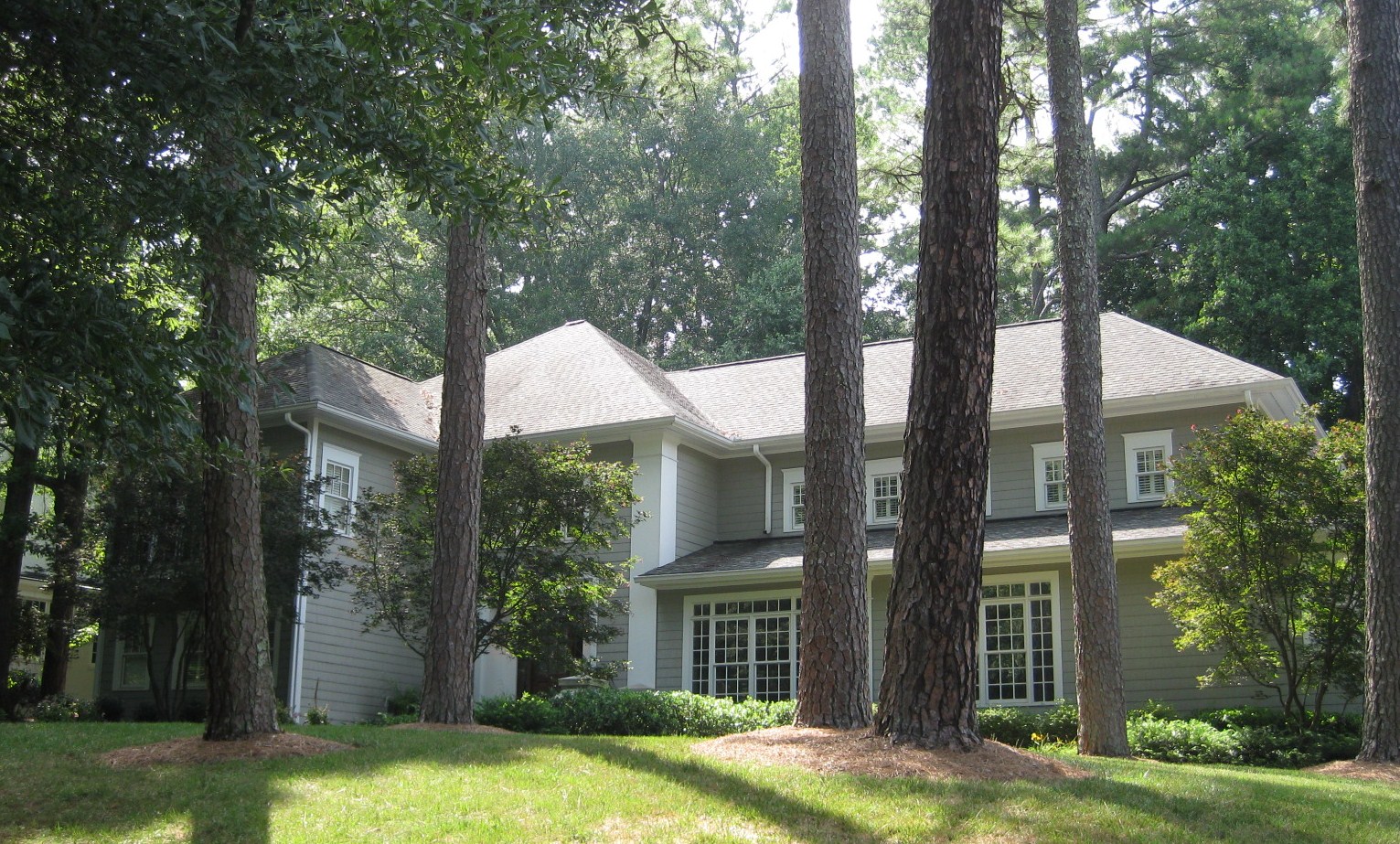
One of Morningside’s former 1960s ranches, enlarged and popped up.


AtlantaJuly20110561
This Morningside home, refreshingly, looks almost exactly the same as it always has.

After Demolition, Green Space & Amazing Playscapes

There were several large sections of Morningside and Virginia-Highland where multiple homes were demolished in anticipation of I-485. Some of these have been transformed into popular community parks. Exploring the inventive playscapes in these parks was, for my daughter, one of the highlights of every visit to Atlanta when she was growing up.

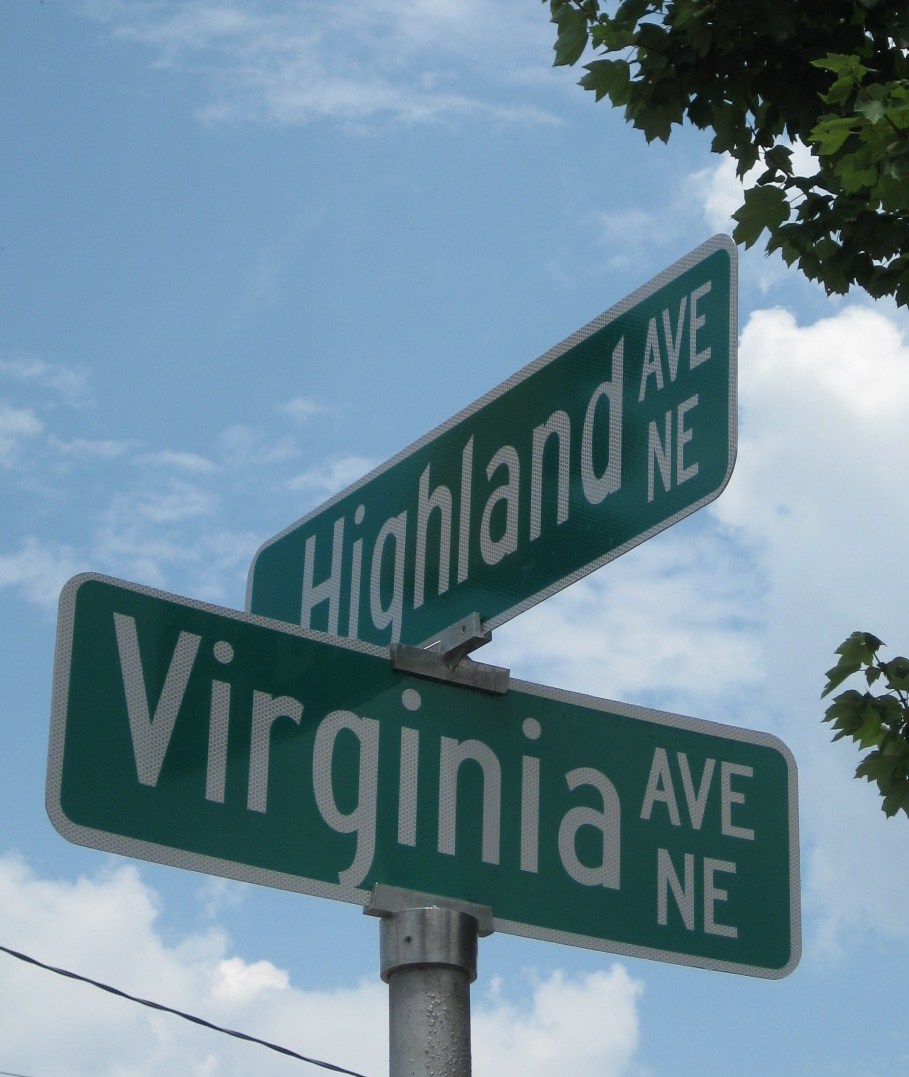
The most extensive of these once-vacant areas is on Virginia Avenue, across from Inman School (formerly Elementary, now Middle), where eleven houses were torn down to make way for a highway interchange. The land remained scrubby and untended for many years. In 1988 it became John Howell Memorial Park, named for a Virginia-Highland resident who helped lead the fight against I-485 and who died from complications of HIV.  Along the Virginia Avenue entrance stand eleven granite piers (modeled on those on St. Louis Place and elsewhere in the neighborhood), each bearing a plaque with an address of one of the lost homes. Appealing landscaping, a children’s playground and a sandy area for volleyball guarantee that the park is always lively.

One section of John Howell Park has become the Cunard Memorial Playground. In the summer of 2003, a sudden blinding thunderstorm stopped evening rush hour traffic throughout the city.  A huge oak tree, its roots weakened, fell across North Highland diagonally onto the SUV of a young family, killing Lisa Cunard and her two sons, Max, age three and Owen, just six months old. Her husband, Brad, who had been driving, survived physically unharmed. The parents had just picked up Max from preschool, and Lisa was riding in the back seat, as she usually did, to be closer to her boys.  Firefighters from that old Virginia-Highland station rushed across the street, ready to extricate victims and perform CPR, but it was too late. 

My daughter and I were in Atlanta during the tragedy. When the storm hit, with violent force, we were stuck in the car with my parents along another tree-lined road not far away. Atlanta’s trees are majestic and many, but they can also be a threat.  Our vulnerability, as lightning struck all around us, was imminently clear. The ride home was slow-going and nerve-wracking, but we were lucky; we made it. That night we heard the news about the Cunard family, who had been so terribly, horribly, heart-breakingly unlucky.

D has a particular fondness for the Cunard Playground. Like many Atlantans, we both feel a connection to the family, because we remember that hideous night so well. I knew the tree that fell; I knew the house in front of which it had stood. We had been in that exact spot many times.

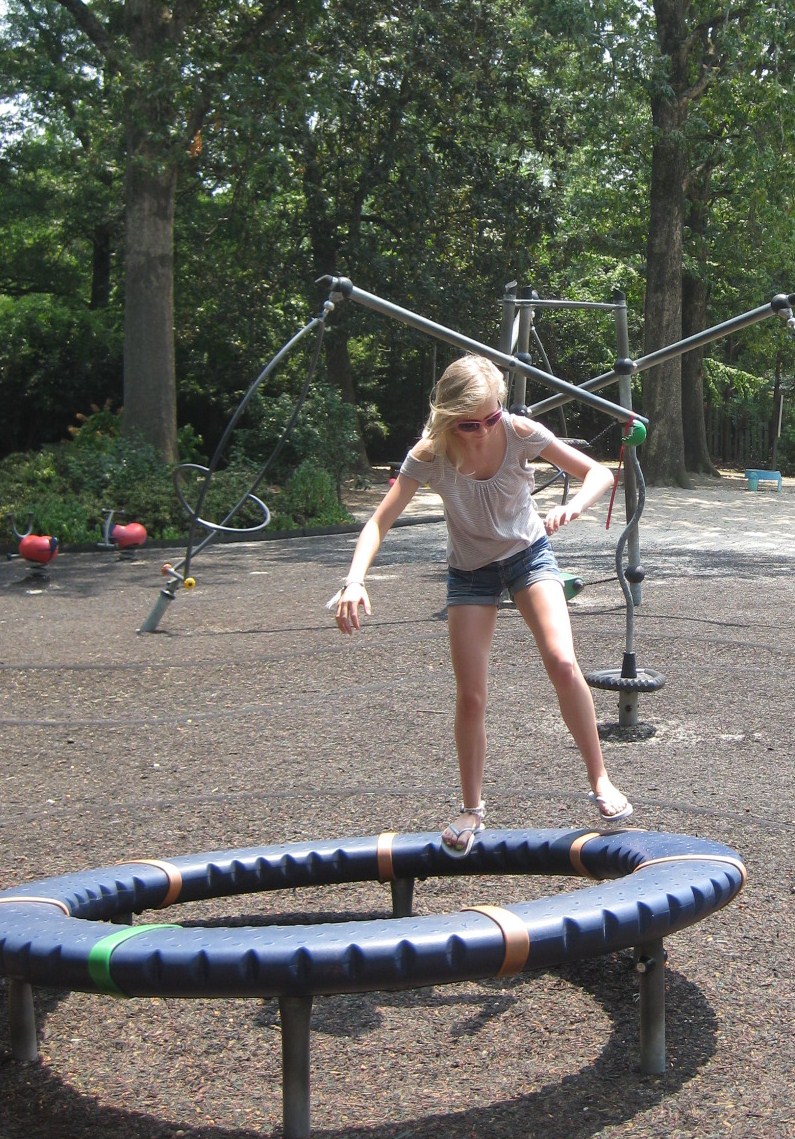
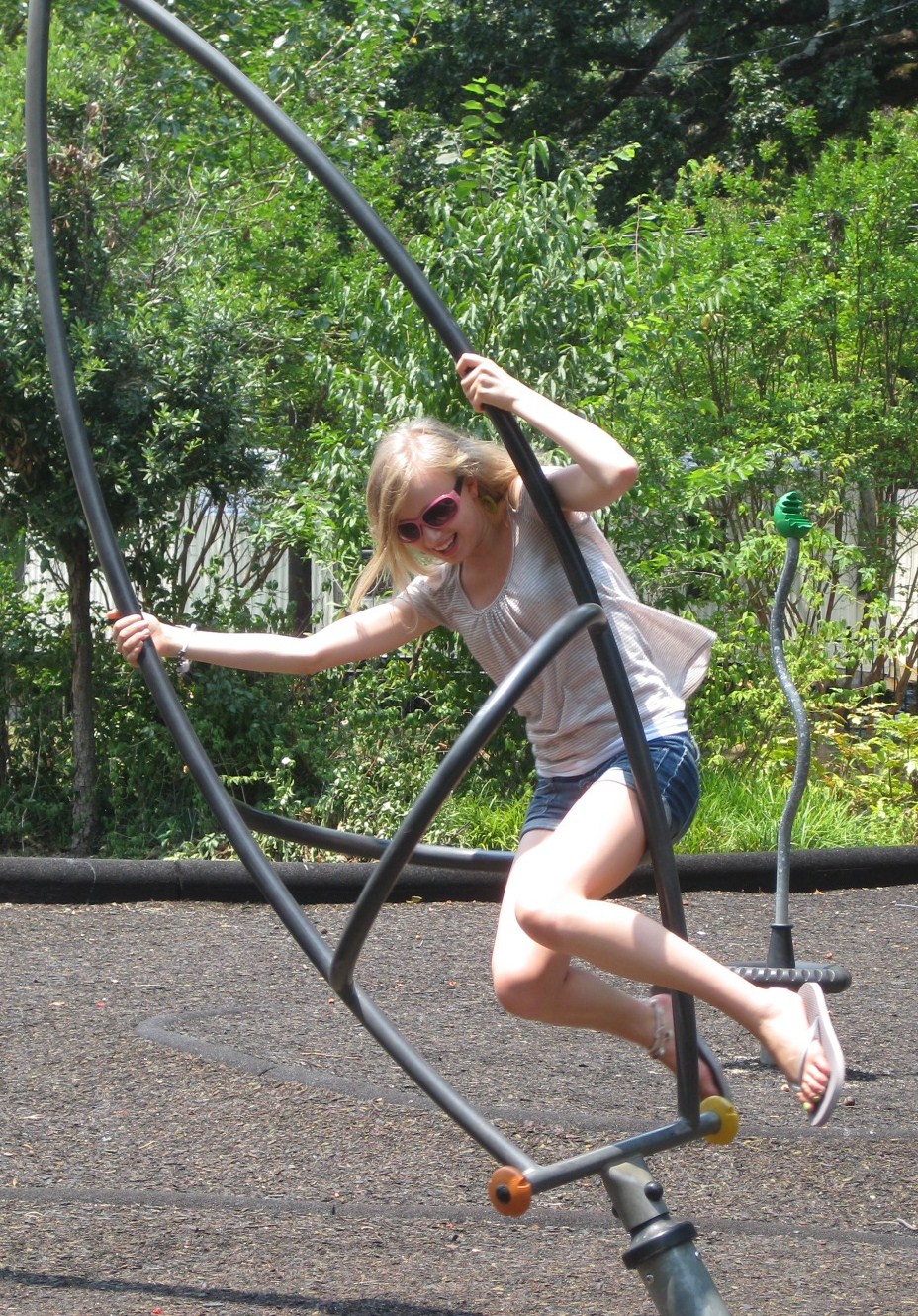
The playscapes at the Cunard include easy-going toddler attractions and some especially ingenious contraptions for older kids. I don’t have the words to describe these latter creations; I’ve never encountered such things before. As if to emphasize the need to live this short life to the fullest, they are apparently intended for determined daredevils. D has always referred to this park as the “spinny” park because it’s possible there to spin round and round, at varying speeds, in a crazy variety of ways. When she urges me to have a go on one of these whirling oddities, I know I’m a real grown-up, because I’m sure that immediate nausea would follow. I also know I would have loved all these inventively twirling things, just as D does, when I was a kid. My husband has tried them, and even he must admit that he also is an adult. 

The Cunard Playground was, like the defeat of I-485, a remarkable community effort. The grieving friends, family and neighbors of the Cunard family joined together to ensure that this loving mother and her two boys, so very young, will be remembered in a vital and meaningful way. The playground is  a unique and fitting memorial, an exultant space that Max and Owen would, no doubt, have cherished.

001
D and her friend who introduced us to the Cunard Memorial Playground.


002
A quiet, briefly non-spinning moment.
Spinny 2
I used to enjoy cutting and pasting so my one daughter would become two. Every day when she was young, though, I was thankful that she was not twins. Here, she attempts the spinning circle, twice.


Atlanta043
Our most recent Atlanta visit, of course, included a visit to the spinny park.


Atlanta039
This thing is one of D’s favorites. I don’t really get it.


Morningside Begins its Comeback

Atlanta, July 2011 065
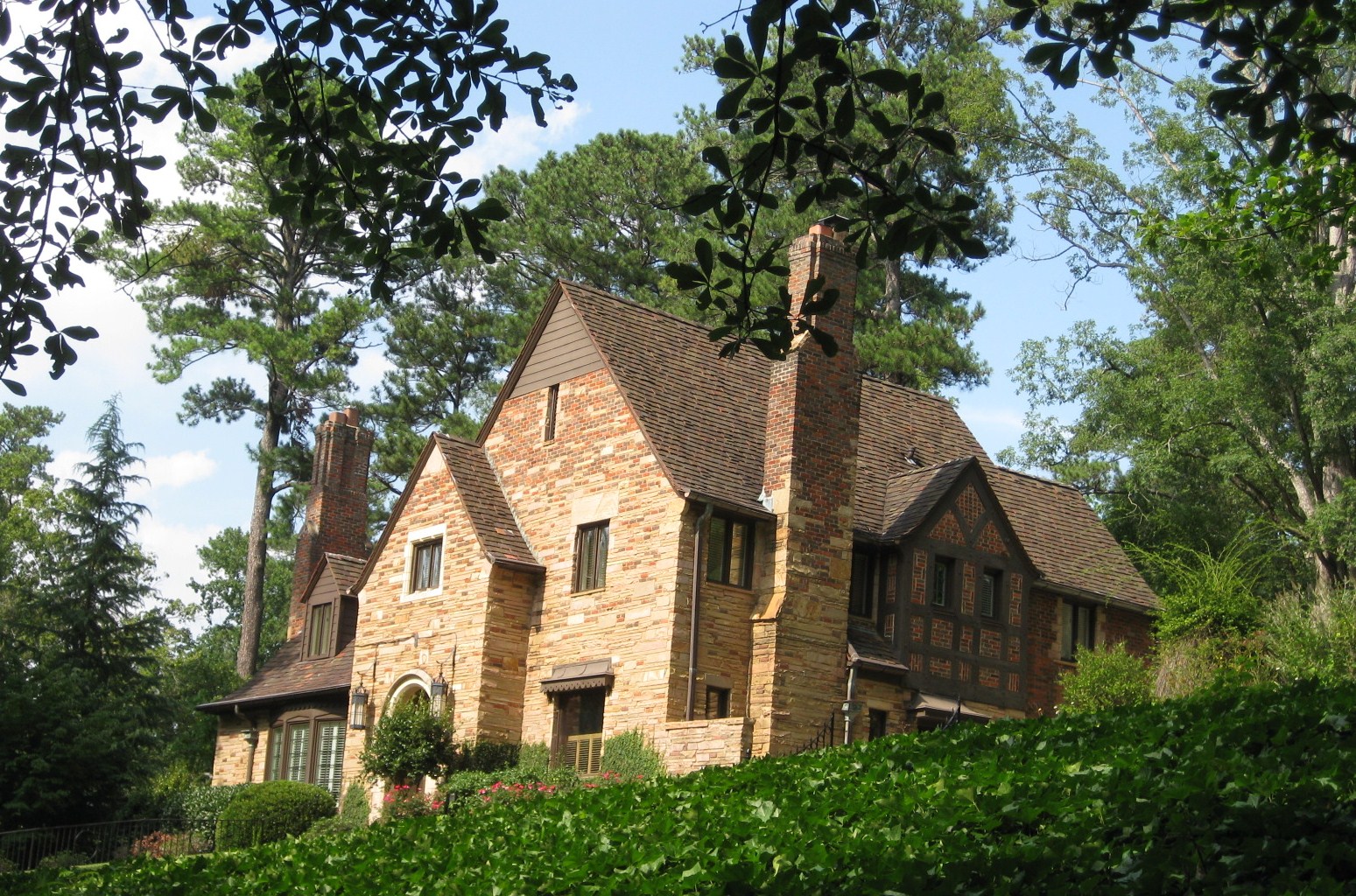
This original Morningside home was never in jeopardy. While larger than most of the 1930s-era houses, its Tudor style is typical.

Morningside recovered quickly after the defeat of I-485. Homes that had languished unoccupied for seven years sold at relatively high prices. Construction soon began on new, bigger houses on the vacant lots we had come to view as common property. This was the only drawback to the resolution of the conflict. My friends, my dog Popi and I had become accustomed to having the run of these quirky recreational areas during the day. The decaying houses were in a constant state of flux, offering new discoveries with every visit. A steady stream of odd objects and eye-opening reading material was left behind by other visitors. Vagrants obviously used the houses occasionally for drinking and sleeping, but they were almost always gone by daylight.

We loved the chaotic wildness of the overgrown lots, where we picked blackberries and flowers, gathered hickory nuts and cut holly in the winter for Christmas wreaths. We appreciated the accelerated pace with which Nature was reclaiming its space—the sturdy oak saplings that forced their way up through cracks in concrete patios, the ivy that pushed through crevices around windows to flourish in drafty old bedrooms. We roamed so freely among the ruins that we had begun to see it as our right.

Nevertheless we were respectful, not destructive, although we often confronted the appalling vandalism of others. Sometimes we found charred floorboards where fires had been set. Mantelpieces and chandeliers were ripped out and stolen. Windows and bathroom fixtures were smashed, purely for fun. We had known many of the former residents; we had been guests in these homes. A cloud of memories swirled around me each time we set foot in the house where my friend Deborah had lived. We had played together there before the road became a threat. I remembered the kitchen, where we shared after-school snacks, as cozy and inviting. It was now ill-used and desolate, its remaining appliances wrenched from the walls. Graffiti streaked across the ceiling of her former bedroom.  Her family had been forced out early in the fight. I wondered where they had gone. How bitter was it for them to know that they had been uprooted for no reason?

On our street, where no houses had been condemned or torn down for the highway, many owners began renovations that they had put on hold. Building permit signs were hammered into front yards and the first of a long parade of Porta-Potties appeared (the ultimate in-town status symbol). Our family embarked in earnest on removing the applied veneer of the early 1960s (linoleum tile, gold carpets, faux wood-grain wallpaper) that masked classic elements of our house. Morningside, its future at last assured, was on the up and up.

Atlanta, July 2011 061
Another of Morningside’s grander original homes, built in the Spanish Colonial style. While it dates from the 1930s, it has had several successive renovations.


GA_KYJuly2010016
The sun hits the eaves of one of Morningside’s smaller, more-typically sized homes.

Morningside, Virginia-Highland, and the Fight Against I-485

Atlanta, July 2011 073

During our time in Atlanta, my daughter and I usually spend part of one day browsing the eclectic shops of the Virginia-Highland neighborhood. Developed in the early 1900s as a “streetcar suburb,” with trolley lines to downtown, Virginia-Highland is now one of the city’s most inviting and vibrant sections. It wasn’t always this way.

When we moved to Atlanta in the late-60s, many such in-town neighborhoods were, to varying degrees, down at the heels. We found an affordable house in Morningside, which adjoins Virginia-Highland. Most Morningside homes dated from the 1930s. Small but well-built, many resembled English cottages. It was a neighborhood with great bones, but a bit tired and frayed. It had the look of a place whose heyday had passed. Most of our neighbors were elderly; Mama and Daddy were among the few young kids. Many homes were behind on routine maintenance. As anyone with a renovator’s soul and an affinity for hard work recognizes, this is the time to buy. Things will get better, my parents reasoned, and they would be instrumental in the upswing.

Atlanta, July 2011 085
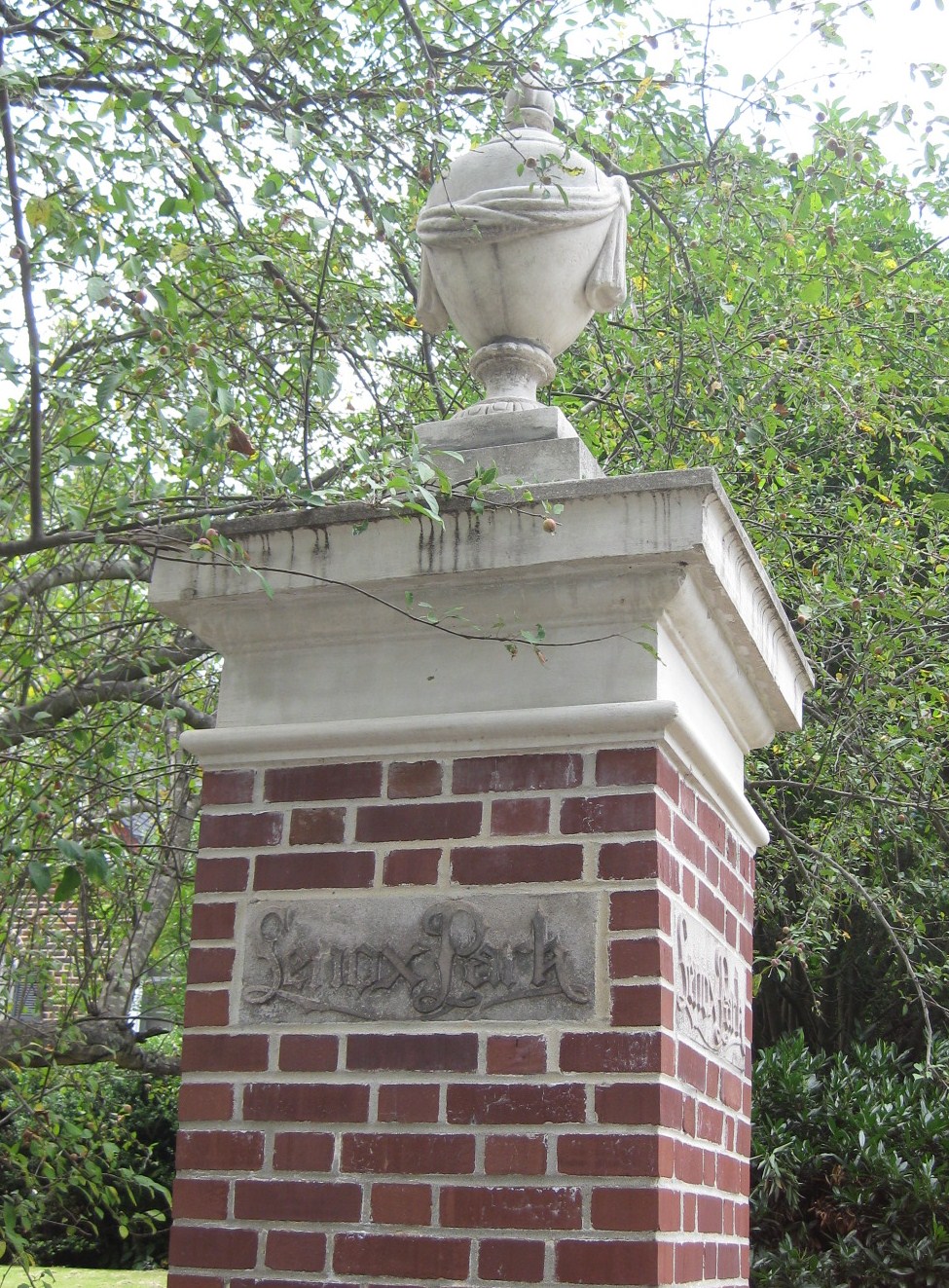
The original marker denoting the boundary of the Lenox Park section of Morningside.

Virginia-Highland was shabbier at the time than Morningside; it was older and had had more time to slide into dishevelment. Both neighborhoods were haunted, now and then, by the ghost of a rumor that a highway was being considered in the area. My parents, and others new to the area, decided to regard it as neither likely nor imminent. But in the years to follow, the threat became all too vivid.

The temper of the times was changing.  Fear of inner city crime was mounting. The conflicts over school desegregation never turned violent in Atlanta as they did in some cities, but they prompted more homeowners to sell and flee to the suburbs.  Older neighborhoods like ours were increasingly branded by state officials as futureless pockets of urban decay. What Progress required, according to the Georgia Highway Department, was a multi-lane freeway to whisk city workers safely home in the evenings to suburban promised lands. The highway, named I-485, would cut a frighteningly large swath through the hearts of Morningside and Virginia-Highland. The ghost was real, and it meant business.

Almost immediately, the state began a fierce program of land reclamation to prepare for the road. Many elderly owners were frightened into accepting low offers for their properties, which were quickly razed or left to deteriorate, unprotected from nature and vandals. It was heart-renching when the moving vans arrived and the slow exodus of boxed-up belongings began.  It was heartbreaking when the “Condemned” signs were posted.  There were a few brave owners, however, who refused to leave, even under threat of legal action. Some of these determined residents remained in the homes they had built, even as they seemed poised to tumble down around them.

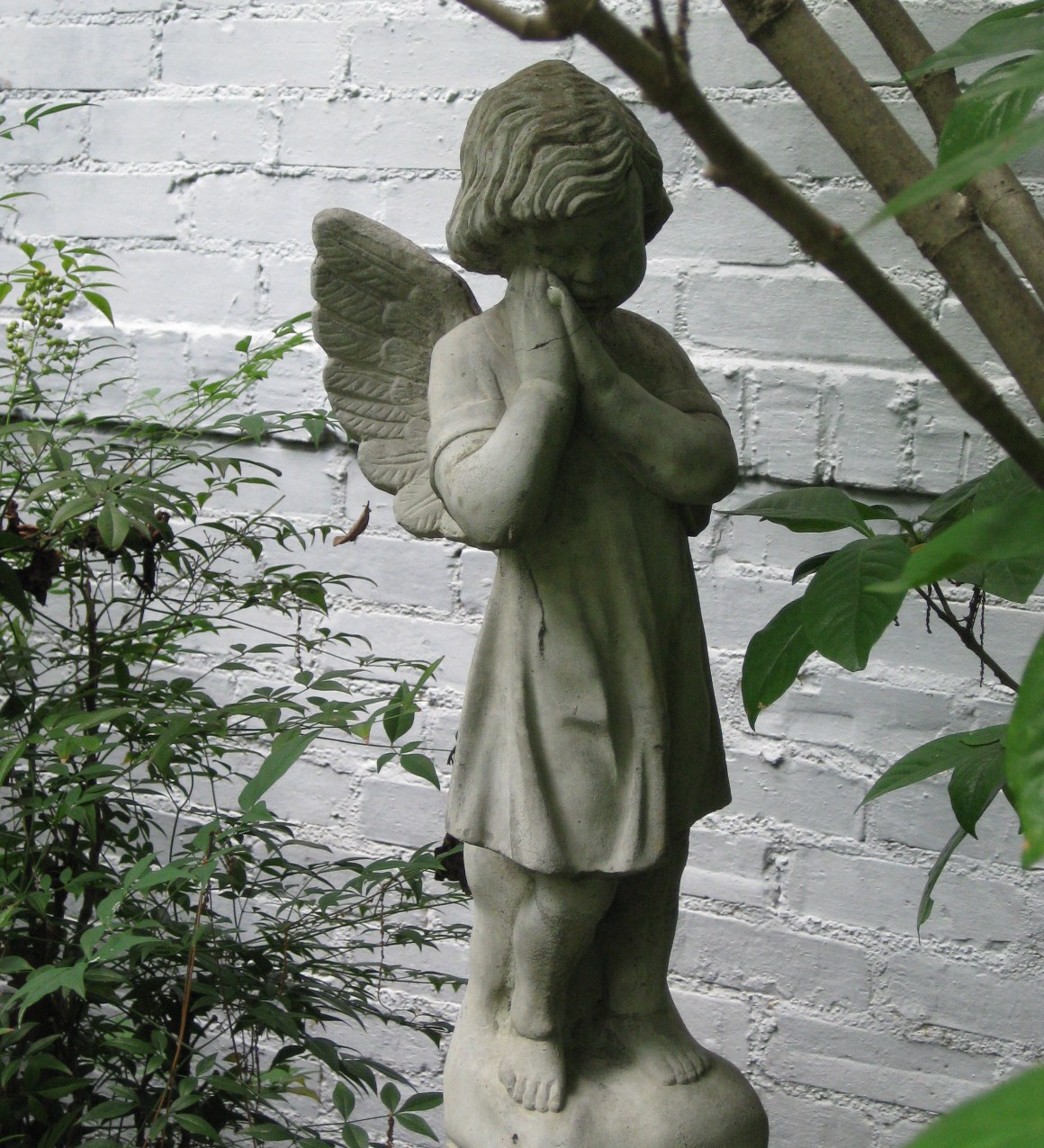
Atlanta, July 2011 092
A Morningside garden angel, in prayer.

I-485 appeared unstoppable once the demolition machines were roaring. It could easily have been declared a lost cause. But a coalition to oppose the road had taken root, and like those who refused to move, this group wasn’t afraid to persevere. Several young Morningside mothers, including Mary Davis and Barbara Ray, who were parents of my friends, played a crucial role in countering the conflict.  Energetic and zealous, they rallied their friends and neighbors. They formed the Morningside-Lenox Park Association specifically to fight the road. They explored various legal angles and kept working even as other groups lost hope. There were several points when it looked as though the fight was unwinnable. But each time they persisted; these women did not give up.  After a while, some of the most pessimistic among us began to glimpse the possibility that together, perhaps, we might triumph. And if we didn’t, it was certainly worth our best effort. As the coalition gained in strength and numbers, the tide gradually began to turn. After several years of closely fought legal battles and imaginative grass-roots efforts, the freeway was stopped.

At first it was hard to believe that we had won. We had lived with the fight, and with uncertainty, for so long, but now it was history. The reality of relief set in. Thanks to five fiercely determined young mothers, our homes and neighborhoods were safe.  Now it was time to start the clean-up. We would be here for a while.

Lilacs, Lyric Hall, and June Bliss

KikoLucy039

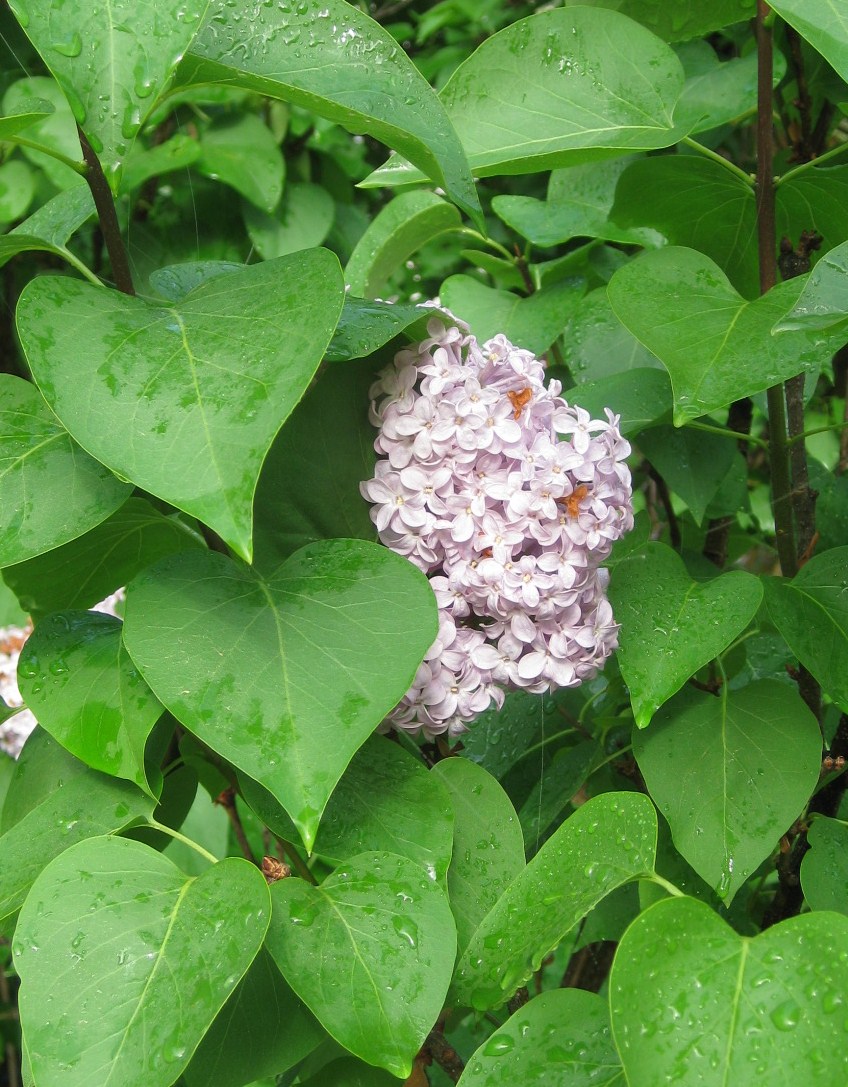
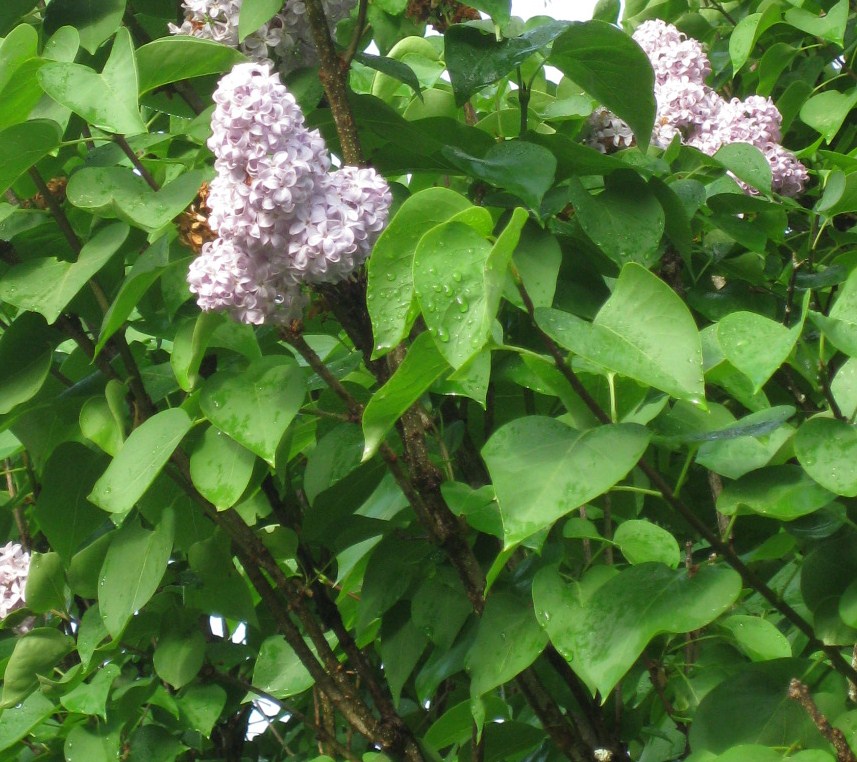
In the early spring of the first year we spent in our house, I noticed green buds emerging from the gray branches of the tall shrub by the front walk. I had wondered about the identity of this large and leggy plant. When I looked closely, I saw the beginnings of lilac leaves. Our new old house was blessed not only by eminent silver maples, but also by a mature, substantial lilac bush. This realization brought me a jolt of happiness more typically associated with an unexpected gift, such as one that arrives in a pale blue Tiffany box. Lilacs have a special place in my heart. Like the maples, they speak of home and loved ones.

Lilacs grew in great abundance around my grandparents’ house, the locus of my earliest and happiest childhood memories. Lilacs surrounded the area in front of the smokehouse and adjacent to the chicken lot. They created a leafy enchanted shelter, a cozy enclave where I liked to play with my grandmother’s kittens.

Atlanta is generally too hot for lilacs. I missed them, growing up in Georgia. For me, the lilac became a symbol of a time long past, alive only in memory and never to be repeated. I didn’t expect to live among lilacs again.

Then I moved to New Jersey, where lilacs, like peonies, thrive. My walks into Rocky Hill took me past a ramshackle former church in the center of town. Built in 1870 as a Methodist Episcopal church, by the early 20th century the building was known as Lyric Hall and used as a community theatre and concert space. I knew the place as the home of a dear friend with the unlikely, romance-novel-worthy name of June Bliss. For many years, June was the warm and capable administrator at the center of the art history department at Princeton University. To anxious grad students she was a calm and motherly presence.  To professors preoccupied with the esoteric details of research, she was a grounding force.

Lyric Hall became June’s home in the early 1970s. She rented out the old sanctuary as a warehouse and lived in a warren-like apartment that had been added to the back of the building in the 1940s. June’s girlhood home was a magnificent Gothic revival house near Princeton, where her sister continued to reside. It baffled me that after growing up in such an architectural gem, she was content with her quirky, cramped apartment. I always imagined how the church could be renovated into a striking, spacious, light-filled home. June probably could have easily afforded such a project, but she wasn’t interested. She was thoroughly without pretense, and her unusual living quarters suited her just fine. I think she enjoyed the surprise in the eyes of first-time visitors’ to her decidedly eccentric home.

The old church was set on an expansive piece of property that adjoined what had once been the town green. June had a large garden in the side yard, bounded by a towering hedge of lilacs. She was generous with her bounty of vegetables and flowers. She encouraged me to cut as many lilacs as I wished, which I gladly did, usually under the watchful eye of the neighbor’s hulking pot-bellied pig. Every spring, thanks to June, our apartment was filled with bouquets of lilacs, in addition to the peonies I bought down the road. On a return visit after H and I had married and moved south, June dug up forget-me-nots from her garden to send back with us.  I planted them behind our townhouse, where they are probably blooming still.

June was a cheerful person with a lively sense of humor and a keen appreciation for irony. She retained her sunny disposition in the face of the cancer that afflicted her for a number of years before finally claiming her life. I remember very clearly the warm summer day I went to the mailbox and found the kind note from June’s daughter that broke the news of her mother’s death.  D was very young at the time, and we had been playing in the yard together.  Seeing my sudden tears, she dashed over to comfort me.  Our lilac bush serves as a reminder that departed friends, as well as the essence of home and family, remain with us always.

This spring, though, I was dismayed that only one small lilac bloom appeared. For several years now, blossoms have emerged only at the very top-most branches.  June’s vigorous lilac hedge, in contrast, bloomed profusely, from bottom to top, for decades. When I asked if she had a gardener’s secret, she laughed and replied that she simply appreciated the plants and left them alone.  Our lilac evidently needs something more than admiration.  I’ve read that an aggressive pruning can reinvigorate an old lilac plant. We will get the shears out this weekend and go to work.

I recently discovered that upon June’s death, her home was donated to the New Jersey Historic Trust. The Trust sold it, with a preservation easement, to an architectural firm that restored the building to its original appearance and now uses it as their headquarters. The gray asbestos siding was removed, the original white clapboard restored and repainted. The arched windows were elongated to their full height and the sanctuary space’s soaring ceilings were restored. June’s old apartment was replaced with a bright and much larger one.

It’s remarkable to me that even though June didn’t care to restore Lyric Hall for use as her own home, she made it possible that others, later, could enjoy the beauty of the renewed historic building. It gives me hope for the rehabilitation of our tired lilac bush.  Lyric Hall flourishes again, a fitting memorial to its former owner, and I’m convinced our lilacs can, too.

KikoLucy043

001
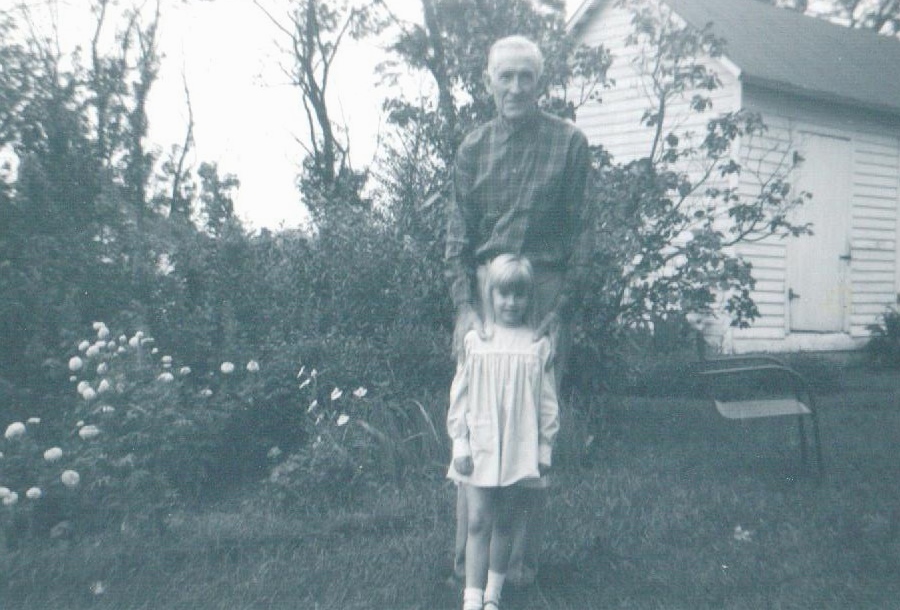
My grandfather and me, with lilacs behind us.

The Silver Maples Say Welcome Home

Maples0141

For the past two weeks or so, the seed pods have been falling from the big maple trees in our front yard. As the wind blows, they hit the roof with a sound like a shower of fat raindrops or forcibly hurled pea gravel. The tiny twirling helicopter blades drift slowly to the ground. Our daughter used to love to chase the flying seed pods. They gave my husband and me a welcome break from hands-on parenting. On warm weekend afternoons, we’d sit in cheap aluminum lawn chairs and watch her zigzag happily across the grass. We all still appreciate those spinning seed pods, despite the legion of tough little seedlings that spring up among the flower beds. We certainly love the trees that send them forth.

It was in the late fall, nearly eleven years ago, when we first saw our house. Most homes in our area date from the seventies through the nineties, and it stood out because of its age. Built in 1920, it was originally the center of a two-hundred acre farm. Unlike most northern Virginians, who apparently put a high value on new construction, I actively wanted an old house. I like the idea of a house with a past, with character, with some history behind it. Having watched my grandparents’ lovely old Victorian slip through our fingers, as well as the demolition of my grandmother’s birthplace, a far more historic dwelling, I wanted the chance to be a good steward of someone else’s family home.

I had all but lost hope of finding a livable old house, but suddenly we had stumbled upon one. It was a little shabby, and it had aluminum siding. But it was a genuine old farmhouse, a classic American four-square, with sizable rooms and a sensible floor plan. While it contained some dated 1970s touches, such as expanses of orange shag carpeting, it was solid and didn’t appear to need structural renovation.

And it had those wonderful trees, a semicircle of six huge trees that shaded the front yard. They were silver maples just like those that twisted their knobby roots through the soft grass at my grandparents’ house in Kentucky. Because it was late November, the branches were bare, but the shaggy gray-brown bark was as recognizable as the face of an old friend. This was the house! I was certain of it. The silver maples offered living proof.

Because my husband is a clear-headed man of business and science, he weighed all conditions carefully and made a low-ball offer on the house. I was anxious, nearly certain we wouldn’t get it, already formulating back-up plans.  Maybe that 1980s house (the one annoyingly referred to as an “executive colonial”) wasn’t so bad after all.  Or we could give up the search and spend another year in our rented townhouse.  But our daughter, a new walker, needed more space and a yard in which to roam.  I wanted an old house. I wanted the old house with the old maple trees. The one that just seemed like home.

Luckily, the prevailing local bias against older homes worked to our advantage. We managed to learn that our only serious competition was a developer whose goal was to tear down the house and build a bigger, newer one. Better yet, two. The owner, fortunately for us, much preferred that the house in which she had raised her children continue to be a family home. 

During the following December, matters concerning our purchase took off on a wild roller coaster ride. There were complications with the contract, concerns about the foundation, the floors, the septic system, the furnace, the roof, the crazy property lines, and more. During our Christmas vacation with H’s family in Rochester, he was on the phone constantly with building inspectors and legal experts. But by early January, the house was ours. Our realtor, who had decades of experience, claimed that the closing was the most dizzyingly complex one she had ever witnessed.

That winter, while H worked especially late, I often sat by an upstairs window in a rocking chair, holding our year-old daughter.  As she nursed, or slept, smiled or cried, I looked out through the somewhat uneven glass at the dark blue shadows the big maples cast on the snow-covered ground. It sure was good to be home.  And it still is. 

Maples008

Maples004

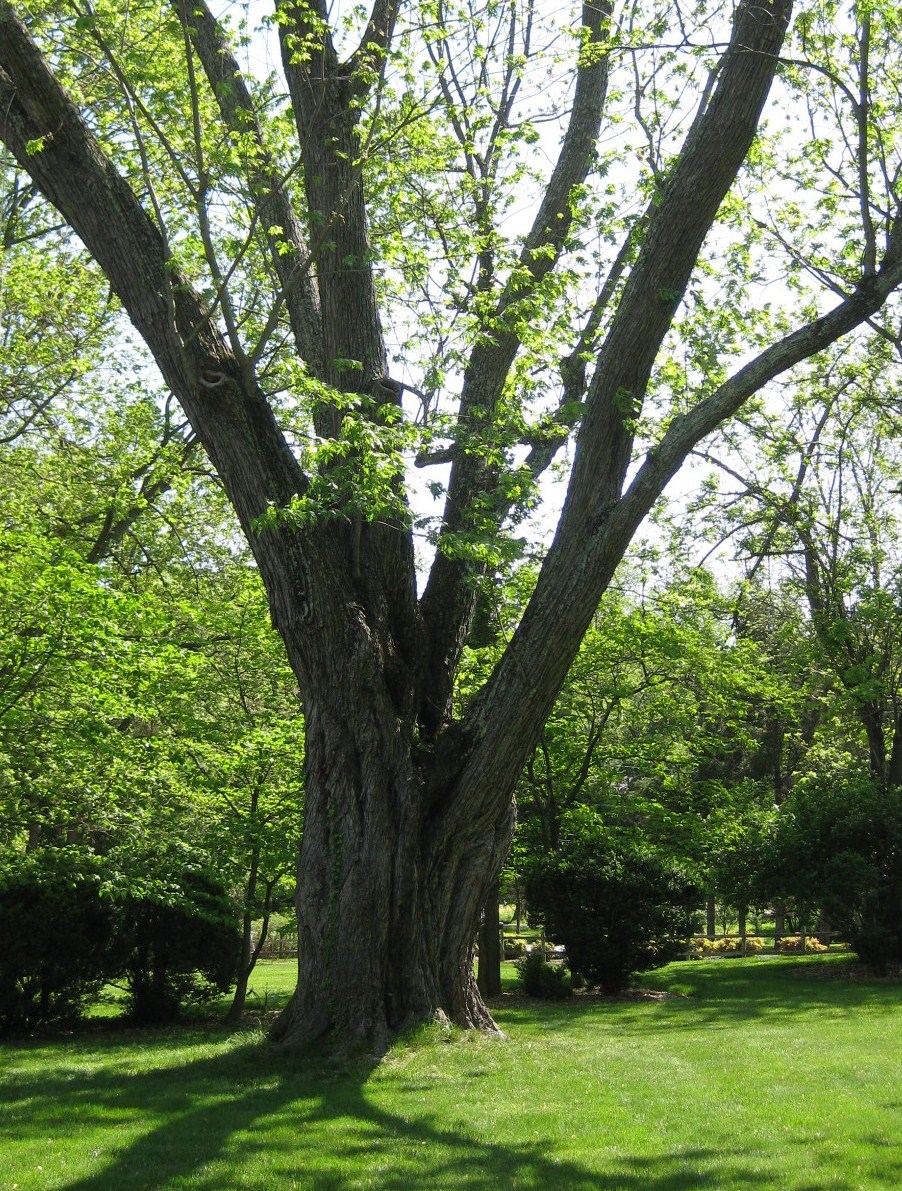
Silver maples are fast-growing trees with limited life spans. 
We had to remove this tree’s branches when they became fragile
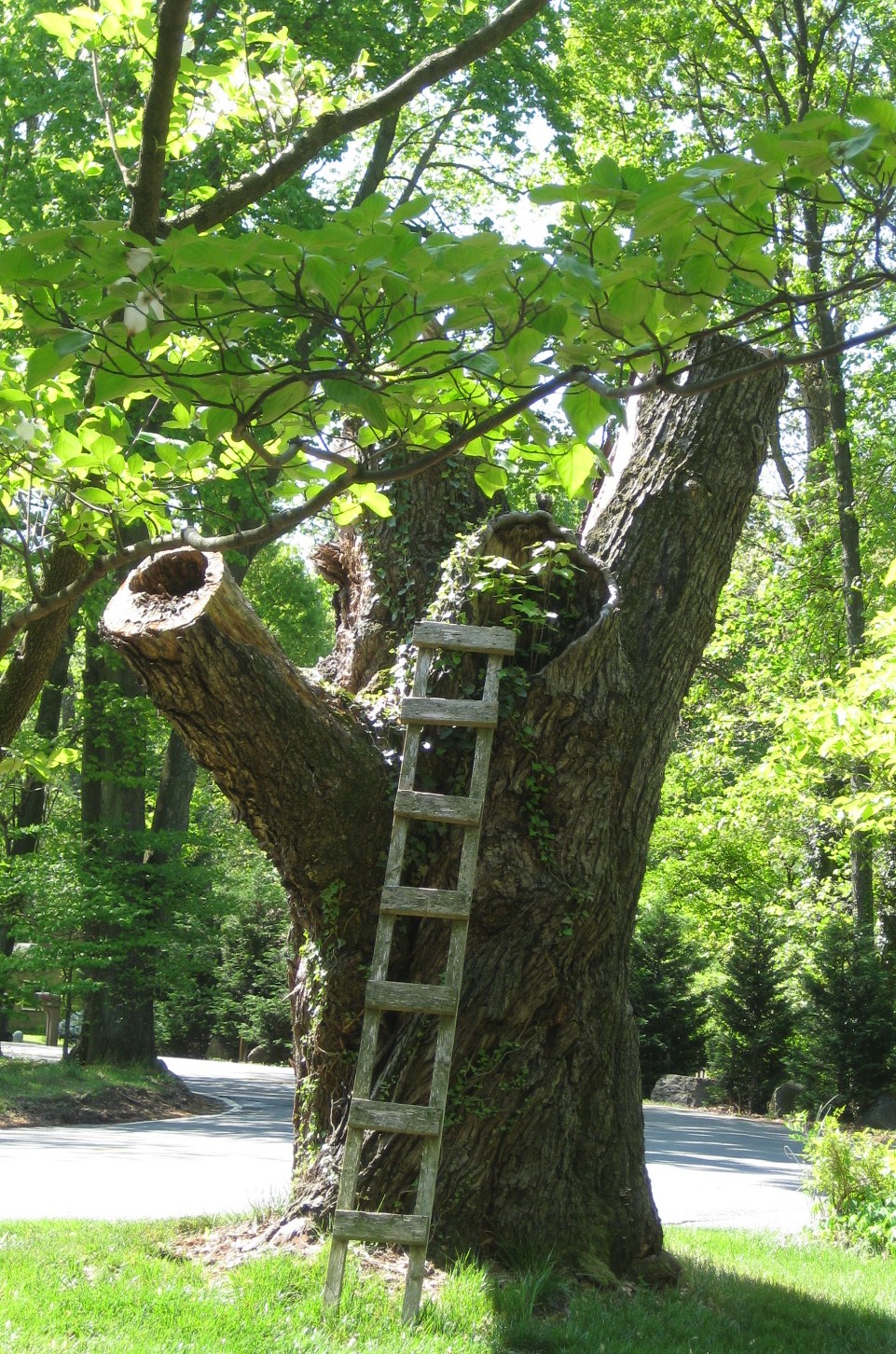
and hazardous to passing cars, but we left the trunk as a monument.  Our daughter occasionally uses it as a place of solitary refuge.

0561

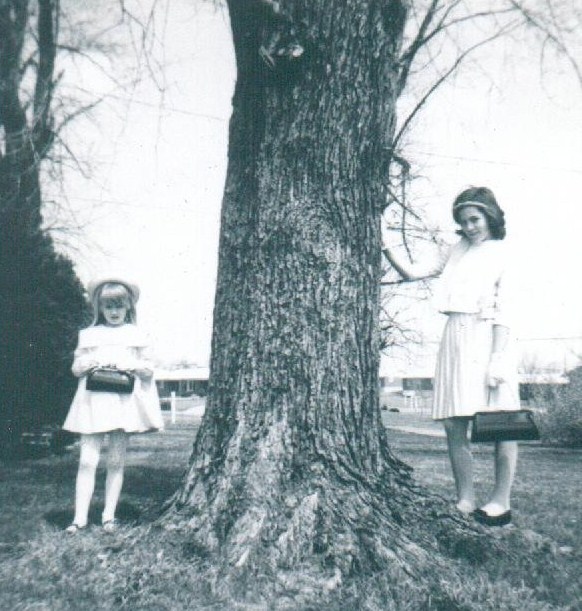
On an Easter Sunday in the 1960s, my friend Jeanie and me
beside one of the silver maples in my grandparents’ yard.

The Hunger Games: A Movie Event for my Daughter

Just as I was bemoaning my daughter’s dearth of memorable movie experiences, she was invited to a birthday party to see The Hunger Games on its opening night. This is great! I thought. She can learn to love going to the movies, and I am not inconvenienced. My parents must have felt a similar degree of relief when I went to Disney World with our church youth group. My husband and I are in complete agreement that opening-night showings of eagerly anticipated potential blockbusters are firmly in our past. I was excited that D had the chance to participate in a true film event. I also looked forward to a pleasant, quiet spring evening at home. Maybe a couple of drinks on the porch with H.  How nice for everyone.

D, ever the skeptic, has a tendency to cast a cool and wary eye on many, if not all, trends in pop culture. It pleases me immensely that she doesn’t follow, willy-nilly, the noise of the crowd. She was especially suspicious of such tween phenomena as Hannah Montana, the Jonas Brothers, High School Musical and Justin Bieber. I think she imagined a vast adult conspiracy to control the tastes of her peer group, and she resented it.

She was unmoved by the prospect of the Harry Potter saga, even though H’s grandmother gave us all the books in the series (after enjoying them herself). I read most of the first book to D when she was in third grade or so. Toward the end, during Harry’s confrontation with Voldemort, her interest waned. The situation was too tense for pleasurable before-bed reading. She resisted when I suggested afternoon readings, and so the book remained unfinished. We saw the first movie several years after it appeared, at home on DVD. With that, her tepid interest in Harry Potter was quenched.

As for Twilight, it sounded ridiculous, according to D. Having been raised on horror stories, I was curious to see what the fuss was about, so I bought the books. After finding the first one more satisfying than I had expected, D read it and gave it a lukewarm review. She felt no need to continue with the next volumes or to see any of the movies.

My daughter was no more interested in The Hunger Games series for several years. Children fighting to the death? Really? How truly horrible!  I agreed with her. It sounded like something best avoided. But as the hype surrounding the movie gained momentum, and as friends she respected spoke of their enjoyment of the books, she cracked. When a friend lent her the first book, she began reading. She loved it, she was surprised to admit. The opening night birthday party gave her a deadline, and she stayed up late finishing the book.

The family of the birthday girl has continued to eagerly embrace the movie-going tradition. I admire their zest and stamina. They took their girls to all the Harry Potter films, typically on opening weekends, many at midnight showings, frequently in costume. Once at a neighborhood party, the mother told me that she and a friend had attended a weekday 1 AM opening of Sweeney Todd. Despite being exhausted at work the following day, it was worth it, she said, clearly elated. I can only vaguely remember a time when I might have felt that way.

D’s first real movie event was a great success, thanks to the enthusiasm of her friend and her parents. The theatre was among the newest and most comfortable in our area. The screen is quite large by today’s standards, and the seating is stadium style. Even if an incredibly tall person sporting a top hat occupies the seat ahead, it’s still possible to see the action.

Thanks to our twenty-first century technology, I got a play-by-play report of the evening. The texts arrived with regularity:

  • In theatre. It’s sold out!
  • Just saw 3 other friends here!
  • Preview for Dark Shadows!
  • It’s starting!

At this point, there was a break, I’m glad to say, during which she actually directed her attention away from her phone and toward the screen. I can imagine the rows of young teenagers putting their phones to sleep and raising their heads in unison. The final film-related text was this:

  • The movie was awesome!

The Hunger Games ended my daughter’s long stint as a reluctant movie-goer. I doubt it will result in her unconditional acceptance of every teen trend to come. She has, however, already expressed an interest in seeing Titanic 3-D with friends over spring break. I bet she’ll be up for Dark Shadows, although she may no longer want me to tag along. If so, Mama will go with me. That’s the thing about mothers—the good ones never get too grown up to be seen with their children.

Hunger Games 005

Finally, a young-adult phenomenon that my daughter endorses.

Movies with Friends: From Frogs to Rocky Horror to Toco Hill

During my late elementary and middle school years, as now, a movie was a frequent element of the tween and early teen birthday celebration. The unintentionally funny horror film, often on the theme of nature’s revenge, was prevalent in the early 70s and perfect for group viewing. Such classic B movies, silly, clumsily cobbled together, yet still scary, wouldn’t have had the same impact had we been sitting around the TV in the cozy safety of a family room.


I think it was for my friend Katie’s birthday that we saw Frogs. It was playing in one of the increasingly faded theatres in Virginia-Highland. The movie poster shows a bloody human arm protruding from the mouth of a frog. Its breathless text reads:

If you are squeamish stay home!!! Cold, green skin against soft, warm flesh!  A croak, a scream. . .FROGS. The day nature strikes back.

The human villain of the story is the haughty patriarch of an old Southern family, eager to celebrate his July 4th birthday at his sprawling mansion nestled uneasily in the oozing spookiness of the swamps. Ray Milland plays Grandpa, as he is called by everyone. Fed up with the overabundance of icky, cold-blooded creatures that call the family property their home, Grandpa hires a man to saturate the surrounding landscape with pesticide. This, of course, does not sit well with the slime brigade, and lots of gruesome death ensues. Despite the movie’s title, frogs do no killing. They merely croak and look vaguely, disinterestedly malevolent. Snakes, lizards, alligators, leeches and spiders are among the many creatures that exact horrifying vengeance on the humans who have the nerve to try to move in on their domain.

Once the critters began to seek retribution, my friends and I huddled two to a seat, for better moral support. Sitting in darkness, surrounded by other shrieking kids our age, the experience was akin to a thrill ride at an amusement park.

We loved this kind of movie, in which most of the human characters are so proud, self-absorbed, or just plain clueless that one tends to root for the animals. The creatures, of course, were there first; it is the people who are interlopers. And like the rat army in the film Willard (for which the young Michael Jackson sang the theme song, Ben), from the year before, the fauna of Frogs were disdained and misunderstood. Their voices needed to be heard. They deserved respect, if not revenge.

Around this same time, we enjoyed another movie with a swampy setting, The Legend of Boggy Creek. It was a docudrama based on sightings of a smelly, hairy Bigfoot-like figure in the remote Arkansas woods. The film attempted a serious tone, which made it all the more laughable to us. Again, we empathized with the creature, whose existential angst was nicely expressed in his unnerving screeches. The rag-tag community of humans that inexplicably made their home in this marshy wilderness did not appreciate the beast’s sporadic appearances and attempts to dine on their pets and livestock. In an attitude common to city kids, we considered ourselves superior to our country counterparts, and the bog-dwelling Arkansawyers on screen were no exception. Yes, we were Southern, but not that Southern. We knew to avoid the double negative, and our accents sounded positively Yankee in comparison. Had anyone reminded me of my rural Kentucky roots, I would have pointed out that my family had the foresight to settle on higher ground.

During our high school years, more and more of Atlanta’s large in-town theatres closed. We continued to flock loyally to those that remained. On weekends we gathered, with crowds of other teenagers, at Garden Hills or The Plaza for midnight showings of Up in Smoke and Rocky Horror Picture Show. This was festive movie-going at its most social, its most raucously, gloriously communal.

The multiplex became more prevalent as the older theatres disappeared. When it was convenient, or for lack of anything better to do, we attended showings in such box-like rooms, the screens hardly larger than some of today’s TVs. A movie like Halloween, which appeared in 1978, was good fun, even at the multiplex. My eagle-eyed boyfriend still managed to note every inadvertent intrusion of the microphone.

My regular movie attendance in Atlanta ended at Toco Hill. Among all the cramped cinema spaces in the city, for years there still survived this 800-seat theatre in a suburban strip mall. Tickets cost just $.99. One needed only to wait a week or two, and nearly every major release came to Toco. Weekend showings filled to capacity, and every age group was well represented. Closed in 2000, the theatre may soon be the site of a bagel company. I hear Atlanta has been an absolute bagel wasteland.

The Plaza, though, now the last of its kind in the city, is still in business. And it still hosts Rocky Horror nights.

0023

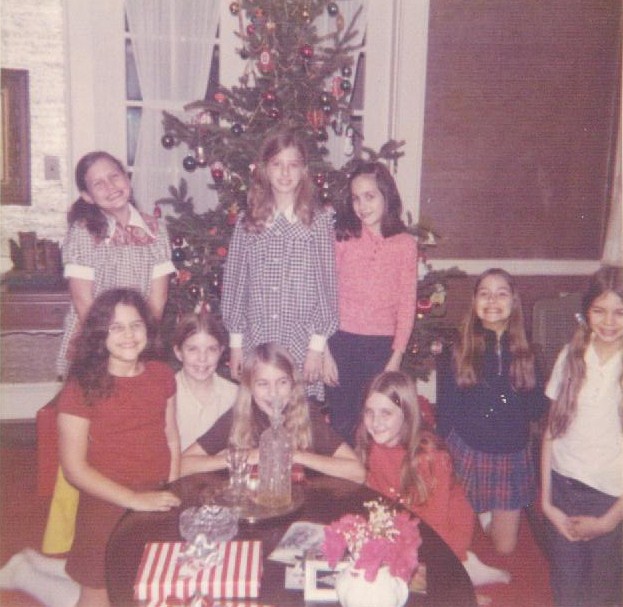
Some of my movie-viewing pals and me,1972.
Apparently, during several years in the 70s, we only
took photos around Christmas time.