All posts by Wildtrumpetvine

Little White Lights, for the Season of Light


House lights 006

I prefer to avoid overhead lights whenever possible.  They  scream institution: school, office, hospital, the DMV, and perhaps worst of all, the department-store fitting room.  They drone on of chores and unpleasantness.  Best to use them, I believe, under only three circumstances:

  • 1.  To quickly (and briefly) illuminate a dark room upon entry (to avoid falling over the dog or some misplaced, unexpected obstacle).
  • 2.  When cleaning, as in vacuuming, scrubbing floors and dusting.
  • 3.  In case of emergencies.

Nothing makes a room or its inhabitants look sadder and more forlorn than a ceiling light casting its cold and dismal glow.  The light is either too harsh or too dim.  The angle is all wrong.  I suspect there are untold numbers of people unwittingly suffering a diminished quality of life because they persist in flicking on the overhead switch, and leaving it on.  

Were they to employ a decent-looking table lamp instead of the ceiling light, a space that once appeared mournful and dejected might become cozy and pleasant.  They might find themselves inexplicably cheerier.

I’ve acquired lots of lamps over the years, mostly at flea markets, yard sales and antique stores.  Others were gifts from my mother, from whom I acquired my distaste for ceiling fixtures.  Our house probably has too many lamps.  In December, some of these are relegated to the basement.  Christmas demands a softer, warmer, more festive glow than most lamps can offer.  The outside of our house gets its special holiday treatment, and the inside is not neglected. 

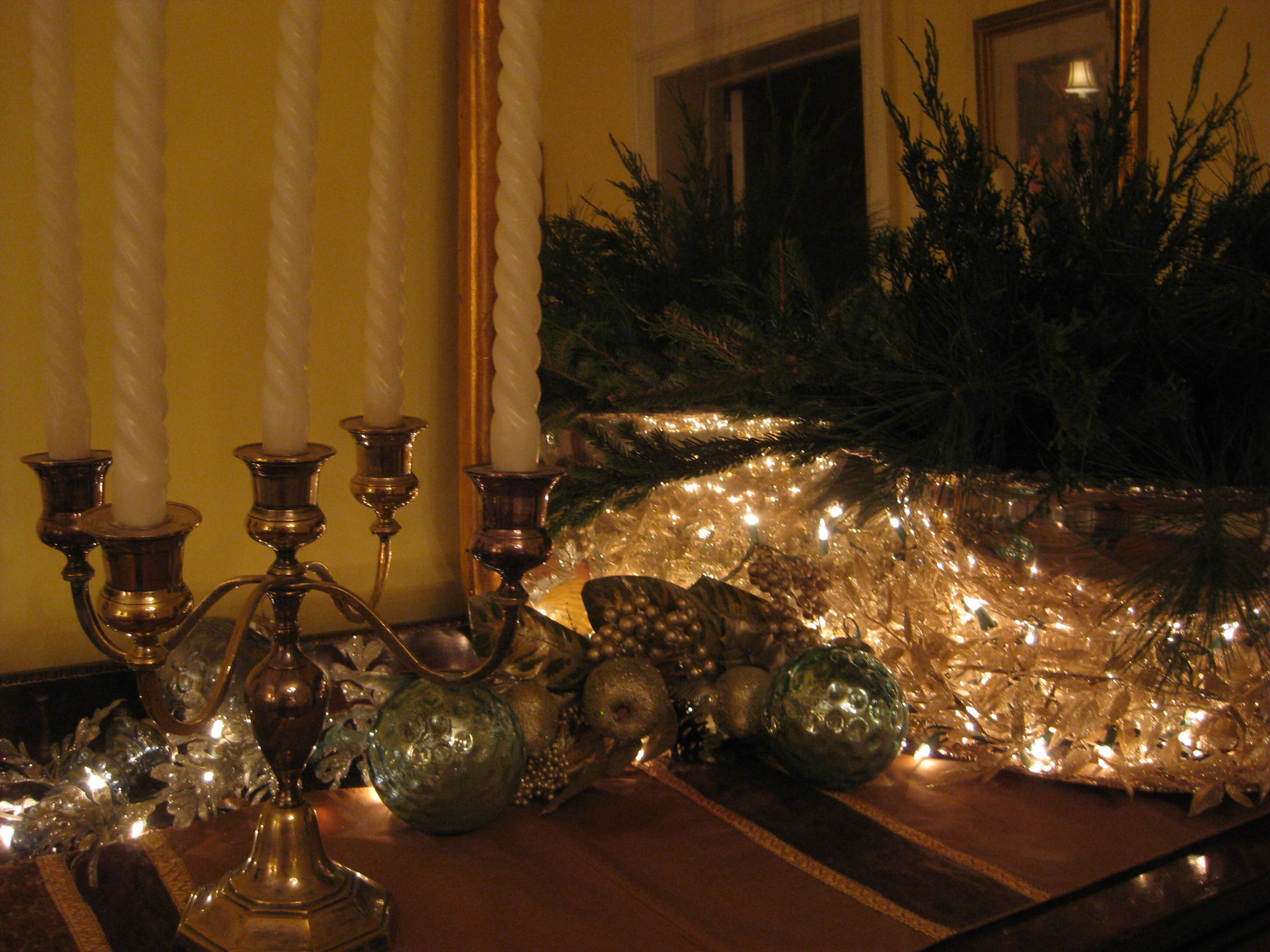
During the Christmas season, the optimal sources of interior illumination, I believe, are strands of small clear white lights.  To some degree, they mimic the effect of candlelight.  Yet compared to candles, they involve considerably less mess and threat of fire.  I discovered the charm of such lights one year as we were preparing for our annual holiday party.  Now we decorate for the party and keep the lights up through Epiphany, January 6. 

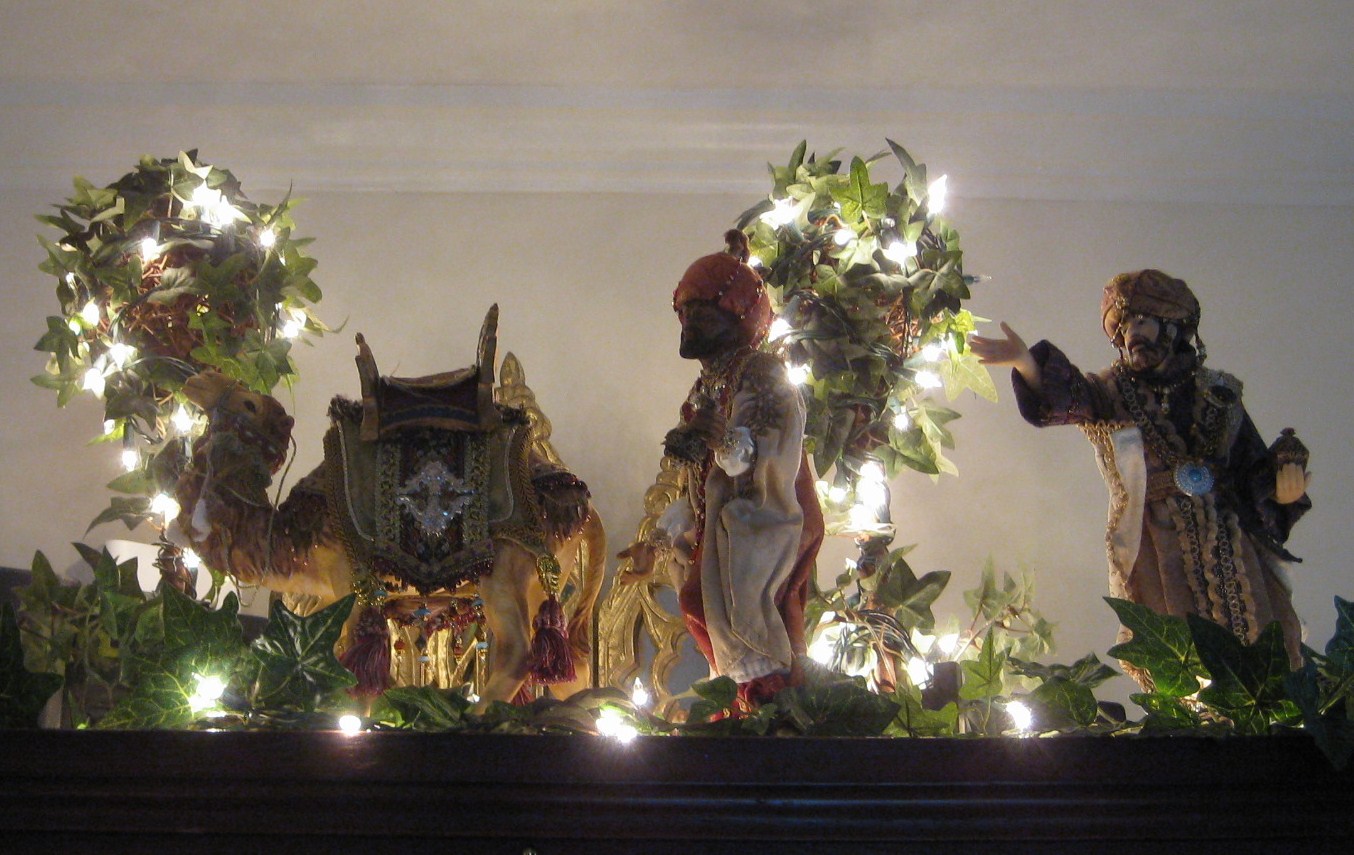
White lights peek out from the ivy at the feet of the large nativity figures occupying the tops of the TV armoire and the adjacent bookshelves. They’re entwined in garlands on the stair banister, atop the secretary in the living room, the sideboard in the dining room, and sometimes on top of the piano.

They adorn our big Christmas tree in the living room, typically a blue spruce.  In the first years of our marriage, before a child came along to distract me, I spent the better part of two days wrapping nearly every branch with lights, for a total of about 1,300.   Now, I lack the time to be so obsessive (at least in that regard). 

White lights decorate our several small artificial trees, like the alpine trees above in the dining room. ( I found that one of these trees alone appears bedraggled and pitiful, but a grouping of three is just right.  We hang our homemade pinecone and cork creatures, pasta and seashell angels on these trees.  See posts from December 2011.) 

Around 5 PM each evening, as the winter night settles in, I start plugging in the many strands of lights.  (Unfortunately my husband has not developed a one-switch system, as he has with the electric candles in the windows and the exterior spotlights.)  Our rooms begin to glow, as if enlivened by tiny stars.  I am reminded that we are in a special season, a time when we focus on the miraculous light that God sent to shine in our dark world. 

Nativity 006

The manger scene atop the bookshelves.
Nativity 003

The nativity figures are so large that the magi and their well-dressed camel occupy the armoire on the adjacent wall.
Sideboard 002

White lights add a warm glow on the dining room sideboard.
Lighting up the Night for Christmas

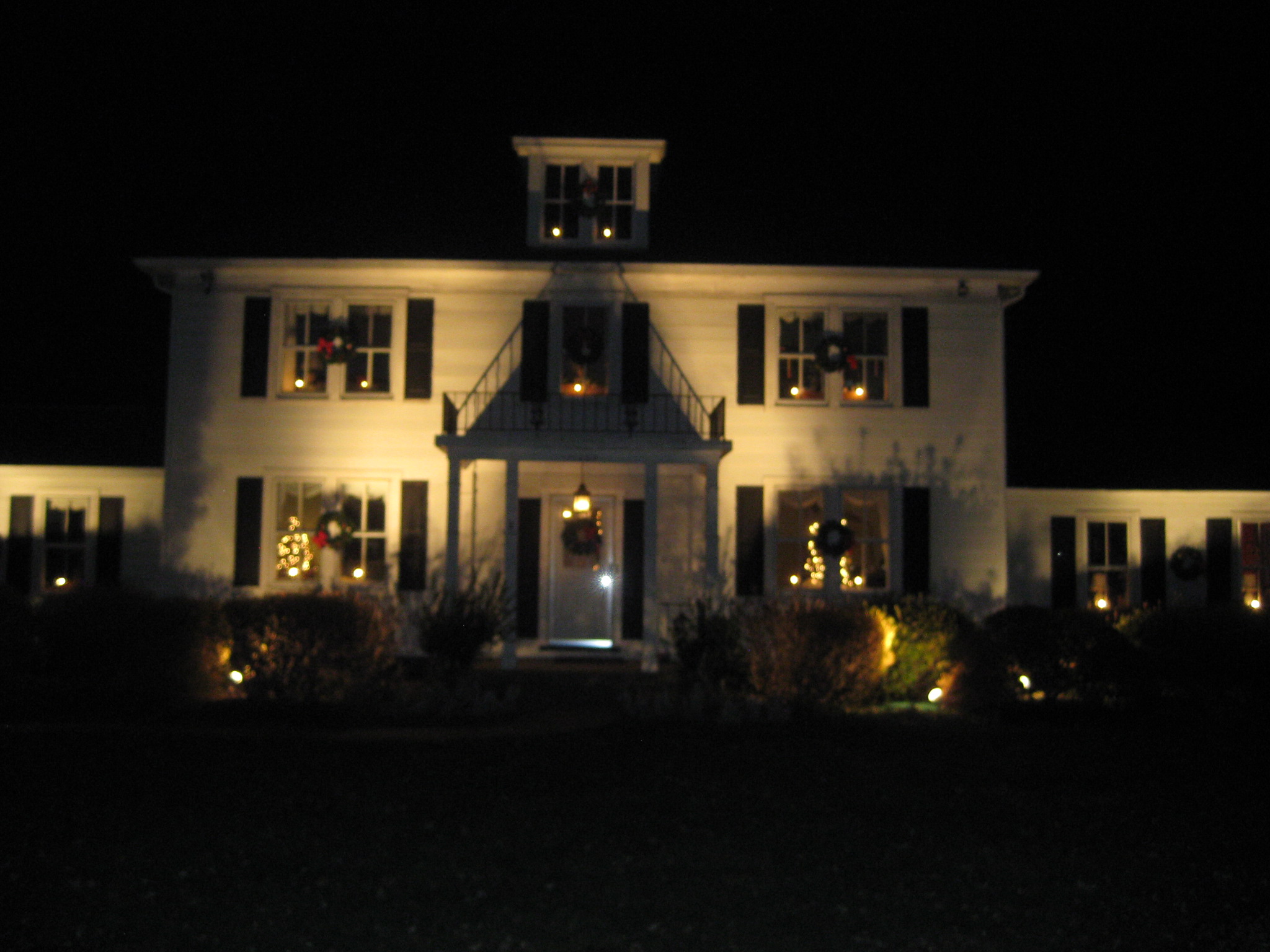
One of the things I love best about the Christmas season is the chance to light up the darkness with light. My husband and daughter feel the same way.  Like Clark Griswold in National Lampoon’s Christmas Vacation (which we watch every year), H has a vested interest in exterior illumination, although he takes a somewhat more subdued approach. There is no stapling of a thousand strings of lights to the roof, no plastic Santa and reindeer; only some carefully placed spotlights and a candle in each window to highlight the wreath above.


During the day, it’s evident, at least under close scrutiny, that our home has many needs: it needs painting and new siding. We really should do something about the windows at some point.  (But I like the old, wavy glass from 1920, as well as those costly to replace “true divided lights.”) None of this matters, though, as dusk falls every evening in December.  With the click of a switch in the basement, the house gleams newly white and clean. Instead of highlighting flaws, the light, like the true light of Christmas, makes them disappear.  All dreariness, all weariness, is erased. The effect is simple and pretty. One month each year, we get to live with light in the darkness. And we decide, yet again, that no home improvements are necessary for a while.

Christmas house 002

A Thanksgiving Pig (in Turkey’s Clothing)

Thanksgiving Pig 003


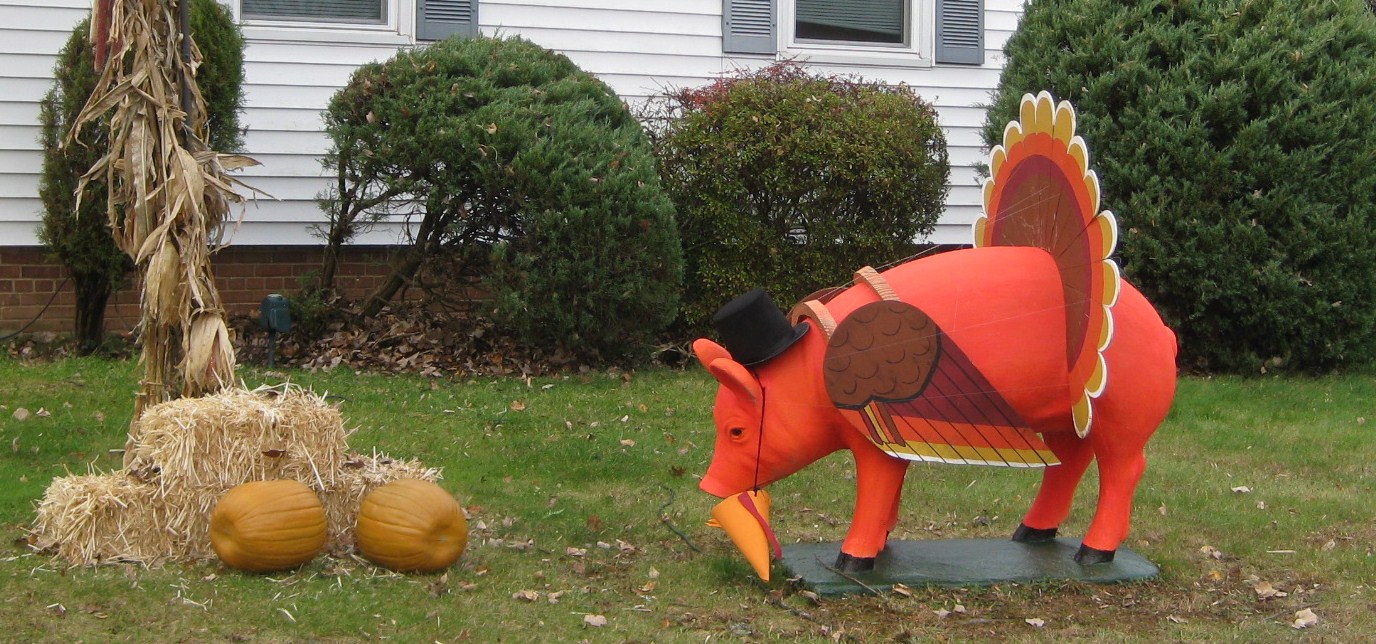
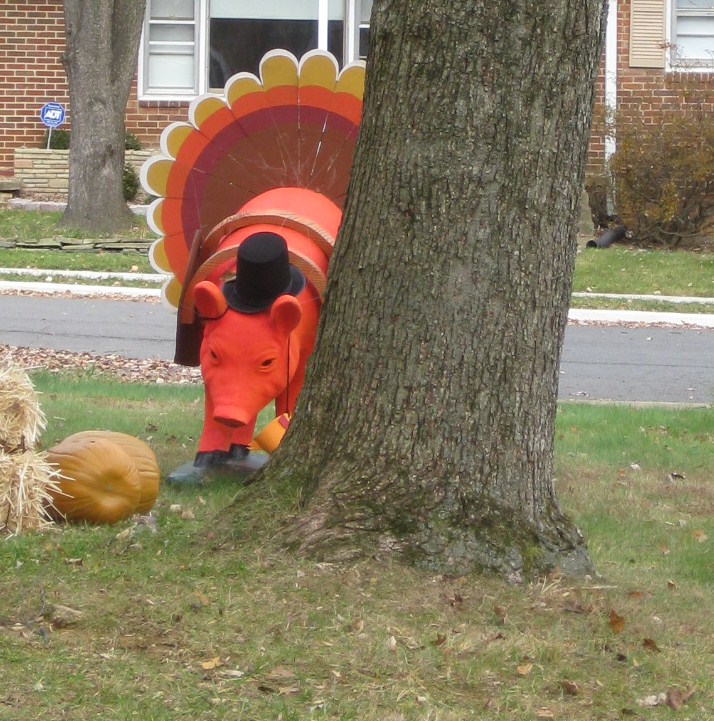
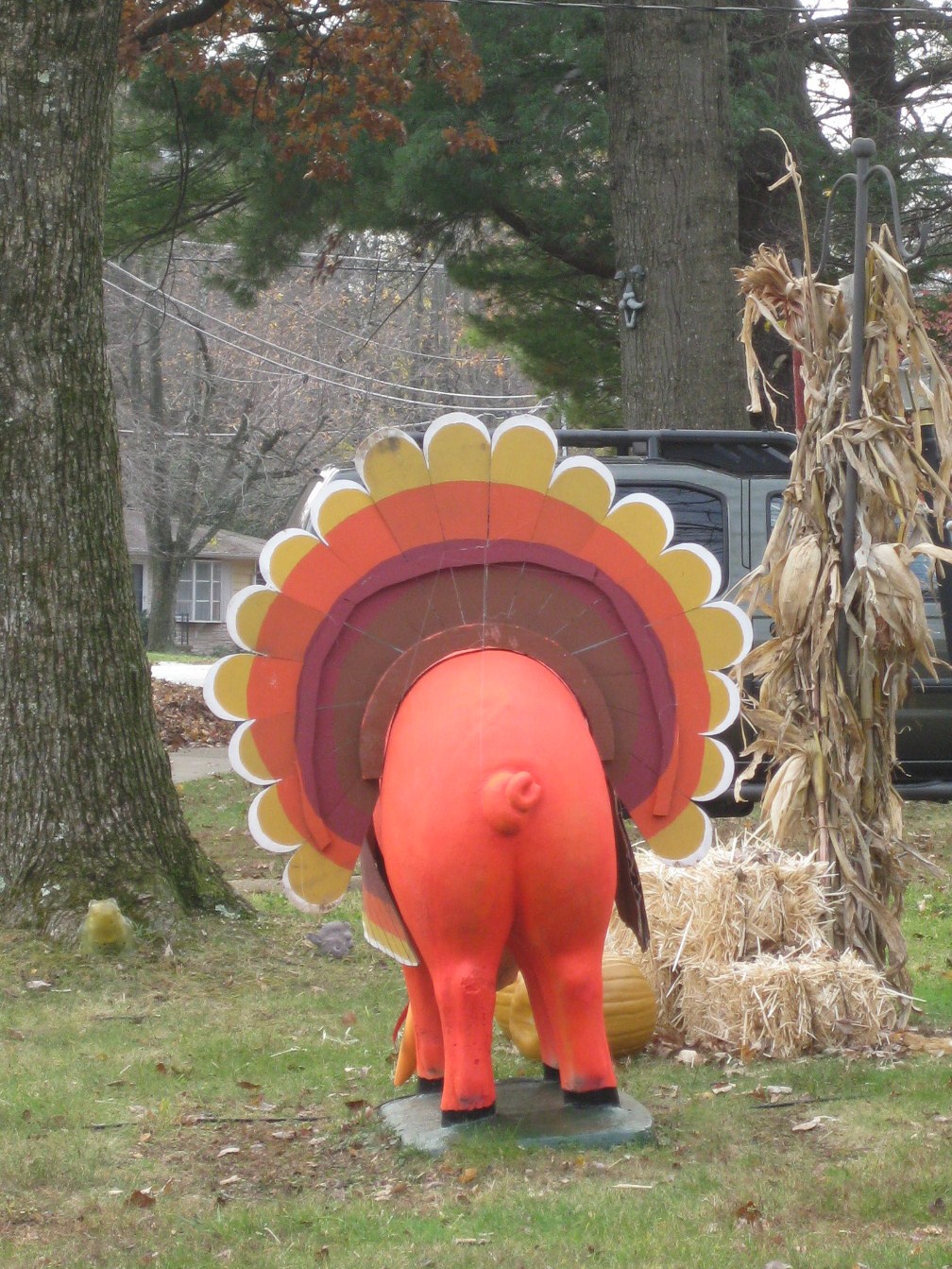
Whimsical, folksy yard art is rare in the suburbs of Northern Virginia.  This sizable, traffic-cone-orange concrete pig that presides over a small residential front yard is therefore all the more unexpected.  Kiko and I discovered the porkturkey last fall when we were walking in an unfamiliar neighborhood.  I laughed out loud, and my little dog was exceptionally suspicious, even warier than he has been of his earlier nemesis, the decorative scarecrow.

In November, as Thanksgiving approaches, the pig dons turkey feathers and a pilgrim hat.  Its beak is partially unfastened, as though to allow for easy snacking.  I have seen the pig without the turkey disguise but not in other apparel.  This year I plan to check on it as various holidays near.  May we expect a Santa pig next month?  A leprechaun pig for St. Patrick’s Day, a bunny pig near Easter?  Has Porky recently shed his Halloween costume? Is he always quite so orange? I will report back as the seasons change.  Meanwhile, I hope you enjoy this cheery, unconventional Thanksgiving pig as much as I do. 

Thanksgiving Pig 001

Thanksgiving Pig 005


November Woods

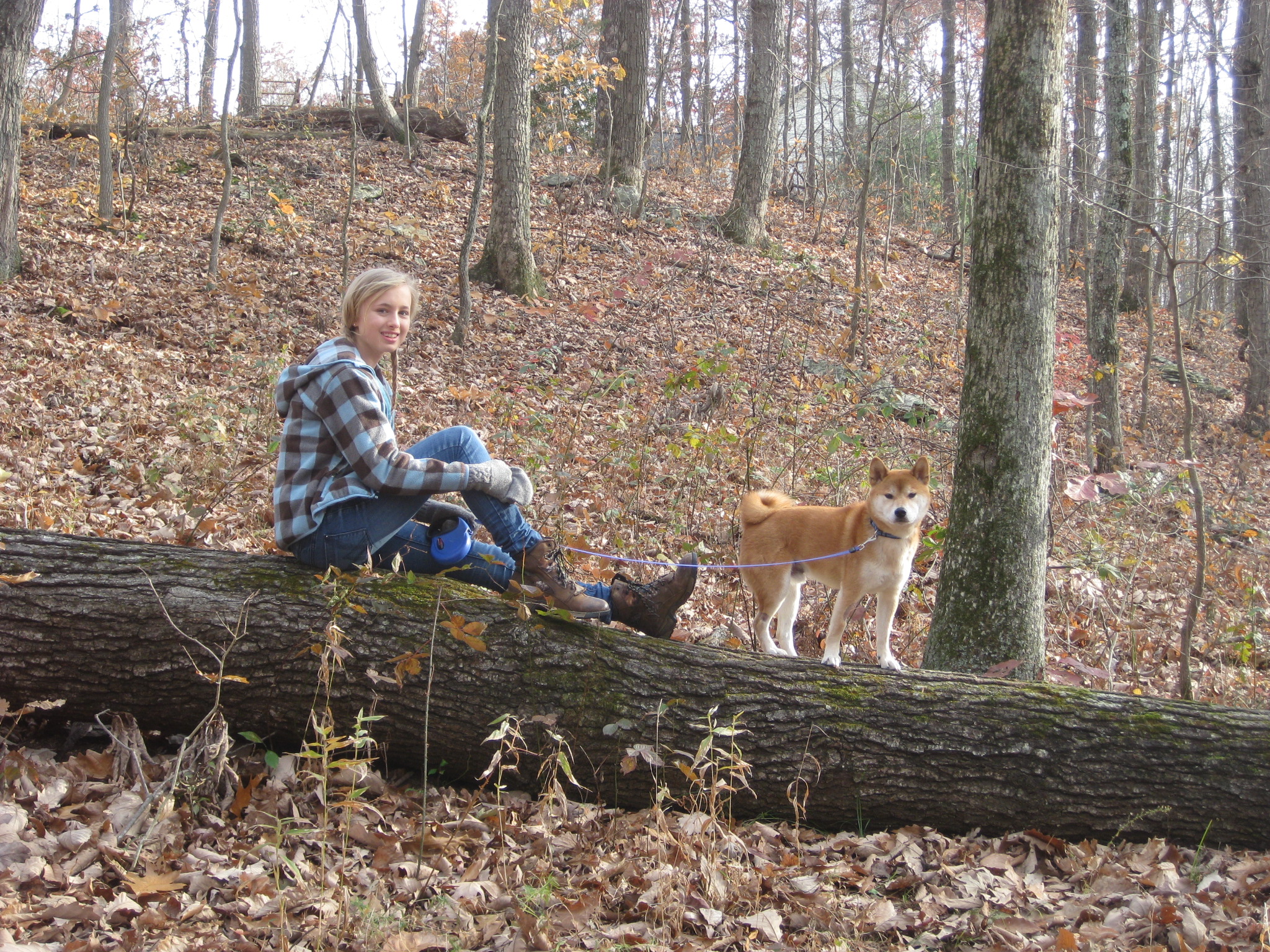
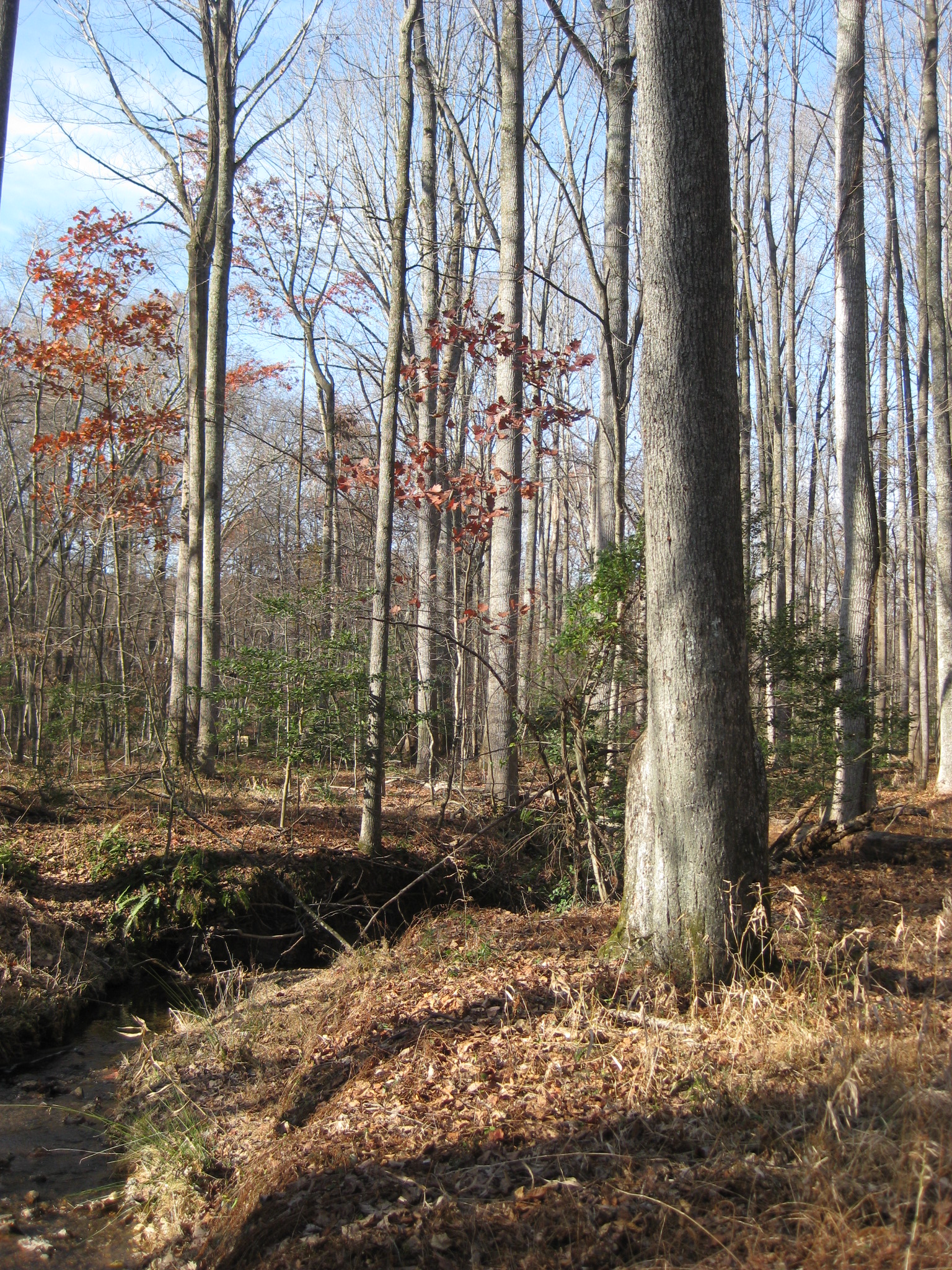
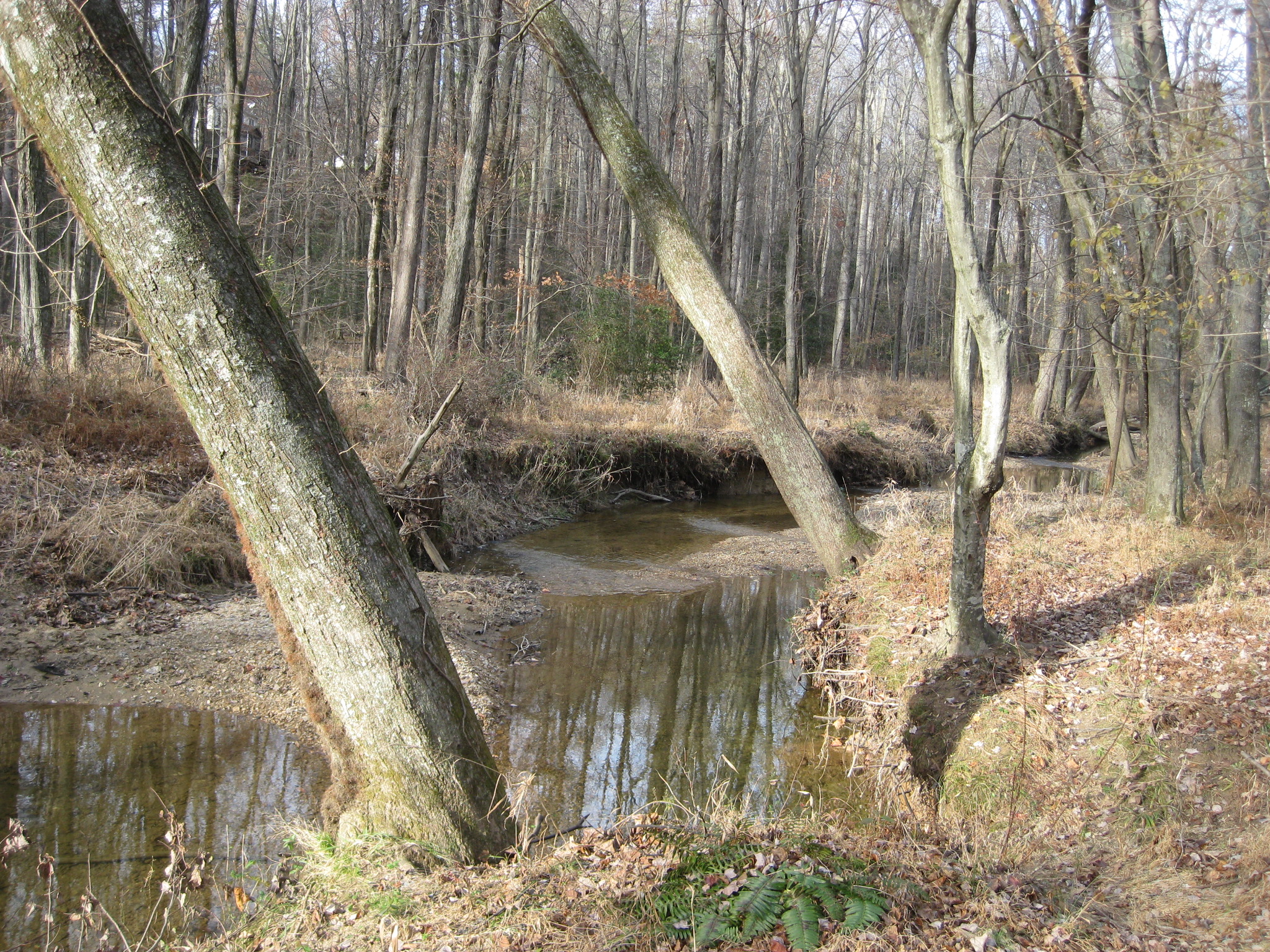
While there is no denying the bright glory of mid-October foliage, I find the muted palette of November equally beautiful in its own way.  After most of the leaves have fallen, our neighborhood woods wear their subtle winter tones of gray, beige and brown.  The few remaining autumn dashes of orange, flame-red and green stand out like colorful stitching on a sensible tan tweed jacket.  On this day, the leaves were so deep that the familiar path was hidden.  Kiko, however, our sure-footed guide, knew the way by smell. 

Woods II 001

Novemberwoods032

Woods II 007

Novemberwoods022

Novemberwoods010

I like the star-like shape formed by the core of this fallen tree’s roots. 

Woods II 015

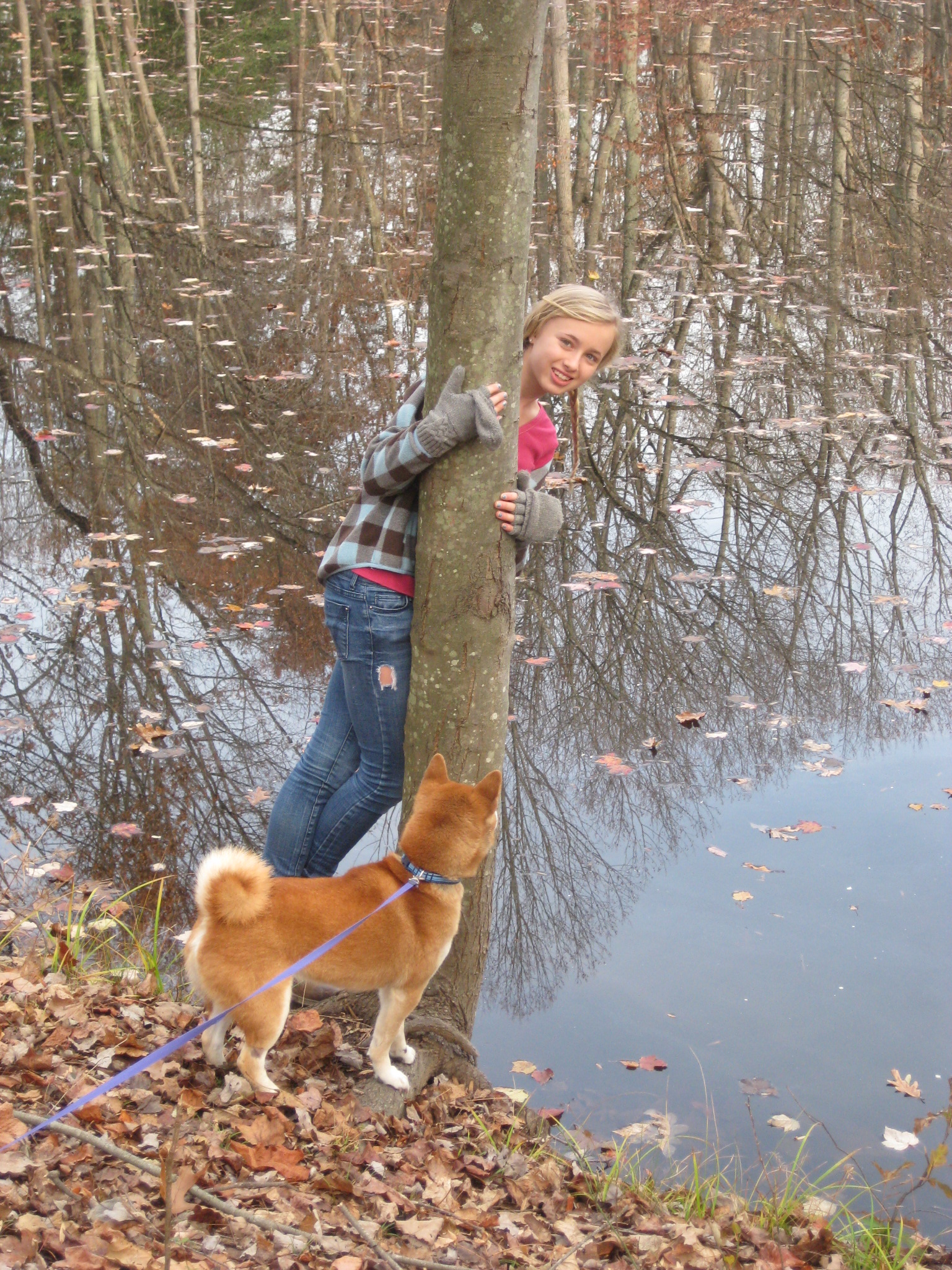
D and Kiko on the banks of the hidden lake.

Remembering Gudmund Vigtel of the High Museum of Art


001
The High Museum of Art, August 1985.

My friend and former boss Gudmund Vigtel died last month at the age of 87.  For nearly thirty years, Vig, as he was generally known, was the face and guiding force  of Atlanta’s High Museum of Art.  He became the museum’s director in 1963, when it was a fledgling institution in a provincial backwater, housed in a nondescript building adjacent to its first home, the Peachtree Street mansion of the High family.

Vig led the High through two pivotal periods of extraordinary growth.  In June of 1962, 106 of Atlanta’s most prominent arts patrons, returning from a museum-sponsored trip to Europe, were killed when their plane crashed on take-off at Orly Airport in Paris.  Since Atlanta’s founding in 1836 as Terminus, the end point of a railway hub, its citizens have tended to value business over culture.  But they are a resilient lot, determined not to be bested.  The Orly tragedy, like General Sherman’s burning of the city during the Civil War, inspired a deeply felt resolve to regroup and rebuild, bigger and better.  Gudmund Vigtel, then assistant director at the Corcoran Gallery in D.C., was hired to head up the new, expanded arts facility to be known as the Atlanta Memorial Arts Center.

Vig must have stood out as a cosmopolitan, dashing European figure in the Atlanta of the early 60s.   Born in Jerusalem to Lutheran missionaries from Norway, he had lived in Vienna and Oslo before his family fled (on skis, as I’ve always heard) from Nazi-occupied Norway into Sweden.  But Vig had Georgia ties as well.  Having studied art in Sweden, he received a Rotary Scholarship that first took him to a small college in north Georgia.  It was not a good fit.  He recounted how he spent lonely afternoons sitting on a big rock, asking himself, Why am I here? Before long, he managed to transfer to the Atlanta College of Art, where the more urban environment suited him better.

I met Vig during the second pivotal period of his  tenure at the High.  During the 1970s he became increasingly convinced that his museum was still too small. When, in 1977, the blockbuster King Tut show bypassed Atlanta for New Orleans because the High lacked sufficient exhibition space, it was clear that Vig was right.  He launched an impassioned campaign for a considerably larger and more striking building.  Despite the board’s initial preference for a local architect, he managed to persuade them to choose the as yet unproven Richard Meier of New York.  Meier would go on to to design the Getty Museum in Los Angeles and to win the Pritzker Prize for architecture.

I had the  good fortune to work for Vig as Secretary to the Director during the High’s first two years in the new Meier facility.  (There are, of course no secretaries at the museum now, or perhaps anywhere; they have been promoted to other titles, if not in salary.) Thanks to my dentist, a family friend, avid art collector and museum patron, I learned about the job opening.  It was the summer of 1983, and I had just graduated from UGA with a degree in Art History.  I was coming to terms with the realization that this was, as I had  suspected, hardly a golden key to a lucrative or, perhaps, any career.  Luckily, I could type.  I applied at the High.  I wasn’t hired; there was a better, faster typist.  About three weeks later, I got a call from the museum.  The other applicant hadn’t worked out, for various reasons. When Vig had referred, for example, to the artist Botticelli in his dictated letters, this secretary had repeatedly transcribed Buddy Chelly.  Was I still interested?

The postmodern Meier building, its undulating facade clad in white enamel tile, was due to open that October when I began work in July. The offices had just moved into the new quarters, but the galleries and atrium remained unfinished.  Heavy plastic sheeting kept some of the dust out but did nothing to diminish the loudness of the construction noise. The pace of construction was quick and constant, and it only added to the excitement of working at the museum.  I loved my front-row seat in the living theatre that was staging the airy new building’s completion.  And I soon became fond of my boss and the rest of the museum staff.

Many of us spend our lives knowing and regretting that we have not yet hit upon the perfect career fit.  Vig found his, it would certainly seem.  He had a broad knowledge and true devotion to art of various genres and styles.  But he lacked any trace of pretense or conceit; he bore no resemblance to the stereotypical artsy intellectual.  Not a single aspect of the life of the museum was beneath him, and he was apparently tireless.  What’s more, Vig had a real  gift for the human connection; he was thoughtful, warm, empathetic, funny and charming.  He inspired the best in every staff member, and we held him in high regard.

As Vig’s dramatic vision for the new building was nearing completion, it was a heady time to be part of the HMA team. The museum opened on schedule in October, with a dizzying flurry of celebratory events  held in the soaring central atrium.  Vig treated his staff with the same respect and courtesy as the most generous or sought-after patrons.  HMA parties were equal-opportunity events.  Security guards danced with curators; art handlers and secretaries rubbed elbows with Atlanta’s civic leaders and the occasional celebrity.  Vig was always there at the heart of the party, like a joyful father of the bride, surrounded, in his elegant home, by those he loved best.

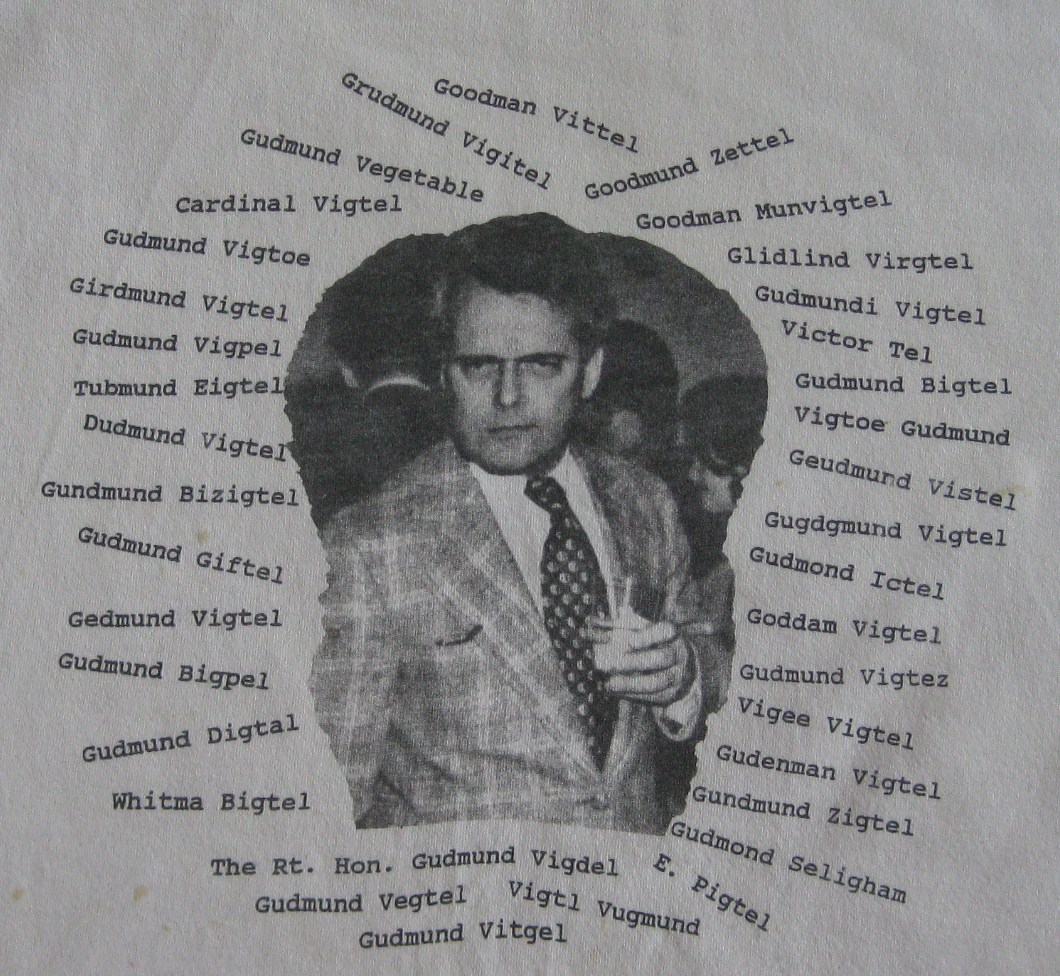
Vig’s oddly spelled Norwegian name confounded most homegrown Southerners.  Yet its pronounciation was straightforward:  Good mund Vig tel, with the accent on each first syllable.  I was amazed by the vast volume of unsolicited letters (many of them very strange, to say the least) that the museum received.  The majority of these erred comically in the spelling of Vig’s name. They variously addressed him as Gudmund Viglet, Gudmund Vigtoe, Goodmood Vigel, Goodood Wigtel and even, somehow, Tubmund Eigtel.  Vig never took himself too seriously, and he found these permutations as amusing as I did.  He also laughed and reassured me when I realized, too late, that one of the letters I typed had gone out to Ms. Roberta Goizueta instead of Mr. Roberto Goizueta, then the Chairman of Coca-Cola.

Vig’s impact on the arts of Atlanta was profound.  Like so many others whose lives he touched, I will think of him often, and with affection.  In my mind I see him now, and it’s 1985.  He’s coming back from checking a new painting in the  galleries, crossing the wide atrium.  He’s walking his characteristically jaunty walk, grey curls bouncing a bit, suit slightly rumpled.   As he approaches, I hear him speak my name in the Norwegian accent he never lost, and I see the customary twinkle in his eye.  Gudmund Vigtel will be greatly missed, but lovingly and gladly remembered.

GV006

On this T-shirt, made c. 1985 by the HMA staff to celebrate Vig’s birthday, he is surrounded by some of the more egregiously erroneous misspellings of his name, collected from letters. Vig’s uncharacteristically gruff expression was intended for comic purposes.  I wish I hadn’t worn the shirt for painting; the splotch on Vig’s jacket is a later, accidental addition.

On This Election Day, Go Vote!

DC2012012

My maternal grandmother Nora was born in 1894.  In 1920, when the 19th Amendment, the Susan B. Anthony Amendment, was passed, she was twenty-six.  She had been married to my grandfather for five years, and they were the parents of a two-year old son, my mother’s oldest brother.  Having lived through a time when women could not vote, my grandmother took that newly granted right very seriously.  She never missed an election, either national or local, and she was quite vocal in encouraging other women to get out and vote.  Not voting was a sure sign of laziness, ignorance, or just “being plain sorry,” according to Nora.

I wish I had thought to ask her, before her death at age 94, about the presidential election of 1920.  I would like to have discussed the details, such as where she voted and how.  Were there long lines, and did the women turn out enthusiastically? Like most rural Kentuckians and Southerners of her generation, my grandmother was an ardent, lifelong Democrat. I assume she cast her first vote for James M. Cox, the Democratic candidate, newspaperman and Governor of Ohio.  Cox, by nearly all hindsight accounts the better man, lost to Warren G. Harding, now remembered primarily for the rampant corruption of his administration. Twelve years would pass before my grandmother chose the winning ticket, when she, no doubt, voted for Franklin Delano Roosevelt in 1932. Interestingly, a young FDR had been James Cox’s Vice Presidential running mate.

Today on election day, I’m especially grateful to the generations of determined women who fought for nearly a hundred years for the precious right to vote.  Because of their efforts, my grandmother voted in 1920, I will vote today, and my daughter will vote before long.  In years past, I may have supported candidates that probably would not have won my grandmother’s vote.  But this year, I feel confident that she would strongly agree with my choice.

On this election day and always, may God bless the United States of America!

New This Year: Spooky Trick-or-Treaters

SpookyGuys006

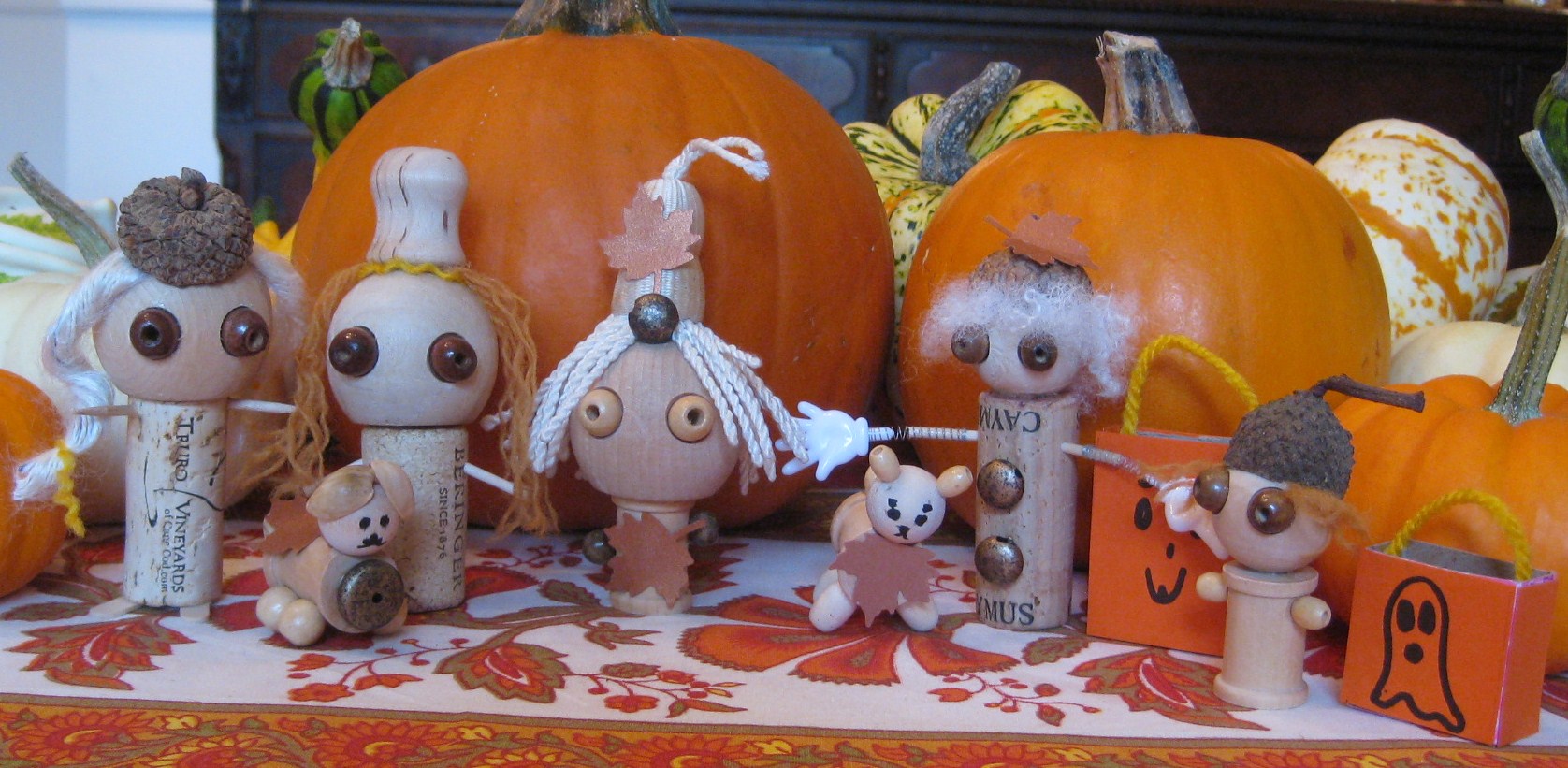
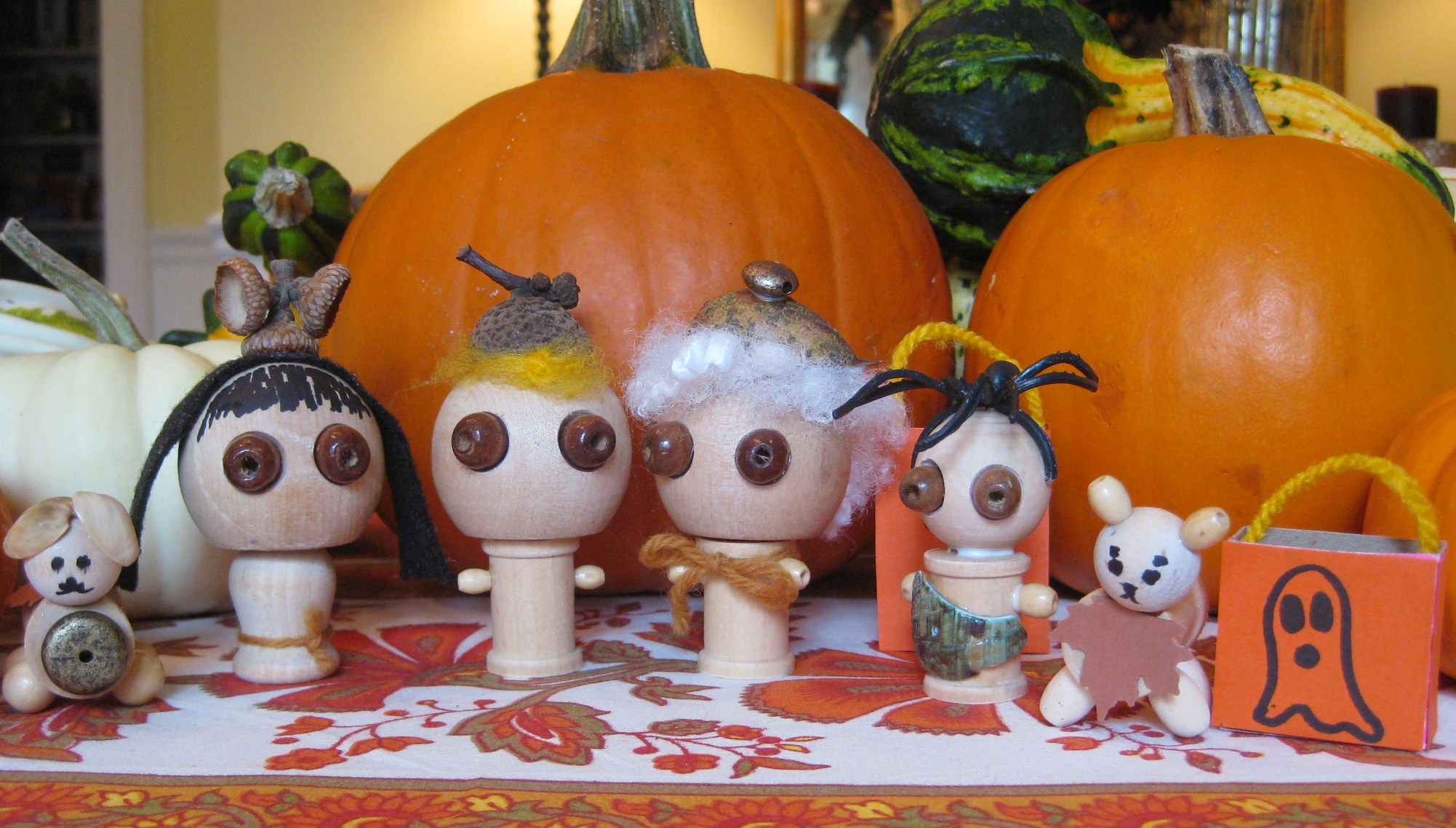
This fall, my daughter and I spent several amusing afternoons in production of these big-headed, bug-eyed trick-or-treaters to add to our Halloween decorations.  Using a Dremel, we drilled indentations for the wooden bead eyes, which we anchored with Sobo glue.  Our goal was to create a variety of strange and crazy-looking little figures, so we rather indiscriminately raided the craft closet in search of odd miscellaneous items.

For hair, we used yarn, felt, an old shade pull, and some of the stuffing that Kiko was at the time pulling out from the toy he was attacking.  Hats are acorn caps, wooden craft cups, and in one case, a plastic spider ring.  For bodies we used small spools or corks.  Toothpicks or wooden beads form the arms.  One figure received oversized white plastic hands on springs that came with a set of Halloween pencil-toppers. We made two dogs, one with ears of pecan shells, the other with wooden bead ears.  Maple leaves from a craft punch adorn several of the creatures.  We covered miniature Nerds boxes with orange paper to make trick-or-treat bags.  Because we didn’t intend our creations to be perfect or traditionally cute, no one (and I won’t name names) flew into a rage when a slight crafting hitch or two arose.

SpookyGuys009

Ready for Halloween: Papier-Mâché Jack-o’-Lantern Friends

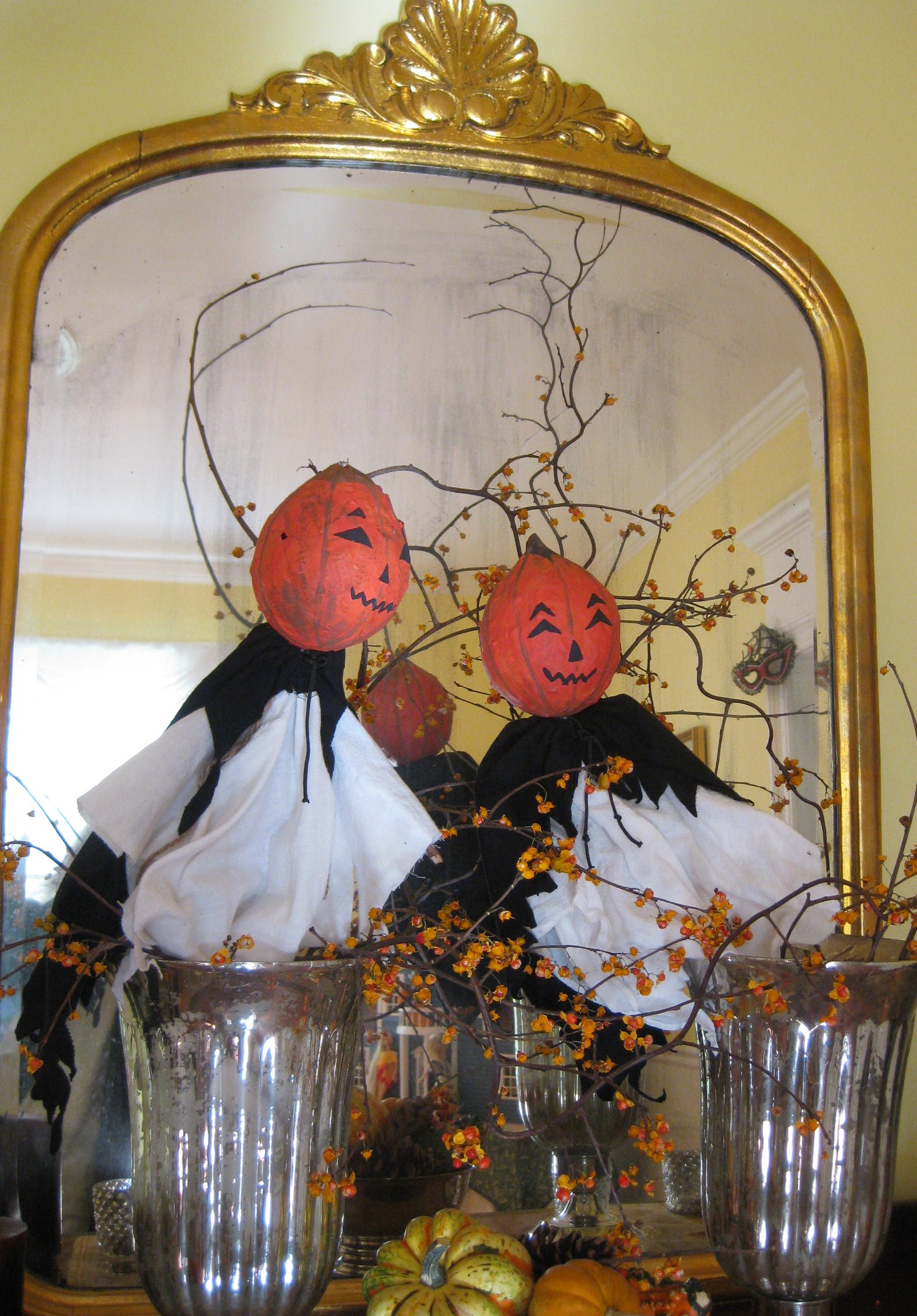
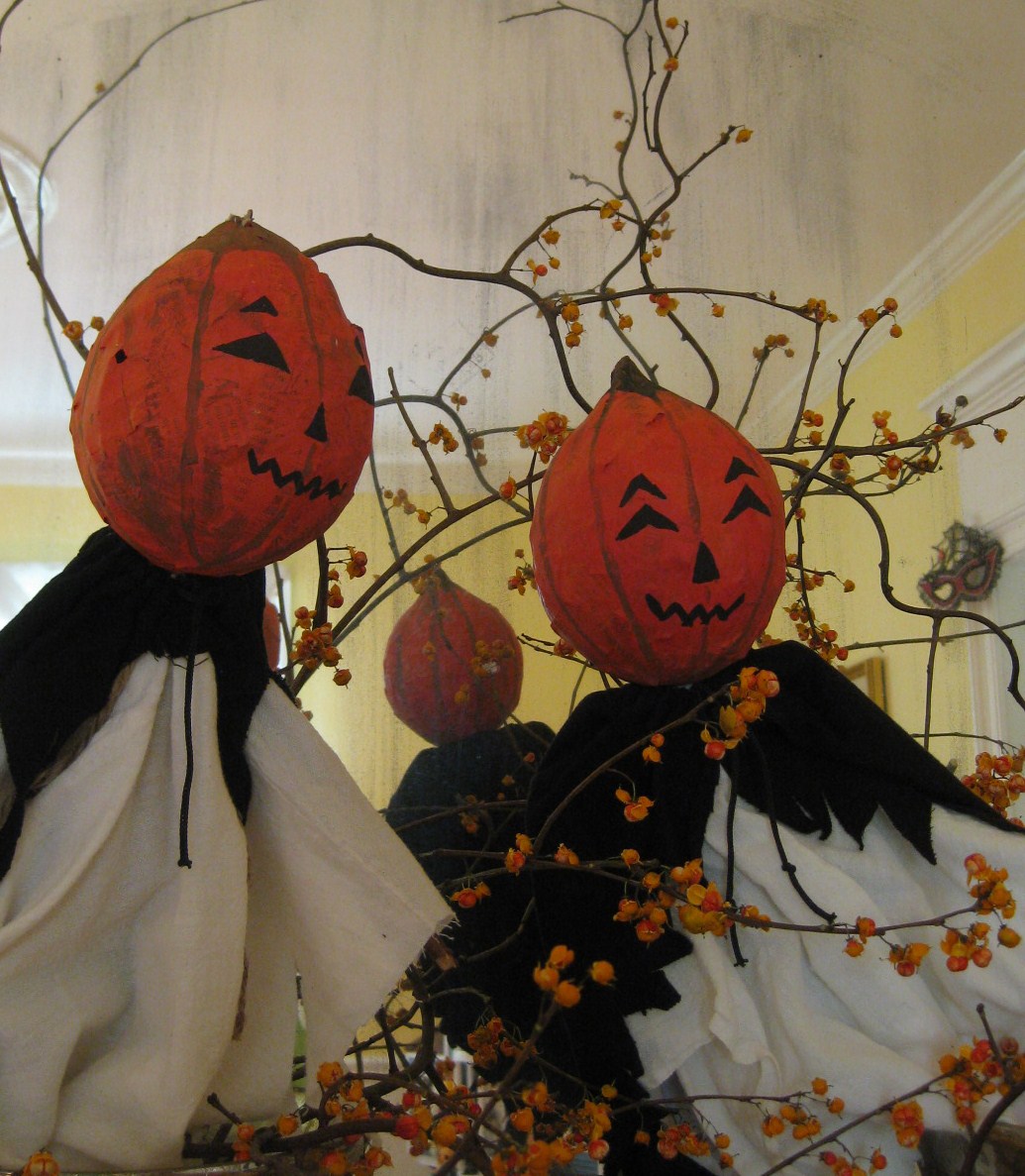
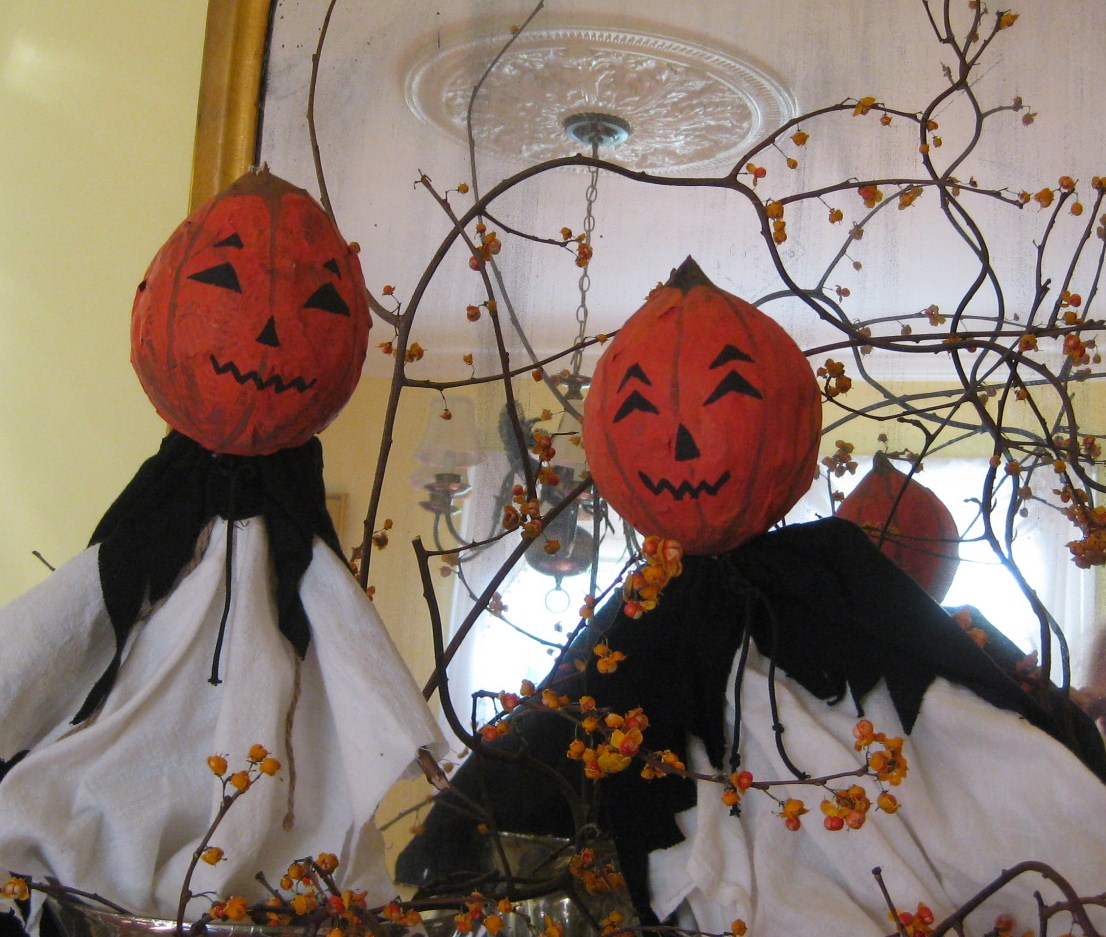
These two jolly Jack-o’-Lantern friends were inspired by a vintage Halloween decoration my mother found in a catalogue.  Several years ago, my daughter and I made the heads out of papier-mâché, using the tried-and-true Kindergarten method of newspaper strips applied to balloons with watery white glue. For the bodies, we wired together sticks from the yard, which we draped with muslin for the gowns.  The black cloaks were formed from two mens’ drawstring shoe bags.  The friends take their place every October on our dining room sideboard.  This year we surrounded them with bittersweet branches and used two mercury-glass hurricane candle-holders for support.
DC2012003

Halloween2012003

Halloween2012007

Anticipating a happy Halloween!

From Little Pumpkin to Halloween Jack-‘O-Lantern

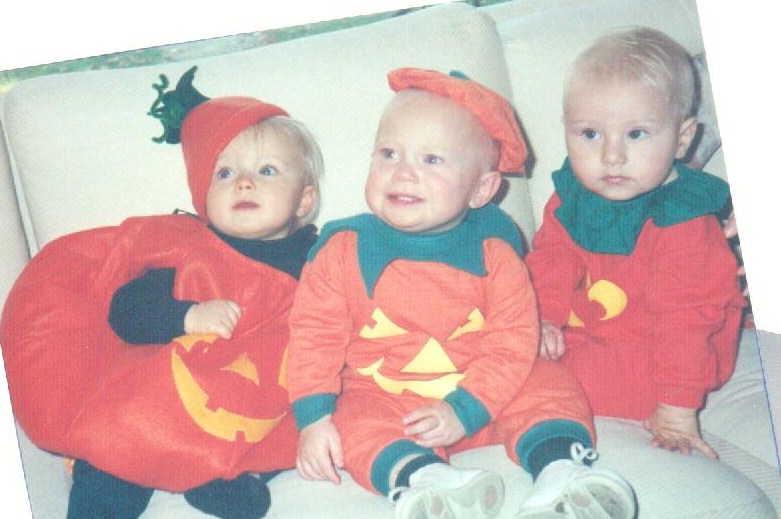
It’s an easy and logical progression from pumpkin to jack-o’-lantern.  Mother/baby Halloween parties across the country are crowded with crawling, crying, babbling, drooling, toddling jack-o’- lanterns.  Our first Halloween event was typical.

001

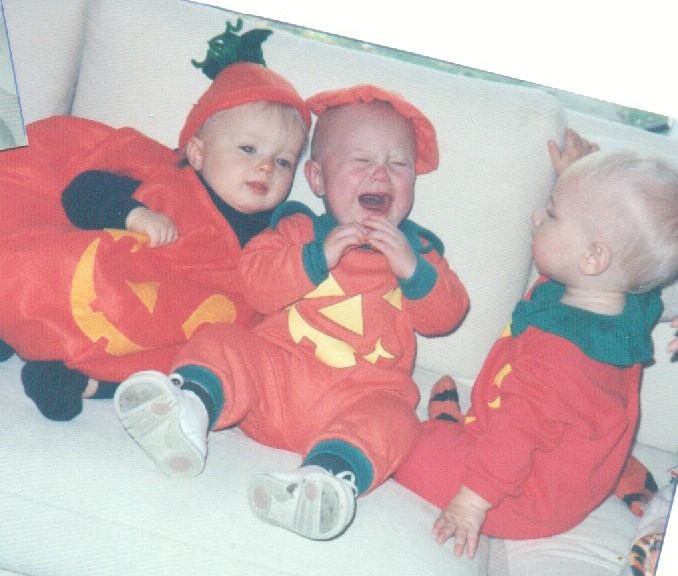
The three jack-o’-lanterns at our Halloween playgroup party are assembled here for a photo opp.  The middle pumpkin took offense, perhaps at the indignity of being sandwiched between two other pumpkins.

3 pumpkins

She continued to protest, loudly and forcefully.  The other two pumpkins seemed mildly interested, at best.

J's 1st Halloween

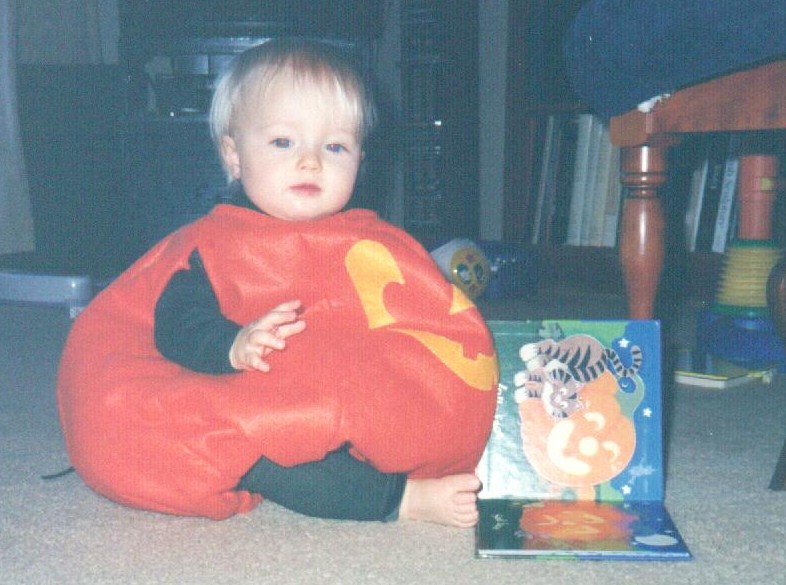
After the party, D relaxed at home by quietly ripping the flaps off a seasonal pop-up book.

004

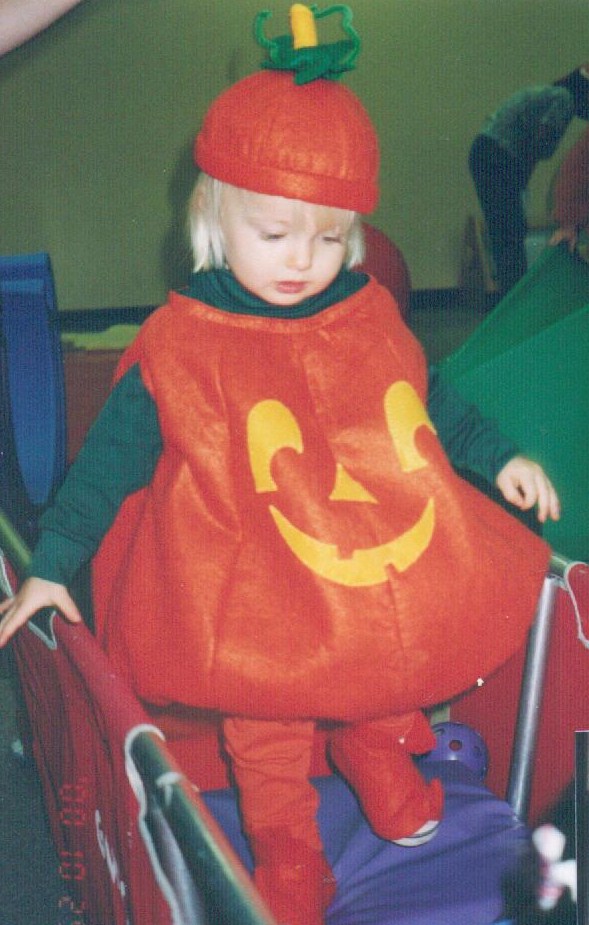
We reused D’s jack-o’-lantern costume on her second Halloween.  As we had expected, our not-quite-two-year-old voiced no protest at having worn that same old thing last year. On her first Halloween, she was not yet walking, and the costume proved cumbersome for a crawler.  Here, at our Gymboree party, she enjoyed being a jaunty pumpkin on the move, walking, running, jumping, and bouncing.

005

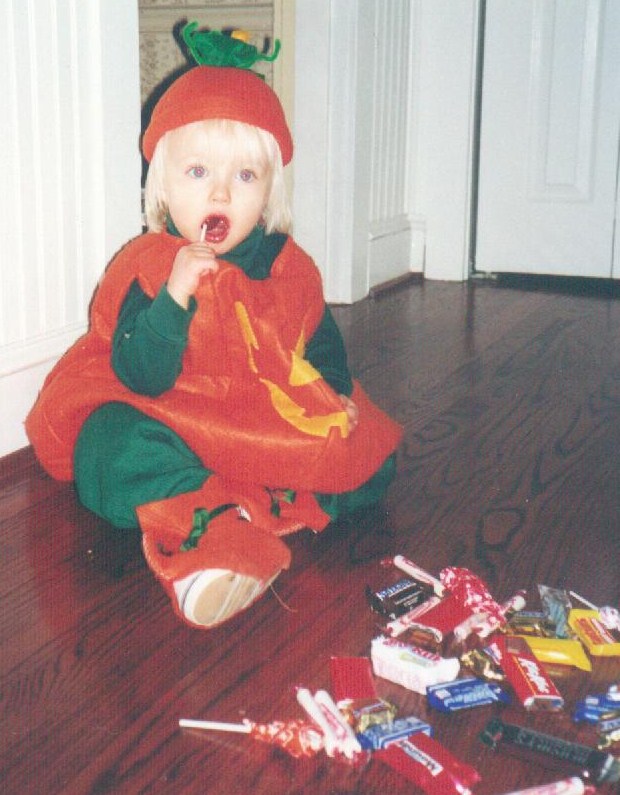
On D’s first Halloween, we went with some of our playgroup friends to an afternoon celebration geared to young children at the local mall.  We couldn’t justify trick-or-treating on behalf of a baby in a stroller.  But on year 2, we hit our neighborhood.  Up to this point, I had limited our daughter’s exposure to candy.  She got a few sweet treats, but, as the baby books advised, not many.  That Halloween, however, the jig was up. The great wealth of the candy universe opened up to her like a treasure chest unearthed, and she rejoiced.  While Kit-Kats were initially her favorite chocolate, she quickly developed an eclectic, enthusiastic palette.  Here, she sits in a trance-like state savoring a lollipop, the contents of her trick-or-treat pumpkin spread around her in what was then the bareness of our kitchen.

Looking Back on our Little Pumpkin

When my daughter and I were choosing our Halloween pumpkins last week at a pleasant local farm market, we were surrounded by parents photographing their little ones among the seasonal displays.  Babies and pumpkins look good together; it’s a natural fit.  Both tend to be round, fat, cute and firm.  Facebook is understandably full of adorable pumpkin/baby duos this time of year.  Our baby is no longer pumpkinesque, which is fortunate, considering she’s nearly fourteen.  But I’m prompted to look back on the years when she was, very much so.

001

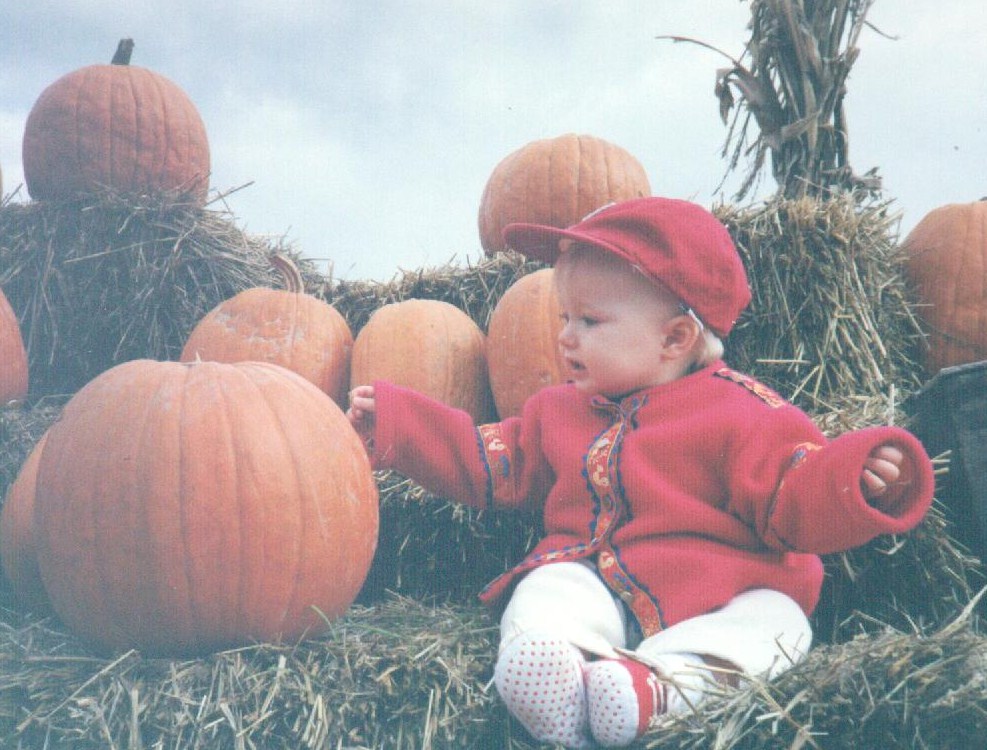
On our first trip to the pumpkin patch with our daughter, the chill of the late afternoon took us by surprise. We had dressed D in soft overalls and a Scandinavian-style fleece jacket, the first of a series that my mother would sew for her over the years.  But either Mama hadn’t yet made the matching fleece hat, or we didn’t think she’d need it.  Her baseball cap clearly didn’t keep her warm, and her lack of mittens didn’t help either.  Her little feet must have been freezing, in lightweight cloth tennies.  In these photos, it’s painfully evident that the kid, not quite ten months old, was borderline miserable but making the best of a bad situation.  She looks as though she’s thinking Where are we? What are these cold round shapes?  Why do they make me sit on such scratchy stuff or on a hard, icy seat?  I do, however, rather enjoy being pulled around on this thing.   

002

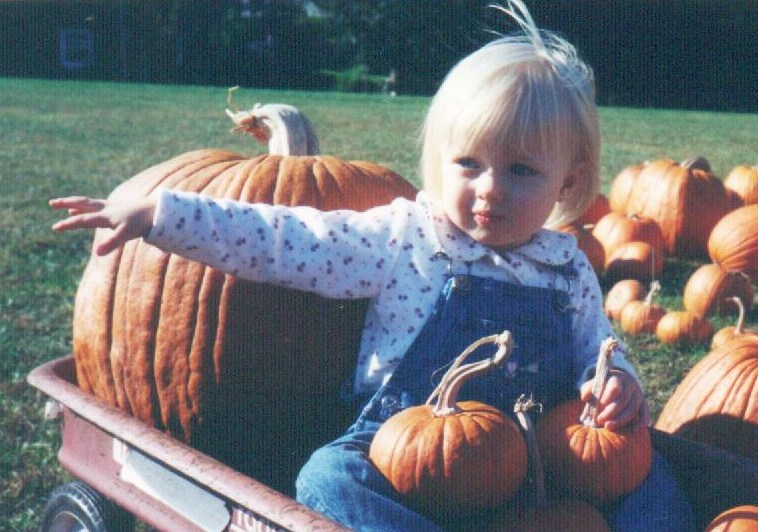
Here, D is wedged in on the Radio Flyer between pumpkins and the bulky camera bag we were never without during those early years.  We had bought our first video camera in anticipation of our new baby, and, like so many new parents, we filmed our growing child during unremarkable moments. Look!  She’s tilting her head!  Look!  She’s blinking her eyes!  She’s lifting her hand!  Amazing!  Marvelous!  No doubt we have extended live footage that documents her discomfort on this outing even more clearly.

2nd Pumpkin patch

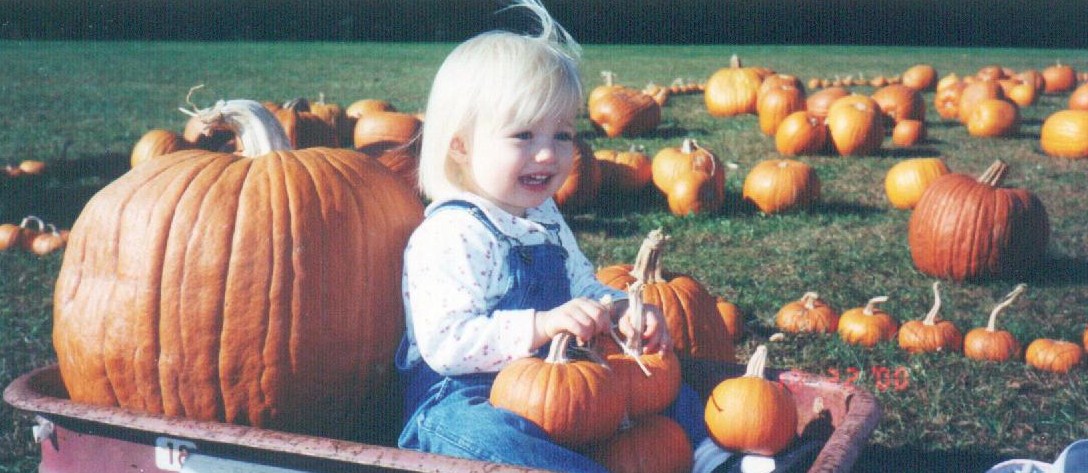
The next year, we made sure to choose a warmer day for pumpkin picking.  Here is our girl surrounded by pumpkins on another red wagon.  Despite the more comfortable temperature, she still doesn’t appear to be very happy.   But I’ve never appreciated a photographer’s insistence on BIG SMILES!  I remember this day as being a fun-filled one.  I’m hoping our baby, despite her conspicuous lack of a big smile, nevertheless enjoyed herself.  I resolve to think she did, because in the years to come she would look forward enthusiastically to pumpkin patch visits. 

003

004

2nd Pumpkin patch 2

Maybe now she’s really had enough!