Category Archives: Family

Mother’s Day, Part I: Mama the Asthmatic Dynamo


00118

My mother suffered from severe asthma throughout most of this year’s mild winter.   It began when she and my father took a walk in early February. The day was unseasonably warm, even for Atlanta, and evidently the pollen was equally unseasonable. Mama’s allergies were triggered, which soon led to asthma that lingered and developed into pneumonia. While her doctor advised hospitalization, she resisted, knowing that her chances for recovery, if armed with the proper medications, were better at home than at the hospital. She has spent time in the hospital with asthma, and it was an experience she didn’t care to repeat.

In March she was only marginally improved, forcing her to miss a family wedding in Kentucky. For the first time in decades, Daddy made the eight-hour drive to his old hometown by himself. My parents rarely speak during long car trips, since my mother typically sits in the back seat. As a child, she was a passenger in several serious car crashes, and she saw her brothers hospitalized multiple times after accidents. In the back seat, she feels a little less vulnerable, not quite so close to the edge of disaster. Despite the silence that reigns as the miles tick by, Daddy has come, understandably, to count on Mama’s presence in the car. He felt her absence sharply during the drive to his brother’s house in Kentucky, where H, D and I met him. Fortunately, Mama had recovered by late April and was able to be with us for the much-anticipated school musical in which my daughter was performing.

The strides made in treating asthma over the ages have not been particularly dramatic. A sudden attack can still quickly accelerate into a desperate situation, as the death of the Pulitzer Prize-winning journalist Anthony Shadid several months ago demonstrates. He was on assignment in Syria, escaping from the war-ravaged country, when his asthma was set off by an allergy to horses. He used his medication, but it wasn’t up to the task. My mother has known this fear all her life.

Mama’s every illness tends to be exacerbated by her asthma. A mild cold, easily shaken by most people, can become a serious concern for her. Exercise and sometimes even routine daily activity can be problematic. Breathing cold air may lead to a sudden, severe attack. She has emerged from two life-saving surgeries only to be set upon by life-threatening asthma.  Mama was frequently sick as a child. Once, after a long absence from elementary school, she returned to find that her desk had been removed from the classroom.

Well into the 1940s, many doctors saw asthma as a psychosomatic condition. Those suffering from it were often considered somehow personally responsible, perhaps due to a general weakness of spirit and body. Anyone who has ever experienced the panic of an asthma attack or the persistent annoyance of mild, chronic asthma knows that, on the contrary, asthmatics require greater strength, determination and coping skills.

During Mama’s childhood, her asthma was combatted with a variety of treatments, most of which had little effect. A common folk remedy prescribed horehound candy (a naturally flavored, sharp-tasting hard candy that was a fixture in old-time general stores but rarely seen now) doused with a small amount of whisky. Although horehound candy continues to be explored as a palliative for respiratory ailments, it merely led to Mama’s lifelong dislike of horehound candy and whisky, served together or separately.

Goat’s milk was widely touted to alleviate asthma. When Mama was twelve, her family bought two goats for the farm. She never acquired a taste for the milk, but she loved the goats. Cute and spunky, they jumped the fence daily to meet her school bus in the afternoons. She had a particular affection for the baby goat born the next year on Washington’s birthday and thus named George.

Like many other asthmatic children, my mother was encouraged to smoke asthma cigarettes made from a mixture of herbs (no tobacco). Breathing the smoke from such herbs is a remedy that dates back to ancient times and may, surprisingly, have some short-term benefit. Mama remembers the cigarettes coming in a round flat tin. They prompted violent coughing fits, and her asthma was not improved.

An elderly neighbor urged a bizarre remedy that he said was sure to work: cut off “a hank of hair” and nail it to a tree. This option was never tried.

The first markedly effective medicine my mother remembers was an adrenaline inhaler, made of glass. This treatment relieved the acute symptoms but worsened Mama’s ever-present insomnia. Weekly allergy shots, which required a drive to Louisville, were of little benefit. Strangely, Mama’s symptoms lessened considerably when she began college at the University of Kentucky and started smoking real tobacco cigarettes.  Her asthma was less pronounced for the next ten years or so. With the move to Atlanta, it worsened again, but she was generally able to manage it with inhaled corticosteroids. (She gave up cigarettes when I was young, and she really doesn’t recommend smoking as an asthma treatment.)

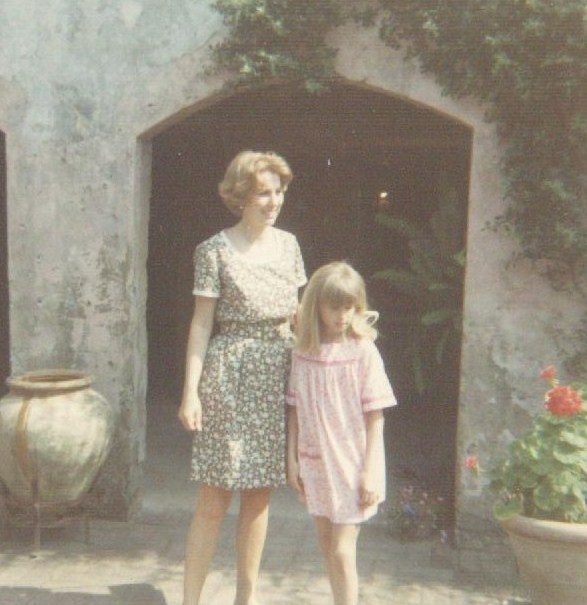
Growing up, I never thought of my mother as weak or sick. Typically, she was, and still is, the opposite, a powerful force of nature.  She requires little sleep.  She doesn’t sit still.  She gets things done.  She takes on tasks that most people wouldn’t consider or would outsource: Time to get to work on reupholstering the antique sofa that’s been in the basement for years.  The porch furniture needs new cushions.  I saw this great dress in Vogue; I’ll combine two patterns and get it done so you can wear it on Sunday.   Let’s rent a sander and refinish this floor.  I’ll repair and gold-leaf these two old frames this afternoon, clean the kitchen floor and then we’ll give the dog a bath.  Her phenomenal energy, a product of a restless temperament, is often heightened by her asthma medication.  It’s only in the last few years that asthma has slowed her down a bit.  Throughout most of my childhood, I awoke to the sound of Mama using her inhaler, and I fell asleep to the whir of the sewing machine in the kitchen.  These were the sounds that told me all was right with the world.  Mama was there, being my Mama, who loved me, unquestionably.
 004

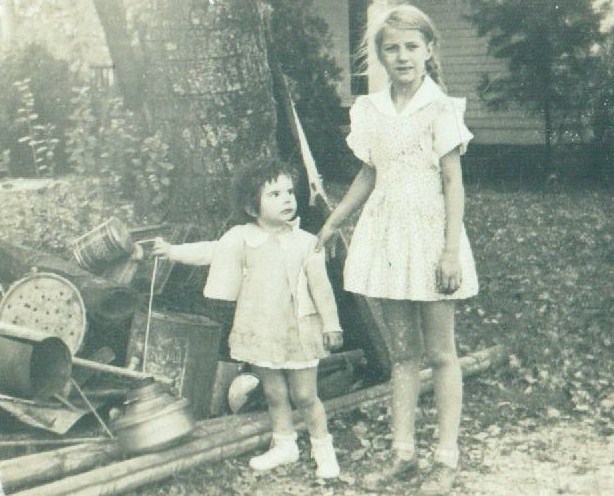
Mama with a younger neighbor, in the 1940s.  Both my parents’ families tended to favor junk heaps as photographic backdrops.
Mama explained this odd assortment of stuff  as being due to  the little girl’s family’s upcoming move.
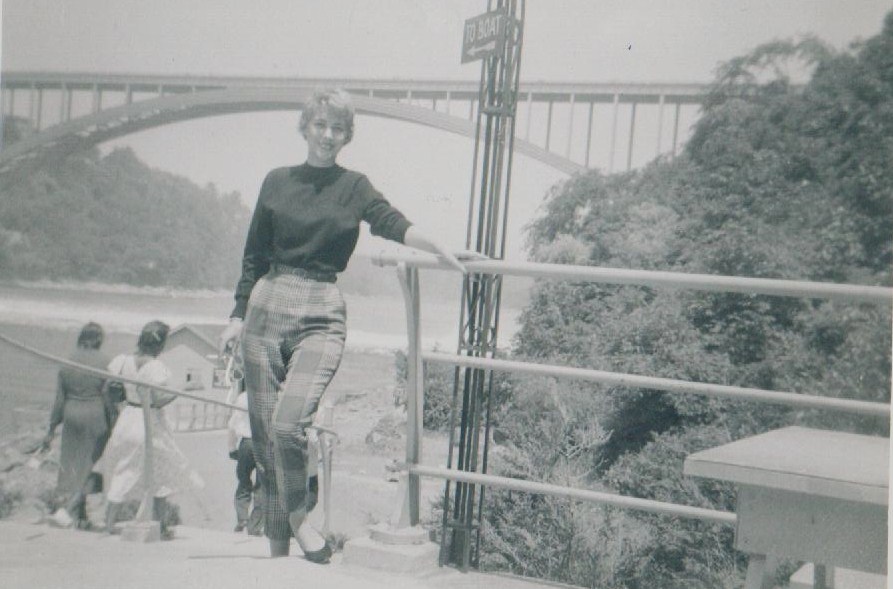
0161

Mama at Niagra Falls, c. 1955.

0051

Mama & me in St. Augustine, Florida, c. 1970.

Up from the Concrete, Roses

Millie0571

Our back yard, when we first moved into our house, was not really a yard at all.  It was a rather dismal expanse of cracked concrete.  The previous owner was the developer who built the neighborhood in the 1970s.  He used the large detached garage to store heavy machinery.  There was a small back porch, to which a wooden wheelchair ramp had been added during the last years of the owner’s life.  The only greenery was an enormous blue spruce that hid the oil tank and sheltered many bird families.

To my husband, the back of the house and its surrounding concrete pad resembled an old gas station.  From the very beginning, he saw it as something that cried out for major changes.  I wasn’t as harsh a judge.  While the area wasn’t pretty, certainly, I saw a convenient play area for our daughter, a place for hopscotch and exuberant chalk drawings.  I envisioned it busy with various toddler vehicles, followed later by a tricycle and a bicycle.

The ramp was ugly, but it served an immediate purpose.  Our daughter fought sleep with great vehemence, but motion made her sleepy.  She often nodded off in the big Graaco stroller if I walked long enough.  When I pushed her very carefully up the incline, she might continue sleeping.  I could park her on the porch while I sat at the outdoor table and snacked or read.

Our concrete yard also functioned well for several years.  It was a busy highway for a variety of wheeled contraptions, an ideal spot for the wading pool.  We bounced basketballs and hit tennis balls off the garage.  Chalk masterpieces were created and washed away by the rain.  And then one day, we no longer needed all that pavement.  We began to imagine what the space could be.  We had a very blank slate.

IMG_2264

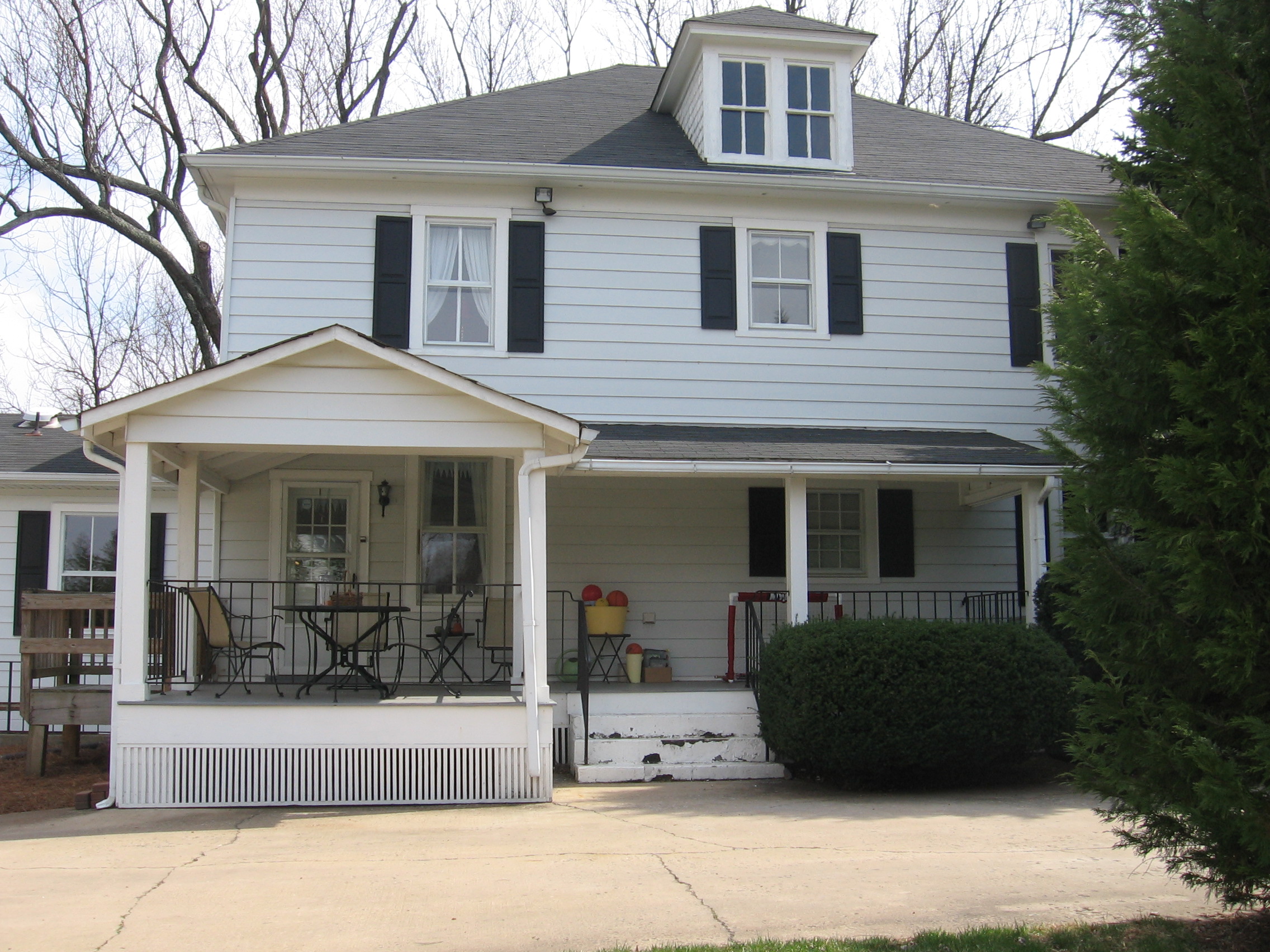
The back of the house, before the re-do. 

067

Lots of concrete.

IMG0402

Unfettered by training wheels, our daughter exults.  She put many miles on her first little bike without leaving the back yard.

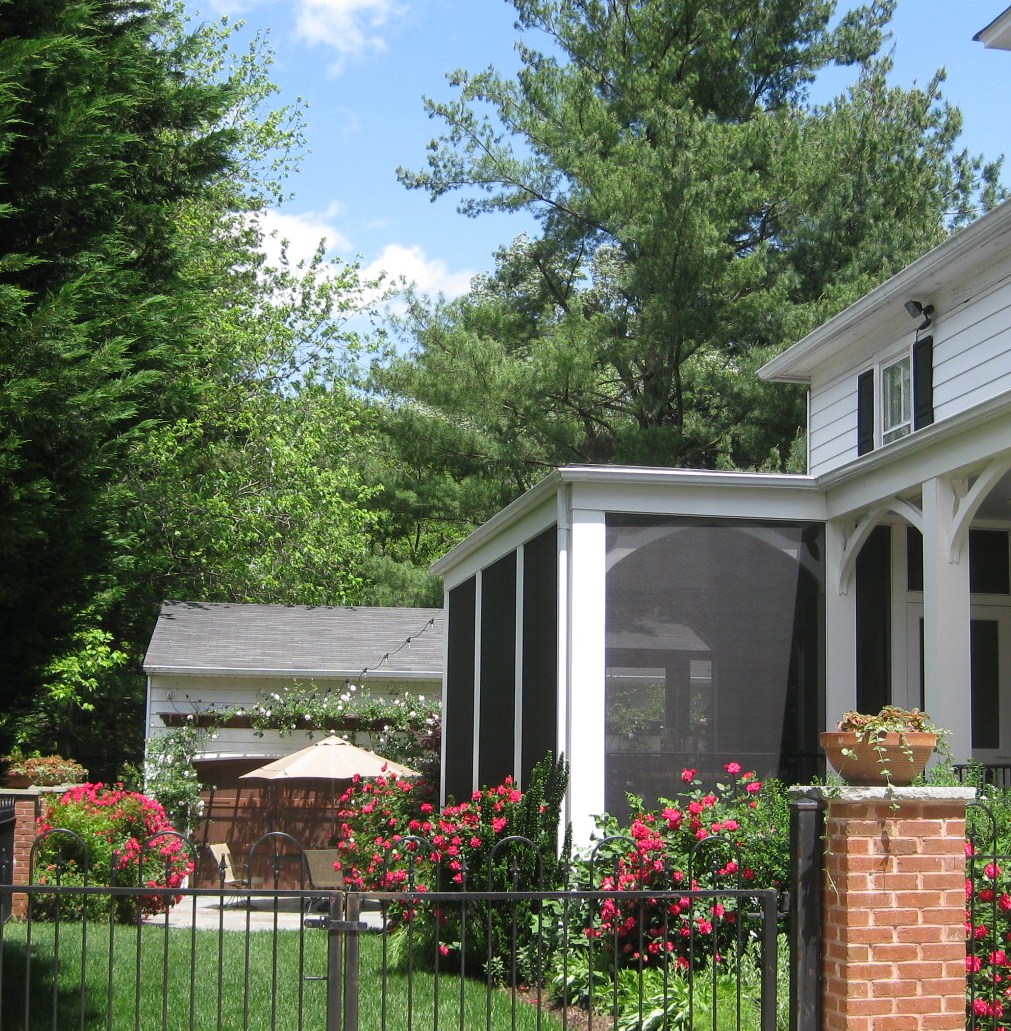
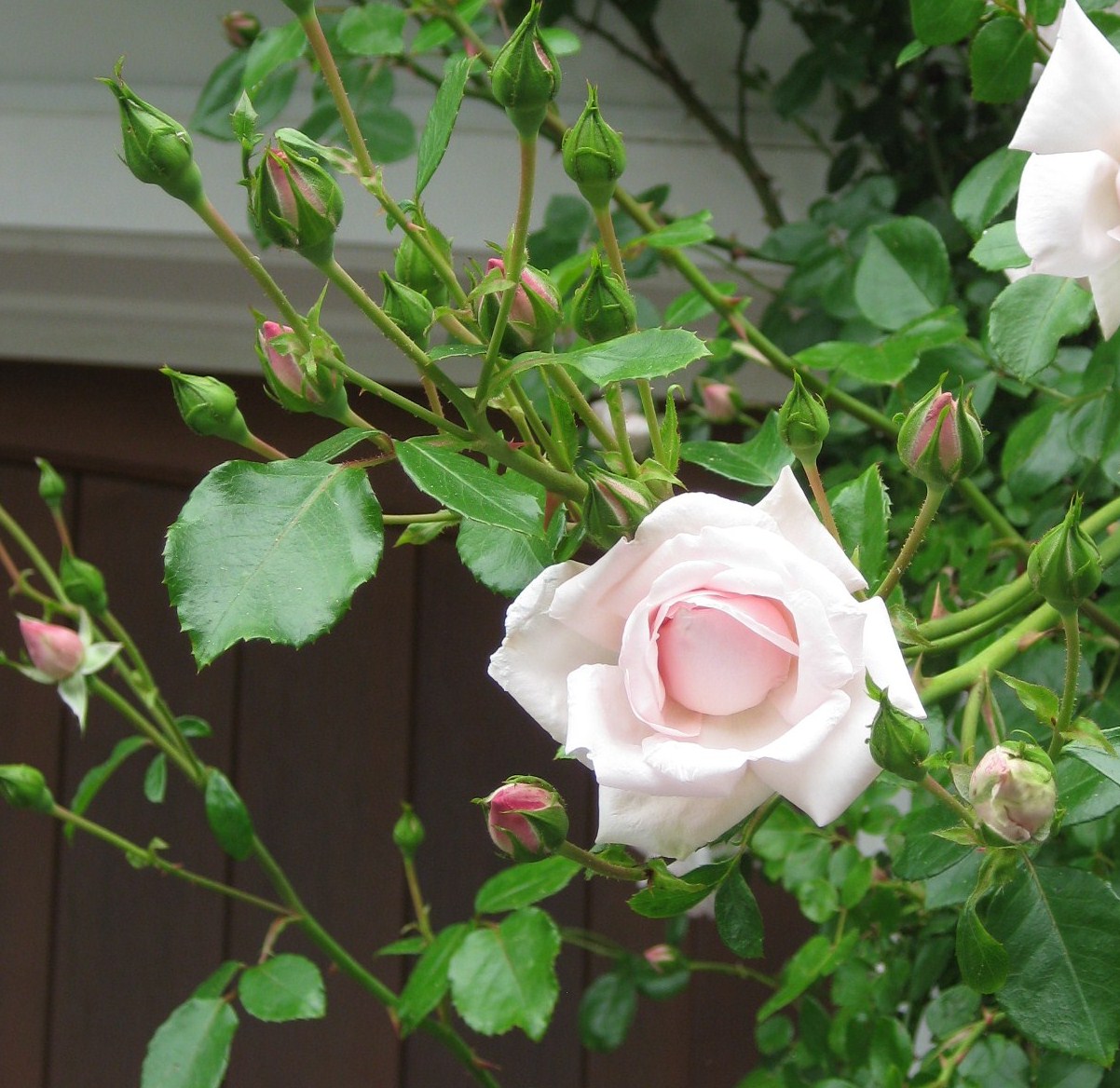
It took us at least two more years of debate and procrastination before we began our big back yard project.  There followed months of demolition, construction and innumerable, inevitable delays.  Afterwards, we were left with a roomy sceened porch, flagstone courtyard, and a more attractive garage.  There is a little grassy area for Kiko.  An old-fashioned wrought-iron fence encloses it all.  Unlike the front yard, which is heavily shaded by the big silver maples, the back is an oasis of bright sunlight.  Where the concrete once baked white-hot,  we now have a profusion of flowering plants.  The red double knock-out roses quickly formed a dense hedge along the fence, and the pale pink climbing roses heartily embraced the garage trellis.  From May to September, we are surrounded by a riot of roses and other flowers.  For those who came by a lovely back yard easily, this might be no big deal.  As for us, we still find it hard to believe that all that concrete gave way to such life and beauty.

038

  The re-do begins, and things look worse before they began to look better. Kiko doesn’t care, though.

Porch 2 007

Our back yard and new porch, after the re-do.

Roses0121

Double knock-out roses along the fence.

Moreroses002

More knock-outs by the screened porch.

Mayroses006

Pale pink roses climb the trellis on the garage.

Roses001

Just one of many perfect roses, within easy reach. 

Lilacs, Lyric Hall, and June Bliss

KikoLucy039

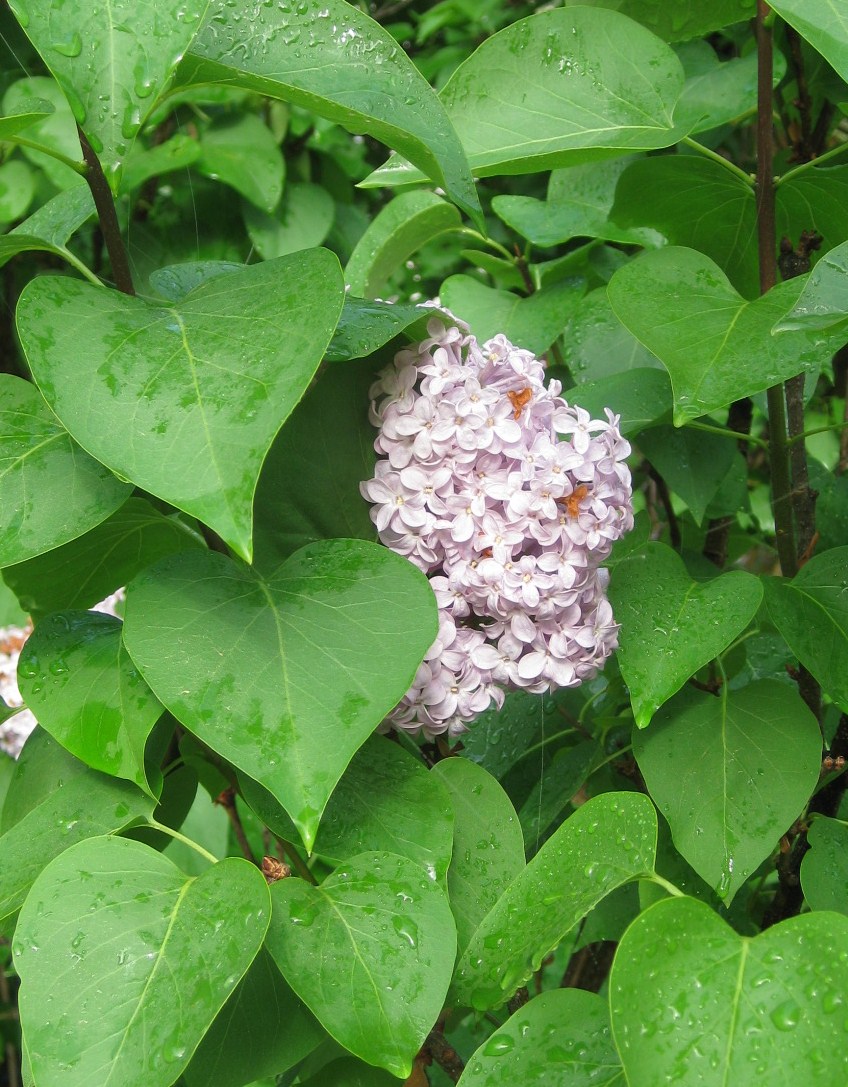
In the early spring of the first year we spent in our house, I noticed green buds emerging from the gray branches of the tall shrub by the front walk. I had wondered about the identity of this large and leggy plant. When I looked closely, I saw the beginnings of lilac leaves. Our new old house was blessed not only by eminent silver maples, but also by a mature, substantial lilac bush. This realization brought me a jolt of happiness more typically associated with an unexpected gift, such as one that arrives in a pale blue Tiffany box. Lilacs have a special place in my heart. Like the maples, they speak of home and loved ones.

Lilacs grew in great abundance around my grandparents’ house, the locus of my earliest and happiest childhood memories. Lilacs surrounded the area in front of the smokehouse and adjacent to the chicken lot. They created a leafy enchanted shelter, a cozy enclave where I liked to play with my grandmother’s kittens.

Atlanta is generally too hot for lilacs. I missed them, growing up in Georgia. For me, the lilac became a symbol of a time long past, alive only in memory and never to be repeated. I didn’t expect to live among lilacs again.

Then I moved to New Jersey, where lilacs, like peonies, thrive. My walks into Rocky Hill took me past a ramshackle former church in the center of town. Built in 1870 as a Methodist Episcopal church, by the early 20th century the building was known as Lyric Hall and used as a community theatre and concert space. I knew the place as the home of a dear friend with the unlikely, romance-novel-worthy name of June Bliss. For many years, June was the warm and capable administrator at the center of the art history department at Princeton University. To anxious grad students she was a calm and motherly presence.  To professors preoccupied with the esoteric details of research, she was a grounding force.

Lyric Hall became June’s home in the early 1970s. She rented out the old sanctuary as a warehouse and lived in a warren-like apartment that had been added to the back of the building in the 1940s. June’s girlhood home was a magnificent Gothic revival house near Princeton, where her sister continued to reside. It baffled me that after growing up in such an architectural gem, she was content with her quirky, cramped apartment. I always imagined how the church could be renovated into a striking, spacious, light-filled home. June probably could have easily afforded such a project, but she wasn’t interested. She was thoroughly without pretense, and her unusual living quarters suited her just fine. I think she enjoyed the surprise in the eyes of first-time visitors’ to her decidedly eccentric home.

The old church was set on an expansive piece of property that adjoined what had once been the town green. June had a large garden in the side yard, bounded by a towering hedge of lilacs. She was generous with her bounty of vegetables and flowers. She encouraged me to cut as many lilacs as I wished, which I gladly did, usually under the watchful eye of the neighbor’s hulking pot-bellied pig. Every spring, thanks to June, our apartment was filled with bouquets of lilacs, in addition to the peonies I bought down the road. On a return visit after H and I had married and moved south, June dug up forget-me-nots from her garden to send back with us.  I planted them behind our townhouse, where they are probably blooming still.

June was a cheerful person with a lively sense of humor and a keen appreciation for irony. She retained her sunny disposition in the face of the cancer that afflicted her for a number of years before finally claiming her life. I remember very clearly the warm summer day I went to the mailbox and found the kind note from June’s daughter that broke the news of her mother’s death.  D was very young at the time, and we had been playing in the yard together.  Seeing my sudden tears, she dashed over to comfort me.  Our lilac bush serves as a reminder that departed friends, as well as the essence of home and family, remain with us always.

This spring, though, I was dismayed that only one small lilac bloom appeared. For several years now, blossoms have emerged only at the very top-most branches.  June’s vigorous lilac hedge, in contrast, bloomed profusely, from bottom to top, for decades. When I asked if she had a gardener’s secret, she laughed and replied that she simply appreciated the plants and left them alone.  Our lilac evidently needs something more than admiration.  I’ve read that an aggressive pruning can reinvigorate an old lilac plant. We will get the shears out this weekend and go to work.

I recently discovered that upon June’s death, her home was donated to the New Jersey Historic Trust. The Trust sold it, with a preservation easement, to an architectural firm that restored the building to its original appearance and now uses it as their headquarters. The gray asbestos siding was removed, the original white clapboard restored and repainted. The arched windows were elongated to their full height and the sanctuary space’s soaring ceilings were restored. June’s old apartment was replaced with a bright and much larger one.

It’s remarkable to me that even though June didn’t care to restore Lyric Hall for use as her own home, she made it possible that others, later, could enjoy the beauty of the renewed historic building. It gives me hope for the rehabilitation of our tired lilac bush.  Lyric Hall flourishes again, a fitting memorial to its former owner, and I’m convinced our lilacs can, too.

KikoLucy043

001
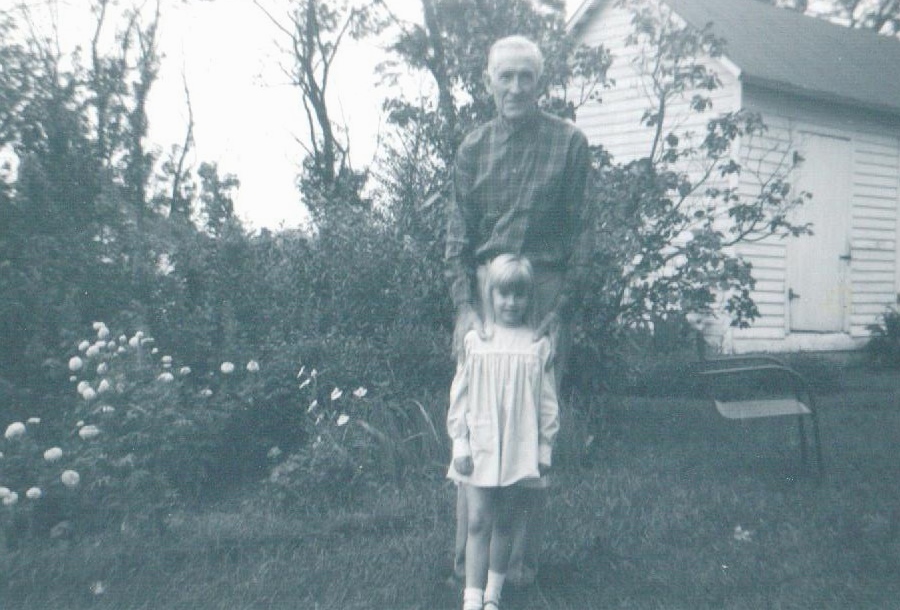
My grandfather and me, with lilacs behind us.

The Silver Maples Say Welcome Home

Maples0141

For the past two weeks or so, the seed pods have been falling from the big maple trees in our front yard. As the wind blows, they hit the roof with a sound like a shower of fat raindrops or forcibly hurled pea gravel. The tiny twirling helicopter blades drift slowly to the ground. Our daughter used to love to chase the flying seed pods. They gave my husband and me a welcome break from hands-on parenting. On warm weekend afternoons, we’d sit in cheap aluminum lawn chairs and watch her zigzag happily across the grass. We all still appreciate those spinning seed pods, despite the legion of tough little seedlings that spring up among the flower beds. We certainly love the trees that send them forth.

It was in the late fall, nearly eleven years ago, when we first saw our house. Most homes in our area date from the seventies through the nineties, and it stood out because of its age. Built in 1920, it was originally the center of a two-hundred acre farm. Unlike most northern Virginians, who apparently put a high value on new construction, I actively wanted an old house. I like the idea of a house with a past, with character, with some history behind it. Having watched my grandparents’ lovely old Victorian slip through our fingers, as well as the demolition of my grandmother’s birthplace, a far more historic dwelling, I wanted the chance to be a good steward of someone else’s family home.

I had all but lost hope of finding a livable old house, but suddenly we had stumbled upon one. It was a little shabby, and it had aluminum siding. But it was a genuine old farmhouse, a classic American four-square, with sizable rooms and a sensible floor plan. While it contained some dated 1970s touches, such as expanses of orange shag carpeting, it was solid and didn’t appear to need structural renovation.

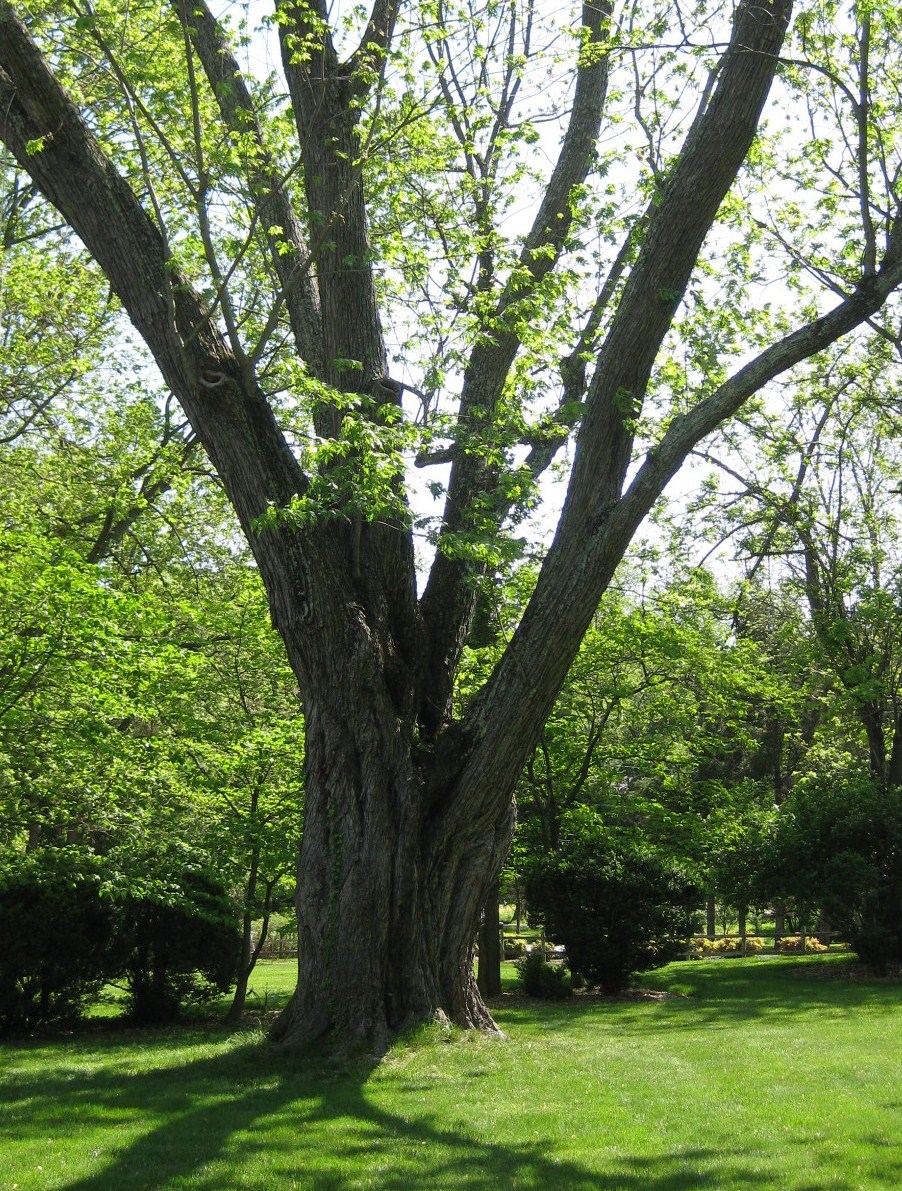
And it had those wonderful trees, a semicircle of six huge trees that shaded the front yard. They were silver maples just like those that twisted their knobby roots through the soft grass at my grandparents’ house in Kentucky. Because it was late November, the branches were bare, but the shaggy gray-brown bark was as recognizable as the face of an old friend. This was the house! I was certain of it. The silver maples offered living proof.

Because my husband is a clear-headed man of business and science, he weighed all conditions carefully and made a low-ball offer on the house. I was anxious, nearly certain we wouldn’t get it, already formulating back-up plans.  Maybe that 1980s house (the one annoyingly referred to as an “executive colonial”) wasn’t so bad after all.  Or we could give up the search and spend another year in our rented townhouse.  But our daughter, a new walker, needed more space and a yard in which to roam.  I wanted an old house. I wanted the old house with the old maple trees. The one that just seemed like home.

Luckily, the prevailing local bias against older homes worked to our advantage. We managed to learn that our only serious competition was a developer whose goal was to tear down the house and build a bigger, newer one. Better yet, two. The owner, fortunately for us, much preferred that the house in which she had raised her children continue to be a family home. 

During the following December, matters concerning our purchase took off on a wild roller coaster ride. There were complications with the contract, concerns about the foundation, the floors, the septic system, the furnace, the roof, the crazy property lines, and more. During our Christmas vacation with H’s family in Rochester, he was on the phone constantly with building inspectors and legal experts. But by early January, the house was ours. Our realtor, who had decades of experience, claimed that the closing was the most dizzyingly complex one she had ever witnessed.

That winter, while H worked especially late, I often sat by an upstairs window in a rocking chair, holding our year-old daughter.  As she nursed, or slept, smiled or cried, I looked out through the somewhat uneven glass at the dark blue shadows the big maples cast on the snow-covered ground. It sure was good to be home.  And it still is. 

Maples008

Maples004

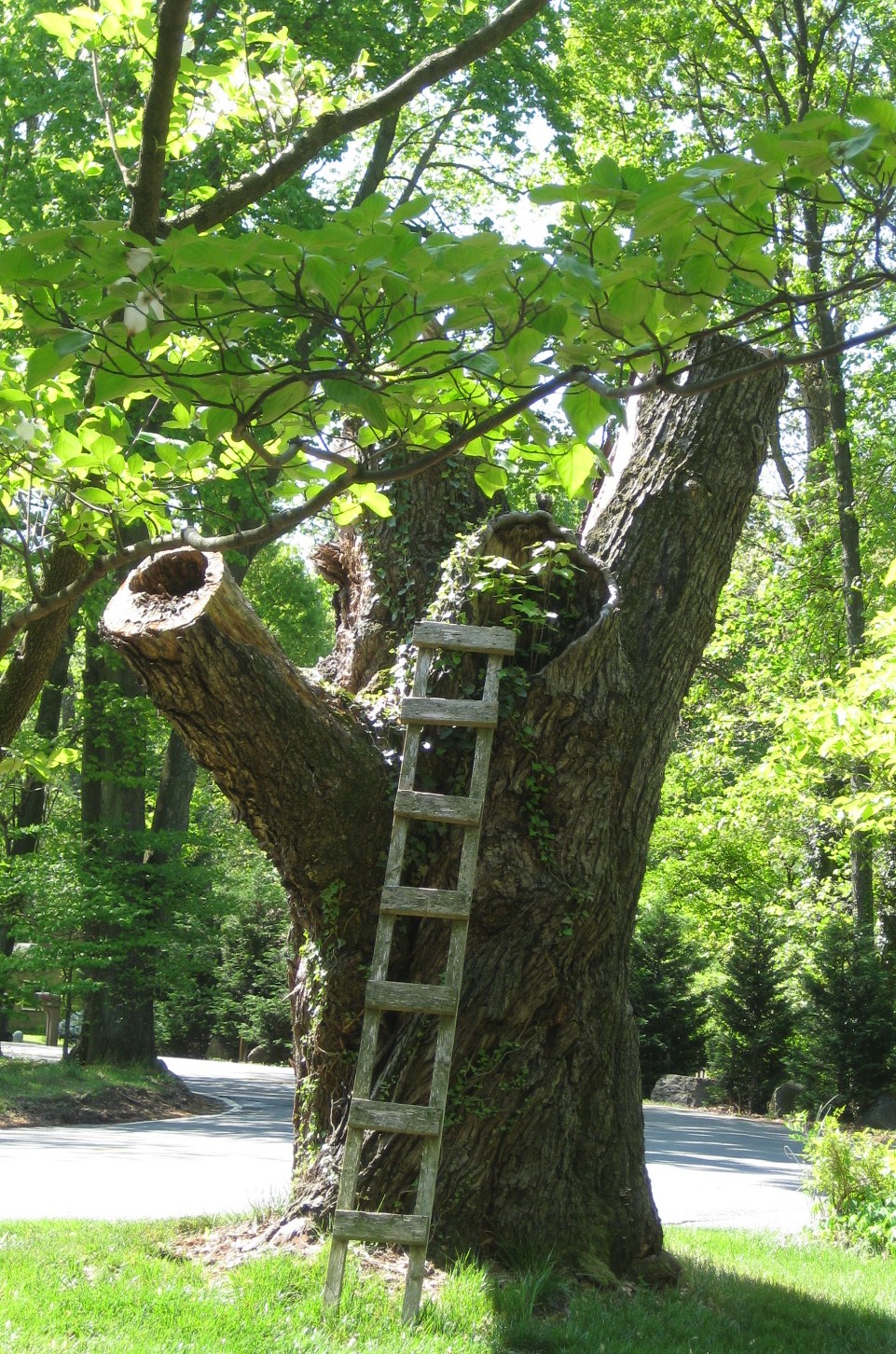
Silver maples are fast-growing trees with limited life spans. 
We had to remove this tree’s branches when they became fragile
and hazardous to passing cars, but we left the trunk as a monument.  Our daughter occasionally uses it as a place of solitary refuge.

0561

On an Easter Sunday in the 1960s, my friend Jeanie and me
beside one of the silver maples in my grandparents’ yard.

Our Good Friday God

Easterprep017

On Good Friday, we give thanks to a loving, compassionate God who suffers with us.  Our God is not a remote, impassive being who rules from on high.  He came down to our level; he entered into the midst of our messy lives.  Jesus, our brother, gave his own life to save us, his unworthy siblings.  He died for us while we were yet sinners.  He knows our worst pain, because he has endured it first-hand: betrayal, sorrow, humiliation, physical agony, and death.  God the Father knows intimately the terrible reality of losing a child.  Our God continues to suffer as we suffer.   He grieves as we grieve, because we are his.  We are family.  Our God surrounds us with his Holy Spirit, as close as our own breath, to sustain and comfort us.

Good Friday is good because our God is good.  This day commemorates the completion of Jesus’s mission.  From the cross, he cried out, “It is finished.”  The perfect sacrifice has been made, salvation has been accomplished, and we are redeemed.

Easterprep008

A Dangerous Game: Ukrainian-Style Egg-Decorating

One year, Mama sent a kit for decorating eggs in the traditional Ukrainian style. A far more ambitious undertaking than our decoupage eggs, it required actual skill in addition to careful planning and immense reserves of patience.

We knew immediately that the intricate, perfect geometry of the typical Ukrainian patterns were beyond us, so we opted for simplified, free-form designs.  We diligently followed the detailed instructions, using the writing tool called the kistka to draw a design with hot beeswax.  We then immersed the egg in one of the dye colors.  This drawing and dyeing process was repeated several times.  Finally, we removed the wax by holding the egg near a candle flame.  We managed to create some attractive and unique eggs that bore no resemblance at all to those pictured in the kit.

We might have completed the project without incident had the eggs been less fragile.  As instructed, we used raw eggs.  And as we learned, one tends to grip an egg firmly while drawing on it with an unfamiliar, hot-wax dispensing tool.  Sometimes one grips too firmly, resulting in an egg being launched, missile-like, across the room.  The shattered egg stirred up the sudden and fiery wrath of my daughter.  Just as quickly, I was ignited by her anger.  Engulfed in a fit akin to spontaneous combustion, I hurled the egg I was holding onto the kitchen floor. I threw this egg (nearly-completed and painstakingly designed), with considerable force, making the inevitable clean-up all the more painful.  In a household of flammable tempers, holiday decorating has its perils.

MoreEaster004

The kit, showing some ideal Ukrainian designs.

Easterprep0291

 Only a few of our Ukrainian-inspired eggs survive.

Eastereggs007

Egg-Decorating Time

Egg decorating has always been a major concern at our house during the week before Easter.  My mother’s love of Easter crafts is almost as pronounced as her devotion to Christmas decorations.  In order to ensure the continuation of the family tradition, nearly every spring she sends new ideas for egg decorating or a specialty kit.  Several years ago, thanks to Mama, my daughter and I tried our hand at decoupage eggs.  This is a fun and relatively child-friendly approach to egg decorating.  It requires minimal skill, a bit of patience, and a tolerance for sticky fingers.  An appreciation for Mod Podge is a plus. The results can be very charming.   

Eastereggs003

Some of our favorite decoupage egg designs.


Eastereggs012

Easterprep046

The kit included several blown-out goose eggs, which offer more decorating space.  These eggs adorn our Easter tree each year.

Easterprep0482

The Hunger Games: A Movie Event for my Daughter

Just as I was bemoaning my daughter’s dearth of memorable movie experiences, she was invited to a birthday party to see The Hunger Games on its opening night. This is great! I thought. She can learn to love going to the movies, and I am not inconvenienced. My parents must have felt a similar degree of relief when I went to Disney World with our church youth group. My husband and I are in complete agreement that opening-night showings of eagerly anticipated potential blockbusters are firmly in our past. I was excited that D had the chance to participate in a true film event. I also looked forward to a pleasant, quiet spring evening at home. Maybe a couple of drinks on the porch with H.  How nice for everyone.

D, ever the skeptic, has a tendency to cast a cool and wary eye on many, if not all, trends in pop culture. It pleases me immensely that she doesn’t follow, willy-nilly, the noise of the crowd. She was especially suspicious of such tween phenomena as Hannah Montana, the Jonas Brothers, High School Musical and Justin Bieber. I think she imagined a vast adult conspiracy to control the tastes of her peer group, and she resented it.

She was unmoved by the prospect of the Harry Potter saga, even though H’s grandmother gave us all the books in the series (after enjoying them herself). I read most of the first book to D when she was in third grade or so. Toward the end, during Harry’s confrontation with Voldemort, her interest waned. The situation was too tense for pleasurable before-bed reading. She resisted when I suggested afternoon readings, and so the book remained unfinished. We saw the first movie several years after it appeared, at home on DVD. With that, her tepid interest in Harry Potter was quenched.

As for Twilight, it sounded ridiculous, according to D. Having been raised on horror stories, I was curious to see what the fuss was about, so I bought the books. After finding the first one more satisfying than I had expected, D read it and gave it a lukewarm review. She felt no need to continue with the next volumes or to see any of the movies.

My daughter was no more interested in The Hunger Games series for several years. Children fighting to the death? Really? How truly horrible!  I agreed with her. It sounded like something best avoided. But as the hype surrounding the movie gained momentum, and as friends she respected spoke of their enjoyment of the books, she cracked. When a friend lent her the first book, she began reading. She loved it, she was surprised to admit. The opening night birthday party gave her a deadline, and she stayed up late finishing the book.

The family of the birthday girl has continued to eagerly embrace the movie-going tradition. I admire their zest and stamina. They took their girls to all the Harry Potter films, typically on opening weekends, many at midnight showings, frequently in costume. Once at a neighborhood party, the mother told me that she and a friend had attended a weekday 1 AM opening of Sweeney Todd. Despite being exhausted at work the following day, it was worth it, she said, clearly elated. I can only vaguely remember a time when I might have felt that way.

D’s first real movie event was a great success, thanks to the enthusiasm of her friend and her parents. The theatre was among the newest and most comfortable in our area. The screen is quite large by today’s standards, and the seating is stadium style. Even if an incredibly tall person sporting a top hat occupies the seat ahead, it’s still possible to see the action.

Thanks to our twenty-first century technology, I got a play-by-play report of the evening. The texts arrived with regularity:

  • In theatre. It’s sold out!
  • Just saw 3 other friends here!
  • Preview for Dark Shadows!
  • It’s starting!

At this point, there was a break, I’m glad to say, during which she actually directed her attention away from her phone and toward the screen. I can imagine the rows of young teenagers putting their phones to sleep and raising their heads in unison. The final film-related text was this:

  • The movie was awesome!

The Hunger Games ended my daughter’s long stint as a reluctant movie-goer. I doubt it will result in her unconditional acceptance of every teen trend to come. She has, however, already expressed an interest in seeing Titanic 3-D with friends over spring break. I bet she’ll be up for Dark Shadows, although she may no longer want me to tag along. If so, Mama will go with me. That’s the thing about mothers—the good ones never get too grown up to be seen with their children.

Hunger Games 005

Finally, a young-adult phenomenon that my daughter endorses.

Mindful Eating, and a Mindful Lent

In Lenten seasons past, I have denied myself some treat that I take for granted. Or I haven’t, and I’ve felt guilty about it. Either way, the result was less than inspiring.

One year, I avoided all desserts, including chocolate, ice cream, cake and candy. I stood firm in my abstemiousness. My Lenten sacrifice was technically a success, and perhaps it was worthwhile. It showed me that I do possess a measure of self-control. But spiritually, there was no real gain. Looking back, I see that I was at times a sanctimonious kill-joy. My husband’s family came for a visit, and I made a beautiful cake. But I didn’t eat a single bite, and I let it be obvious that I wasn’t eating. This, no doubt, did nothing for my own or anyone else’s spiritual edification.

Another year I tried to turn Lent into a diet. I may have lost a few pounds; I can’t even remember. Possibly I became lighter, but no more enlightened. It was during this time that I realized Sundays were not included in Lent. This prompted me to overindulge every Sunday, making Monday’s austerity even harder to face.

This year I’m not giving up a specific treat. Instead, my goal is to observe a mindful Lent. There is much talk these days of the benefits of mindful eating, a Buddhist-inspired practice whereby in savoring a single almond or three raisins for a half hour, we discover a more abiding pleasure in food. I will not go to this extreme, but I will try to be far less mindless in my eating. On most days, at least, I will count out my twelve cancer-fighting cashews (recommended by Dr. Oz), instead of grazing thoughtlessly from the container. And on all days, I will try to be thankful for the bounty of nourishment that is within our easy grasp. I will cook healthy meals for my family, and consume in moderation.

I will try to be mindful not only in eating, but in living. The Biblical basis of Lent is the forty-day period of prayer and preparation that Christ spent in the wilderness before beginning his ministry. Remarkably, he fasted the entire time, and even in his physically weakened state, he resisted repeated temptations by Satan. That forty-day fast was certainly a serious endeavor, so much so that it tends to make us forget about its greater purpose. We trivialize Lent when we turn it into an exercise of nothing more than our willpower over food. Christ’s forgoing of food was not the point; it was one aspect of spiritual preparation, of renewing his connection with the Father in order to be effective in his ministry.

After the example of Jesus, Christians are encouraged to strengthen their ties to God during the six weeks before Easter. By following a more disciplined program of Bible study, prayer, introspection, good works and moderate or sparing consumption, we are better equipped to fully appreciate the power and the glory of the resurrection.

Maybe I’m taking the easy way out this Lent. It’s true that I hate the thought of giving up chocolate, for example, when we have Russell Stover’s candy remaining from Valentine’s Day. (I also hate waste.) But simply giving up on a certain food hasn’t helped me recharge my spiritual battery in the past. Instead, my goal will be to live each day of Lent mindfully, prayerfully, and humbly. I probably won’t succeed every day, but I will keep my sights on the brilliant blessing of Easter that awaits. This will give me a fighting chance.

Russell Stover's 001

Not off-limits for me this Lent, but to be savored (mindfully)!

Movies with Friends: From Frogs to Rocky Horror to Toco Hill

During my late elementary and middle school years, as now, a movie was a frequent element of the tween and early teen birthday celebration. The unintentionally funny horror film, often on the theme of nature’s revenge, was prevalent in the early 70s and perfect for group viewing. Such classic B movies, silly, clumsily cobbled together, yet still scary, wouldn’t have had the same impact had we been sitting around the TV in the cozy safety of a family room.


I think it was for my friend Katie’s birthday that we saw Frogs. It was playing in one of the increasingly faded theatres in Virginia-Highland. The movie poster shows a bloody human arm protruding from the mouth of a frog. Its breathless text reads:

If you are squeamish stay home!!! Cold, green skin against soft, warm flesh!  A croak, a scream. . .FROGS. The day nature strikes back.

The human villain of the story is the haughty patriarch of an old Southern family, eager to celebrate his July 4th birthday at his sprawling mansion nestled uneasily in the oozing spookiness of the swamps. Ray Milland plays Grandpa, as he is called by everyone. Fed up with the overabundance of icky, cold-blooded creatures that call the family property their home, Grandpa hires a man to saturate the surrounding landscape with pesticide. This, of course, does not sit well with the slime brigade, and lots of gruesome death ensues. Despite the movie’s title, frogs do no killing. They merely croak and look vaguely, disinterestedly malevolent. Snakes, lizards, alligators, leeches and spiders are among the many creatures that exact horrifying vengeance on the humans who have the nerve to try to move in on their domain.

Once the critters began to seek retribution, my friends and I huddled two to a seat, for better moral support. Sitting in darkness, surrounded by other shrieking kids our age, the experience was akin to a thrill ride at an amusement park.

We loved this kind of movie, in which most of the human characters are so proud, self-absorbed, or just plain clueless that one tends to root for the animals. The creatures, of course, were there first; it is the people who are interlopers. And like the rat army in the film Willard (for which the young Michael Jackson sang the theme song, Ben), from the year before, the fauna of Frogs were disdained and misunderstood. Their voices needed to be heard. They deserved respect, if not revenge.

Around this same time, we enjoyed another movie with a swampy setting, The Legend of Boggy Creek. It was a docudrama based on sightings of a smelly, hairy Bigfoot-like figure in the remote Arkansas woods. The film attempted a serious tone, which made it all the more laughable to us. Again, we empathized with the creature, whose existential angst was nicely expressed in his unnerving screeches. The rag-tag community of humans that inexplicably made their home in this marshy wilderness did not appreciate the beast’s sporadic appearances and attempts to dine on their pets and livestock. In an attitude common to city kids, we considered ourselves superior to our country counterparts, and the bog-dwelling Arkansawyers on screen were no exception. Yes, we were Southern, but not that Southern. We knew to avoid the double negative, and our accents sounded positively Yankee in comparison. Had anyone reminded me of my rural Kentucky roots, I would have pointed out that my family had the foresight to settle on higher ground.

During our high school years, more and more of Atlanta’s large in-town theatres closed. We continued to flock loyally to those that remained. On weekends we gathered, with crowds of other teenagers, at Garden Hills or The Plaza for midnight showings of Up in Smoke and Rocky Horror Picture Show. This was festive movie-going at its most social, its most raucously, gloriously communal.

The multiplex became more prevalent as the older theatres disappeared. When it was convenient, or for lack of anything better to do, we attended showings in such box-like rooms, the screens hardly larger than some of today’s TVs. A movie like Halloween, which appeared in 1978, was good fun, even at the multiplex. My eagle-eyed boyfriend still managed to note every inadvertent intrusion of the microphone.

My regular movie attendance in Atlanta ended at Toco Hill. Among all the cramped cinema spaces in the city, for years there still survived this 800-seat theatre in a suburban strip mall. Tickets cost just $.99. One needed only to wait a week or two, and nearly every major release came to Toco. Weekend showings filled to capacity, and every age group was well represented. Closed in 2000, the theatre may soon be the site of a bagel company. I hear Atlanta has been an absolute bagel wasteland.

The Plaza, though, now the last of its kind in the city, is still in business. And it still hosts Rocky Horror nights.

0023

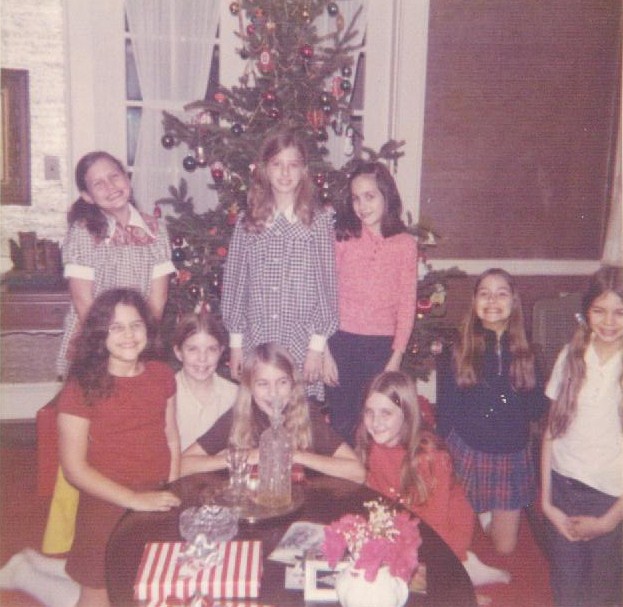
Some of my movie-viewing pals and me,1972.
Apparently, during several years in the 70s, we only
took photos around Christmas time.