He had to be up to something. He couldn’t give up the practice cold turkey. It was one that was hard to top, but harder still to stop. In anticipation, my daughter and I decided to make the first move. We’d gone to Sears and, with a salesman’s help, picked out a perfectly lovely “air nail gun.” While we didn’t really know what it was, H had asked for it. He’d written it on the official “Family Christmas List,” a piece of note paper taped to the kitchen wall.
We beganpostingthe list several years ago in response to an annual after-Thanksgiving conversation, probably familiar in many households. Someone would bring up the topic of Christmas gifts.
What do you want for Christmas?
I don’t know. I really don’t want anything. I certainly don’t need anything.
You know we’re going to get you something. You might as well give us some idea.
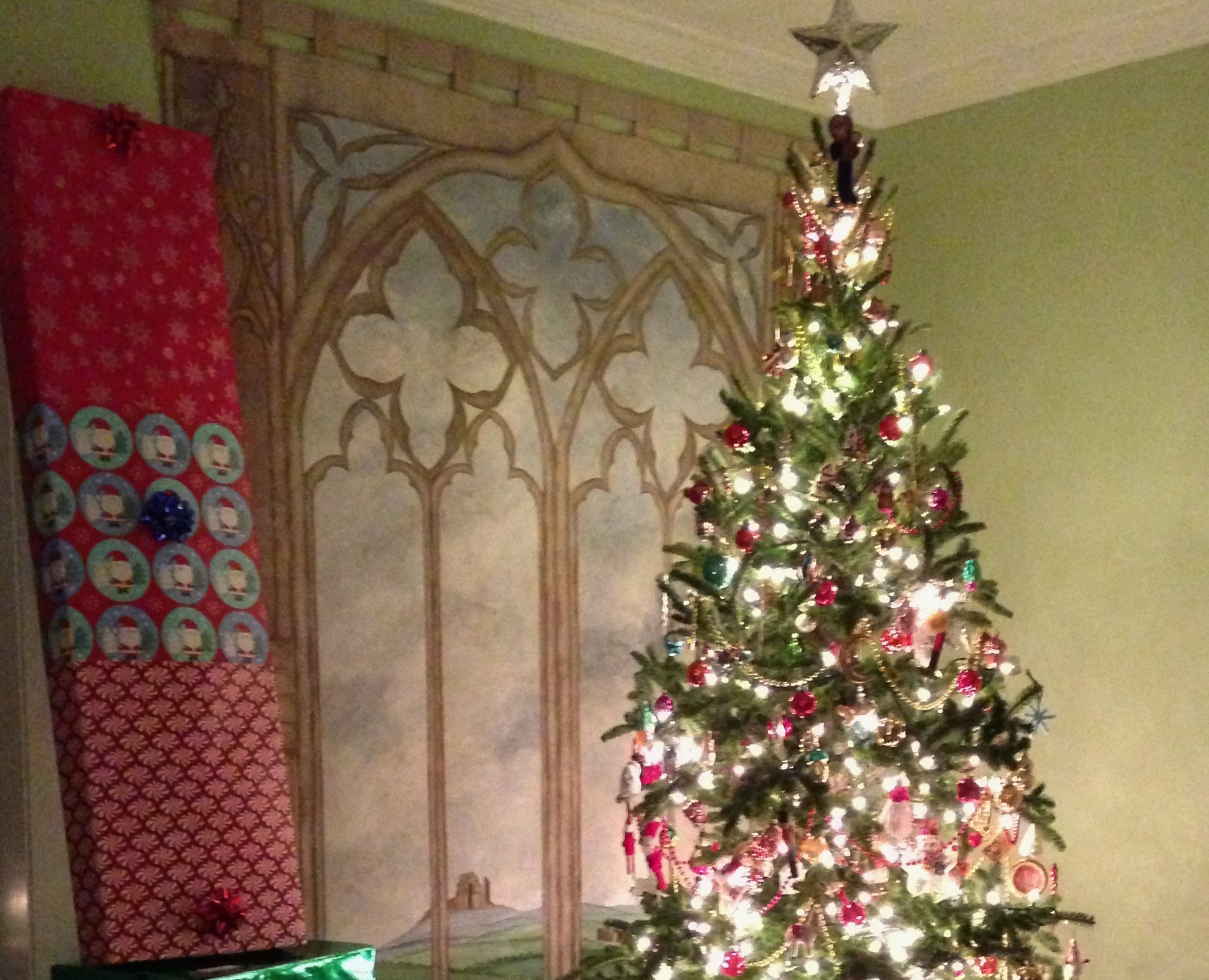
We have to have stuff to wrap and put under the tree. After nearly twenty years of marriage, I’ve become as dedicated a wrapper as my husband, despite being raised in a more minimalist holiday tradition. H’s Christmas list entries typically consist of highly specialized electronics, tools or windsurfing gear for which my daughter and I can’t be held responsible; we lack the expertise. He orders them and thanks us for our consideration and generosity. But this year, D and I actually went to a store and came home with an air nail gun. We weren’t sure it was the exact one he had in mind, but we kept the receipt. The package was of medium size and weight. We disguised it in an exceptionally long box, which we wrapped in three types of paper. Propped in a chair next to the Christmas tree, it greeted H rather boldly when he returned home from work. He was pleased to see that we were in the game.
His response began a couple of days later, when a single square package appeared by the tree. Wrapped in shiny paper, it was marked with a large letter E. An unassuming beginning, perhaps, but one that promised more to come. Later that night, another foil-encased box appeared atop the first, marked with another letter. By Christmas morning, there stood, as tall as the tree, a tower of seven packages, the letters spelling out our daughter’s name. A simple, but impressive presentation.
What’s in the boxes, of course, is of less importance than their visual impact and the process of unwrapping them. Some might say it’s a terrible waste of paper and not very green. This is probably true. But it can also be said that it’s a way of focusing more on the act of giving than on the gift itself. In this case, our family would agree on the truth of that old adage: It’s the thought that counts. Our gift-wrapping is nothing if not thoughtful.
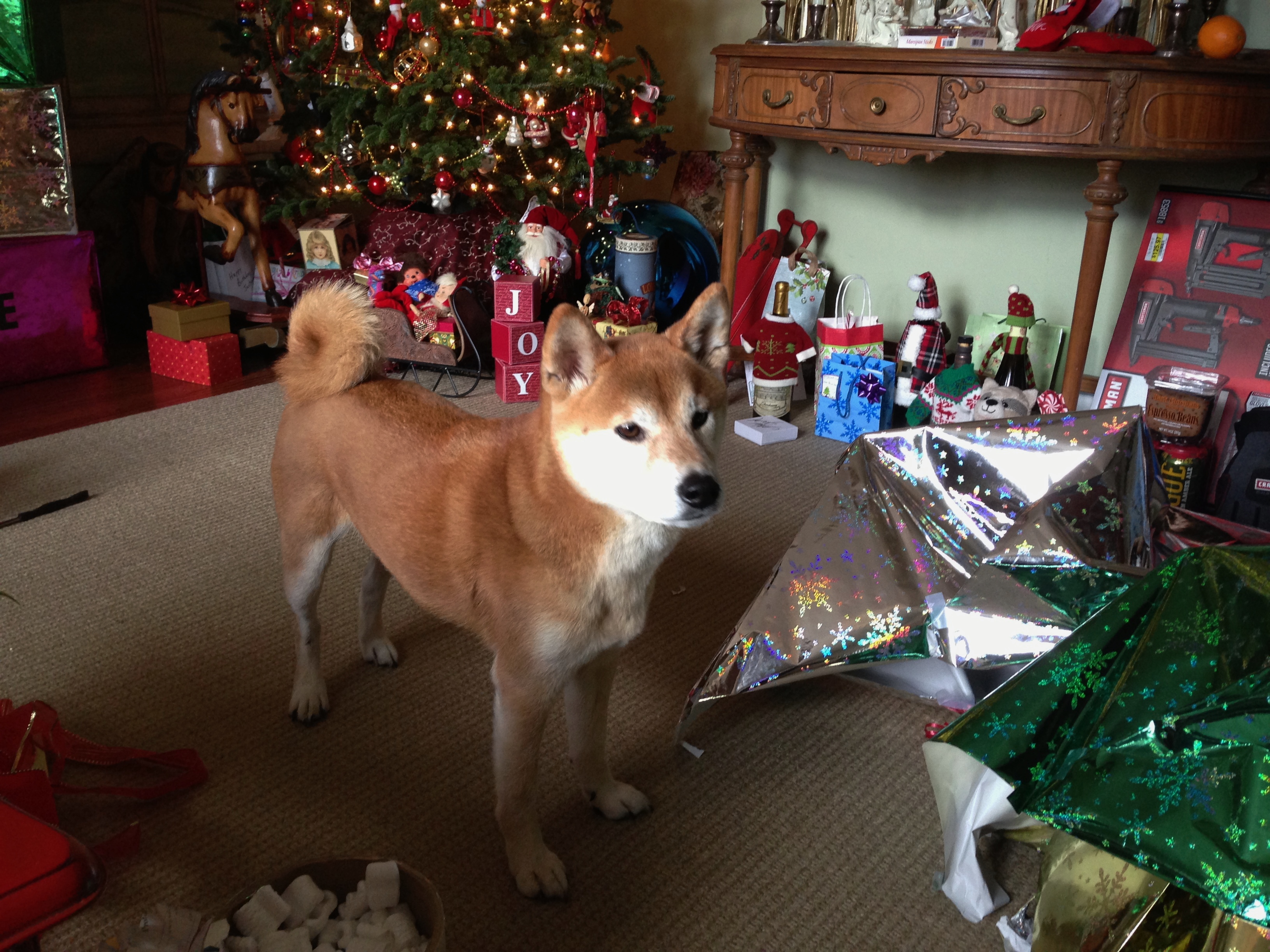
Kiko, on the other hand, isn’t so much into thoughtfulness or presentation, at Christmas or any other time. For him, it’s all about the smell, and he smells treats. What happened to his stocking? And is there more beef stick?
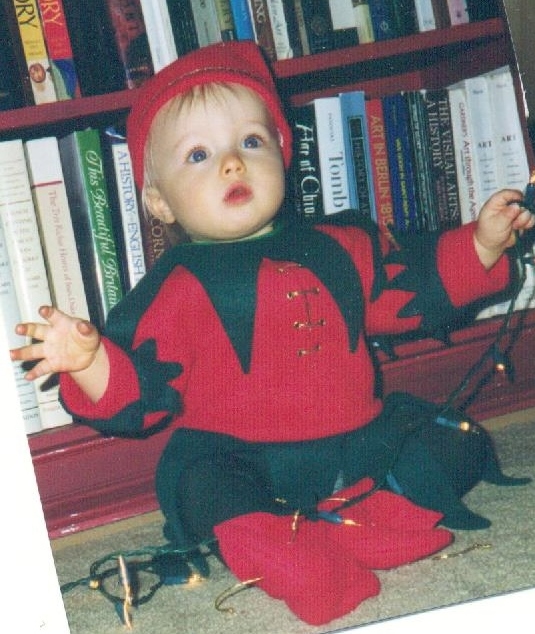
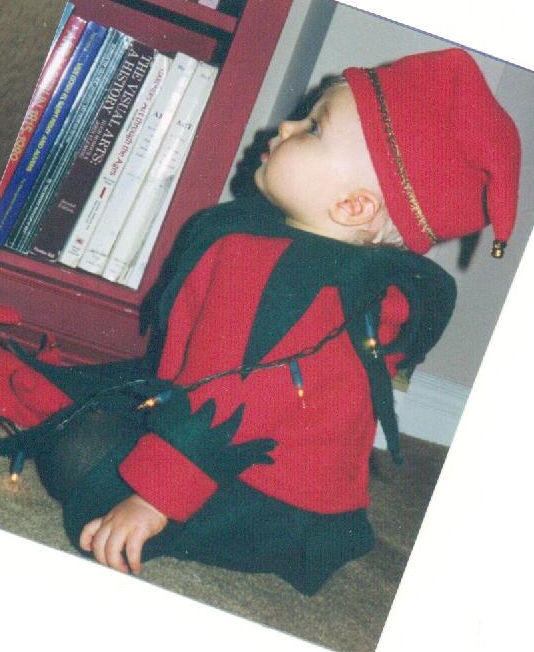
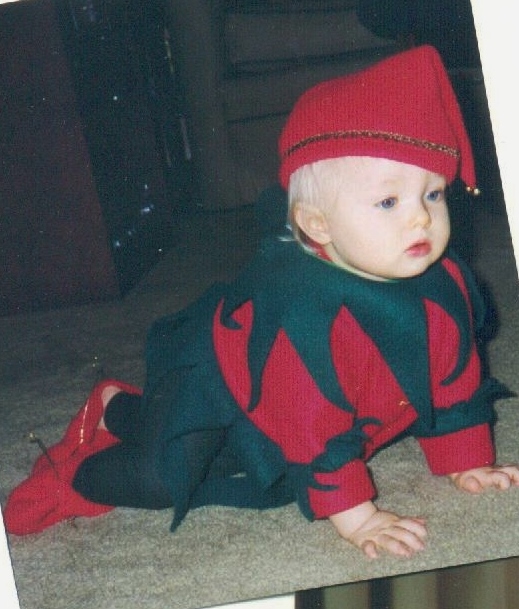
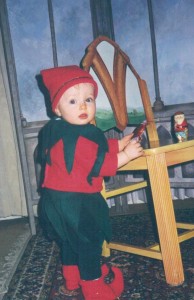
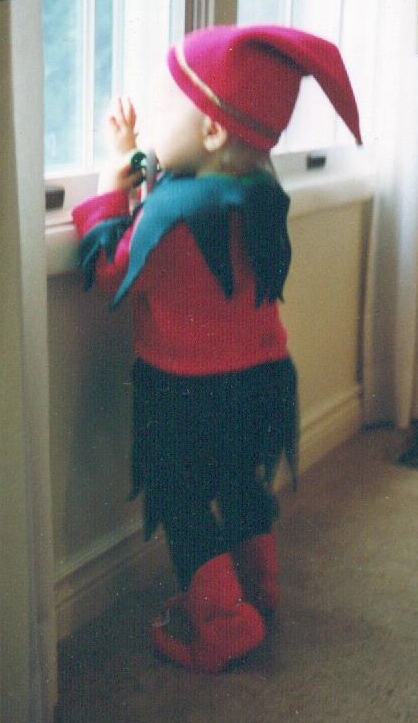
One holiday activity (and chance to go overboard) is no longer available to me. That’s dressing up my daughter in a Christmas costume and photographing her endlessly. Over the years, my mother had outfitted most of my dolls with Christmas dresses, coats, capes, and sometimes special hats. She was eager to transfer her efforts to our real-life baby doll when my daughter came along. For her first Christmas, Mama made her an elf outfit out of soft fleece. While D was, like many babies, often the contrarian, from the very beginning she was pleased to play dress-up and pose for the camera. Here, then, some photos from fifteen years ago, of our little Christmas elf, not quite twelve months old.
December 1999
To new parents, nothing says “Merry Christmas” like their baby decked out in holiday gear.
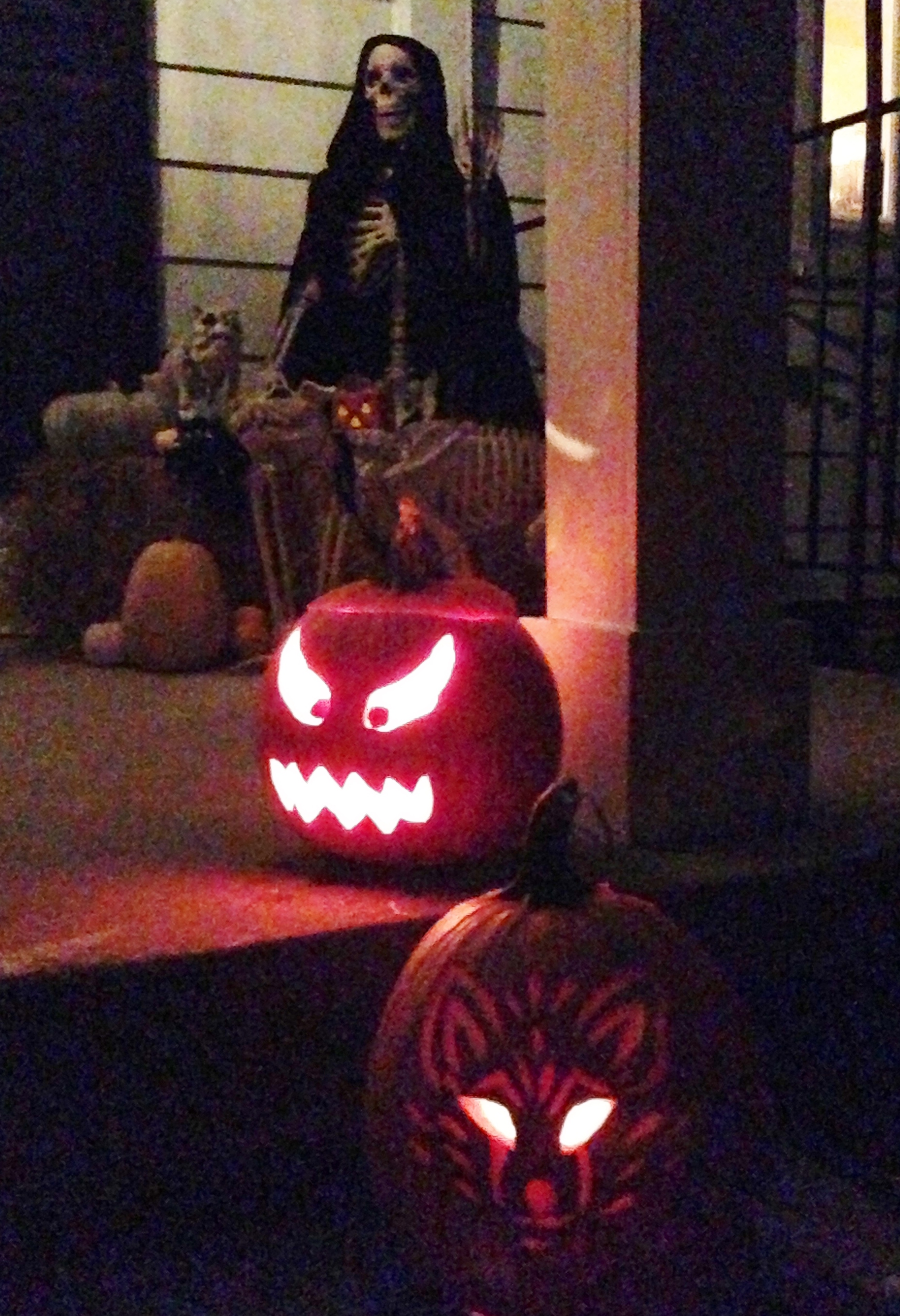
This October, after some deliberation, my daughter decided that her trick-or-treating days were behind her. She’d had a good long run: fourteen Halloweens of neighborhood candy collecting. Last year a mother answering the door at one home had uttered that dreaded criticism: Aren’t you girls a little old for this? My daughter seethed inwardly at these words.
It bugged me, too, I have to admit. I’m quite happy, one night a year, to hand out treats to polite, costumed children and teenagers of all ages, shapes and sizes. Who outgrows a love of candy, anyway? It certainly doesn’t happen in my family. My eighty-something father begins buying Halloween goodies as soon as they appear in stores, usually around July 5th. He and Mama see it as their duty to make sure the Butterfingers, Snickers and Milky Ways are up to par for the kiddies. By the time Halloween rolls around, they are quality-control experts.
Nevertheless, there comes a time when the annual house-to-house trek becomes more of a slog than an adventure. As with most pleasures that we outgrow, one day we wake up and know in our bones: the payoff is no longer worth the trouble. Facing the truth can be painful, but not facing it tends to be more so.
Trick-or-treating, then, was out. But my daughter has not outgrown her love of Halloween. And this year, for the first time in recent history, the holiday would fall on a Friday. Better yet, that Friday was an early-dismissal day that marked the end of the quarter and the start of a four-day weekend. She refused to settle for staying home and answering the door. She determined to celebrate Halloween, and properly. Without trick-or-treating, but with friends, costumes, and, of course, candy.
For additional thoughts on Halloween and trick-or-treating age limits, see On Improving Halloween, from November 2011.
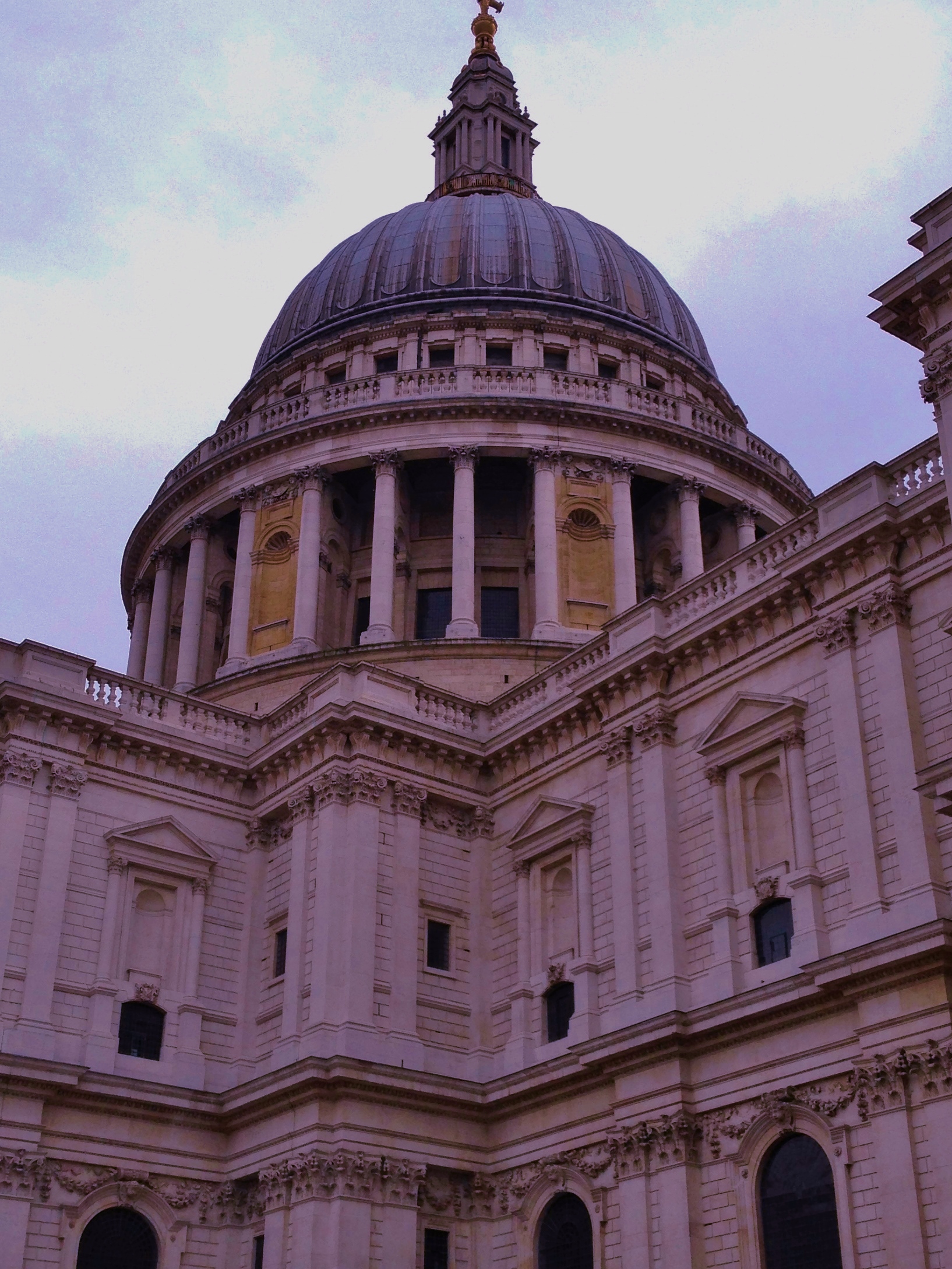
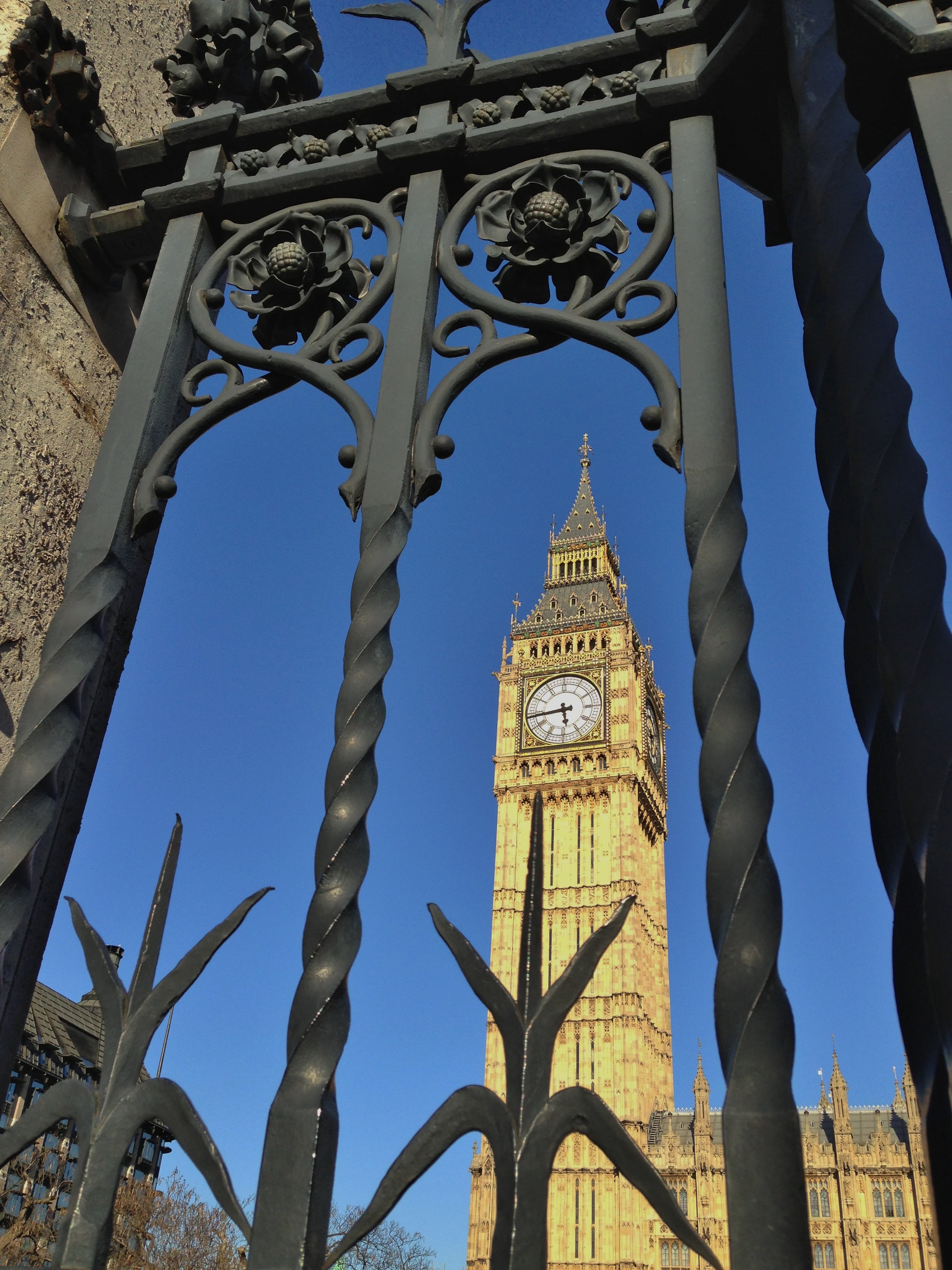
I was looking forward to showing my daughter Saint Paul’s Cathedral, which I’d studied repeatedly in various art history courses. D was familiar with it from her preschool years when Mary Poppins was a revered staple in our video library. In those days, I tended to remind her, too often, that the “Feed the Birds Church” was a real, famous, enormous church in London. Sometimes I’d show her pictures of it in my architecture books. And if my husband were in on the viewing, he’d explain how young Michael’s tuppence, used for bread crumbs for the birds, instead of deposited into Mr. Banks’ bank could, in theory, have caused a run on the bank. No doubt D would have preferred fewer teachable moments while she watched her movie, but that’s a burden some only children must bear.
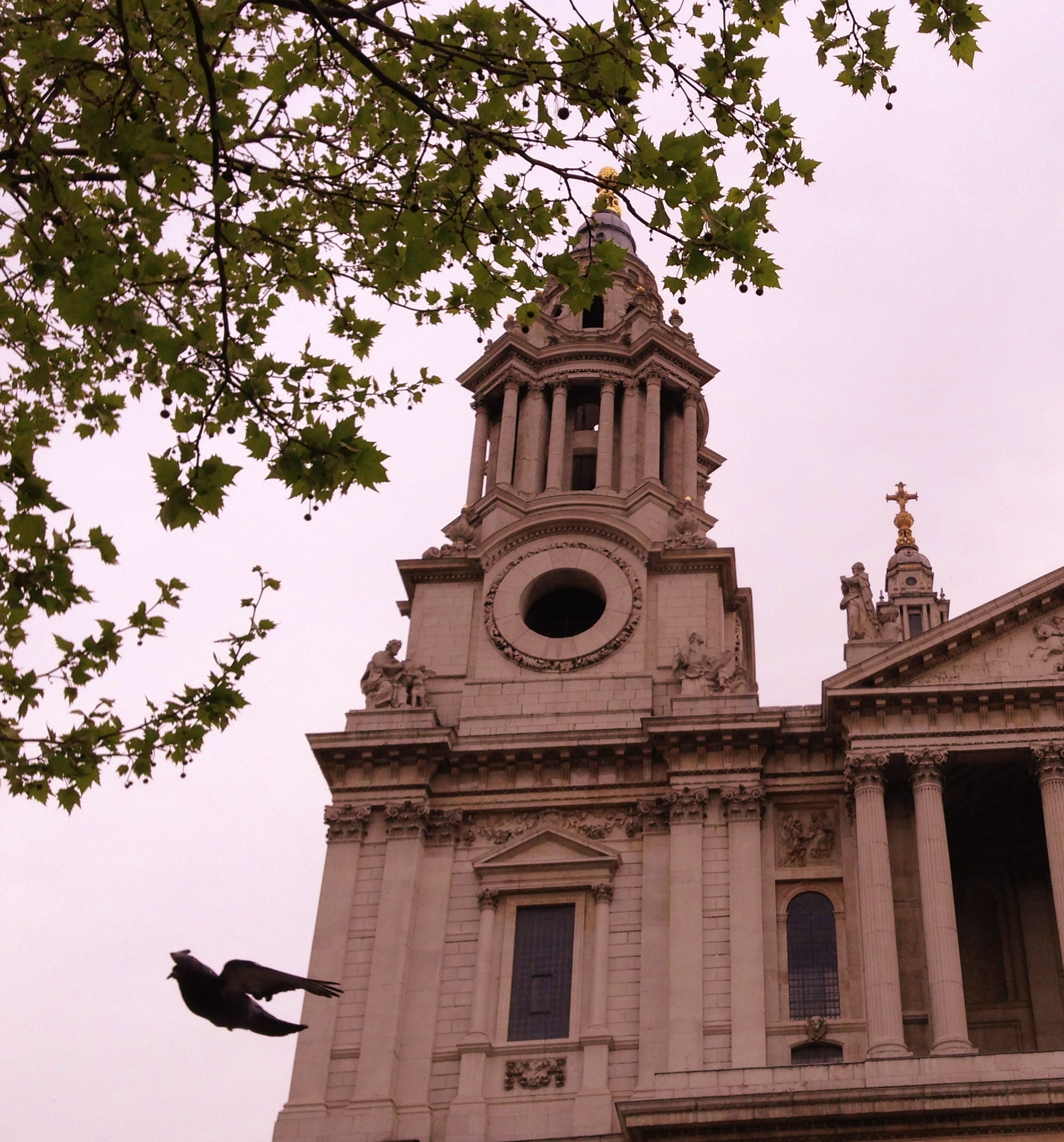
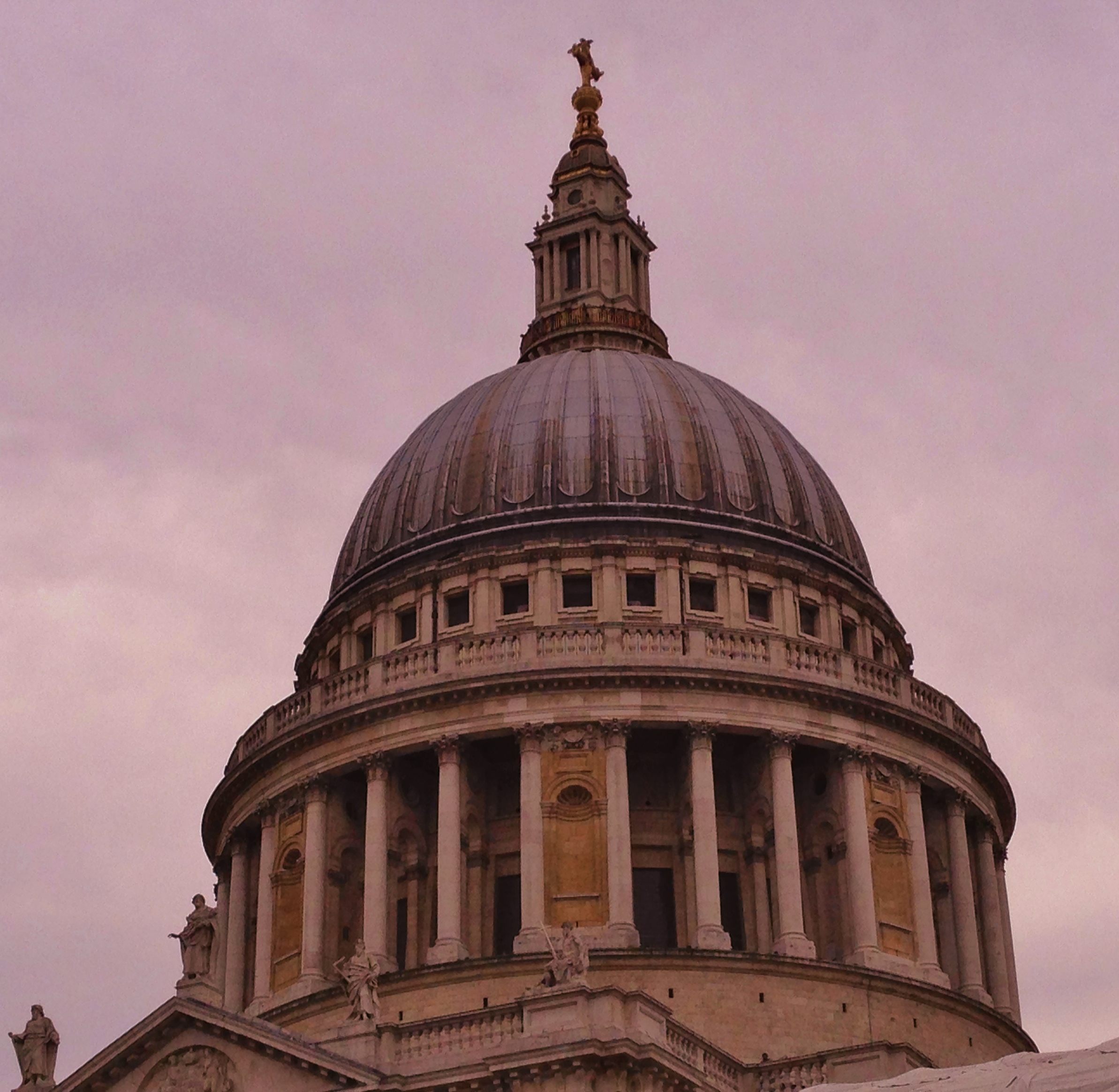
St. Paul’s stands atop Ludgate Hill, the highest point in London. A church dedicated to St. Paul the Apostle and prolific New Testament author had existed on the spot since the sixth century. The current church replaced a large medieval basilica built in the Romanesque and Gothic styles. Like much of the City of London, it was destroyed in the Great Fire of 1666. At the time of the fire, a young Christopher Wren had been involved in updating Old St. Paul’s. A network of wooden scaffolding was in place as the stone walls were being repaired. Had the scaffolding not caught fire and ignited the wooden roof beams, portions of the medieval church might have been salvageable. After the destruction, Wren was hired to design a grand new cathedral. Wren rebuilt over fifty London churches, but St. Paul’s is his crowning glory, a masterpiece of the English Baroque style.
The highly sculptural west front of St. Paul’s, with its double temple front and twin towers.
Feed the birds, tuppence a bag.
Wren’s monumental dome drew on Italian Renaissance forerunners by Michelangelo, Brunelleschi and Bramante.
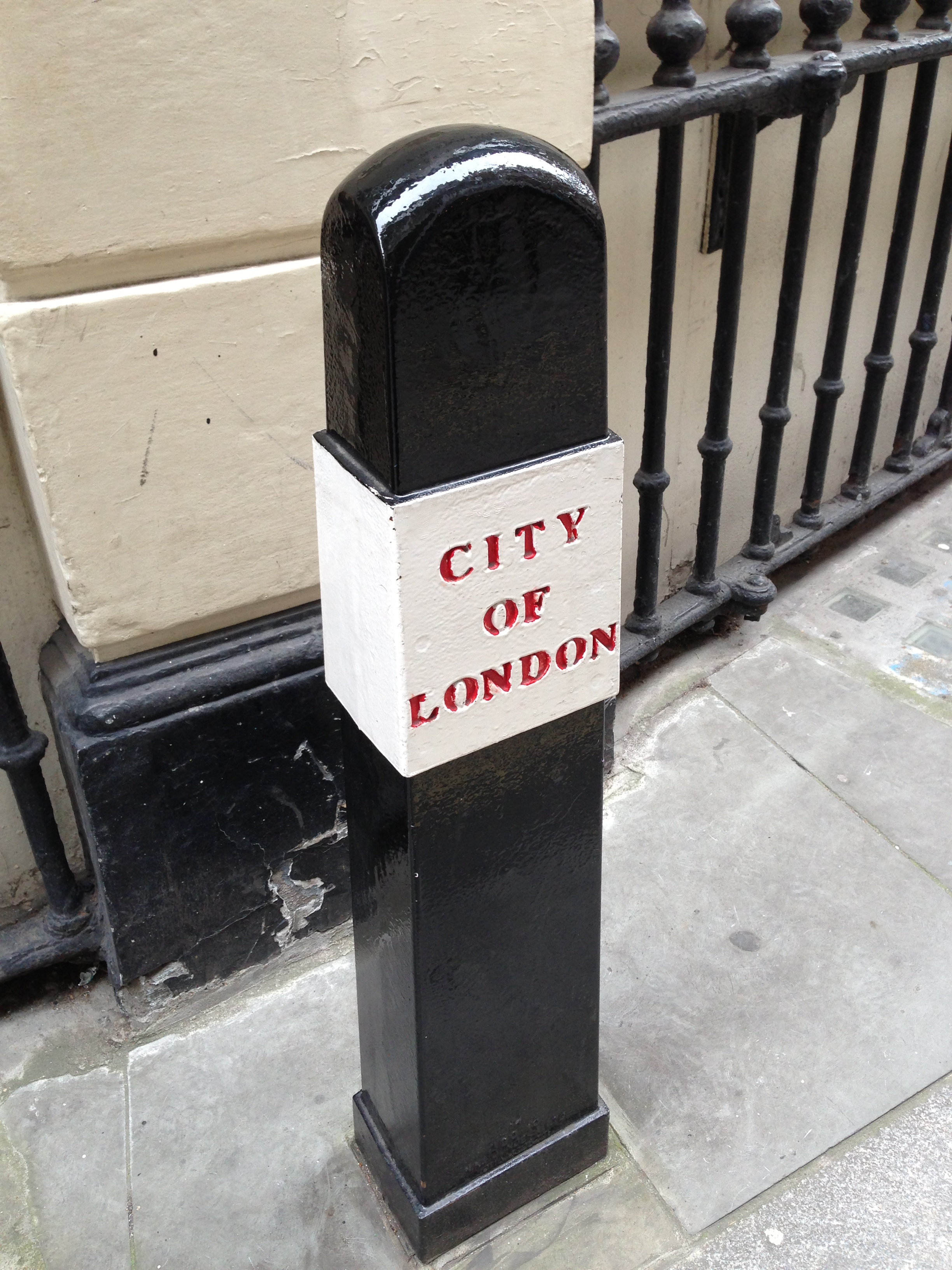
From its earliest days, St. Paul’s has been a distinctly urban church. Considering its location in the densely crowded City, the heart of London’s commercial district since ancient times, it could hardly be otherwise. Seventeenth-century images of Old St Paul’s show the hilltop basilica closely surrounded by haphazardly constructed smaller buildings. The warren of wooden homes and shops that encroached upon one another made suppressing the four-day Great Fire particularly difficult.
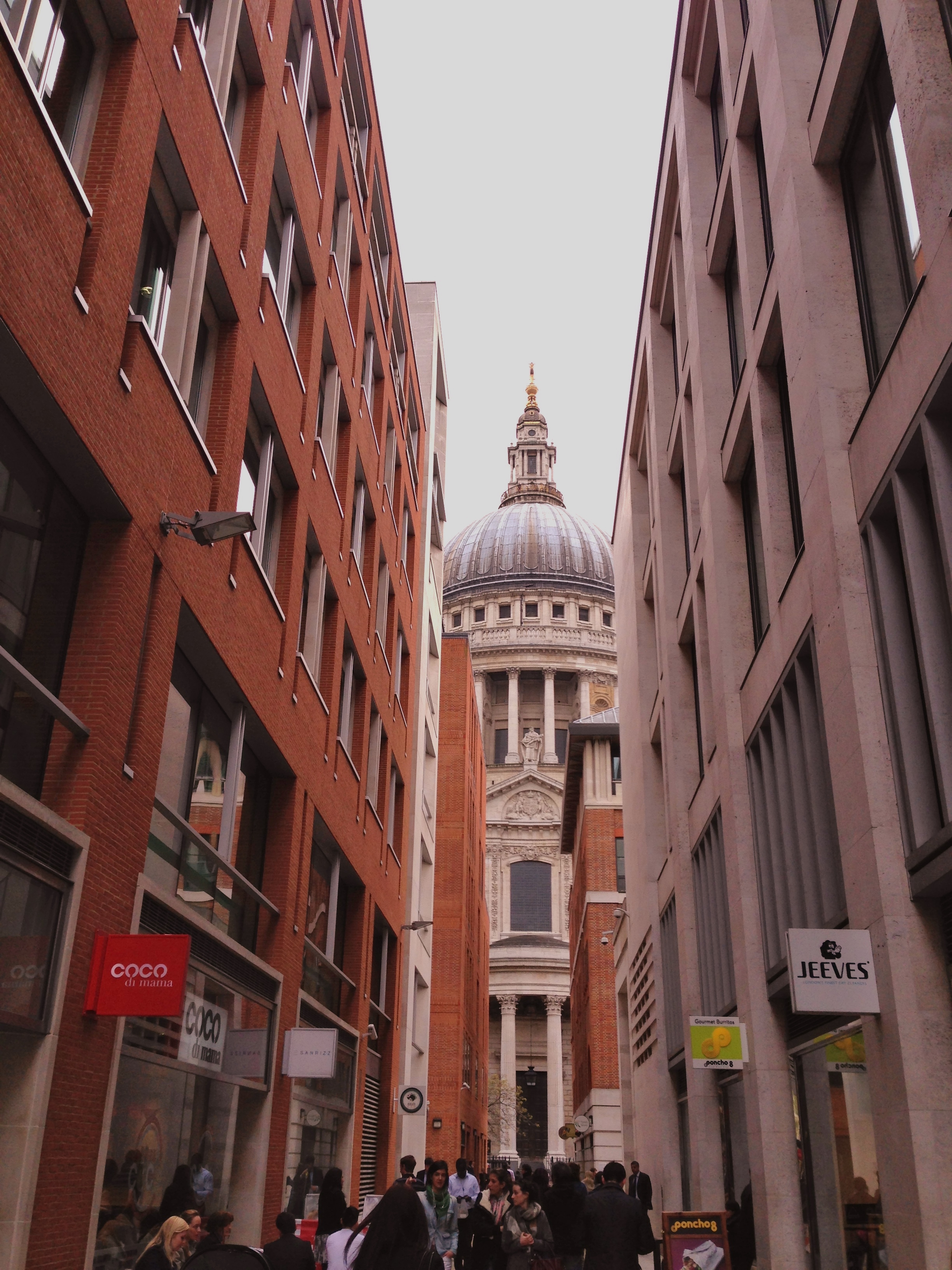
That St. Paul’s continues to be hemmed in on all sides by ordinary office buildings is therefore not surprising. But, I wonder, do they have to be so emphatically ugly and insinuatingly pushy? A wave of fresh disappointment hits me every time I approach the great church from a street like the one pictured above.
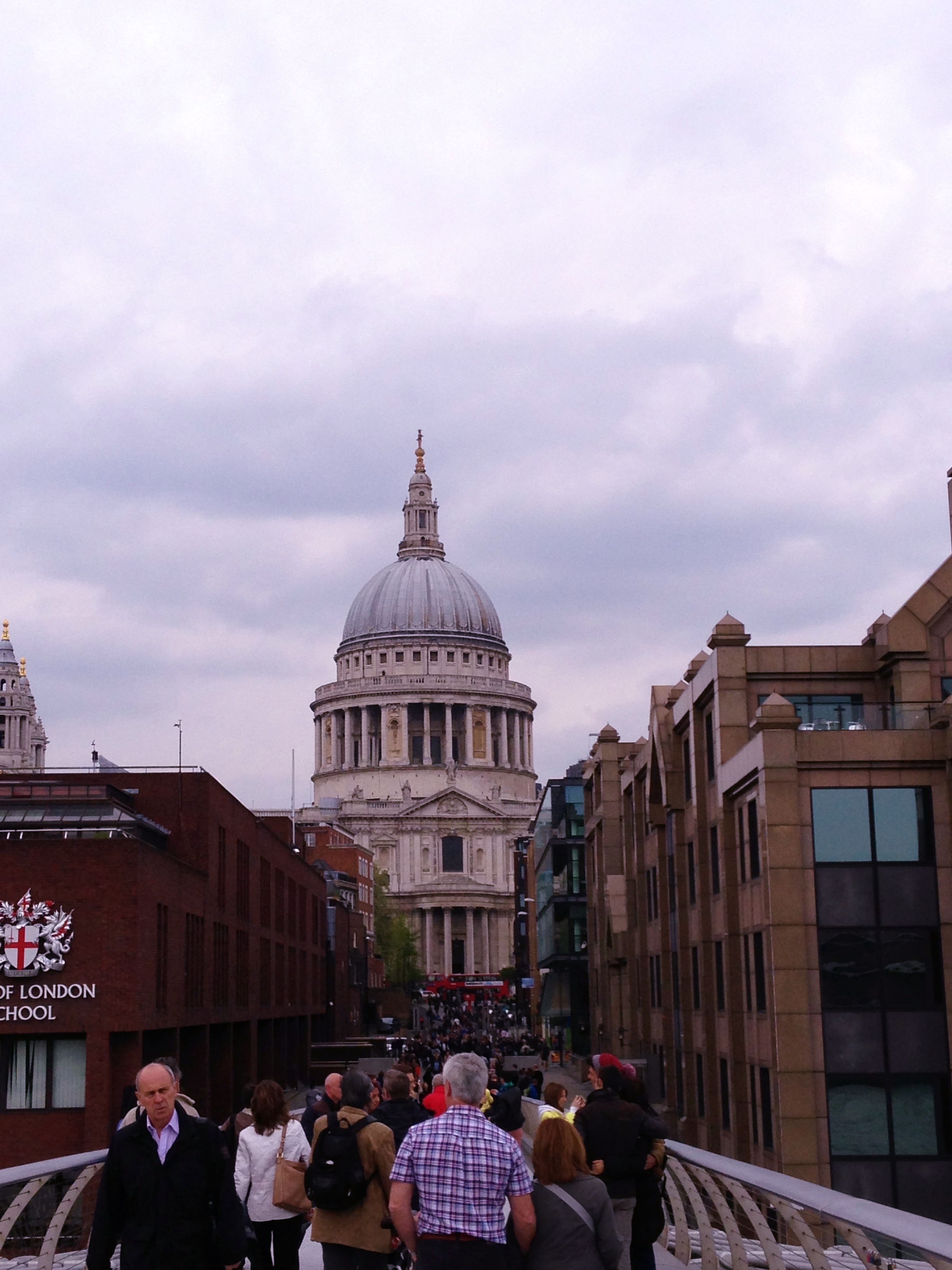
The British flair for the sweeping, spectacular vista is nowhere in evidence around St. Paul’s. Above, a view from the Millennium bridge.
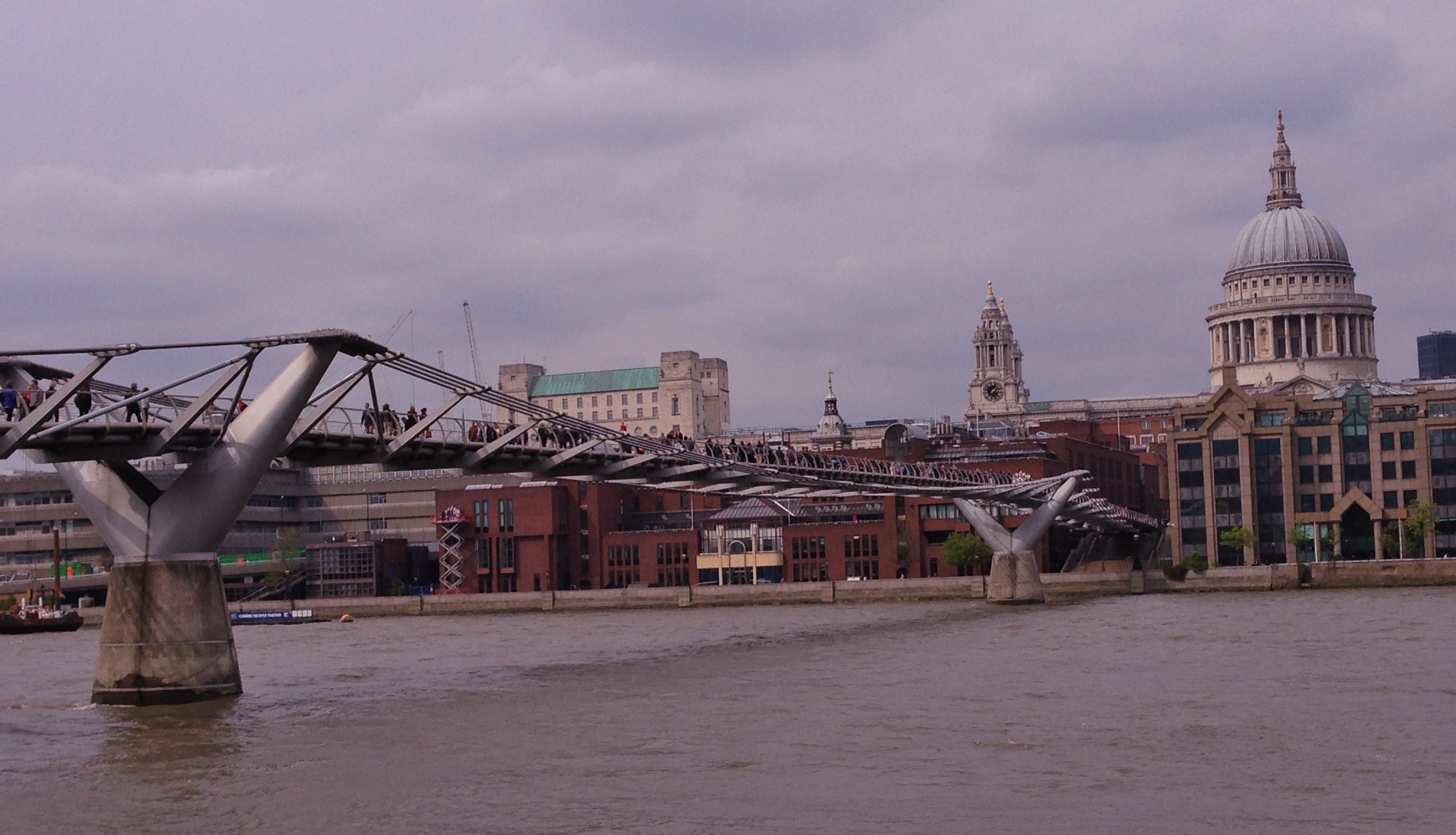
The Millennium Bridge and St. Paul’s from across the Thames.
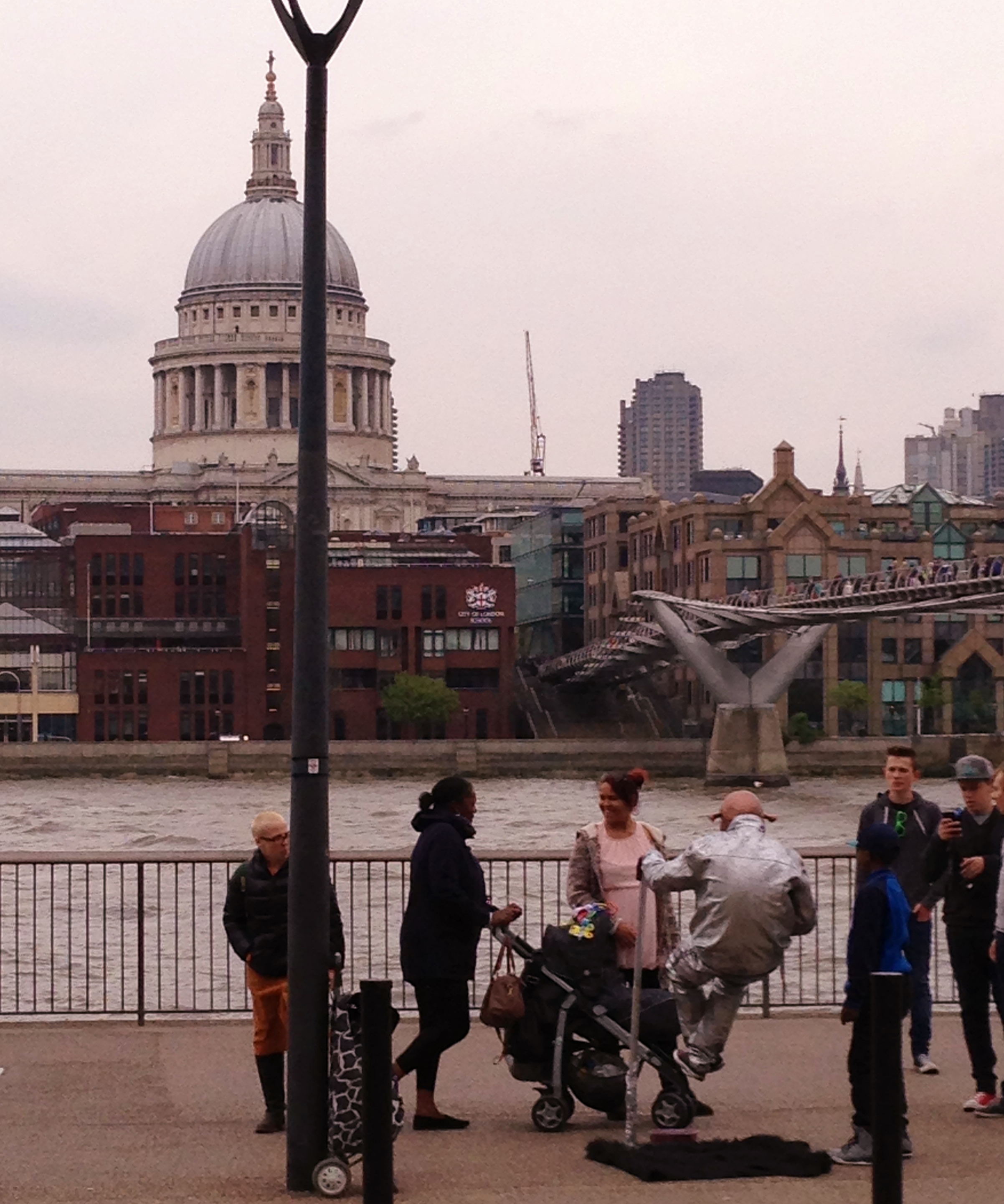
St. Paul’s looks down on the life of the city, as it has since its completion in 1708. Above, in Bankside near the Tate Modern, a Shrek in a silver track suit amuses pedestrians by hovering in mid-air. Despite the labyrinth of buildings that crowd the base of the Cathedral, the dome still towers well above newer, less distinguished neighbors. Let futuristic skyscrapers such as “The Shard” and “The Gherkin” continue to pop up, as long as they don’t blot out the vision of that iconic dome.
Arriving in London’s St. Pancras station after a twenty-five year absence, the first of many changes that had overtaken the city since then began to wash over me like a wave. In 1989, work on the Channel Tunnel, following decades of planning, discussion, and ongoing set-backs, was in its very early stages. Back then it was still called the “Chunnel,” and its progress, or lack thereof, was daily tabloid fodder. The media eagerly fanned the flames of unease about the possibility of a land link to the Continent opening up a deadly rabies pipeline. Enormous, rambling St. Pancras had sat largely derelict. With its brooding red-brick towers and aura of neglect, it could have been mistaken for a Victorian mental asylum. It was gratifying to see how beautifully the station had been restored and updated to accommodate the Eurostar line. Had it been in a U.S. city, it more likely would have met the wrecking ball than renovation.
Emerging onto the streets of London, a less welcome transformation confronted me. The classic, classy black cabs–those timeless Hackney carriages–where were they? I knew they still existed, in a somewhat updated form, and in colors other than black. But the streets outside the station swarmed with garish purple and orange minivans. We could have been in Cleveland. We settled for one such vehicle to take us to our hotel on Grosvenor Square. Oh well.
One thing that had not changed, however, was the near-anarchic state of London’s traffic, which tends to be particularly alarming upon first arriving. Cars, motorcycles, bicycles and pedestrians are constantly darting aggressively from unexpected directions, especially at round-abouts. About half the vehicles appear to be confused by the concept of left-side driving. Our driver was frequently outraged at the ignorance and rudeness of others on the road. Some things, then, never change. In comparison, Paris’s streets were those of a sleepy backwater.
As we made our way through the chaotic congestion, in sudden fits and stops, I caught a glimpse of the new British Library next door to St. Pancras. When I left the U.K, it had been no more than a hazy, perhaps-some-day project. Most of my daily dissertation research had taken place in the manuscript room of the old library, then part of the British Museum on Great Russell Street. Less often, I worked under the vast grand dome of the historic main reading room. The new facility, perhaps a model of sleek twenty-first century efficiency, struck me as lacking in charm.
But it didn’t matter. It’s highly unlikely that I’ll ever turn the brightly painted and gilded pages of a fourteenth-century Apocalypse again, in the new library or elsewhere. I had abandoned my academic ties, let all those bridges quietly smolder away to ashes. I’d come to the conclusion, as I was finishing my dissertation, that a career in college teaching wasn’t for me. That was fortunate, since jobs in my field were extremely rare. I have no regrets about the course my life has taken. Do I? No, I don’t.
But I do miss the chance to page through those amazing medieval books, written and illustrated by hand. Their quirky images, typically more humorous than frightening, despite the accompanying text of Revelations: the dragons that resemble perky, pointy-eared dogs sitting for treats (in my mind, now, I see Kiko in every one), and the New Jerusalem descending from heaven, looking like a Gothic princess’s dream doll house. I can point out some of the books to my daughter, although they’ll have to remain safely inside their hermetically sealed glass display cases. See this one? I studied it. I had it in front of me for an entire week. It was removed from display so I could examine it! I think she’d be impressed. Someday, I’ll show her. But probably not on this trip.
It’s my daughter’s first day of tenth grade. My baby is a high school sophomore. That would be hard to believe, if she didn’t look so grown up. And if she weren’t regularly driving. She got her learner’s permit at the end of June, and so far, she’s a cautious but not overly fearful driver. She’s determined not to be like me, hesitant to drive on the “big roads,” which I define as anything with an on-ramp.
Only two more such “first days,” and then she should be off to college. Now that is truly hard to believe.
As September rolls around, I get a bit nostalgic for the years when my daughter didn’t go back to school. Or for those years when school meant only preschool, three mornings a week. I like to recall crisp, sunny afternoons, when she and I had nothing more pressing to do than to wander the neighborhood in search of signs of fall. We’d collect acorns, pine cones, and brightly colored leaves. Some we used for decoration; others for crafts. (See here.) After our walk, we might spread an old quilt on the lawn and spend a couple of unhurried hours lazing there, talking, reading and snacking.
Back then, there were no hard-to-find school supplies to track down, no quandaries over which binder is better, no piles of tedious forms to complete and sign. No back-to-school nights for H and me. We’d already met the teachers. We knew them. And we had absolute confidence that if our daughter needed extra help with the curriculum, we were experts in every field of study: we knew our ABCs, we knew how to count, and how to spell our daughter’s name.
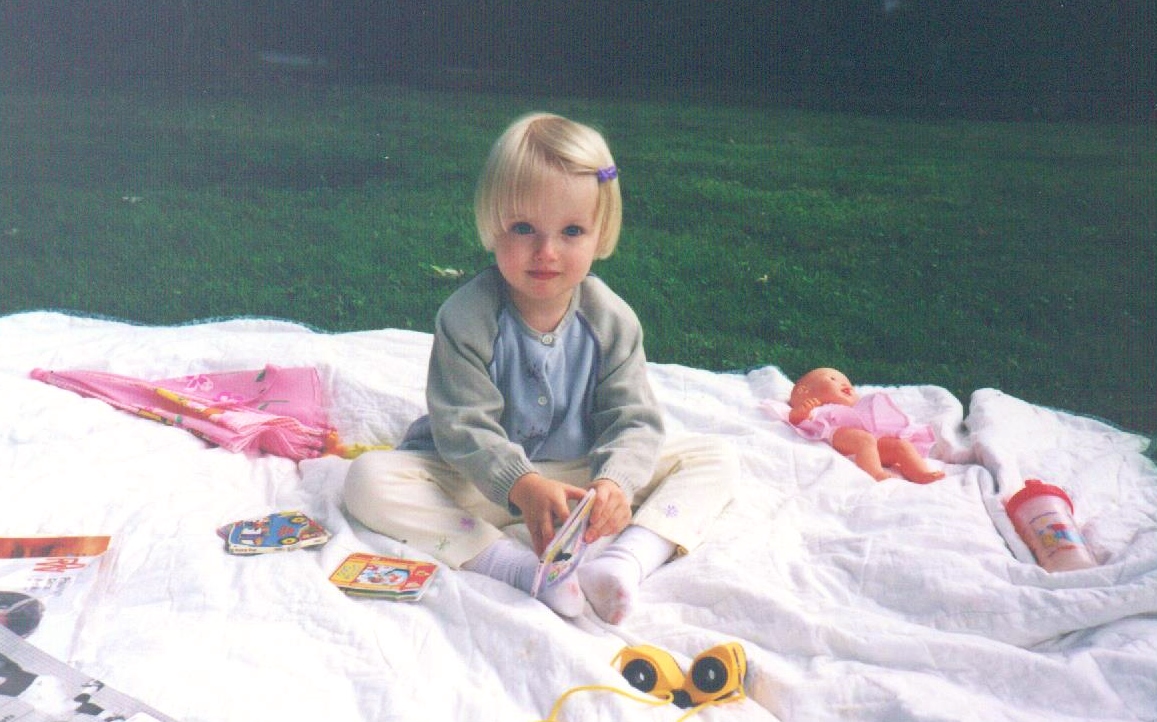
Afternoon on the lawn, September 2001.
This year, as D takes pre-calculus and chemistry, I’m glad I married someone whose intellectual strengths are my weaknesses, and vice versa. Should our daughter need assistance in math and science, my husband will be on it. I can advise on some aspects of history and English. But we’ve learned to wait to be asked. Both of us are very glad that we no longer have homework, and we have no interest in doing our daughter’s.
Thinker with a sippy cup: D in the fall of 2001.
What’s harder is not offering up certain nuggets of unsolicited advice on non-homework topics. Sometimes we know we should keep quiet because we need to let D live her life. Many situations are only made worse by our meddling in them. Other times, we realize that by saying one thing, we might prompt D to do the opposite. She’s not a rebel. But she is a teenager.
Before we left for Paris, we had reached a family decision to take the Eurostar train to London instead of traveling further in France. We’d compare two major European capitals. It would be a great experience for our daughter. My husband was interested, since he had spent little time in England. But I wasn’t sure I was ready to return to London. It had been twenty-five years. I had waited too long. So long that any return trip would always be too soon.
When I was last in England, I had felt very much at home. A year of living in London, traveling regularly to Cambridge and Oxford and elsewhere throughout the UK had left me feeling like a local. The next year, a month-long follow-up visit seemed like a return to the old home place.
But England was no longer home. That priceless cache of experience I had accumulated piece by painstaking piece–all that familiarity, all that intimate knowledge of a place and its people–it had mostly vanished. Staying away for two and half decades will do that. Now, I’d be just another middle-aged tourist mother traipsing from site to site, attempting to decipher an unwieldy map.
The whirlwind of mixed-up memories that spun around me in the garden below my old Paris dorm room had been daunting enough. I was afraid London would stir up a contrast even more uncomfortably extreme. Could I face yet another collision of the current me with the student me from half a lifetime ago? Of course I could face it. But I doubted very seriously that I would enjoy it.
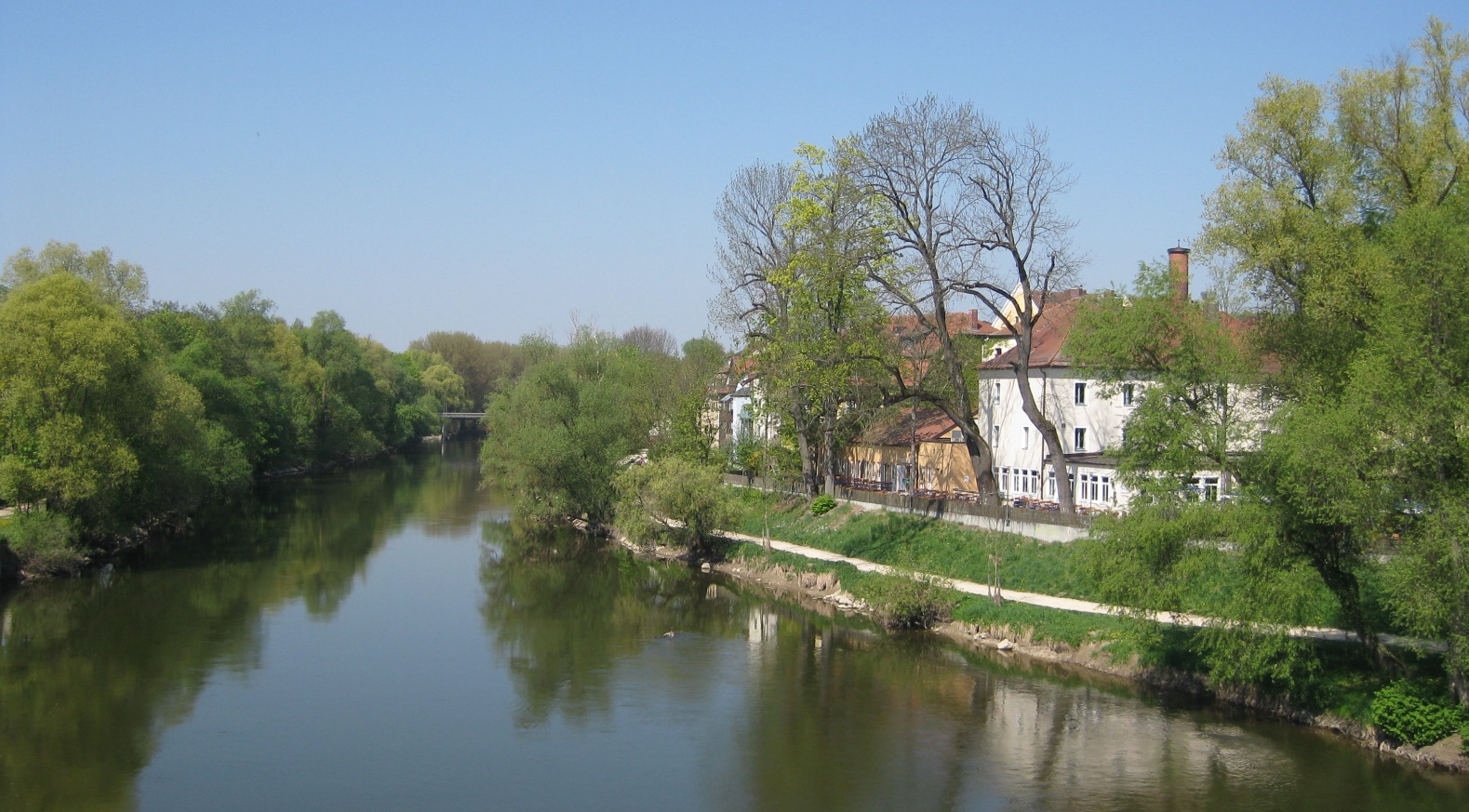
I understood with new clarity how my father must have felt when we stood on a certain medieval bridge in Germany. As an eighteen-year old fresh out of high school, he’d been stationed in Regensburg with the U.S. Occupational Forces after World War II. Before long he was seeing a beautiful German woman in her mid-twenties. She’d lived in an apartment building on the other side of the bridge. He’d become like one of the family, welcomed by her mother and her small daughter. When his overseas service had been cut short following the sudden death of his father, he’d never said a real goodbye to Anna-Marie. He thought he’d return shortly. He didn’t.
Sixty years later, he was in Regensburg again at last, accompanied by his wife, daughter and granddaughter. Did he want to cross the Stone Bridge and see if anything remained of the old buildings he remembered? No, he didn’t. It was all too much. Too much time past, too much change, internal and external, to wrap one’s head around.
A sixty-year wait for a return trip is certainly too long. A lapse of twenty-five years wouldn’t be nearly as overwhelming, would it?
A View from the Stone Bridge, Regensburg, April 2011
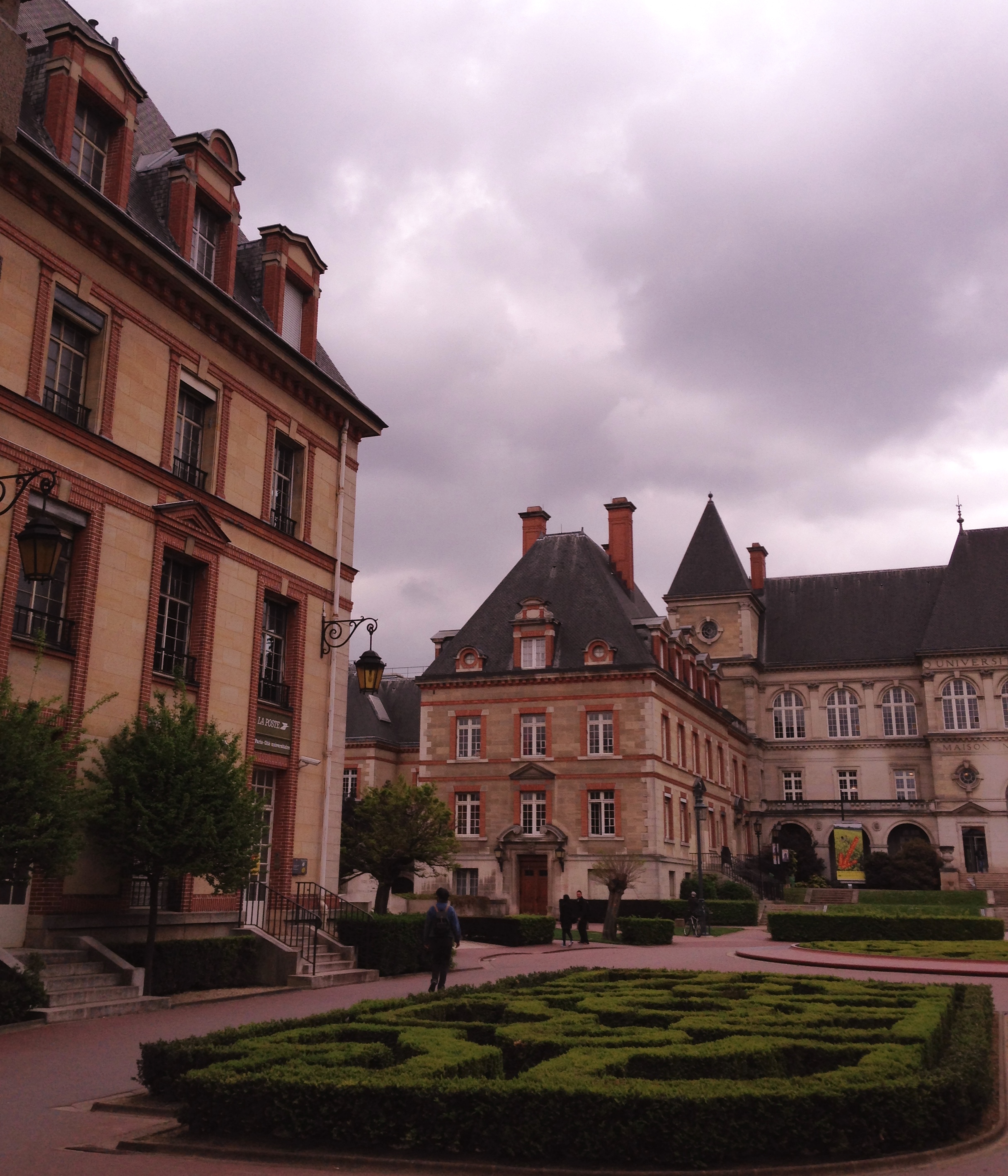
All the transparent life layers have flipped by in a whirring flash. I’m back to the present, and it’s April 13, 2014. But the past is incredibly close. It circles around me like a bird immediately overhead; I hear the beating of its wings and feel the air they displace. In the garden of the Cité Universitaire on the southern edge of Paris, I feel as though I’ve just learned the resolution of a suspenseful film. I don’t know the end of the story (thank goodness), but I’ve discovered the end of the middle, and it’s an immense relief.
Throughout my teens and twenties, whether I’d ever marry was an open question. I knew I wanted marriage, but I wanted it with the right person. I’ve never held to the notion that there’s one perfect match out there for each of us. There are no perfect matches. Probably, for most of us, we might come across several people over the course of a lifetime with whom we could forge a more or less happy union, depending upon circumstance and our commitment to perseverance. But it’s a limited number, while the number of bad choices is huge. And making that choice is a tricky business, as the divorce rate attests.
I bided my time for so long because over and over, I’d seen that Right One morph into a Never Mind. Appearances are deceiving, as are first impressions. In a recurring dream, heavy with doom, I found myself married to one of my many Mr. Wrongs. They were all nice guys, but after a promising start, they turned out not to be right for me. I didn’t want that dream to become a reality. As I stand here with my husband, my husband of nearly nineteen years, it hits me like a revelation: I found a good one, and I think it’s gonna work out!Whew!
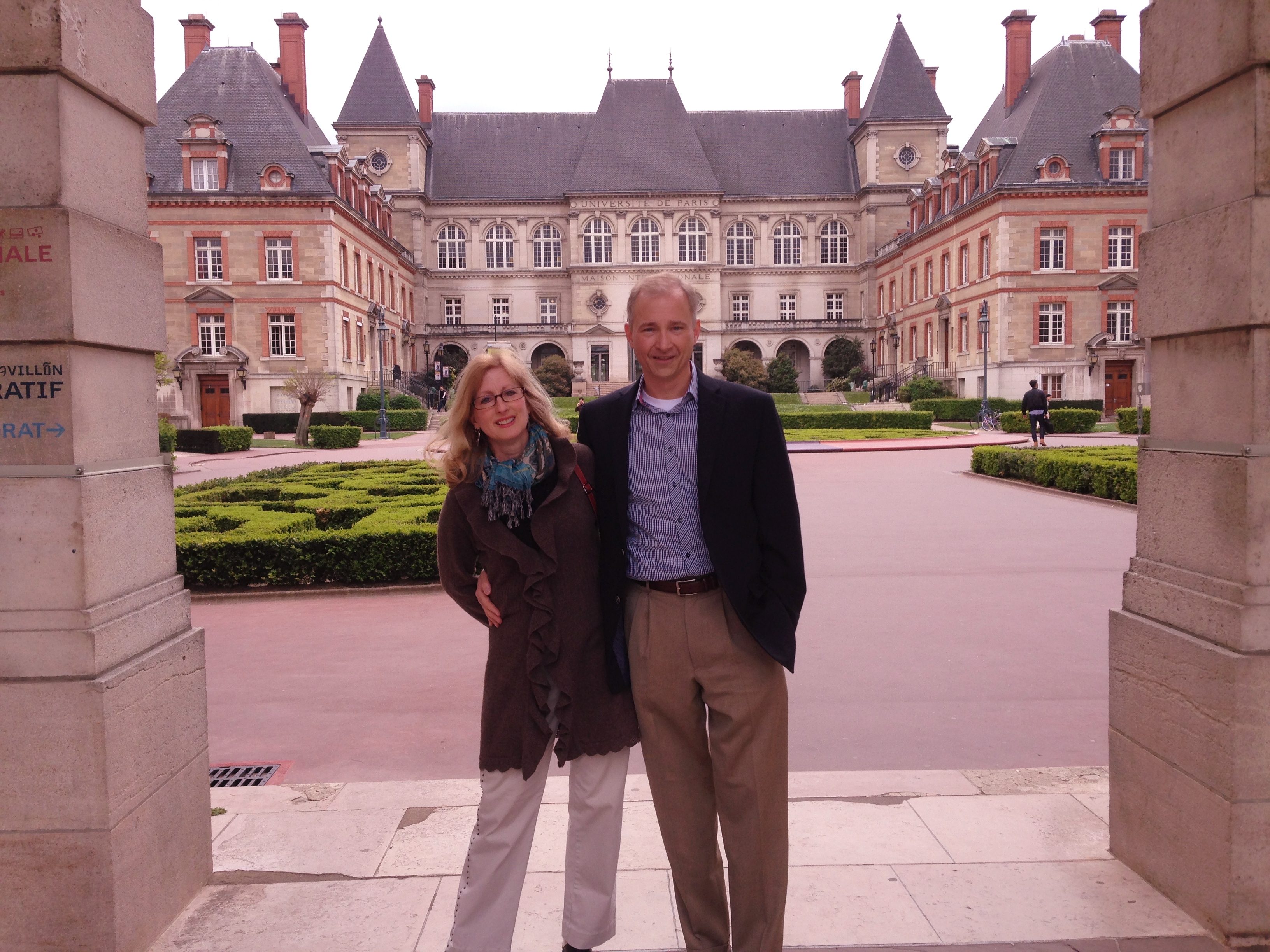
He’s my Mr. Right: with H in front of the Maison Internationale at the Cité Universitaire.
Like many women, I’d worried that in postponing marriage, I might miss out on being a mother. I knew I wanted a child some day. Certainly one child. Possibly two, if I got started early enough (although that seemed unlikely). But not three or more. I know my limits. I had grown up a contented only child. I saw no reason to crowd up the house with kids. But I really wanted my shot at motherhood. Would I get it? The answer seems to be revealed anew: Yes, yes, yes! I’m here with my daughter, my fifteen year old daughter. I got my girl! The girl I’d always wanted. While I had prayed for a healthy child, boy or girl, I’d secretly always wanted a daughter, with the hope that she and I would be close, just as my mother and I are.
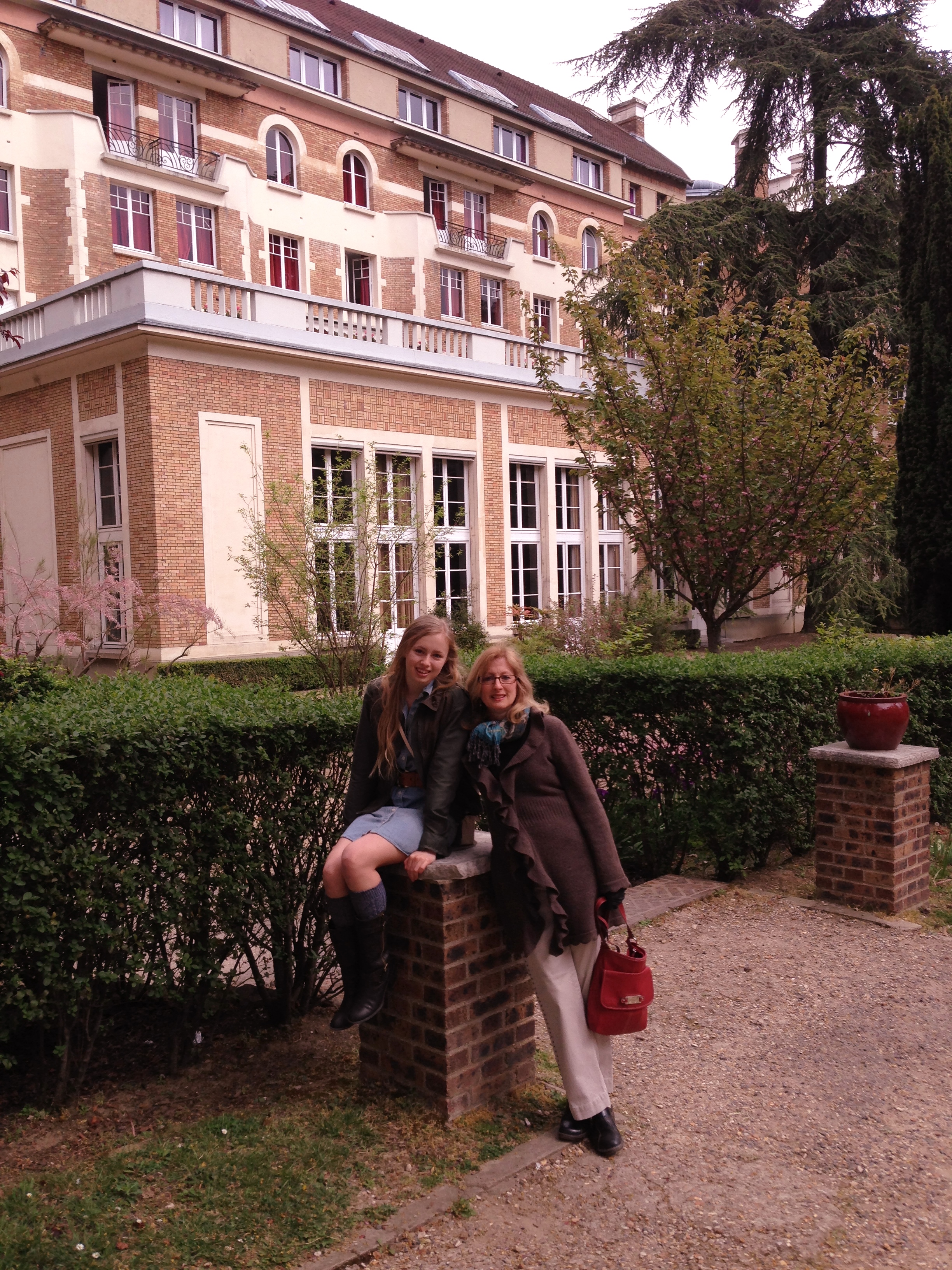
Me and my girl, my buddy, in the garden of the Cité. My old balcony and its open door are visible above.
How glad I am that I went back with my family to my former Paris residence. Given the opportunity, I will continue to return to such places supercharged with memory. The swirl of emotions they stir up is not for the faint of heart, nor is the undeniable reality of time’s passage. There’s no doubt about it–I’m quite a bit older. Perhaps older than I’d ever imagined being at nineteen. But in returning to this spot where I was so memorably youthful, I can still sense the essence of that youth, which seems to hang in the air like the smoke from fireworks on a hot July night. I’ve changed, but I haven’t changed. I think I’ve gained some wisdom over the years. My ninety-four-year-old grandmother once remarked to me that she still didn’t feel truly old. I’m starting to understand how she feels.
In going back, I came to see more clearly who I am and how I became that way. And it has made me emphatically grateful for the loving family who went there with me, for the first time.
Standing in the garden of the Cité Universitaire this past April, below the room that served as home during my college summer in Paris, I felt like I was in a time warp with tunnel vision. I could reflect on successive Paris life layers at once, one atop another. Today’s post concerns a time thirteen years after my travels in France as a grad student. It’s 2002. For the first time, I’m in France and I’m not a student. It feels strange. The responsibilities of adulthood have caught up with me. I’m a wife and mother, here in the city with my husband and my parents. We’ve left our nearly three year old daughter at home with H’s parents.
It had long been a goal of mine to accompany my parents to France. During my year in England, we had traveled together for three weeks, but we hadn’t yet done France. In the spirit of parental sacrifice, Mama and Daddy had repeatedly stayed home and paid, or helped pay my way. We had always said Sometime, we’ll all go. That sometime seemed to have arrived in 2002. We were all healthy and ambulatory. H, like me, was eager to return to France. Fourteen years had passed since his semester in Rennes. The overlap in the timing of our European student adventures had provided us with a point of commonality that may have been crucial in drawing us together initially. (See That French Connection, April 2014.) Ever the dutiful son-in-law, H didn’t complain about traveling with his wife’s parents, or sharing the tour-guide obligations.
Our daughter was old enough to understand that we weren’t leaving her for good. H’s parents were willing and able to care for her. Very briefly, we considered taking D with us. But I could see how the trip would unfold. She’d be continually preoccupied with something that seemed totally inconsequential to adult eyes. Under the fascinating spell of fallen leaves in the dirt, she’d be oblivious to the historic splendor all around her. My entreaties would go unheard: Look up, sweetie! Look at the beautiful towers. See those funny creatures way up high? Those are gargoyles. My mother would miss most of the sights she’d anticipated for so long. In an effort to make the trip proceed more smoothly for the rest of us, she’d devote her attention to placating her granddaughter. I’d feel guilty. We’d all be testy. Best to leave our toddler with Grandma and Grandpa at home, where she could enjoy, unimpeded, the pleasures of domestic leaves and dirt.
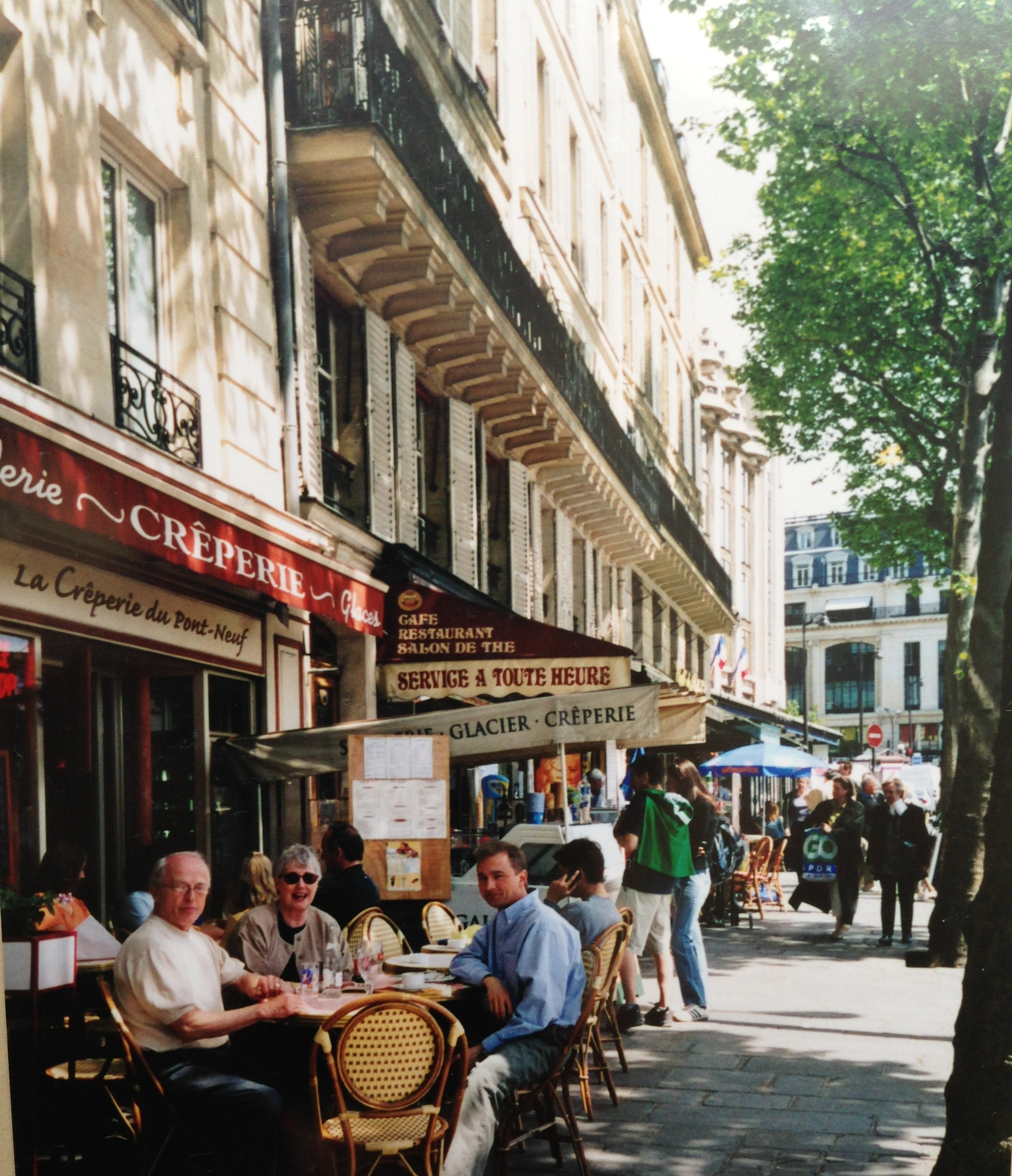
On our first day in France, May 2002: H and my parents at a crêperie near Notre-Dame.
My objectives for travel abroad have varied according to the stages of my life. As a student wearing the rose-colored glasses of youth and freedom, the realm of possibility was vast. Who knew what adventures, what fulfillments of fantasy lay ahead? Caprice, romance, astounding coincidence–while I didn’t take such winged creatures as my due, I also didn’t rule them out entirely. Who’s to say absolutely that I would not meet a sensitive, handsome young man as we admired the same obscure, underappreciated painting in the Louvre? Was it utterly impossible that he’d be involved in the thoughtful restoration of his family’s ancient and immense château? That my fresh American sensibility would invigorate him like a breath of fresh air? That we’d fall in love and live happily ever after among the rose-blanketed walls of honey-colored stone? That the surrounding village would be peopled by delightfully eccentric and charming characters, who would hold us particularly dear as Lord and Lady of the Manor? Such a scenario was clichéd, antiquated and extremely unlikely. But it wasn’t entirely impossible. After all, I was young. Anything was possible. And I’d experienced the unlikely before.
On this trip, it’s a different story. As a no longer young adult traveling with my husband and parents, my goals are considerably more modest and down-to-earth. I’m looking forward to seeing my parents appreciating my favorite French sights, and to comparing student experiences with my husband. I’m hoping for beautiful scenery, comfort, the avoidance of injury, illness and mishap. While my parents are hardly frail or weak, they are, obviously, even less young than I. A successful visit will be free of emergency room visits, crippling accidents, assaults and major transportation breakdowns. It will mean not losing Mama or Daddy temporarily or permanently on the Metro. Perhaps most importantly, it means an uneventful return that brings us back home safely to our little daughter.
Without incident, we check off the sights my mother the history buff had been waiting years to experience: Notre-Dame, the Sainte-Chapelle, the Louvre, Versailles, the Arc de Triomphe. (Daddy is sunnily content to go wherever she, H or I suggest.) We avoid misadventure but find ourselves on its heels several times, as when we stumble upon the aftermath of a purse-snatching and the apprehension of the thief. My parents are hardy, adaptable, unfussy travelers. They don’t even grumble when, after wandering the Versailles gardens and Marie Antoinette’s Petit Hameau, we miss the last passenger trolley and have no option but to walk for what seems like many miles. We enjoy several pleasant days in Paris before we head to the Loire Valley. Mama wants to see some châteaux.
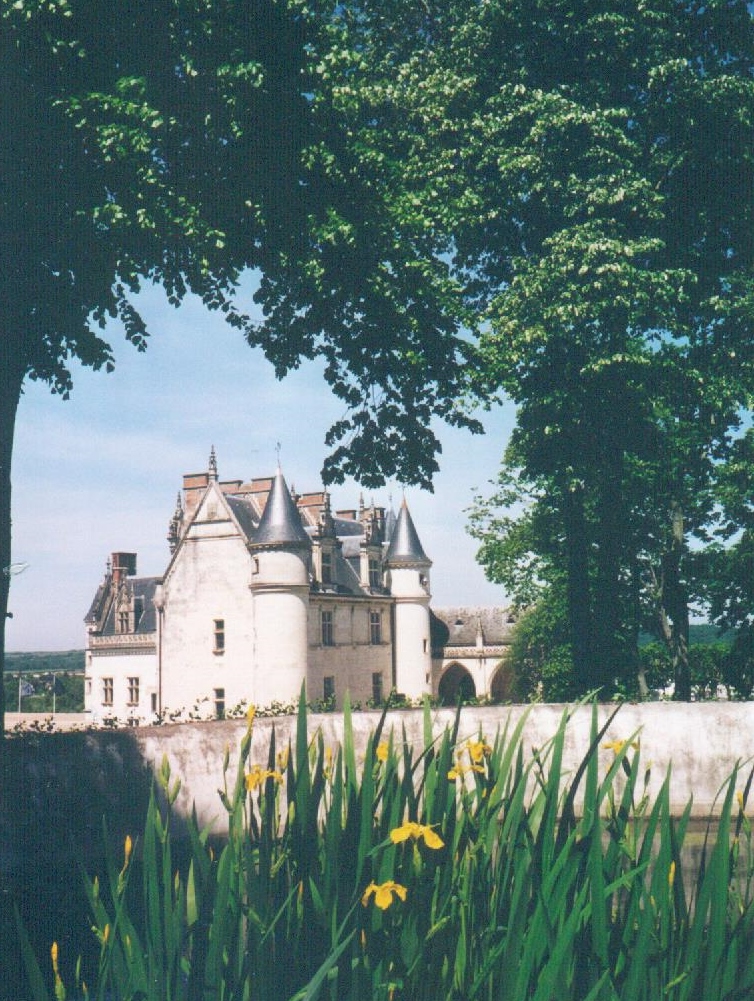
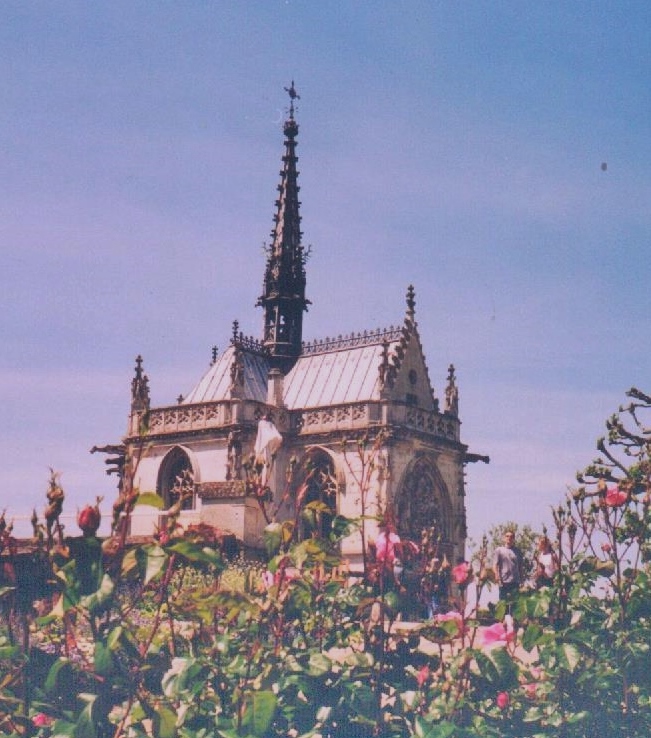
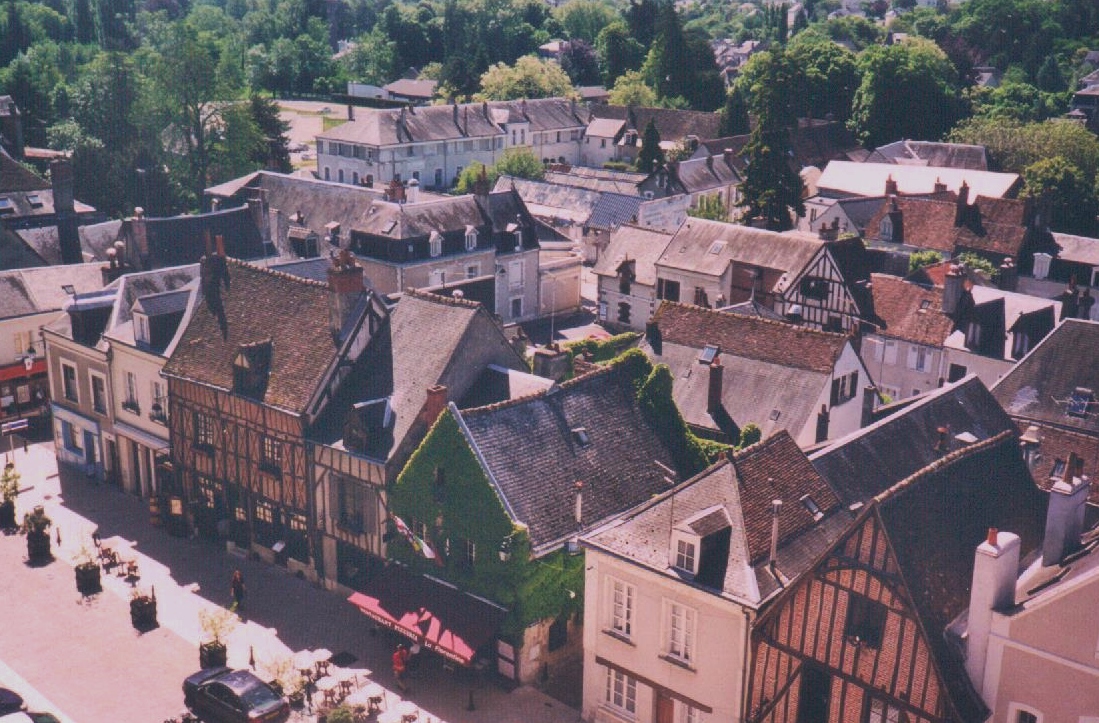
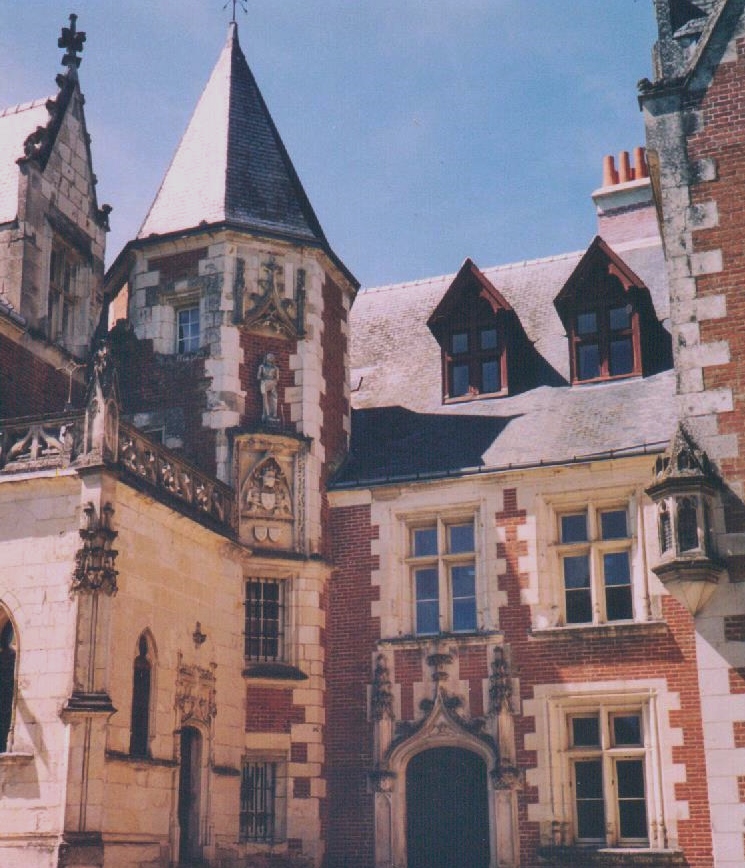
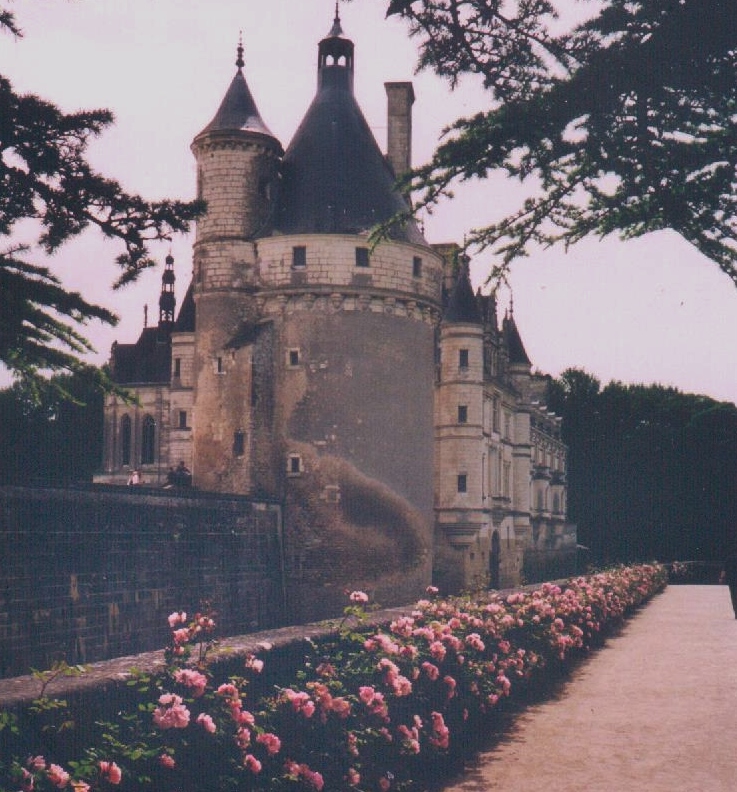
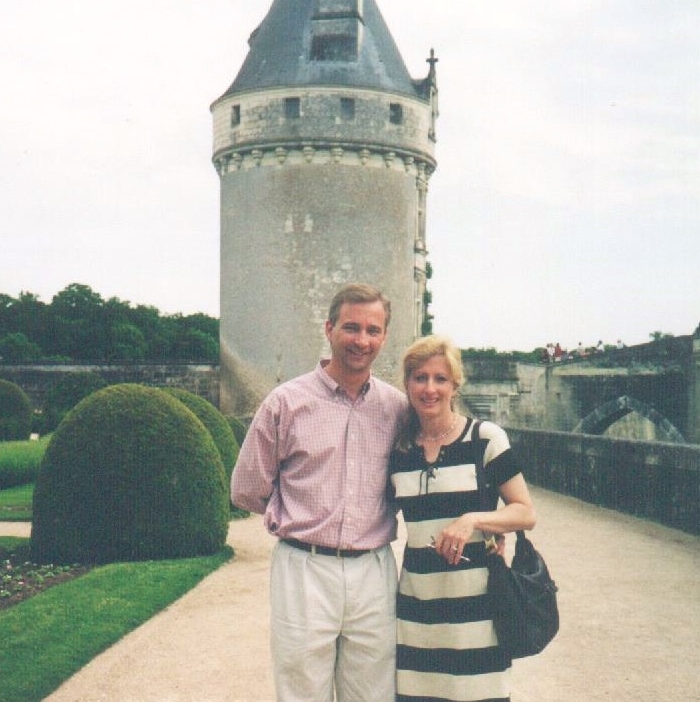
We take the TGV train to Tours, where we rent a car. Although in 1988, Daddy drove Mama and me swiftly and confidently along Britain’s winding roads, this time he’s happy to yield the wheel to H. Our home base in the Loire Valley will be the picturesque little town of Amboise. The royal Château d’Amboise, a multi-turreted castle worthy of Sleeping Beauty, is the centerpiece of the town. It’s a short, lovely walk to the Château du Clos Lucé, where Leonardo da Vinci, as artist and inventor in residence and buddy to Francois I, spent his final years. The Châteaux of Chenonceau and Azay-le-Rideau are nearby.
The Château d’Amboise.On the grounds of the Château d’Amboise is the 15th-Century Chapel of Saint-Hubert, said to house the remains of Leonardo.The town of Amboise seen from the Château ramparts.The Amboise clock tower.The Château du Clos Lucé.Chenonceau.H and I at Chenonceau.
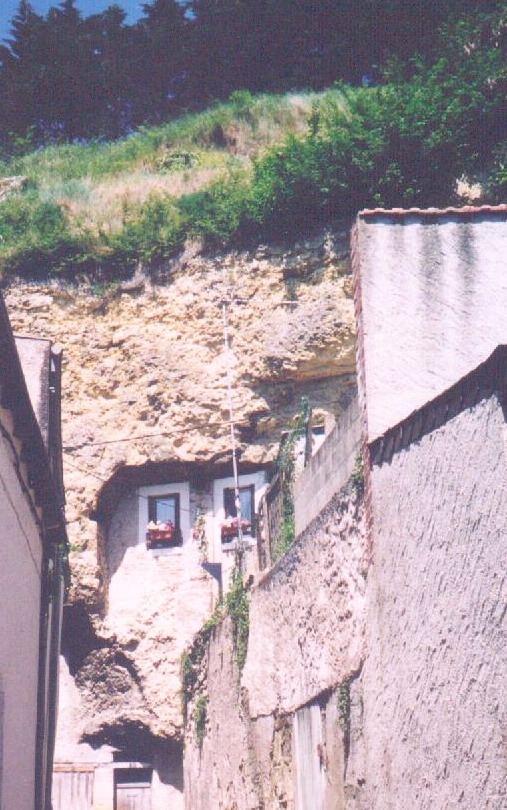
Also within an easy walk from the center of Amboise are several so-called troglodyte homes built into the cliffs of soft tufa, a kind of limestone. The stone, evidence of a prehistoric sea that once covered the area, was quarried for local building. The resulting caves offered unique housing opportunities. Much sought-after, they’re typically equipped with most modern conveniences and need no heat or air conditioning.
An Amboise cave home.
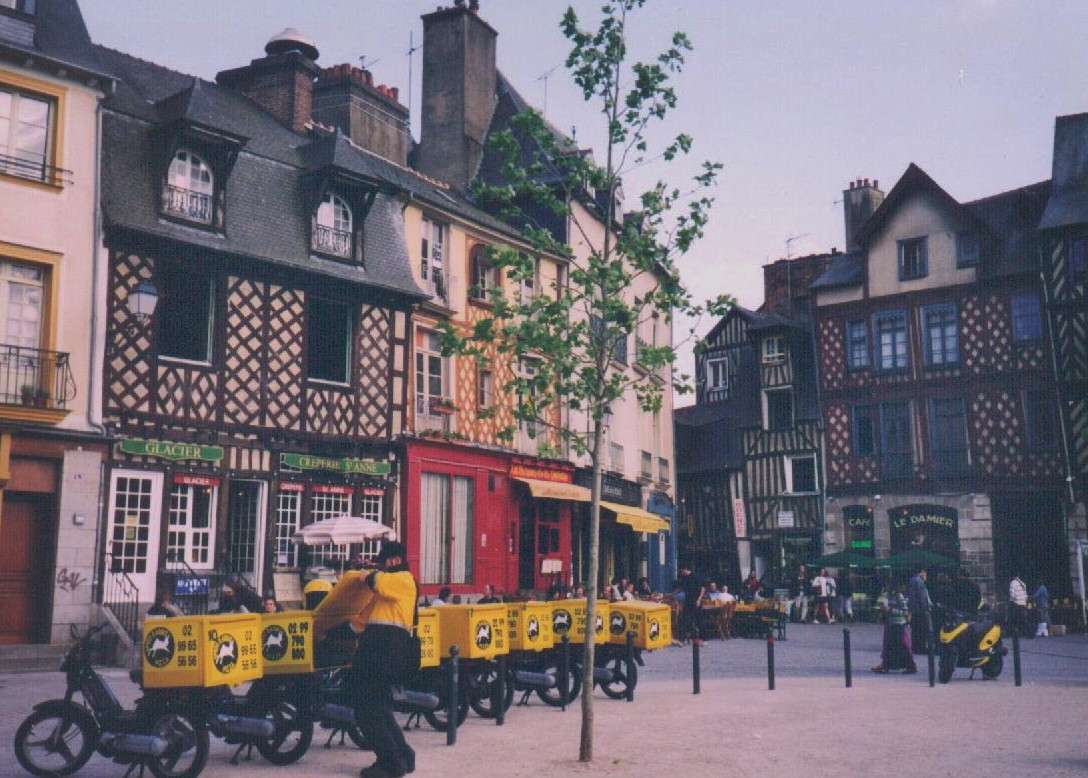
From Amboise, we drive west to Rennes. Although it’s familiar territory for my husband, I’ve never been here. As we walk through the old town and the University section, he recalls his student days. I’d heard the stories, now I can experience the setting first-hand. He points out the buildings where his classes met, the cafés, parks and shops he frequented. As he shows me the route he took to school, I can see him riding through town on his moped, blonde curls visible under the helmet. Thankfully, he was wearing that helmet when a truck hit him one morning. Were it not for that helmet, it’s doubtful we’d be standing here together.
In old town Rennes, a pizza delivery cyclist loads up.
Although H had been in sporadic contact with his French host family since he stayed with them in 1988, he hadn’t told them our travel plans. Our time would be short, and a visit could be awkward since my parents speak no French. But on the road to Mont Saint-Michel, H realizes that we’re tracing his old route to town. Their home is so close. Seems like we almost have to drive by. H has no trouble spotting the house. As though on cue, his French parents are walking out the front door. They recognize H immediately, after fourteen years and no prior notice of his arrival. Monsieur and Madame Treguier welcome us warmly. They are merrily insistent that we return for dinner that evening. We find ourselves saying yes. Who knows when we’ll be back? My parents urge us to go. They’re invited, as well, but they’ll stick with dinner at the hotel. That’s probably a good decision, since Daddy tends to find any long conversation tedious, even if it’s in his own language.
That night, after a beautiful day with my parents at Mont Saint-Michel, H and I are treated to what feels like a homecoming meal. The Treguiers’ younger daughter lives in town and is able to join us. Of course she’s a grown woman now, but H remembers her as a little girl. Madame Treguier brings forth dish after delectable dish, seemingly effortlessly from her tiny kitchen, beginning with a dramatically heaping platter of bright red langoustines. I really don’t know how she does it. For H and me, it takes all our collective brain power to speak sustained, passable French for several hours. The constantly flowing wine helps, until it hinders, and we have to resort to covering our glasses with our hands. The Treguiers are as generous with their wine as H had remembered. In fact, as soon as we arrived, Monsieur Treguier had proudly showed us his brand new wine storage area, his “cave,” built under the garage.
It’s a wonderful, celebratory evening. I get to peel back the layers of my husband’s life, just as I have my own. I see him as his host family remembers, as a very green, very American college boy. They recall fondly that when he first arrived, they secretly despaired. Would they ever be able to communicate with him? He had had only one year of college French, and his language skills were rudimentary. Fortunately, he showed remarkably swift improvement, and his charm was immune to the language barrier. Wow, I thought. With many more years of French study behind me, I’d lacked the courage to stay in a French household during my Paris summer.
Seeing H through the eyes of the Treguier family brings to light one of the traits I most admire about him: his quiet confidence. Whatever the challenge, if he considers it worthwhile, he’s up for it. Immerse himself in a totally French-speaking environment with minimal skills? He’ll manage it. Drive an enormous delivery truck through all the boroughs of New York City? Sure. Fix the car, any car? Easy. Repair the hole in the ceiling? Yes. Master windsurfing on his own? He’s done it. Teach his daughter to ski? Of course. Show her a better approach to that algebra problem? Certainly. Yet he’s never showy or arrogant. He has no ancestral château, but what a guy. Indeed, what a great guy. I can tell that the Treguiers agree.
That night in Rennes, the Treguiers’ deep affection for my husband is apparent. What’s more, they extend their high regard and good will graciously to me, and even to our daughter, back at home. They urge us to return in the near future, to bring her and spend more time with them. As we say our goodbyes, it’s like leaving a family reunion in some best of all possible worlds. It’s one of those times when the bonds of true friendship are revealed at their strong, resilient best, stretching across miles, years, languages and cultures.
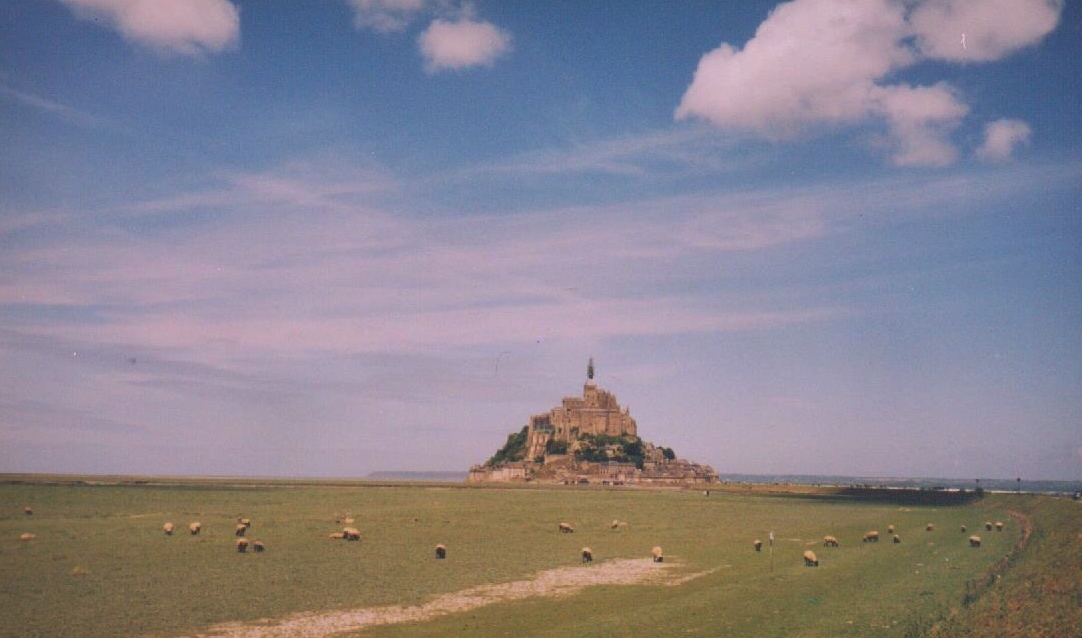
Mont Saint-Michel in Normandy, one of my favorite spots in France. (See European Vacation ’75: Part II: Mont Saint-Michel, April 2013.)
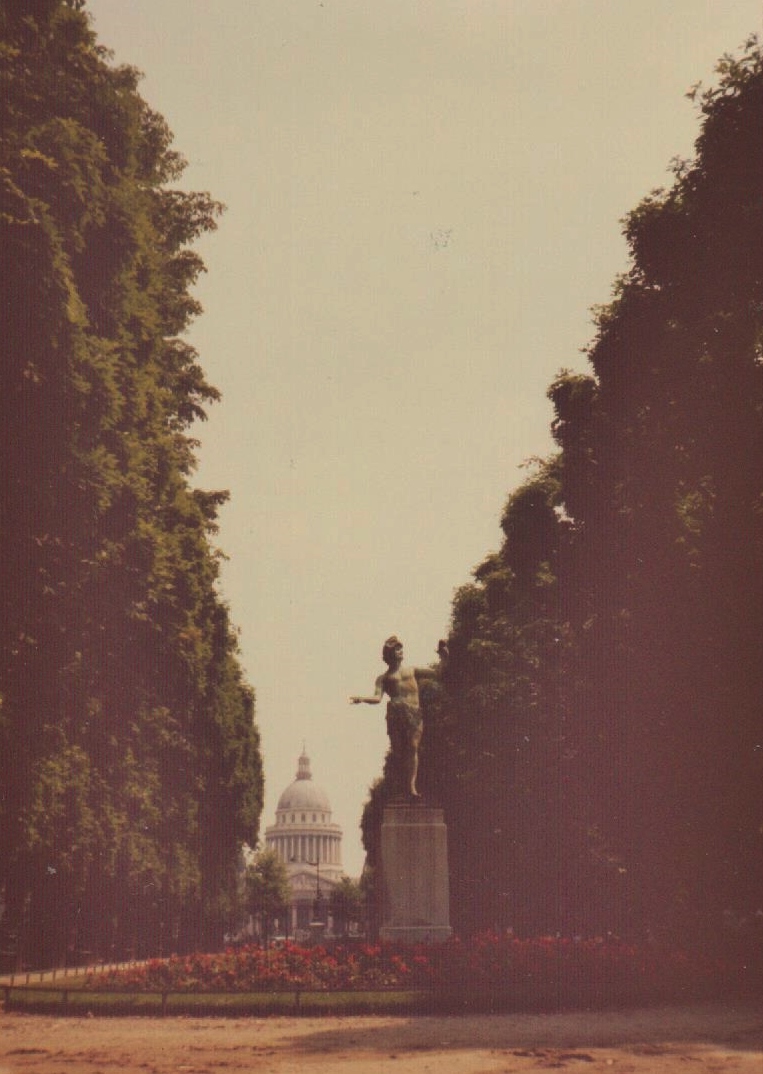
View of the Pantheon from the Luxembourg Gardens, July 1982.
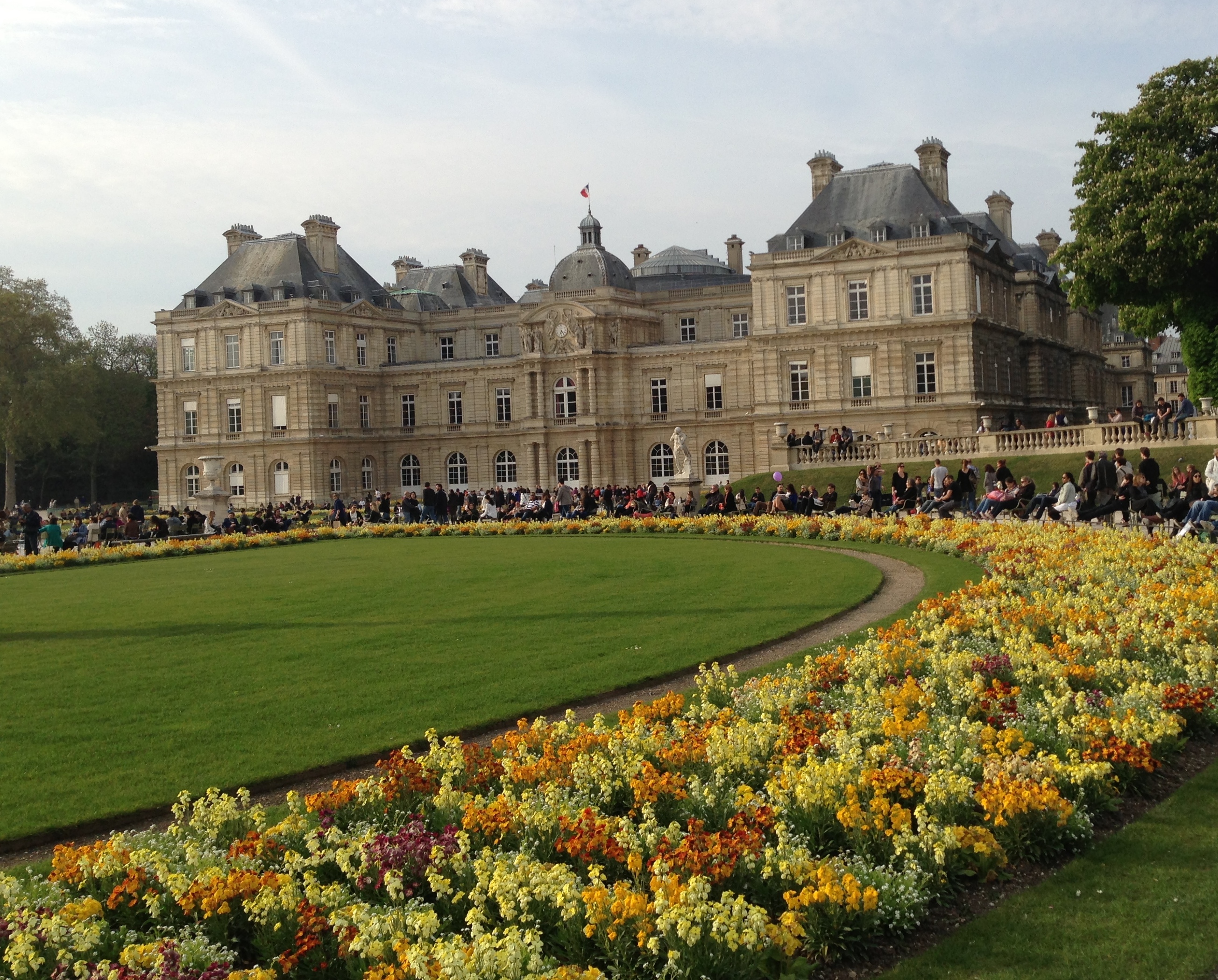
From the Pantheon and our hotel, it’s an easy walk down rue Soufflot to the grand gated entrance to the Luxembourg Gardens, a green oasis in the heart of Paris’s streets of stone and brick. The name is proof that the French don’t forget their history. In the early seventeenth century, the land was owned by the Duke of Luxembourg. The palace and gardens owe their existence to Marie de’ Medici. After the assassination of her husband, Henry IV in 1610, the Italian-born Queen needed a change of scenery and a move from the Louvre. She bought the land in 1612 and commissioned a palace and gardens inspired by her memories of Florence’s Pitti Palace and Boboli Gardens.
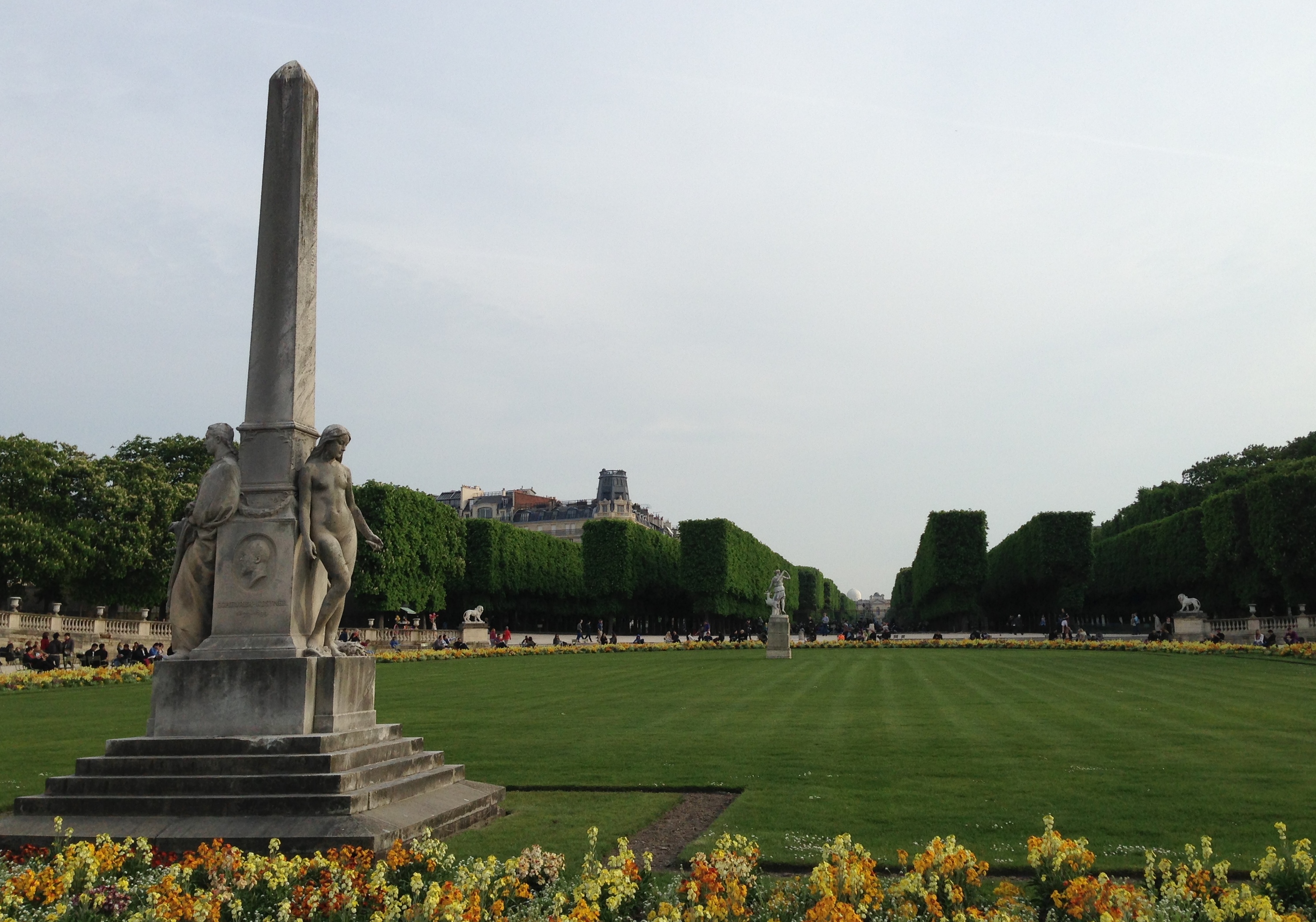
The circular lawn panel.
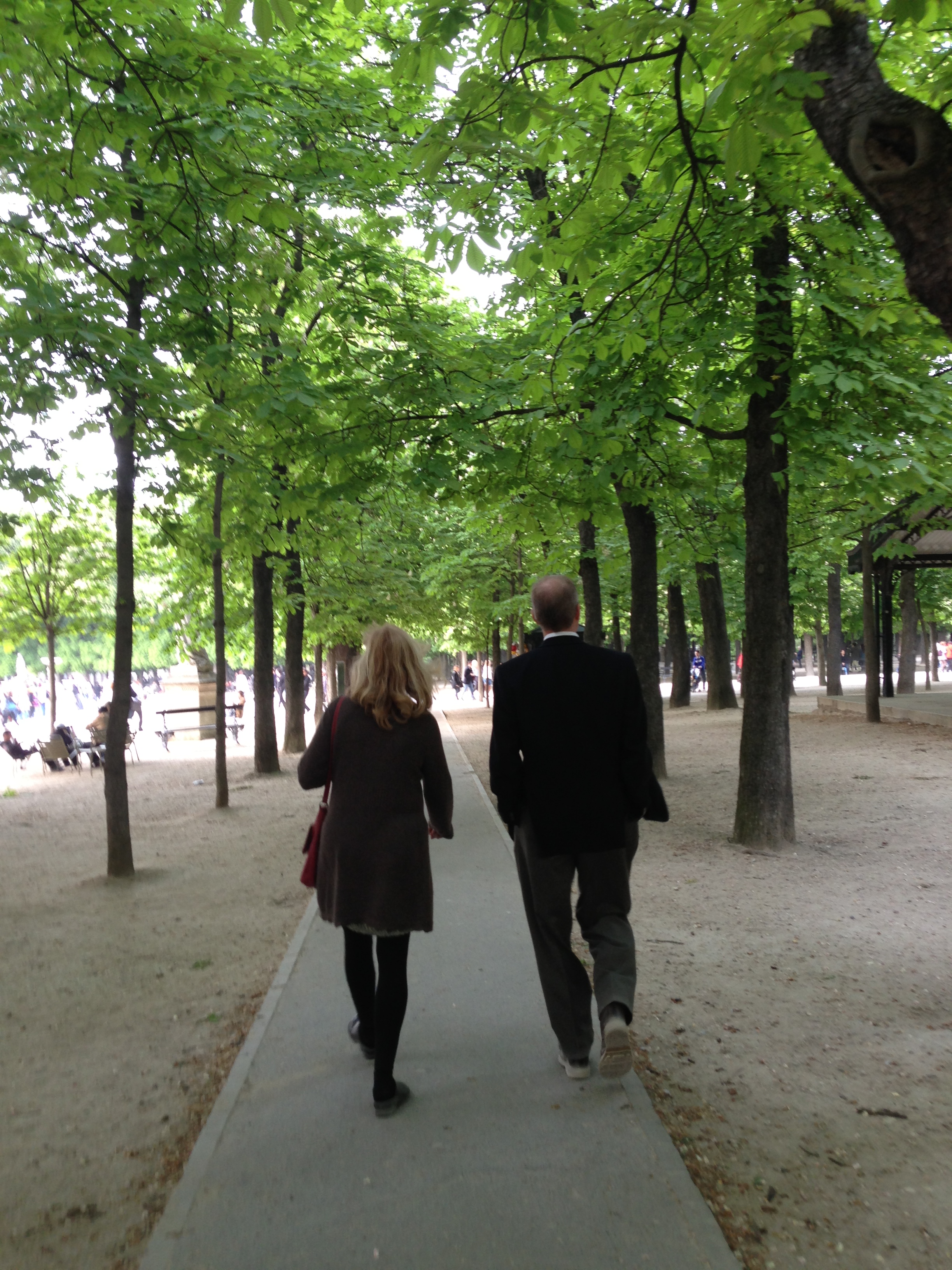
The fifty-five-acre park features expanses of perfectly manicured lawn, bordered by allés of carefully tended horse-chestnut trees and bright flowers that change with the seasons. Many statues accent the greenery.
The Italian Renaissance-style Palace was completed in 1627. It now houses the French Senate.
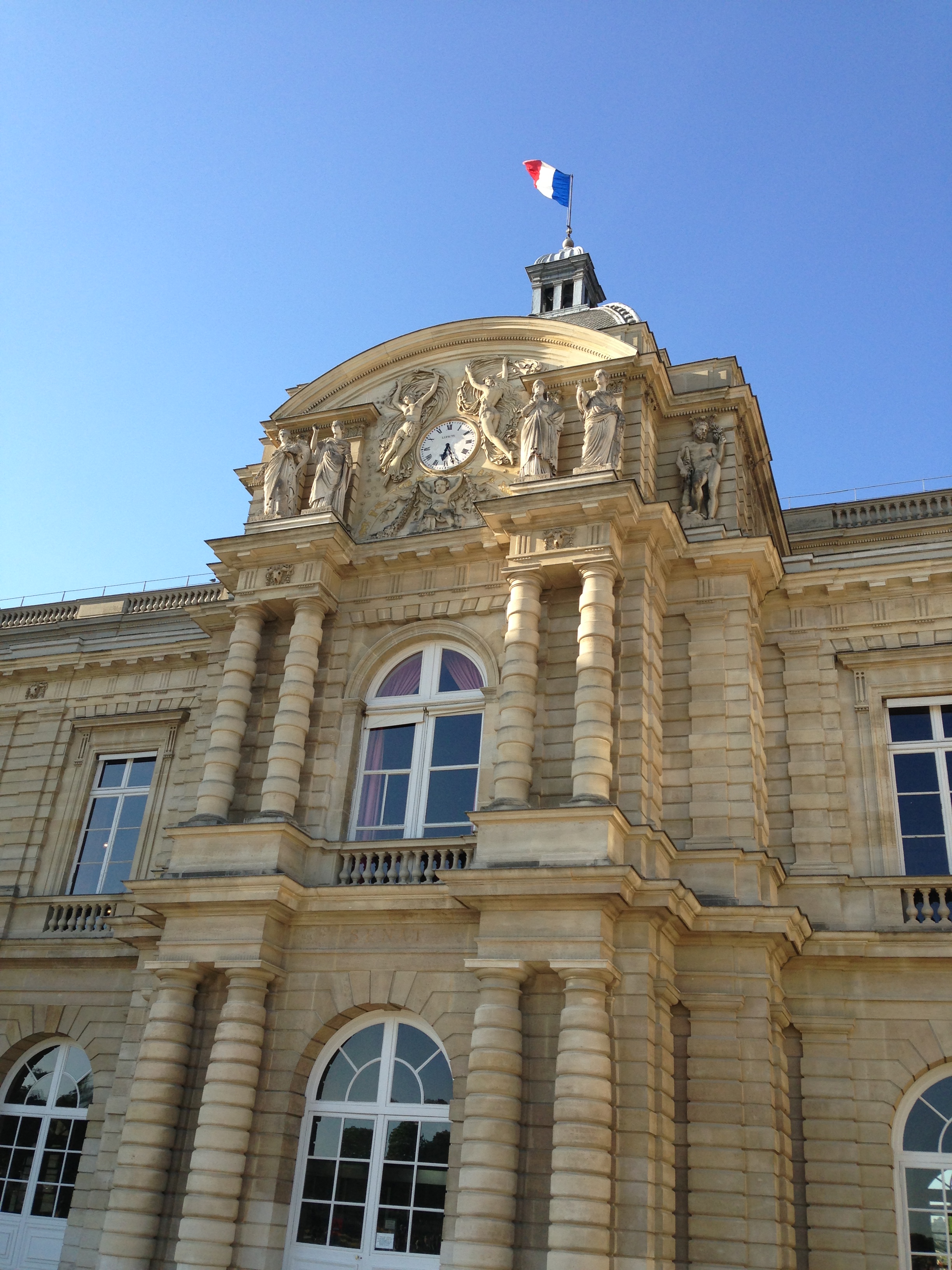
The central pavilion of the Palace.
A popular spot in the park is the eight-sided pond known as the Grand Bassin. While children sail sturdy rental boats, parents may relax in the rows of green garden chairs.
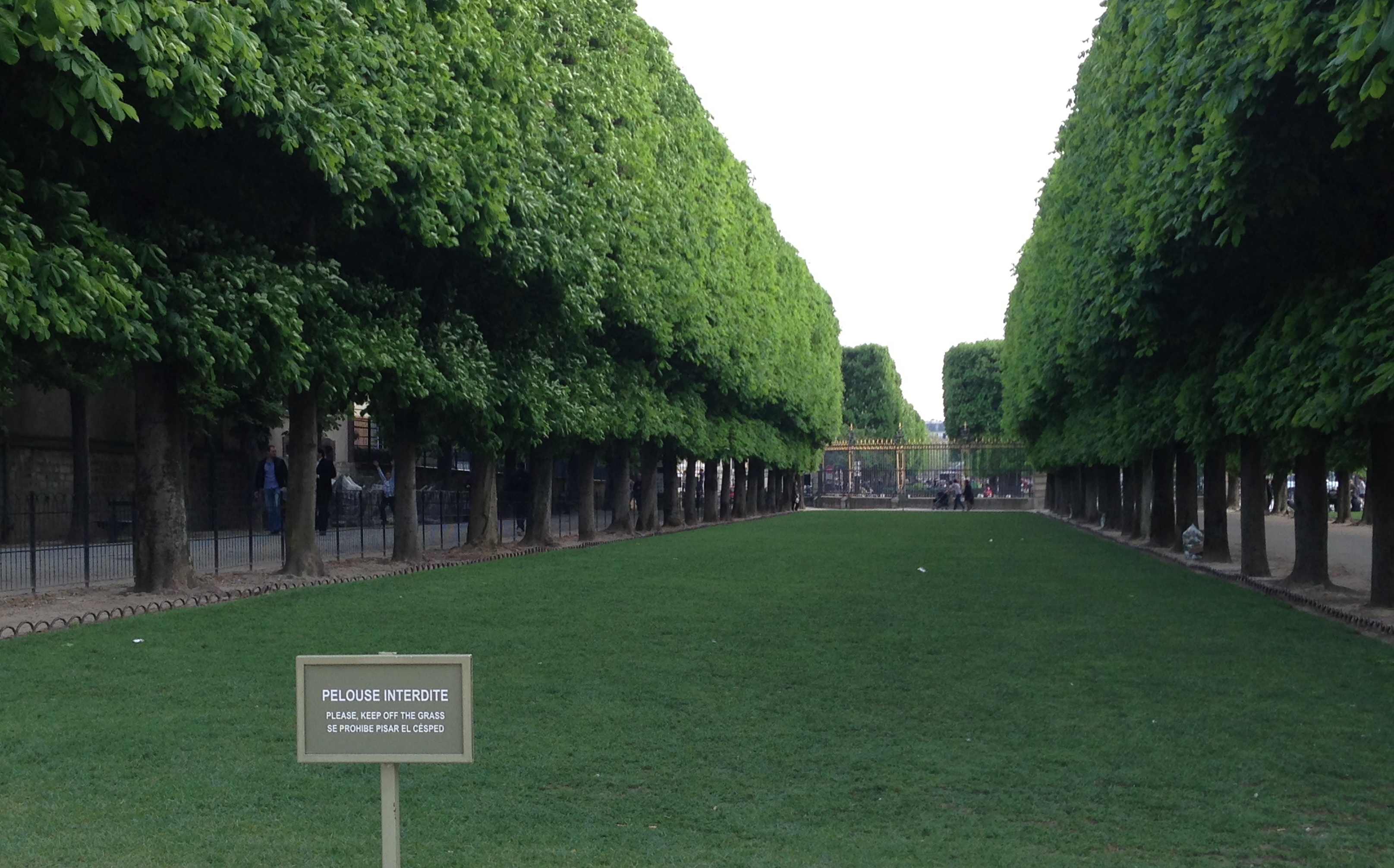
Pelouse interdite.
Lawns are scarce in Paris and highly prized. Early on during my Parisian student summer, our group was picnicking in a park. We noticed an approaching gendarme, gesticulating enthusiastically. We thought he was happy to see us. Soon it became evident that we had mistaken his exasperation for overt friendliness. We learned then that the pelouse is typically interdit. In the Luxembourg Gardens, some of the lawns are preserved by alternating pedestrian access. While the above panel was off limits, a nearby one was populated by picnickers and sun-seekers.
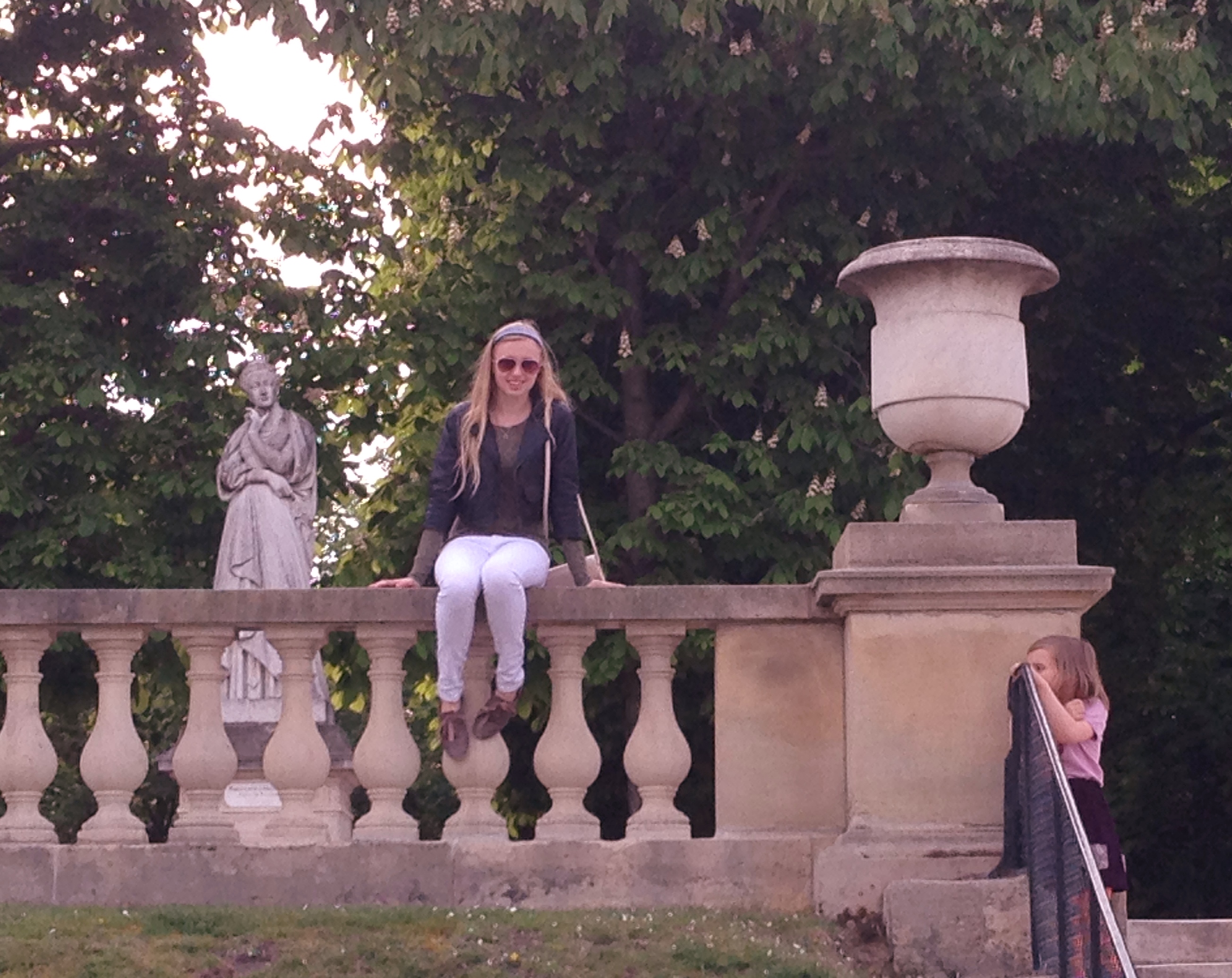
Our daughter claims a perch between French Queen and a local child.
The Medici Fountain dates from the time of the Palace.
One of my favorite spots in the city is the Gardens’ Medici Fountain. The strangely beautiful, grotto-like structure reminds me of something I’d hope to see in a dream. It stands at the end of a short allée of chestnut trees. Even on the hottest summer days, by the fountain it’s cool and quiet in the welcome shade.
You take some of this park with you when you go. Your shoes will be coated with a tell-tale layer of fine white dust.
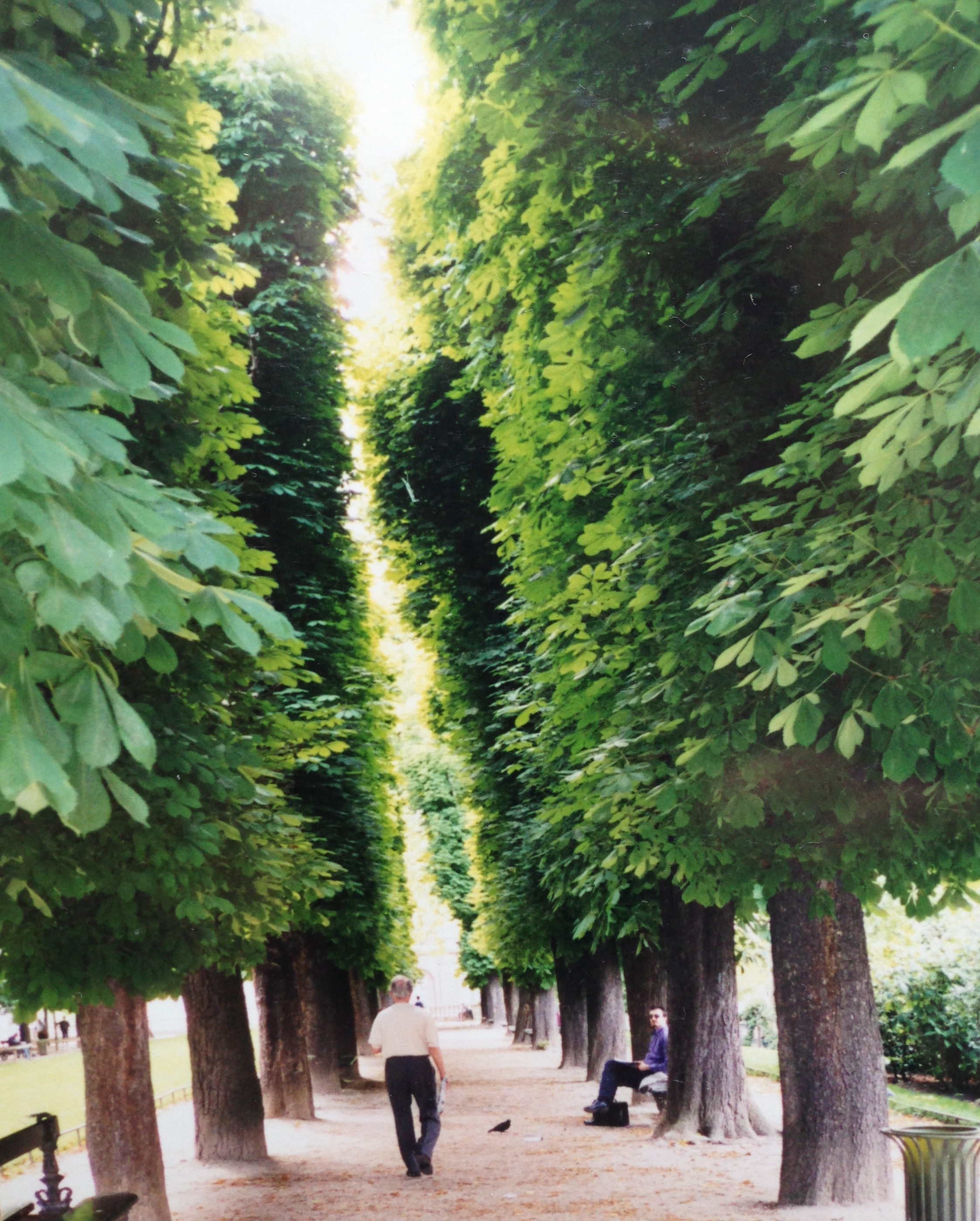
My father walking along a Garden path, May 2002.
A blog about motherhood, marriage and life: the joys and frustrations, beauty and absurdity, blessings and pain. It's about looking back, looking ahead, and walking the dog.