Christmas is five days away. Every year around this point, I ask myself: how can this be? How can Christmas be upon us? But this year, more than ever, time seems slippery, unreliable, prone to eccentricity. Yesterday seems like a month ago, yet wasn’t Halloween just last week? Is it because of my advanced age? Is it because of sudden and broad temperature fluctuations? In a typical seven-day span, here in Northern Virginia, we experience weather appropriate for all four seasons, sometimes in a single day. Is it because we’re approaching our third Covid winter, and the weeks and months are draped in a veil of sameness?
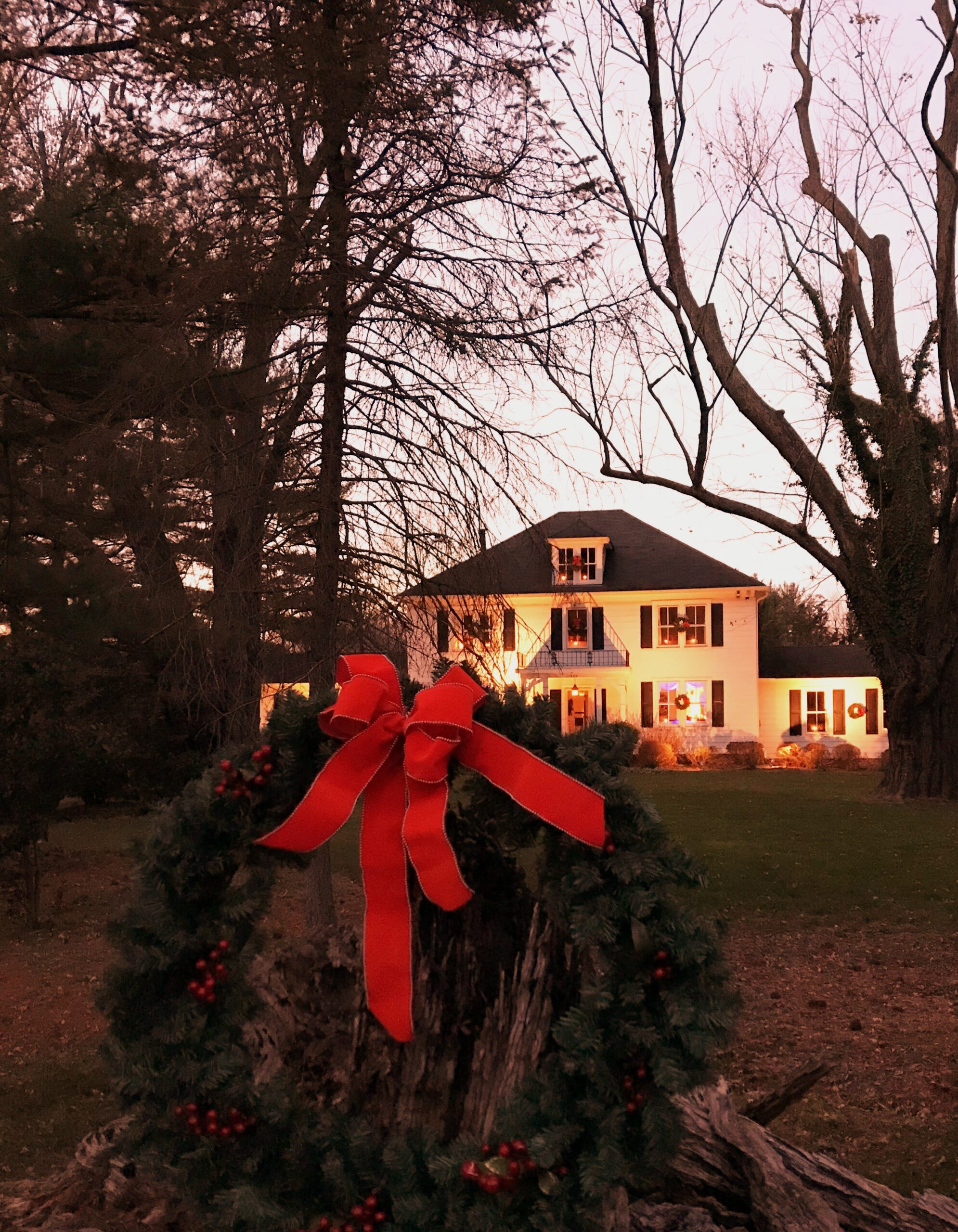
It’s certainly not because I’ve neglected the usual Christmas prep. I haven’t, and it’s kept me too busy to write. The evidence of the season is all around me, but still, this mid-December has an air of unreality. Something just seems off.
After further reflection, I think it may be this: the back-of-my-mind awareness that our daughter will no longer be joining us for an extended winter break. The Christmas season, in recent years, has begun in earnest for me with her arrival home from college. Last year, it started with her final online exam, as she was already here. I think what I’m missing now is the anticipation of having her back with us for about a month. That extra spark of excitement is absent.
At this realization, I had a mental pep talk with myself. Our daughter will be coming home soon, for about a week. She can’t stay longer because she’s gainfully and happily employed. (I’ve never held a job that ticked both boxes.) She’s embarked on a career that relies upon her training. This is why she went to college. At least it’s why the time, trouble and expense of college can be justified. All those demanding classes in aerospace engineering and astronomy are being put to good use. And while she’s a Maryland resident now, she’s closer to home than she was in Charlottesville. When she first began applying for jobs, my husband and I both feared that she’d find it necessary to move to the West Coast. In the rare absence of traffic, she can drive home in about an hour.
So I’m a lucky mama. We should see our dear daughter in two days. And then Christmas Vacation will officially begin.
As my mother reminds me, having recently watched a PBS show about the medieval origins of the twelve days of Christmas, December 25 is only the first day of the festive season. I’ve got plenty of time to get that spark of excitement back. In fact, I’m starting to feel it already.
The spirit of the season is popping up in unexpected places. Here, for example, is a radish that resembles a little head in a pointed elf cap.
The halls have been decked. It’s time to savor the joy of Christmas.
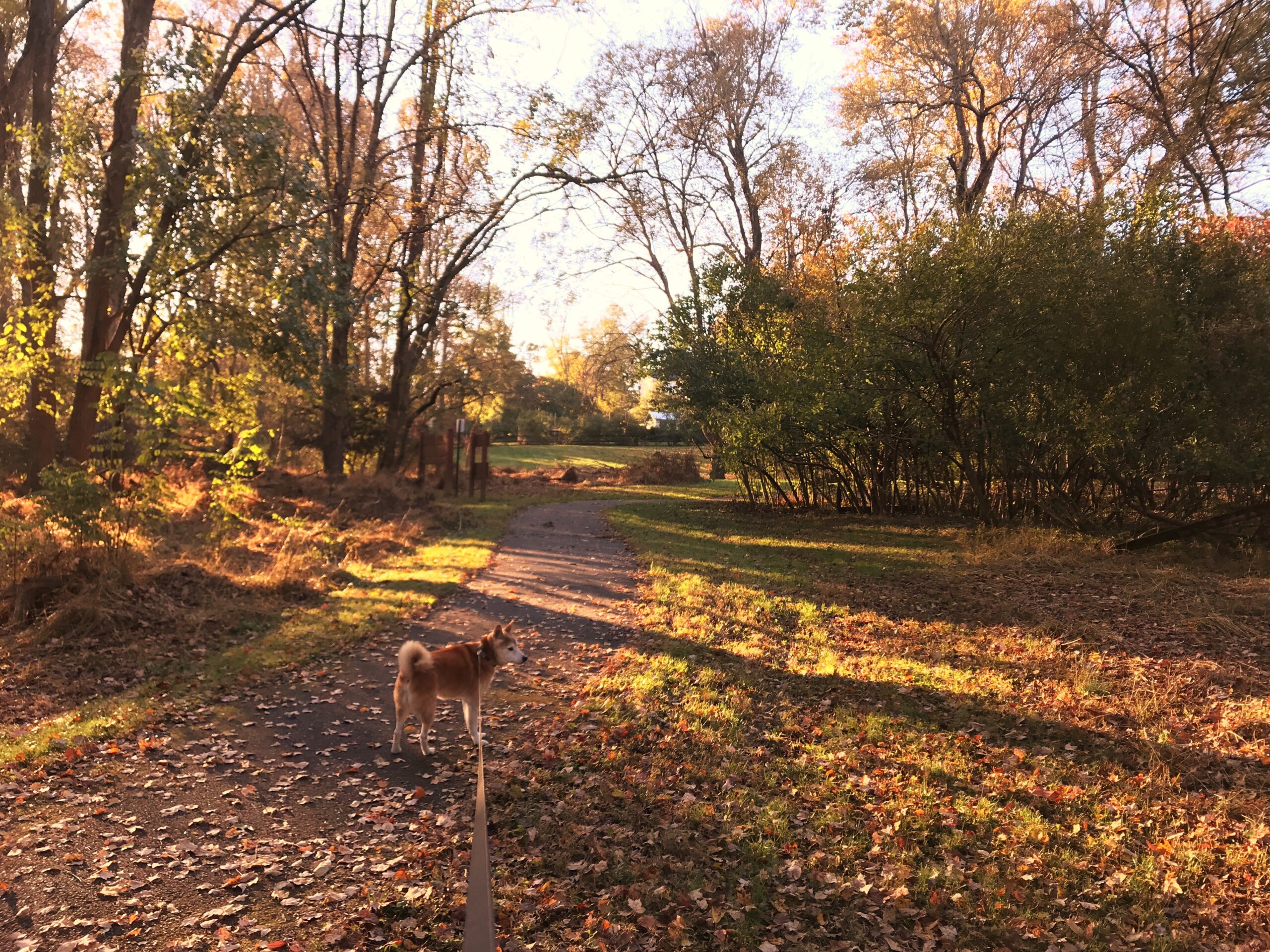
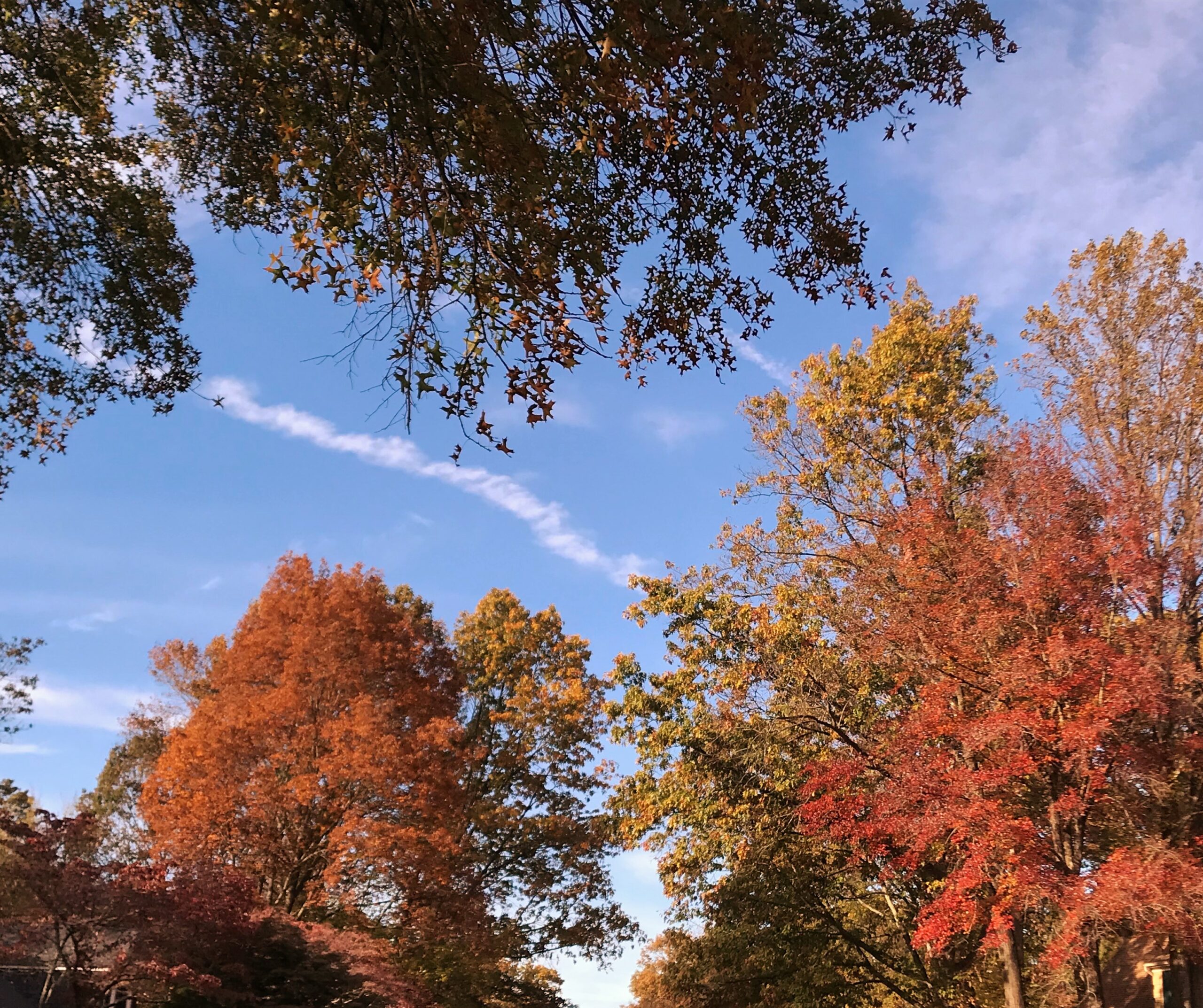
This fall’s brilliant colors and bright sunshine have kept the words of this old familiar hymn very much on my mind. As Thanksgiving approaches, they’re even more appropriate.
For the beauty of the earth,
for the glory of the skies,
for the love which from our birth
over and around us lies;
Lord of all, to thee we raise
this our hymn of grateful praise.
For The Beauty of the Earth, Words by Folliot Pierpoint, 1864, Music by Conrad Kocher, 1838
Thank you, this Veterans’ Day to all those who put their lives on the line to defend our country and our freedom. My father is the first veteran in our family that I typically think of on this day set aside to honor those who’ve served. My Uncle Bill is the second. Daddy was stationed in Regensburg, Germany, with the U.S. Army Occupational Forces following World War II. My mother’s brother, Bill, enlisted at sixteen and served as a Frogman in the Pacific.
While looking for a photo of Daddy or Uncle Bill to post on Veterans’ Day, I came across a picture of another family member in a military uniform. I don’t recall my father ever mentioning his distant cousin, Hunter, above. According to the inscription on the back of the photo, in Daddy’s neat handwriting, Hunter was a Lieutenant in the Air Service during World War I. He was born August 30, 1895 in Jane Lew, West Virginia, which is also my grandmother’s home town. He survived the war, and died at age sixty-five on May 9, 1960 in Martinsburg, West Virginia. He’s buried in Arlington Cemetery. The photo bears no date, but it must have been taken in 1917 or ’18, when he was twenty-two or twenty-three. When he was my daughter’s age.
I learned from another cousin that Hunter was the son of my great-grandmother’s brother, which makes him my grandmother’s first cousin. He was married in 1922 to a woman named Marion, and together they had at least one child, a son. I wish we knew more about Hunter’s experiences during the war. I wish I could read some of his letters home, as we’ve read my Uncle Bill’s. I wish we knew more about Hunter’s later years, as well. I hope he has grandchildren now keeping his memory alive. I hope they have photos that document other notable stages in their grandfather’s life. But I’m grateful that at least I have this lone visual record, this window into Hunter’s young adulthood, when he was a dashing pilot in jodhpurs and goggles, striking a jaunty pose before climbing into his plane to do his patriotic duty. Thank you, cousin Hunter, for your youthful confidence and courage. I hope it stood you in good stead throughout your life.
The last time our daughter was home for Halloween was in 2017, her senior year in high school. Her return for the recent holiday weekend therefore seemed extra special. Slim was eager to see our daughter, as well. He recognized her as his ideal partner in preparing for all things Halloween. She is nearly as big a fan of the day as he is. Ever since she was a toddler, Halloween anticipation has begun for her in the summer. (See Friendly Ghosts of Halloweens Past, October 2013.)
In 2020, because of Covid, young parents in our neighborhood organized a Halloween parade, with all trick-or-treating outside. The kids progressed from one end of the neighborhood to the other, to tables set up by families in front of their homes. It worked so well and was so enjoyable that they decided to do it again this year. I liked it because it made it easier to appreciate the costumes and gave more time to chat with kids and their parents.
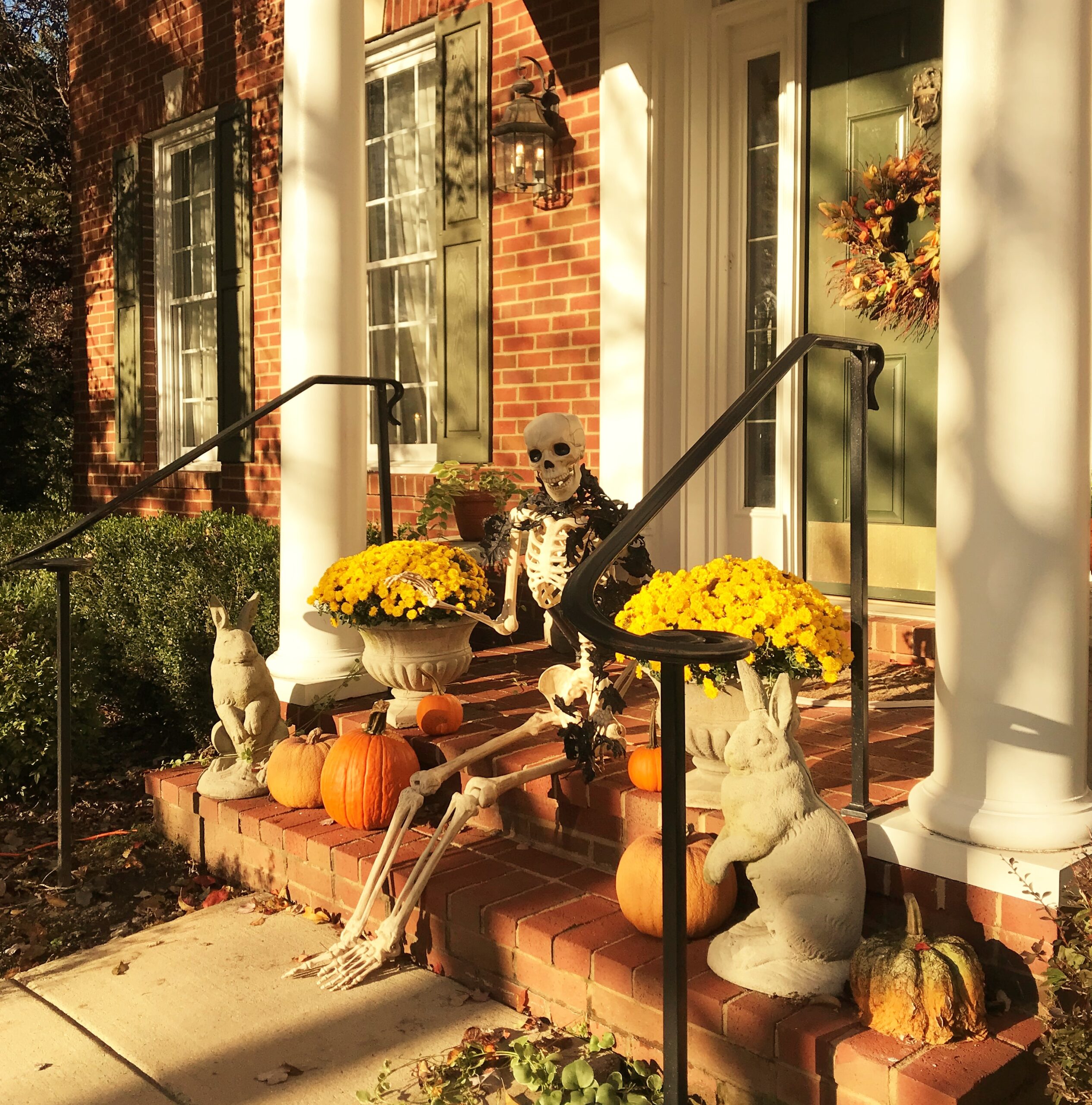
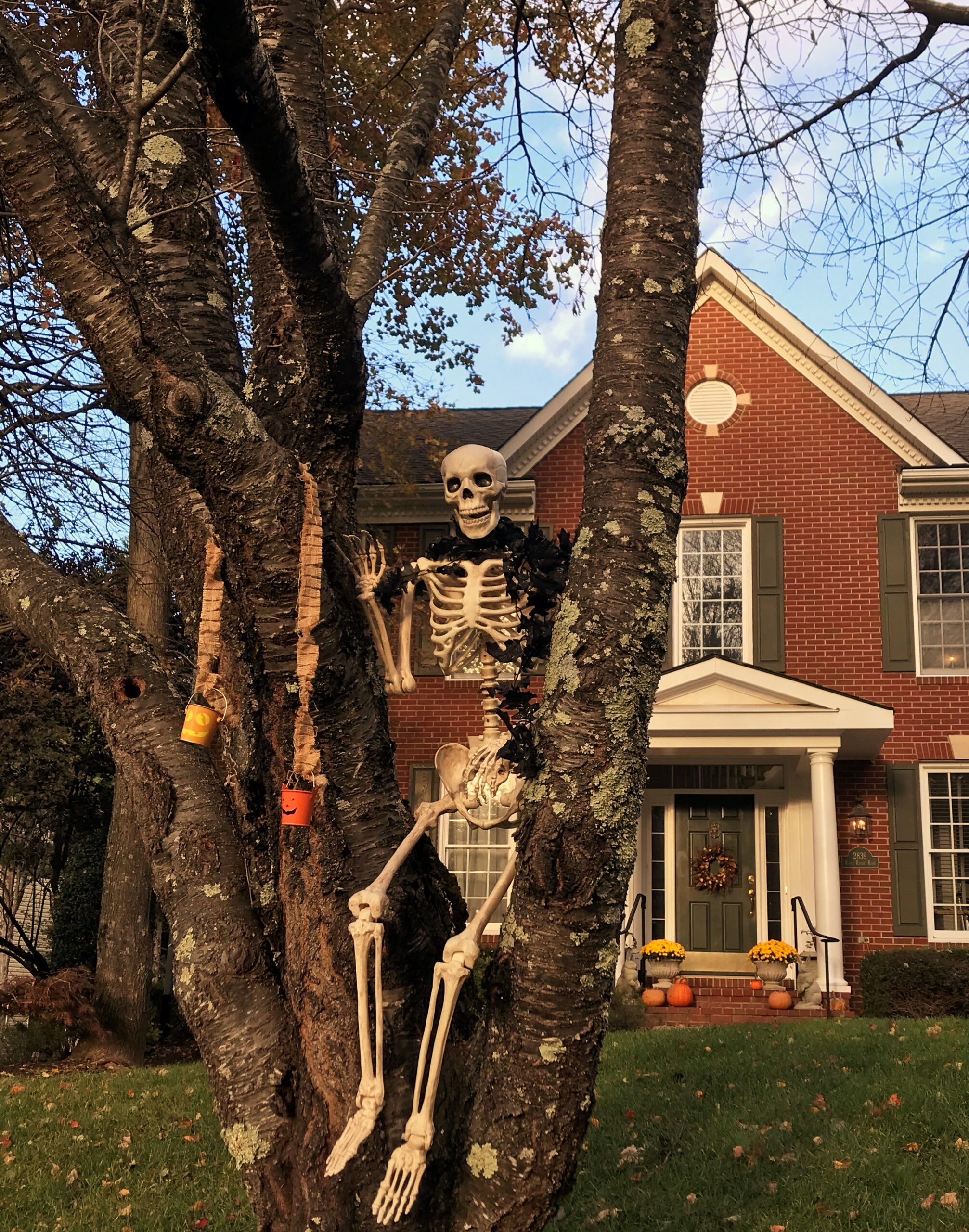
Our daughter was determined to make our Halloween display as thorough as possible. Slim was equally zealous, of course. Together, they hauled out all the old, mostly homemade decorations that D recalls fondly from her childhood: Fred, the stuffed dummy, the tombstone and graveyard fencing, various skulls and bones, jack-o’-lantern votives, spiders and spiderwebs. They festooned our tables for treats in appropriately witchy garb. They set up the fog machine and an outdoor speaker for projecting spooky sounds. They rolled out the love seats from the garage so we could be comfortably seated during the parade. This persuaded even my mother to join us. When we began to see the children approaching, Slim climbed up in a cherry tree, and D, wearing the gorilla costume that we just happen to have, hid herself from view.
Our daughter, quietly channeling her inner gorilla. A tense moment.
As each group of children chose their treats, my husband, holding a heavy chain, would ask, “Has anyone seen my pet gorilla?” Then D would pop up from behind the love seat and jump around. The performance was well-received, usually with genuine surprise. No one was overly frightened, which was as intended, but one little boy asked his mother to remain close by his side as he got his candy. Several trick-or-treaters, and possibly one parent, wearing an inflatable T-Rex costume, engaged in high-spirited dance-offs with the gorilla.
Thanks to our friendly neighborhood, the parade, to the presence of Slim and our daughter, this Halloween was one of the happiest I can remember. It was rewarding to see just how many children live among us. We were impressed by the innovative costumes, on both kids and adults. How satisfying it was to see neighbors out socializing as they provided treats. As Slim likes to remind us, Halloween has evolved from an ancient Celtic harvest festival into a day when we affirm our common humanity through a love of sugar. It’s a day to welcome back, unapologetically, the child that abides within us, no matter our age. A time to share some sweetness and joy with others, simply because we’re God’s children here together. After all, it’s the custom to give candy not only to those we know personally, but to everyone who stops by.
It was a perfect top-off to the evening when a small Superhero jumped out of a highly decorated SUV and brought us a festively wrapped bottle of sparkling wine. We’d won one of the prizes for best display. Our daughter’s and Slim’s efforts had paid off. We’d given treats, and we got a treat. That, my friends, is Halloween, isn’t it?
Slim was more than excited to learn that Trunk or Treat at our church was back on this year, after being Covid-canceled in 2020.
He jumped for joy when he heard that our daughter would be returning from Maryland for Halloween weekend. He hadn’t seen her since he popped in on her unexpectedly in Charlottesville in 2018 for Trick or Treating on the Lawn. (See here and here.) On a beautiful Saturday, with perfect fall weather, D joined Slim, me and the pack in the church parking lot, to greet and provide candy fuel to a large and enthusiastic crowd of happy, creatively-costumed kids and their families. After so much isolation during the darkest days of the pandemic, the gathering was especially cheery. The rousing music provided by our church pianist from a keyboard in the back of his pick-up truck served to further heighten the mood. Slim sang along with every tune, as his musical reportoire is vast.
On the ride home, he was simply giddy. I repeatedly had to remind my rowdy passenger to remain seated. He waved eagerly at passing cars and emitted celebratory whoops, hoots and hollers. He belted out a steady stream of snippets from his favorite party songs: Cel-e-brate good times, come on! . . . Let’s paint the town! And shut it down! . . .We’re gonna party like it’s 1999! . . I got me a car, it seats about twenty, so come on and bring your jukebox money! . . .Well, I’m just out of school, like a real, real cool. Gotta dance like a fool, Got the message that I’ve gotta be a wild one, Oh yeah, I’m a wild one. . .
Yes, that Slim, he’s a wild one. But his is a sweet, innocent wildness, like that of a child. And his humor is infectious; he can bring a smile to even the dourest of faces. I’m glad he’s here. Everyone needs a friend like Slim.
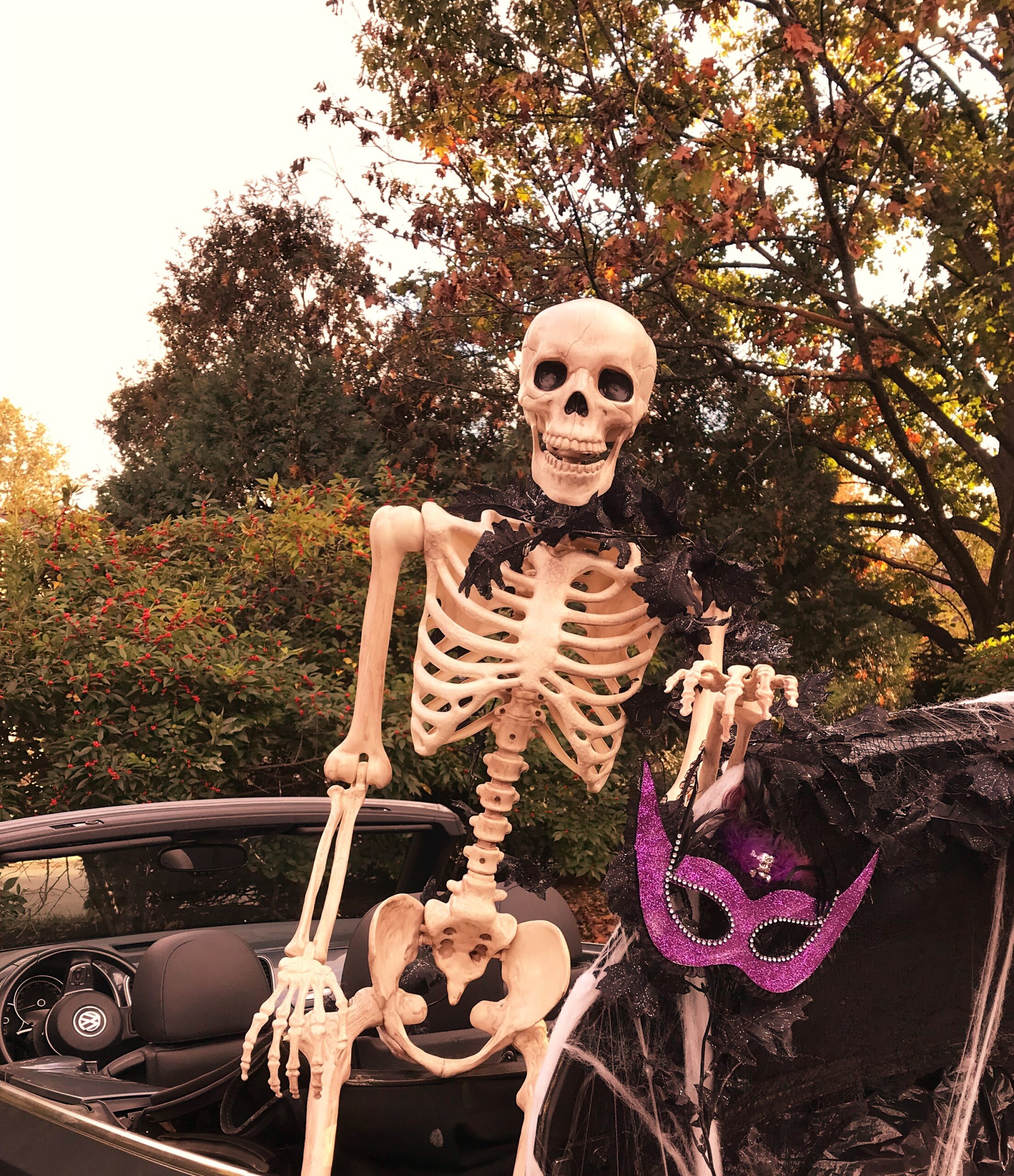
Once home, he whistled for the pack to join him in the annual Halloween joyride. The gang piled into my VW in a flash. Even Kiko moved briskly, which is unusual for our elder statesman these days. Time to cruise the neighborhood to promote more Halloween fun! The big day approached!
Our old family friend, Slim, emerged from his state of semi-hibernation in early October, as is his custom. After eleven months in the dim silence of my mother’s basement, he was a bit taken aback by the bright warmth of the autumn sunshine and the profusion of life that was bursting forth outdoors.
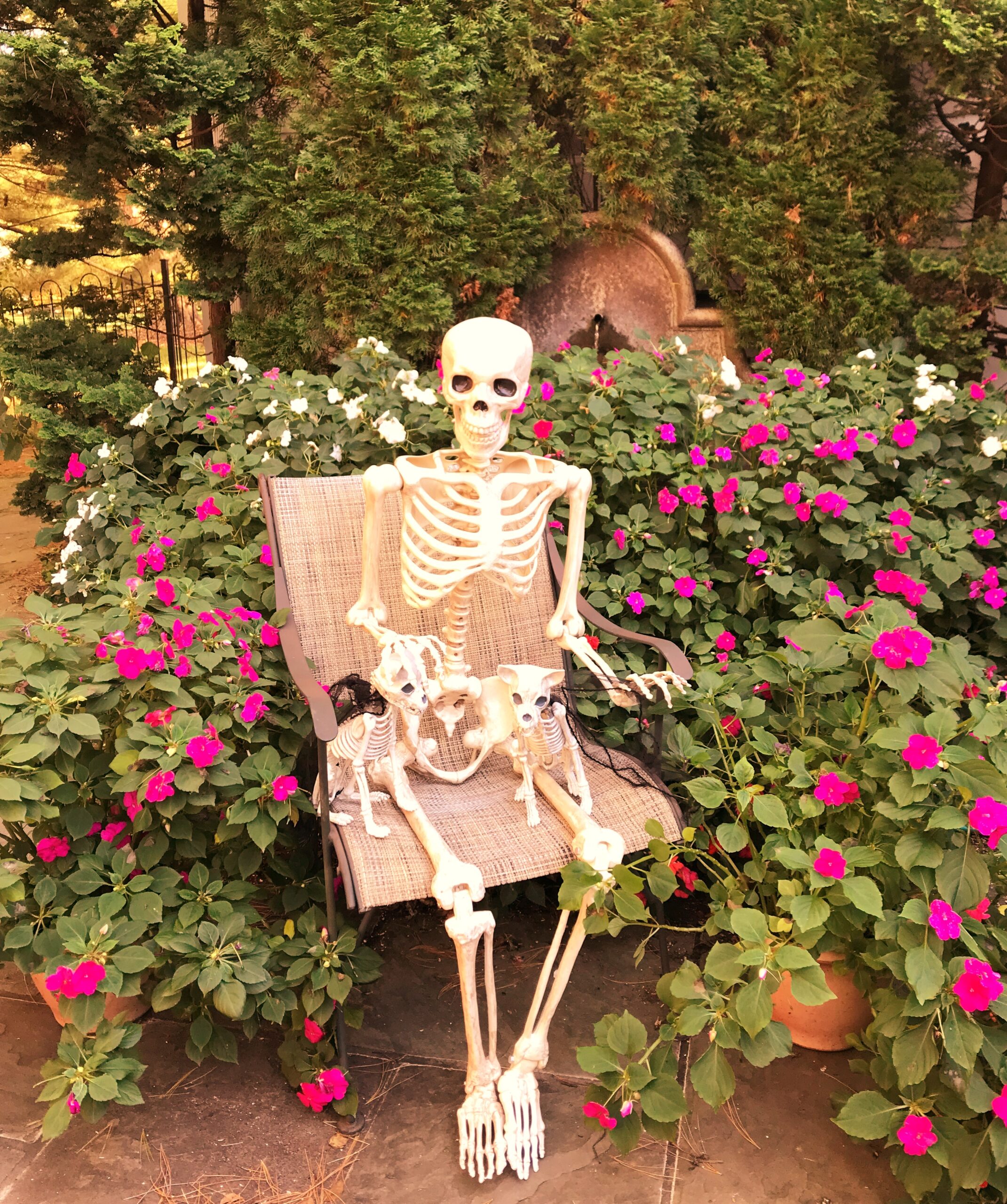
Quite the nature lover, Slim was amazed at the continued proliferation and abundance of our summer flowers. “Is it July?,” he exclaimed. Usually long gone by October, this year the impatiens have kept flourishing, and growing, their stems over three feet in height. They almost completely hide the fountain, providing a sheltering hedge for a pair of frogs who claimed it as a homestead. The frogs grew steadily and serenaded one another loudly for months. Now they watch over a bevy of tadpoles. Their well-being in the face of approaching cold weather has been worrisome for Slim. Because the fountain must be drained before temps dip to freezing, he has vowed to help us relocate our amphibian friends to the nearby creek.
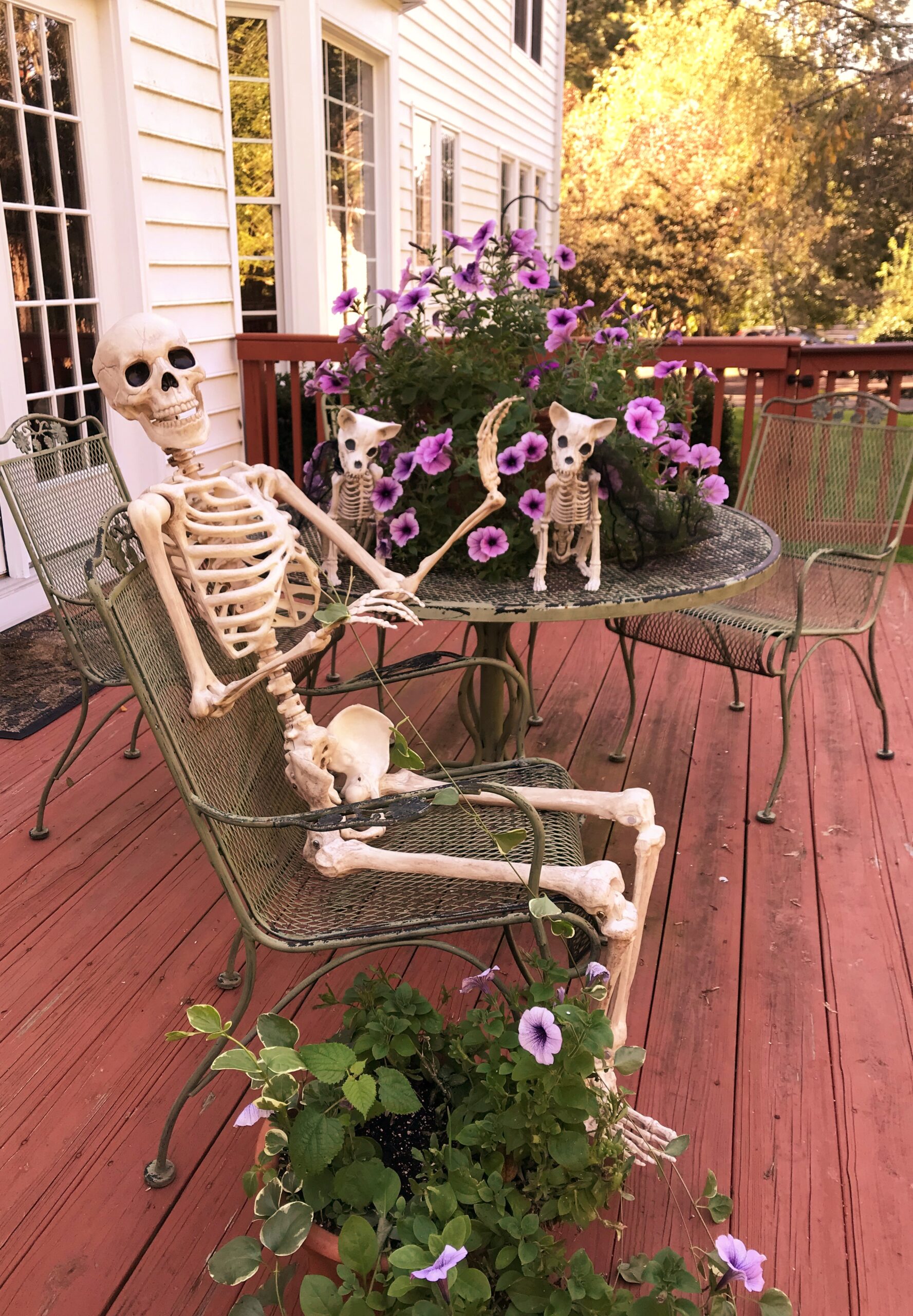
On sunny afternoons, Slim could often be found soaking up the rays alongside the opulent petunias on Mama’s back deck. Loyal canine twins Rocky and Ruth were usually by his side.
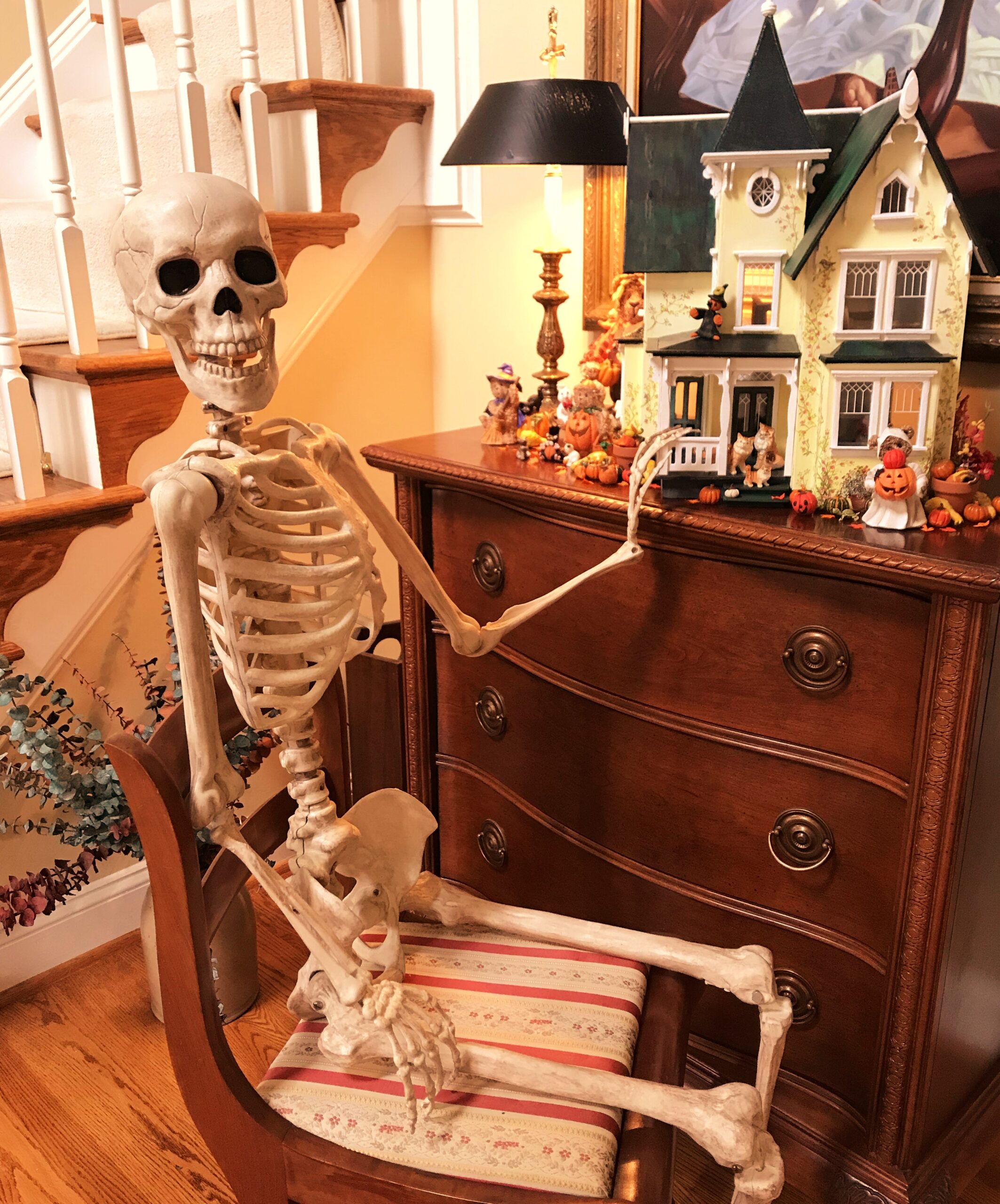
Slim delights in the charms of seasonal decor. He put the finishing touches on the Halloween display around my most recently constructed dollhouse, placing a couple of tiny Sculpey-clay jack-o’-lanterns just so. He has a heart for little things as well as little critters, and no detail is too insignificant to escape his observant eye.
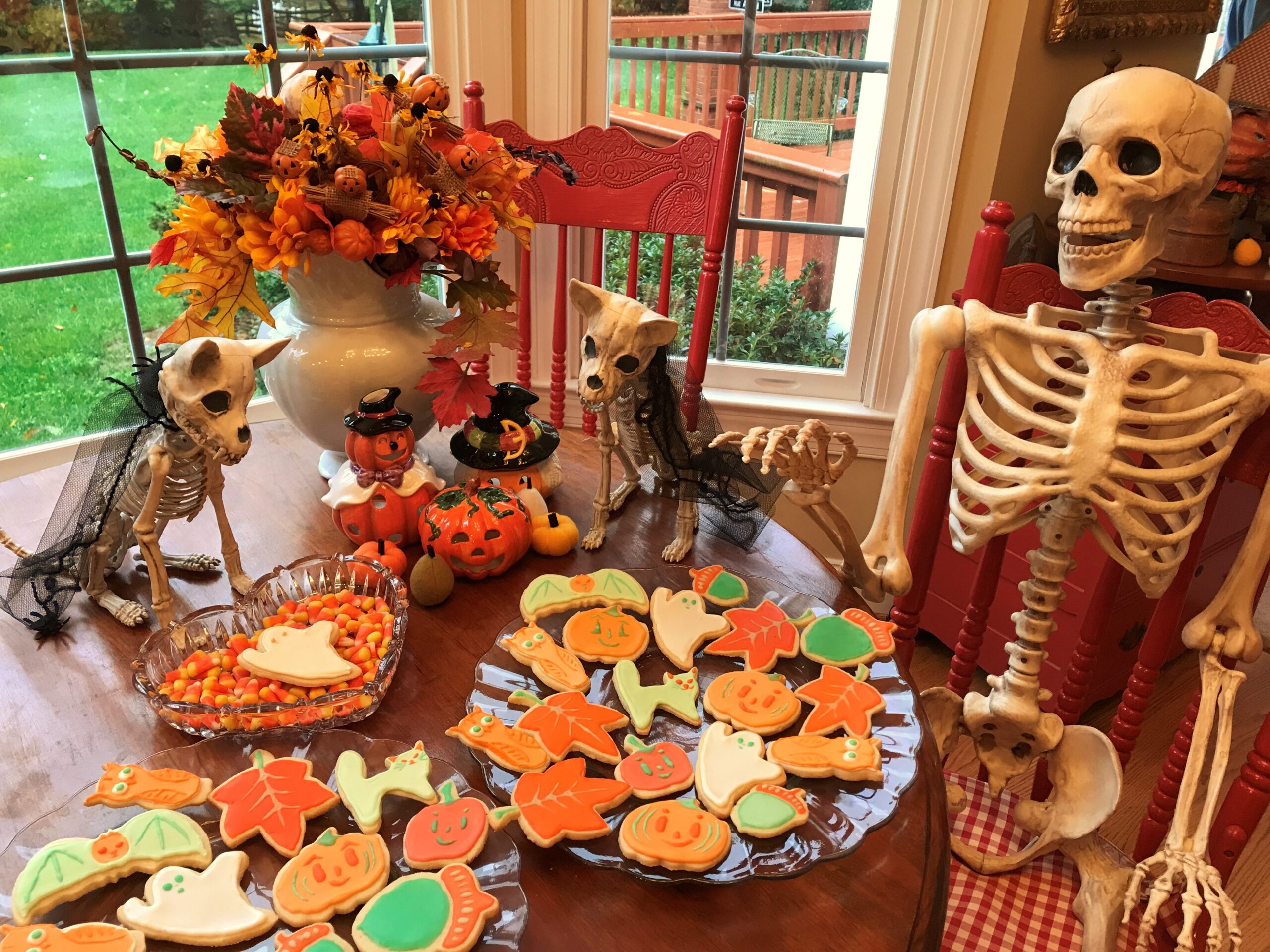
After Slim amped up the festive decorations on my mother’s kitchen table, it became one his favorite inside spots, for sitting, chatting, and watching the many birds at the feeder. He noticed before I did that the slate-colored juncos had returned. He offered helpful tips as I worked at a recent endeavor: trying to make iced sugar cookies that are decorative as well as tasty. With his assistance, my efforts improved. It shouldn’t have surprised me in the least to learn that he has a deft hand with a pastry bag.
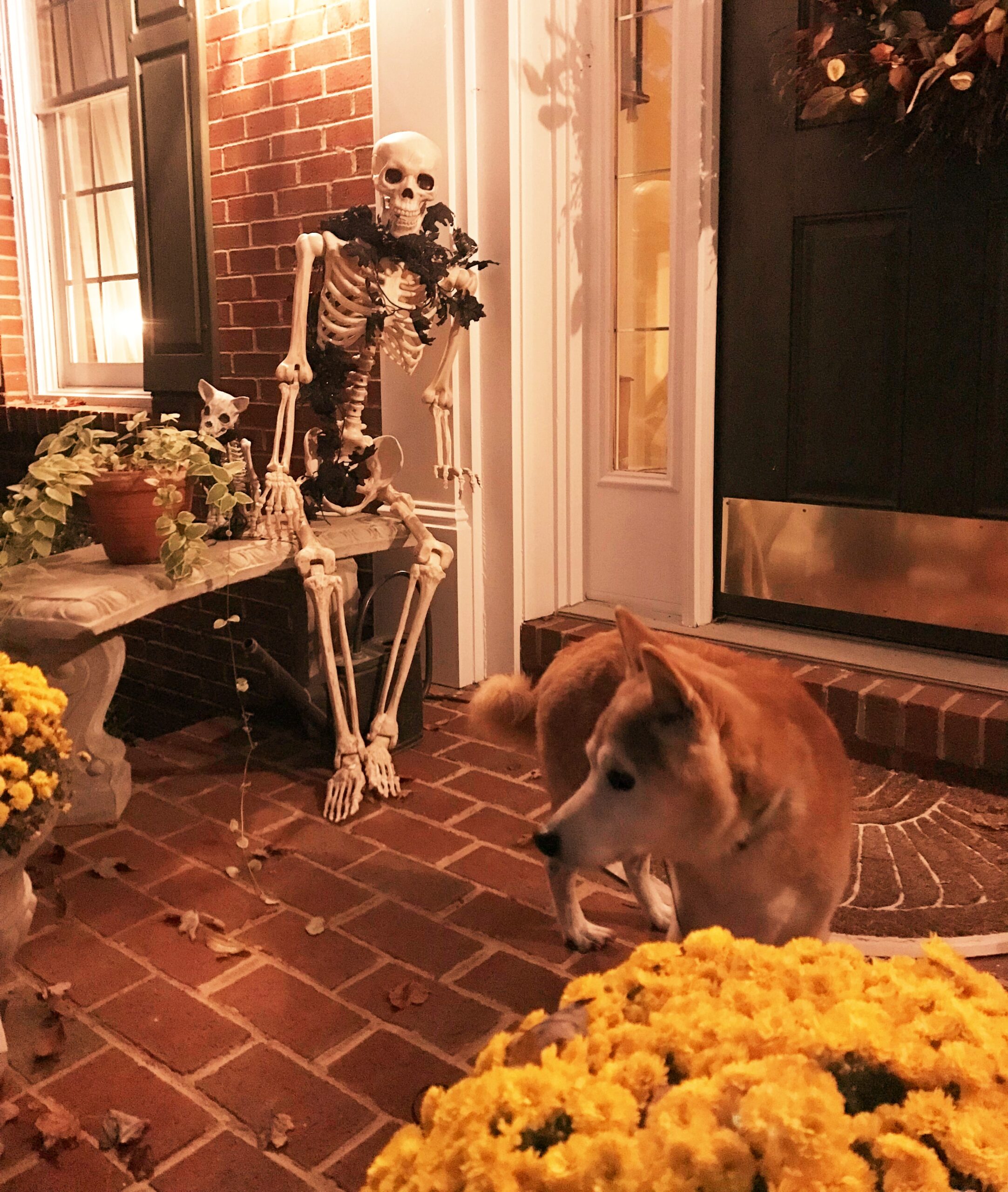
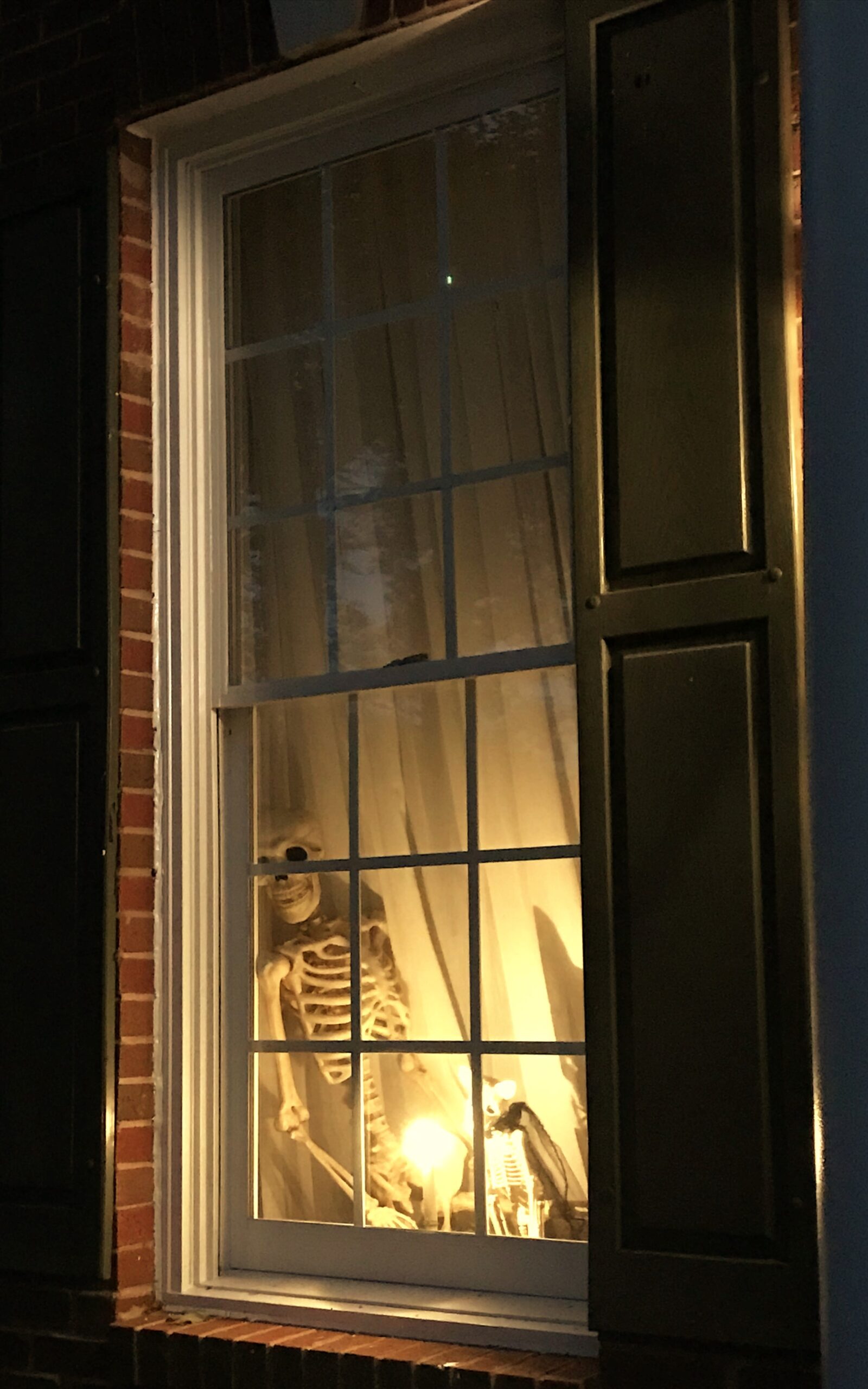
Every night, Slim assumes a post at a front window, looking out on the neighborhood until drifting off to sleep and to sweet Halloween dreams. Seeing him there as I pass my mother’s house on Kiko’s last walk of the evening, I’m reminded of Riff Raff peering out of that upper window in Rocky Horror Picture Show, and his words echo in my head:
There’s a light. . .over at the Frankenstein place.
There’s a light. . . light. . .in the darkness of everybody’s life.
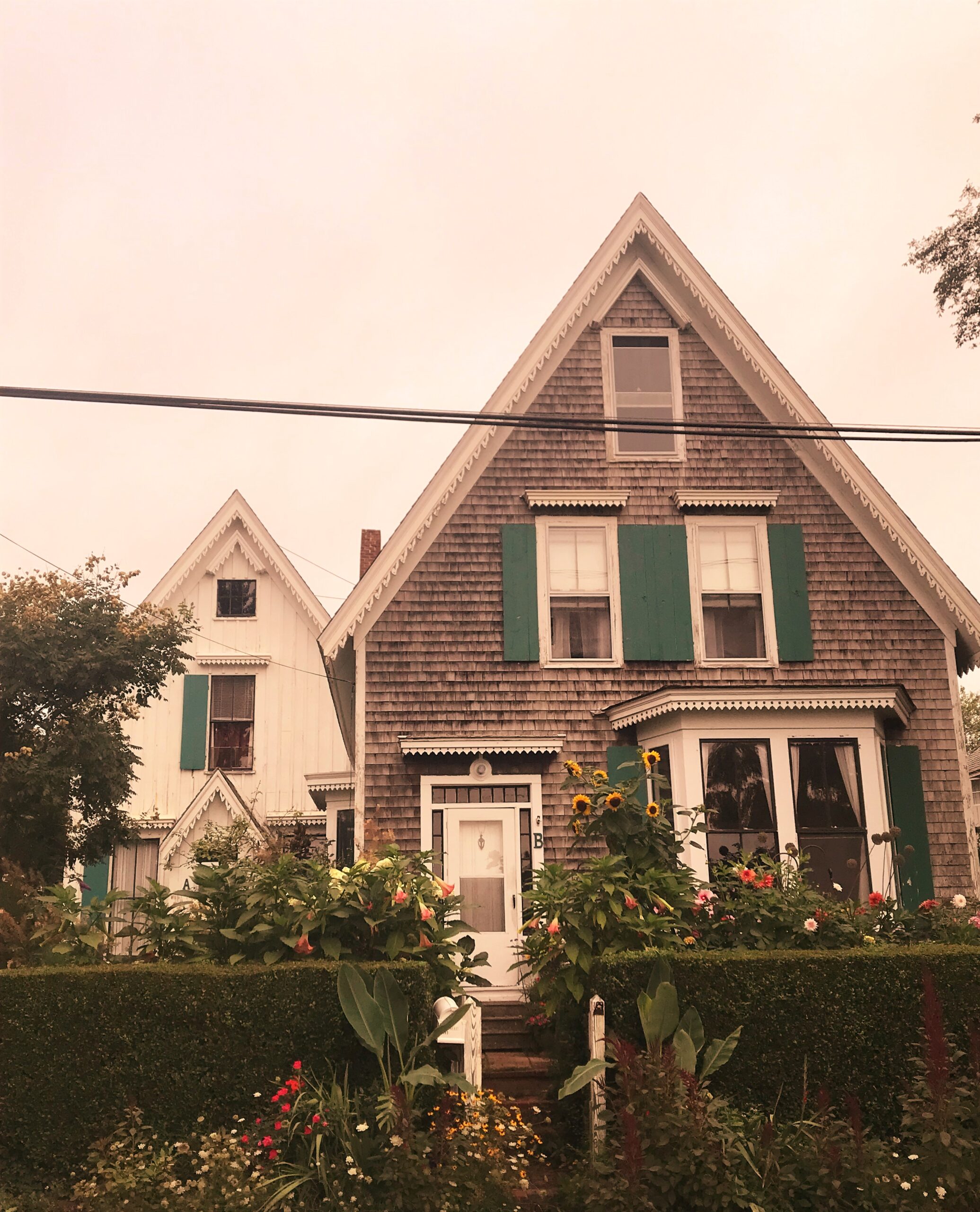
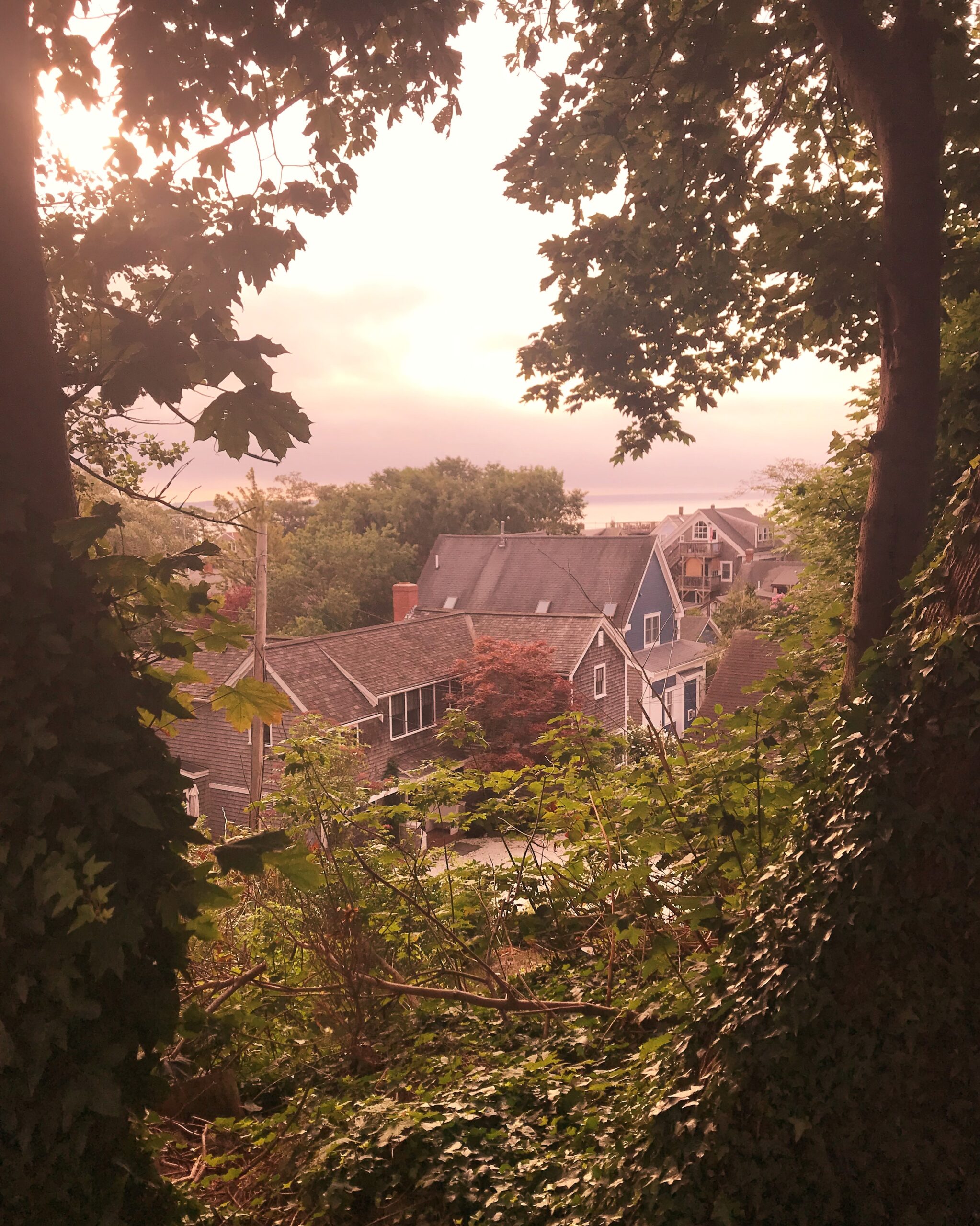
In one of my longer Provincetown walks this summer, I got as far as the hilltop apex of Bradford Street, where the tall, narrow Gothic revival cottages above are located. With their sharply peaked roof lines, the structures could well be the home of friendly witches in a children’s book. The neat, enclosing hedge and abundant plantings further enhance the compound’s charming storybook aspect. Built by a sea captain in 1850, and home to several artists over the years, the cottages are now owned by a local art and antiques dealer.
The view toward the bay from the upper windows of the buildings above must be spectacular. I took this photo from just across Bradford Street, at the edge of a precipitous drop.
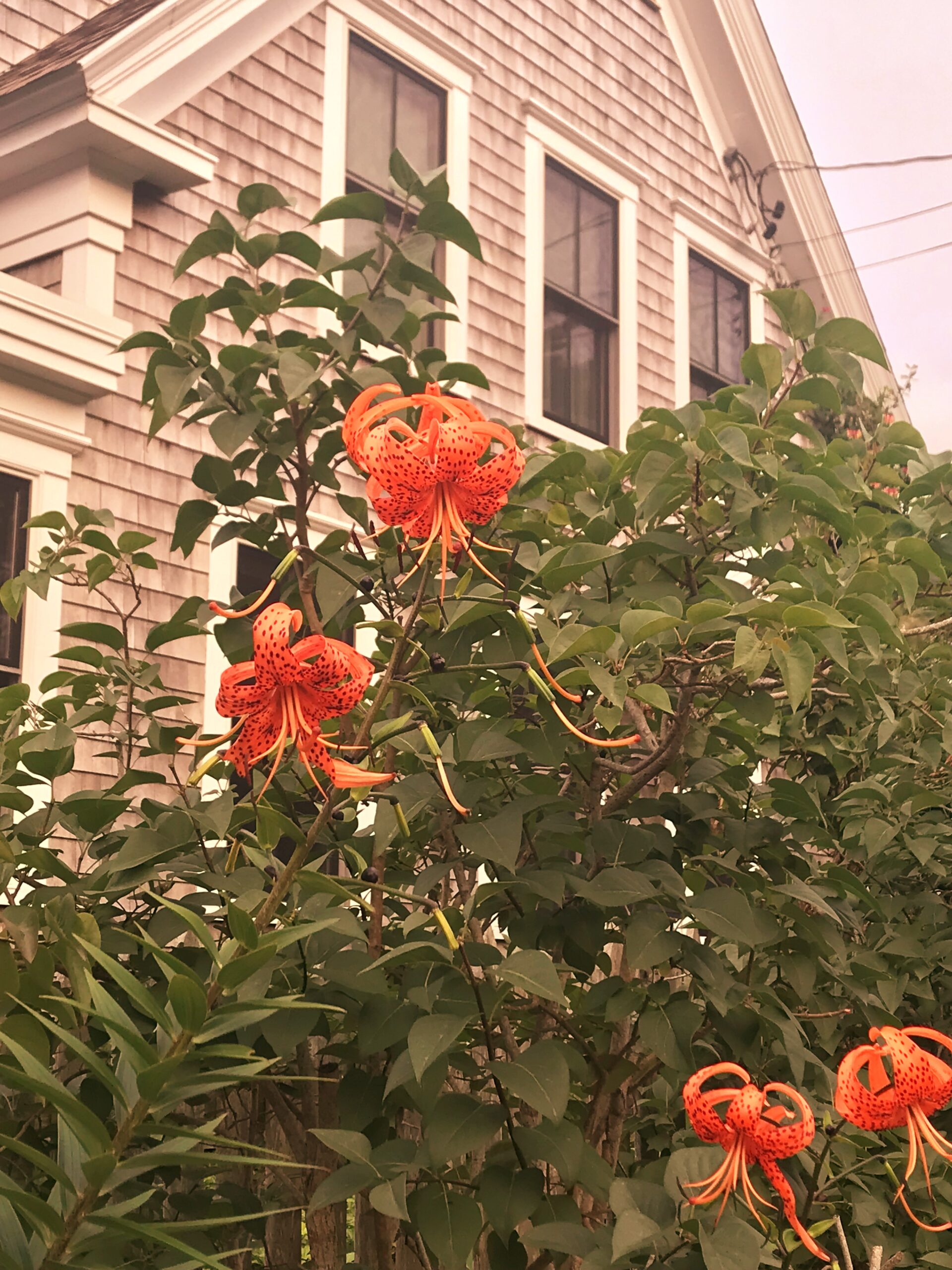
Flamboyant orange tiger lilies stand out against the weathered shingles of another hilltop Bradford Street home.
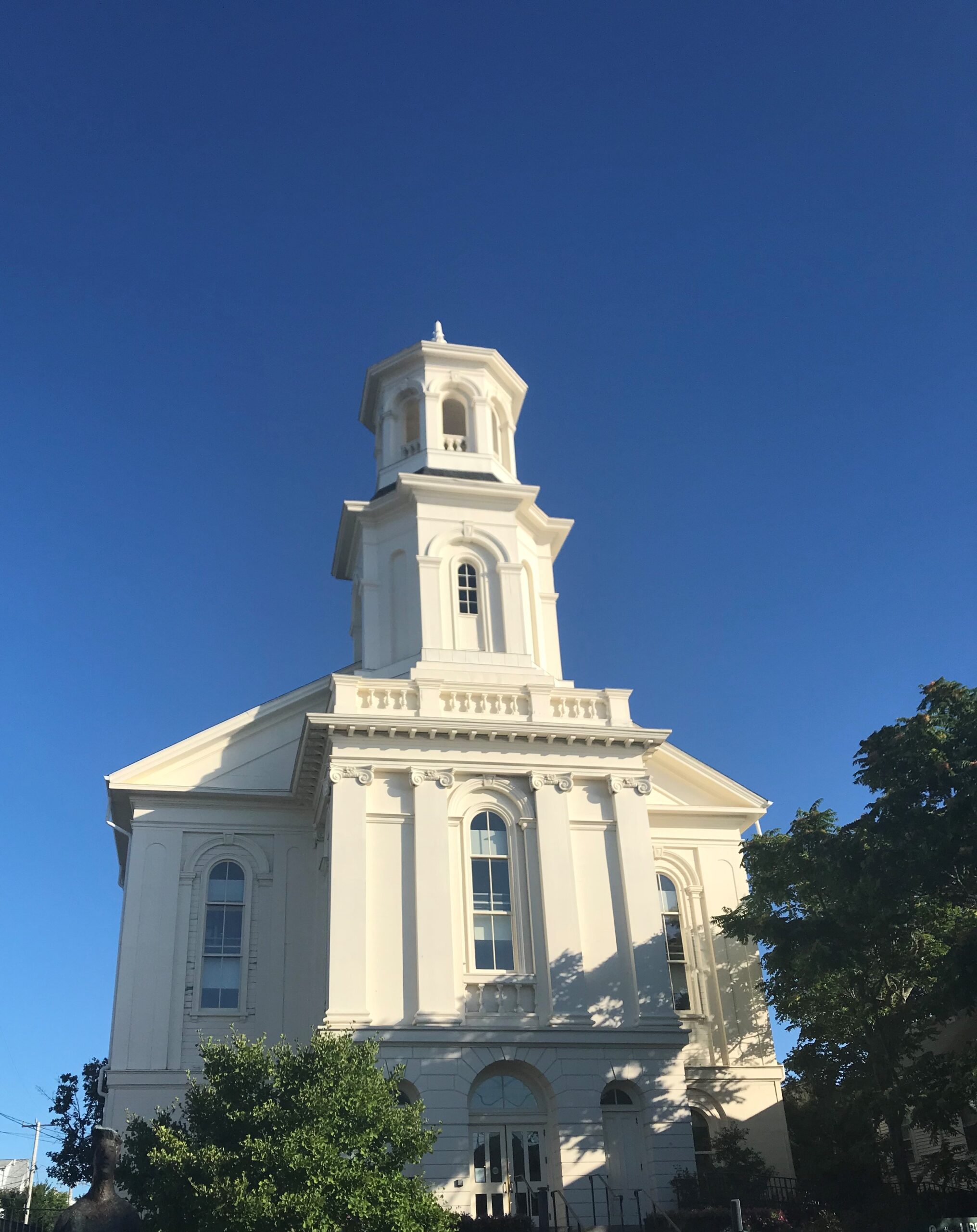
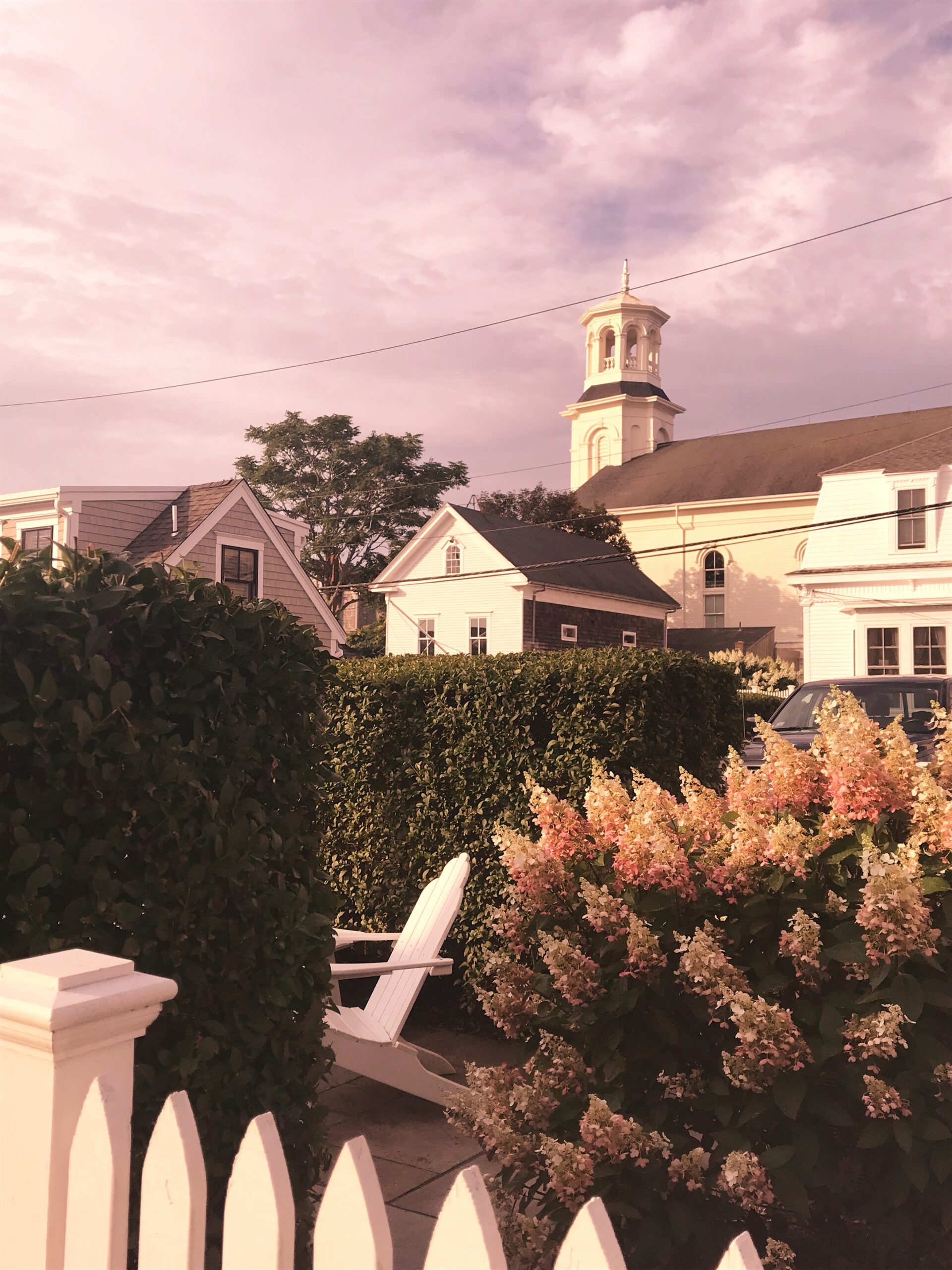
Back on Commercial Street, near the heart of town, is the elegant wedding cake building above. At the time of its construction in 1860 as the Center Methodist Episcopal Church, it was purported to be the largest Methodist church in the United States. Its original, emphatically tall steeple was removed after it was damaged in the severe winter storm of 1898. Since then, the arched belfry alone has topped the building. Once the congregation left for a newer, more easily manageable building in 1958, the church became home, for about a decade, to the Chrysler Museum, and later, to the Provincetown Heritage Museum. Following an extensive renovation, completed in 2011, the building now serves as the town’s Public Library.
The building’s light-filled interior is well worth a look. It’s high-ceilinged upper floor still contains a sixty-six foot long, half-scale model of the Provincetown schooner, the Rose Dorothea, winner of the 1907 Lipton Cup Fishermen’s Race. The model, completed in 1988, by a group of volunteers led by Francis “Flyer” Santos, is a tribute to the long tradition of New England shipbuilding and to the intrepid fishermen of Provincetown.
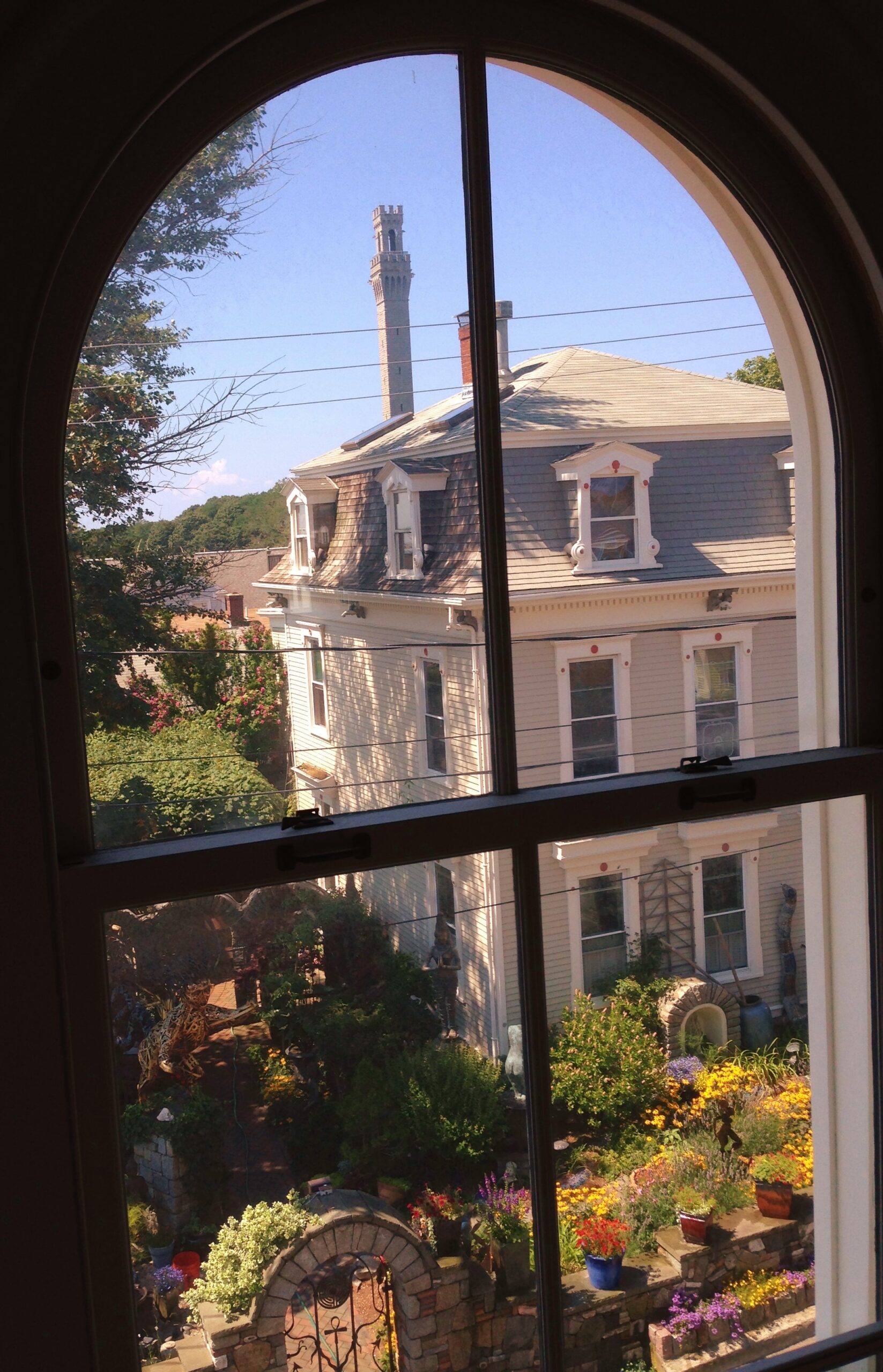
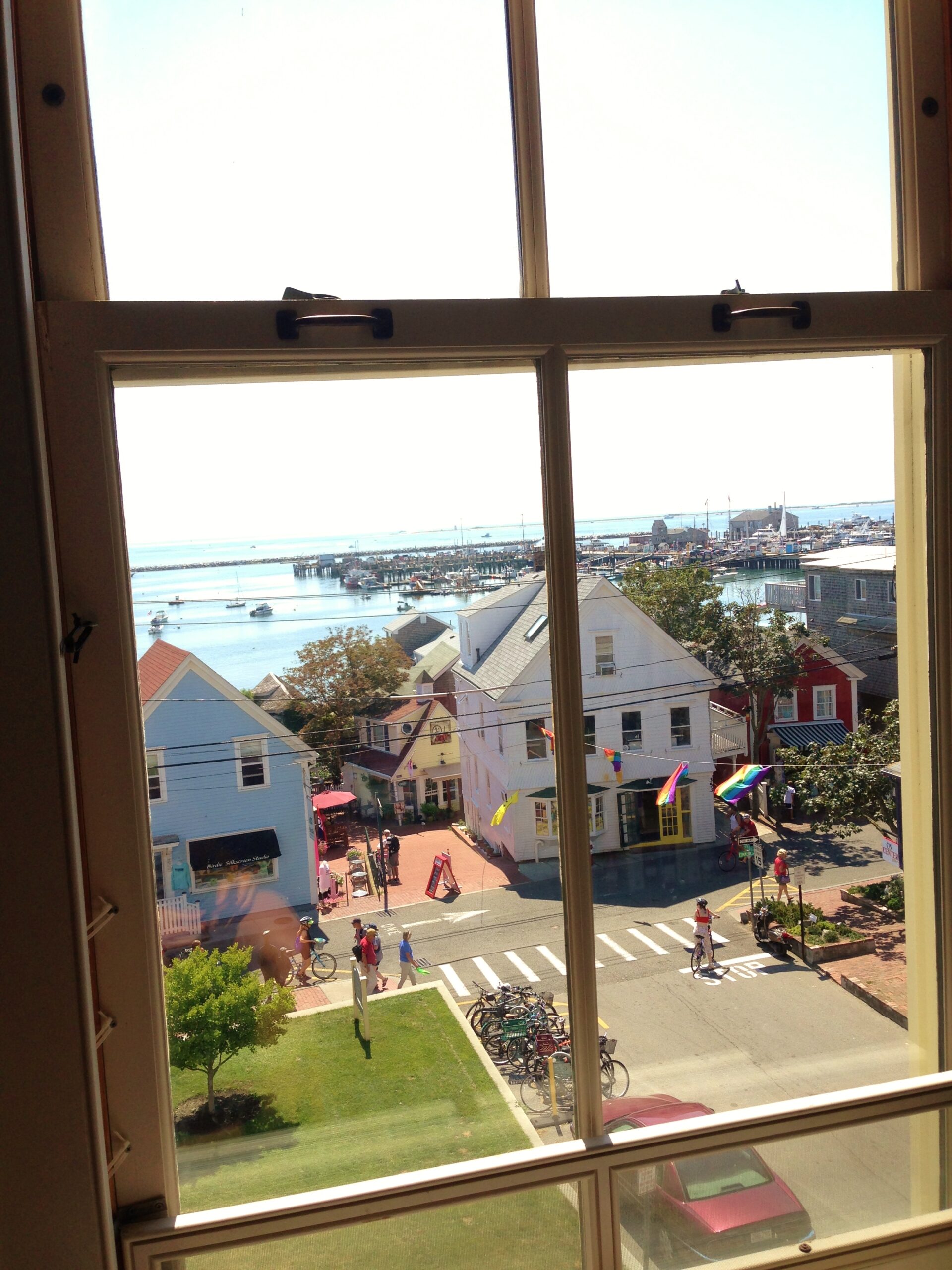
The library, with its large windows, is a lovely place from which to survey the surrounding town. Above, we look across Center Street to the home built around 1870 as the parsonage of the Methodist Church. The current owner is the proprietor of Provincetown’s Shop Therapy, which bills itself as a “world famous alternative lifestyle emporium.” The wild spirit of the sculpture garden that surrounds the house is similar to that expressed in the brightly colored murals that adorn the facade of Shop Therapy. The Pilgrim Monument rises in the background.
This view above shows Commercial Street shops, the harbor, pier and breakwater.
I like to walk the town’s short lanes that connect Commercial and Bradford streets. They offer unique perspectives on enclosed gardens and quiet enclaves mere steps away from the tourist crowd.
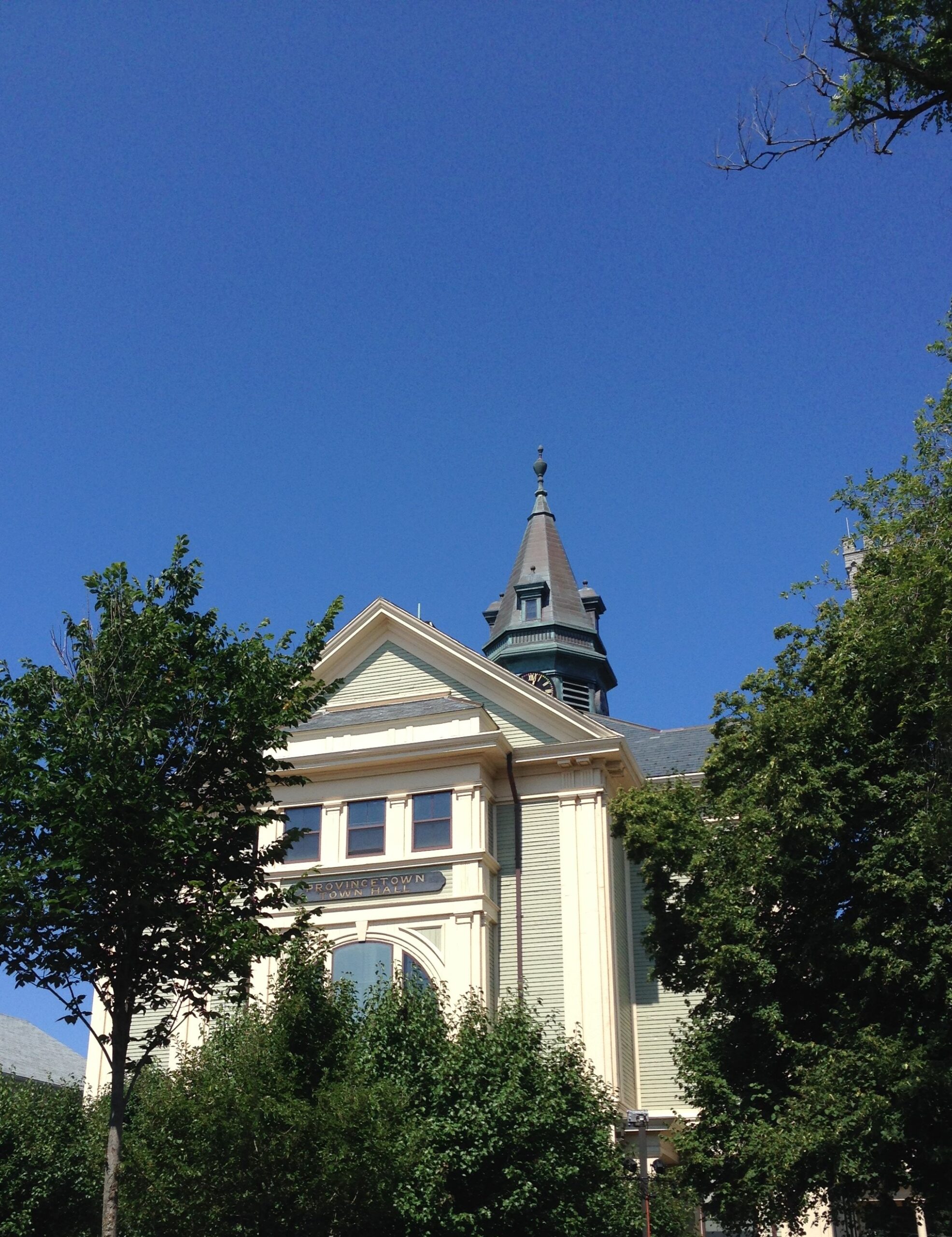
Town Hall, as seen from Commercial Street.
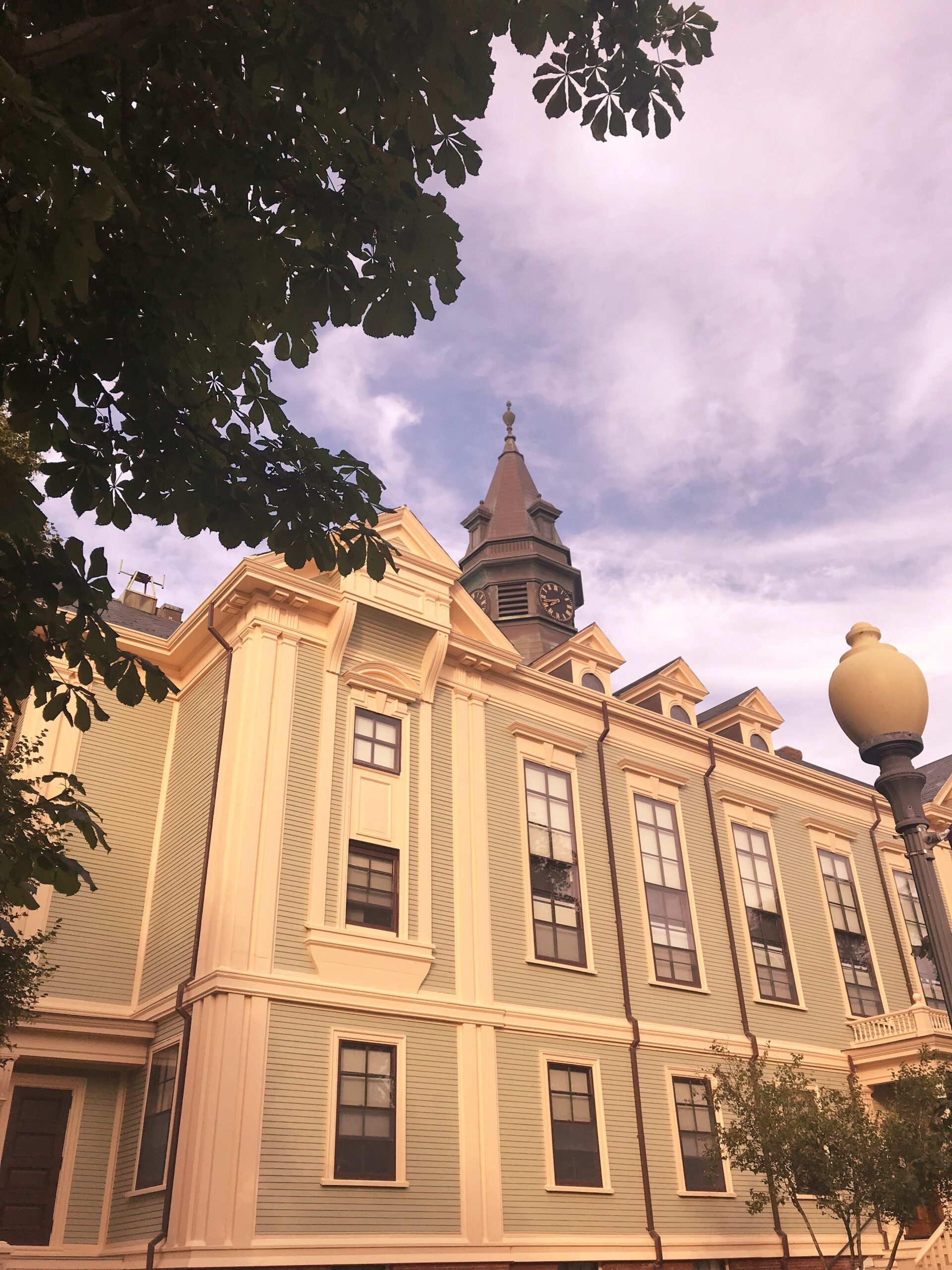
Provincetown’s government center is Town Hall, built in 1886 and situated at the very midpoint of the town. Every registered, resident voter is a member of the town’s legislative body. Town Meetings, as well as concerts and special events, take place here in the capacious auditorium. The Victorian building underwent a massive renovation, completed in 2010, after portions of it were deemed structurally unsound. The current green and white color scheme mimics the original palette.
A side view of Town Hall, from Ryder Street.
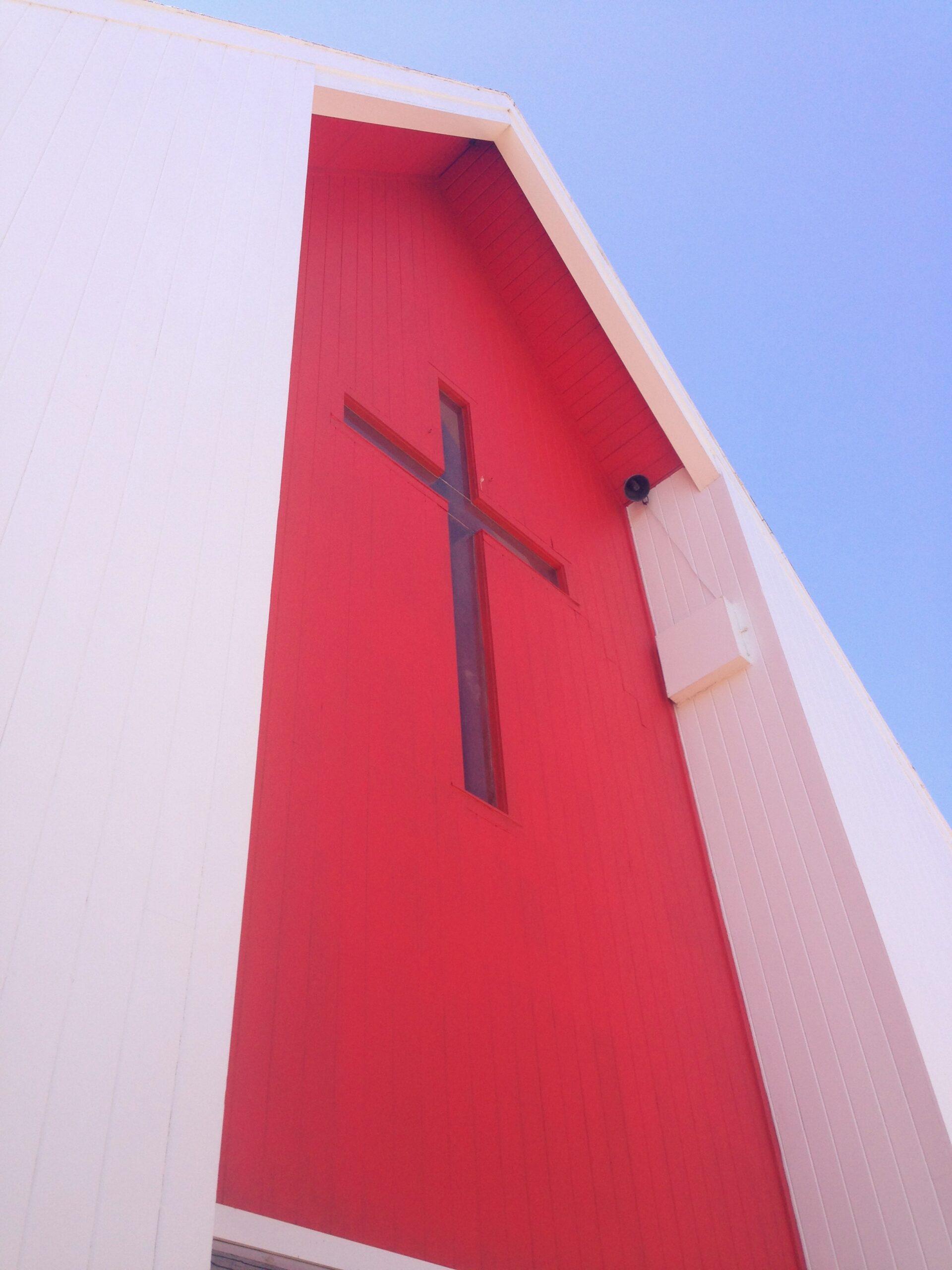
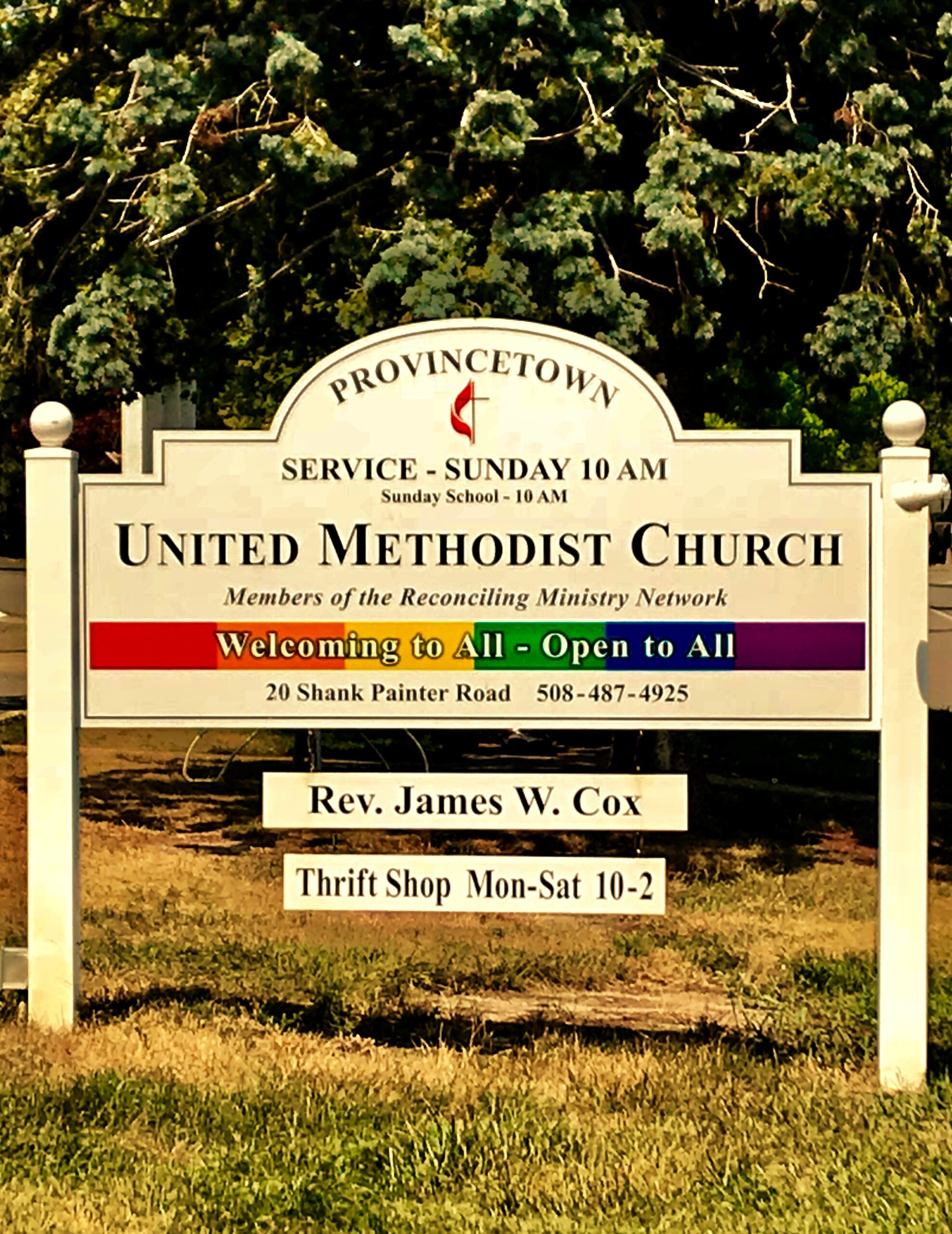
Following the sale of the Center Methodist Church, the congregation built their new home on Shank Painter Road, a bit removed from the town center. The spare Modernist building opened in 1960. The sanctuary, with steeply sloping redwood walls, resembles the upturned hull of a boat. Provincetown United Methodist Church is a vital hub of community life. In addition to Sunday worship, the congregation runs a Thrift Shop and Soup Kitchen. The church hosts a number of twelve-step groups and serves as a rehearsal space for some theater groups. Our family has been attending worship there once every summer for many years. It has become our church home away from home. We looked forward to being back in the company of the small, welcoming congregation, to an uplifting sermon by the Reverend Jim Cox and to a moving anthem by the delightful “Joyful Noise Choir.” When we arrived on our annual Sunday morning in August 2019, we were surprised, and somewhat alarmed, to see that Reverend Jim was not there. A guest minister presided. Toward the end of the service, she seemed to be stalling for time. Before long, Rev. Jim was proceeding slowly up the center aisle. Gravely ill, he’d come to say goodbye. He died just over a month later. We’re grateful that we could be among the flock that day, to thank him for being such a source of kindness, wisdom and good cheer, for walking the walk of faith and love of neighbor in all circumstances. Appropriately, his Celebration of Life included a New Orleans-style brass band “Second-Line Procession” from Town Hall to the Church.
The Delta surge of Covid prevented us from attending church this year in Provincetown. As of June, the pastor is Edgar Miranda. God willing, we’ll meet him next year.
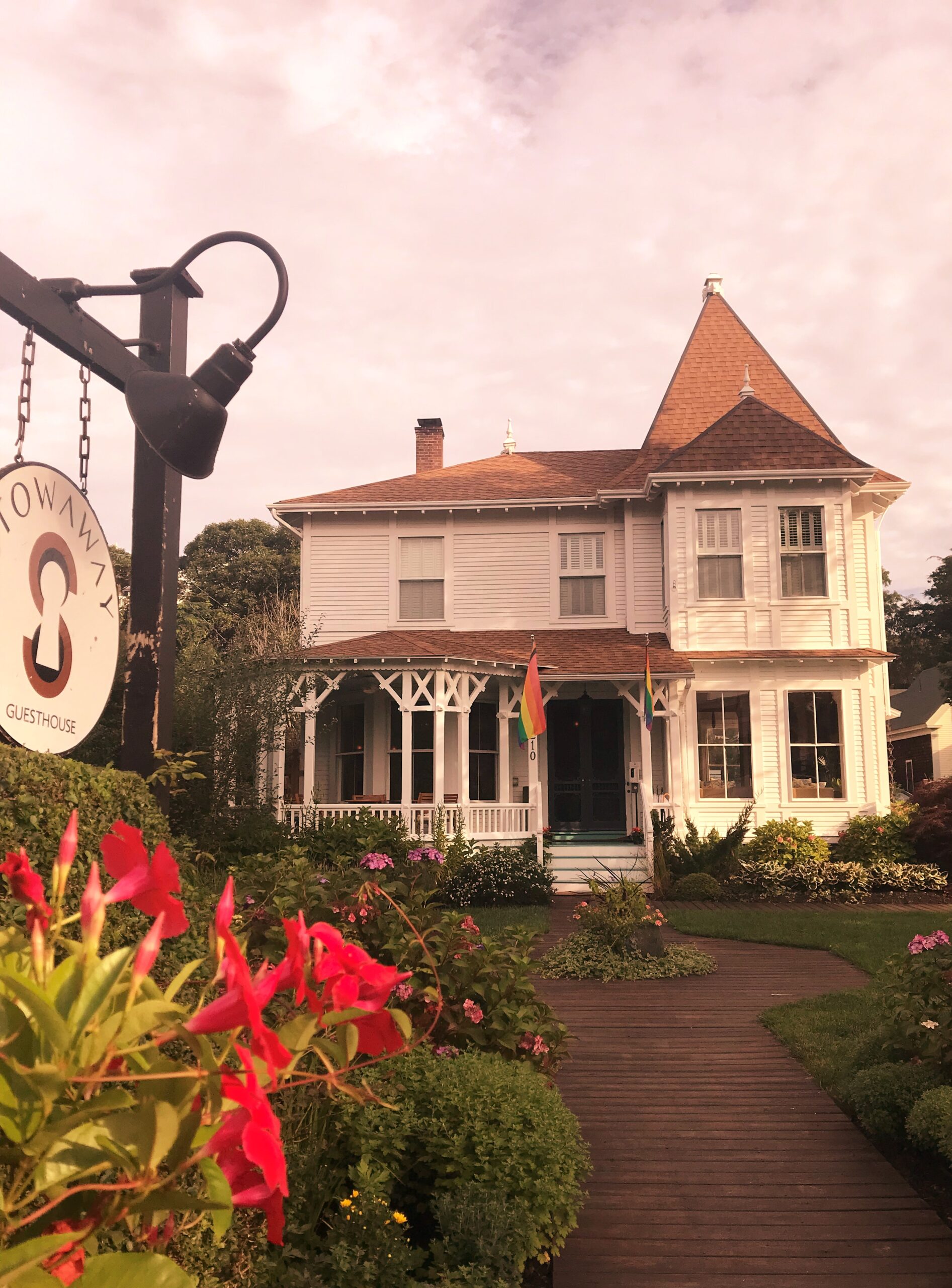
This large Bradford Street residence, built in the 1870s, stands out for its dramatically peaked gable roof and Stick Style ornamentation. It was home to a succession of artists and merchants before opening its doors to paying guests. Currently operated as Stowaway Guesthouse, its pleasant rooms are brightly painted, and the spacious grounds are lushly landscaped. It’s one of Provincetown’s many inviting, privately run inns.
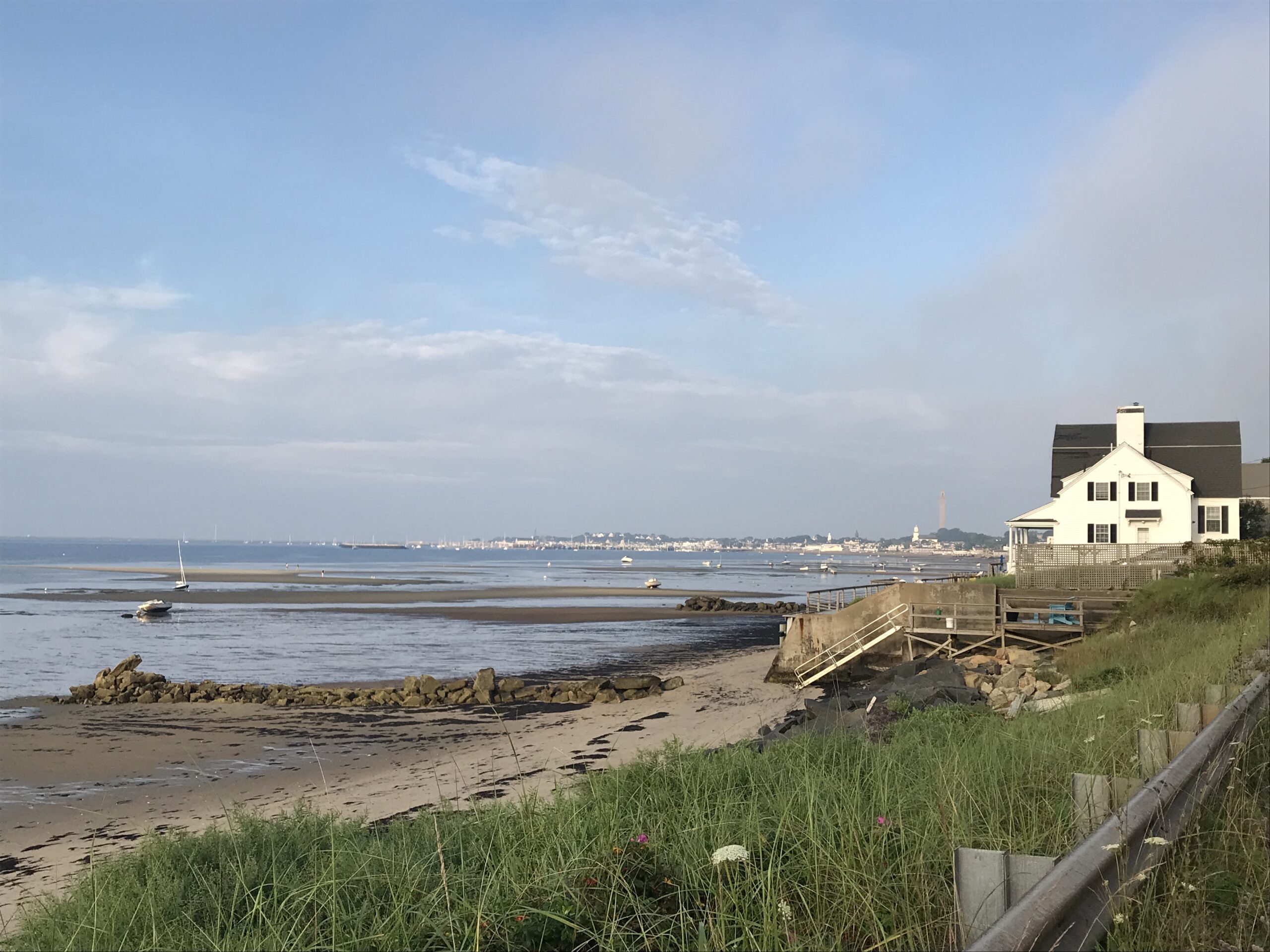
On every return walk to Truro, I pause again to look back toward Provincetown. The familiar elements are there: the white house, the bay, the curve of the town. When the distinctive features of the Provincetown skyline, such as the Pilgrim Monument, the towers of the Library, Town Hall and the Unitarian Universalist Meeting House, are visible, it calls to mind a decorative miniature village in a model train display. On cloudy days, the buildings blur together into a vague impression, a palette knife rendering in tones of gray and white. Sometimes, as in the view from our cottage in Truro, dense fog obscures the town altogether, and the white house could be perched at the very edge of the world. At low tide, the home looks out to a vast, low basin of sand. At high tide, the waters of the bay seem to lap at the base of the porch. The view is never the same, yet always the same. I find this somehow comforting. I know it will be there waiting for me next year. And it reminds me that even in the most mundane of life’s daily routines, there lies the potential for endless variety, for boundless possibility.
I didn’t make it to Provincetown’s far West End this summer. I’ll save that part of the tour for next year.
Back in the Covid summer of 2020, it seemed reasonable to hope that in a year, a visit to the Cape would no longer involve considerable pandemic restrictions for the vaccinated. But that was well before the rise of the Delta variant and Provincetown’s post-July 4th surge in breakthrough infections. Therefore, many of our favorite activities–dining inside at restaurants, seeing musical and comedy shows, singing in a packed crowd of strangers around Bobby Wetherbee’s piano at the Crown & Anchor–remained off limits. There would be no festive Ptown nightlife for us this time, sadly. We didn’t, and still don’t, want to take risks that could bring the virus back to my mother. But walking through town in the early mornings, when the streets are nearly empty, seemed safe. I don’t always walk down Shore Road further into Truro. Sometimes I head in the opposite direction, and before long, I’m in Provincetown.
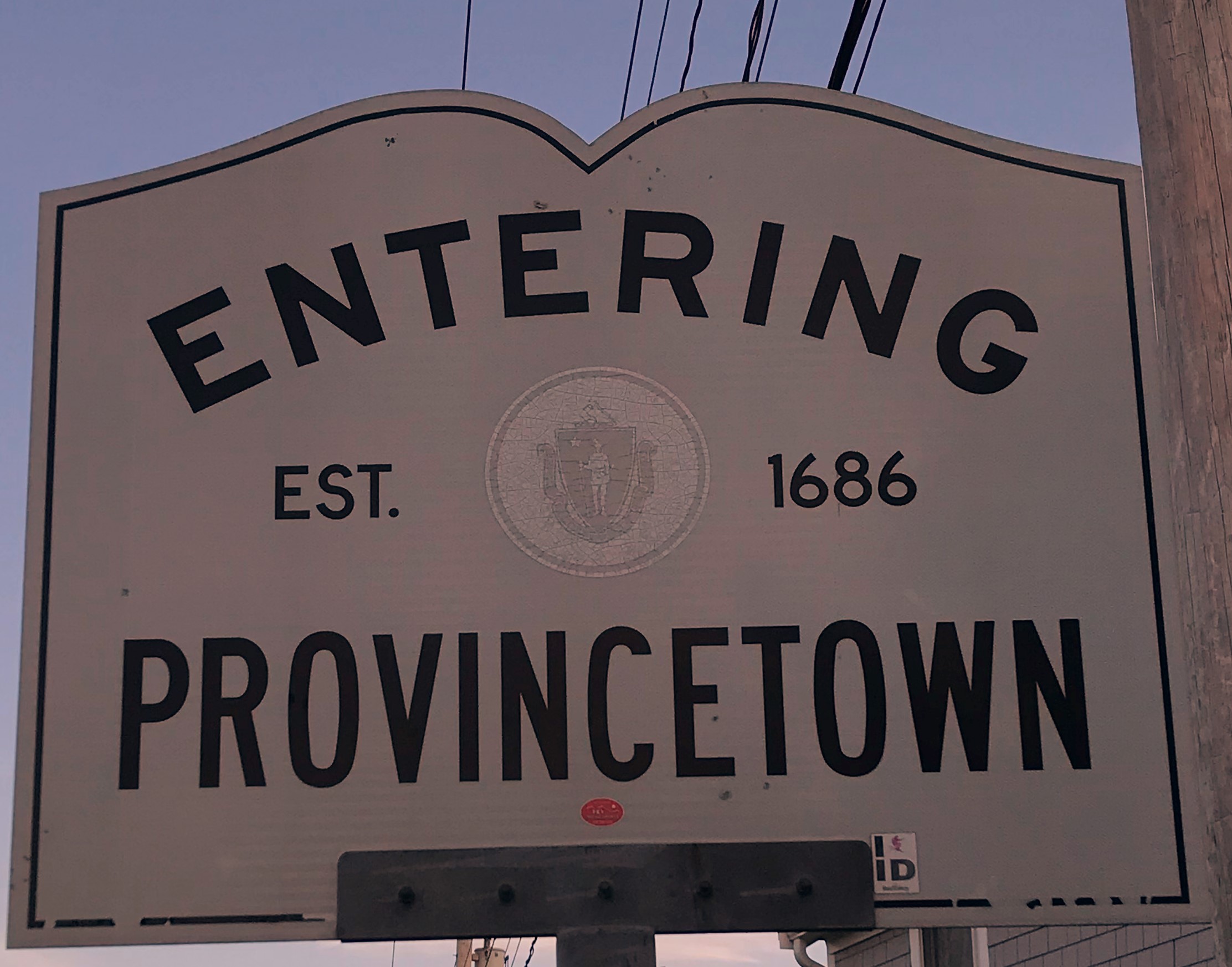
In terms of actual area, Provincetown is a small place. Its narrow, curving peninsula occupies about seventeen and half square miles. But surrounded on three sides by water, and with the vast, ever-changing sky above, it seems much larger. The year-round population is less than 3,500, but it swells to about 60,000 in the summer. The town’s spirit, too, like its capacity to receive guests, is generous, expansive, and welcoming.
Provincetown’s colorful present is matched by a colorful past; there’s a lot of history here. The original residents were the Nauset tribe, who interacted with the Pilgrims not long after they arrived on the Mayflower in 1620. The Nauset, and their neighbors the Wampanoag, like many of the Europeans who followed, valued the area and its deep, protected harbor, primarily for its excellent fishing. The Pilgrims moved on in two months to Plymouth, but the colony continued to rely heavily on fish from its waters. The town was a prominent whaling center for nearly two hundred years. Provincetown whaling ships sailed as far as the Azore Islands, where Portugese sailors often joined the crews. By the 1860s, Provincetown was home to a substantial, and growing, Portugese community. The railroad made the remote village more accessible in the 1870s, and the area’s great natural beauty began attracting tourists and artists. The first of many art schools opened in 1899. By the early twentieth century, Provincetown had become a destination for writers and theater people, as well as visual artists. In the summer of 1916, the Provincetown Players gave the first-ever performance of a play by the young Eugene O’Neil. When Tennessee Williams arrived in 1940, a gay community was already flourishing. In the 50s and early 60s, attempts were made to shutter gay-themed entertainment spots. These efforts failed. Today, Provincetown welcomes everyone. It’s a big-hearted, good-humored, judgment-free zone, a place where no one is a misfit, where no one is friendless for long.
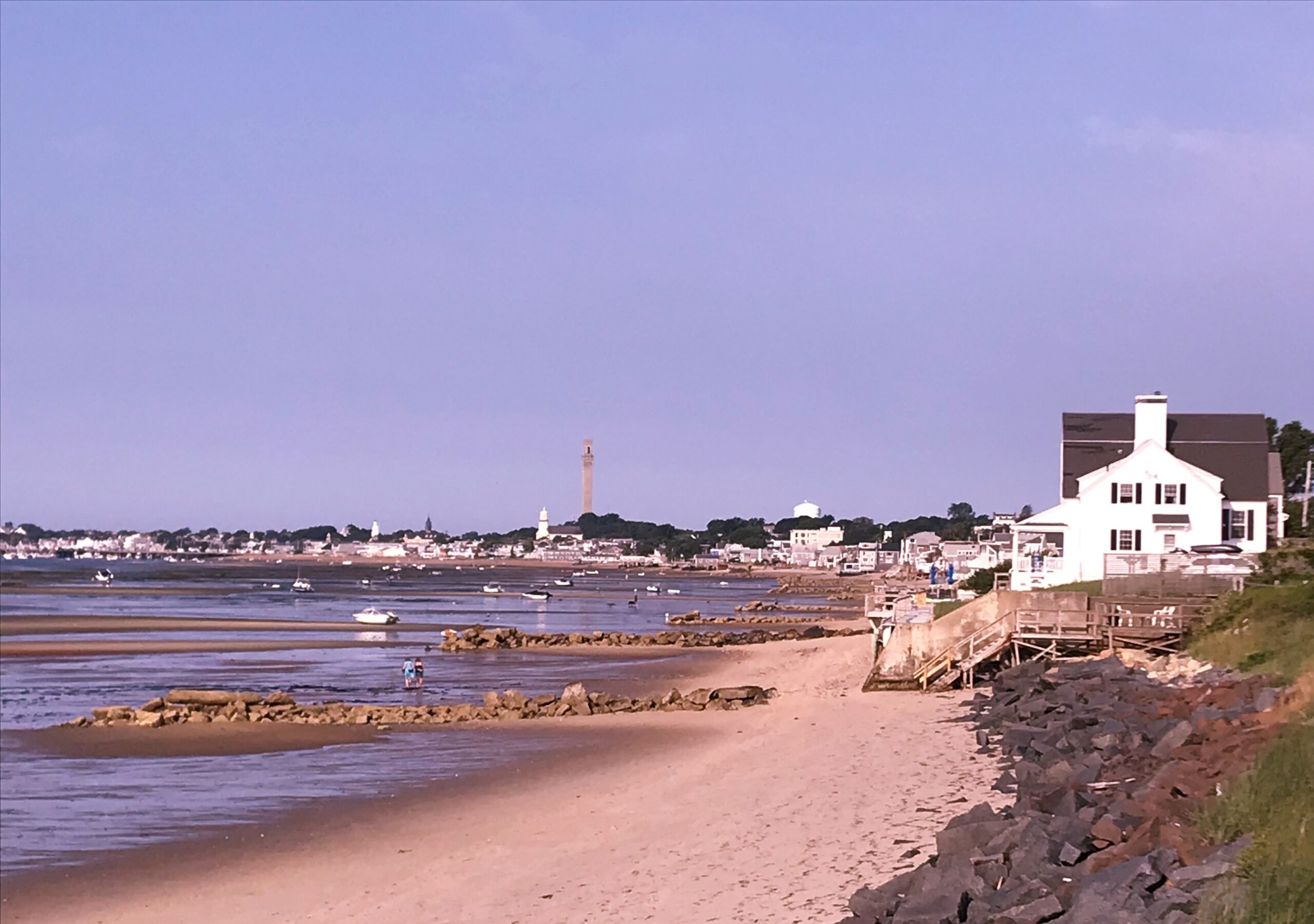
And it’s a beautiful place. In the quiet early morning, it’s especially easy to appreciate the town’s charming architecture and gardens, and to catch near-hidden glimpses of the bay between buildings. On my walk from Truro, I usually pause at a wooden stairway leading to the beach, where I take in the view above. The big white house at far right, with the bay and the curve of the town behind it, is one of the most frequently painted and photographed scenes on the entire Cape. A Colonial Revival built in 1917, the house is situated near the division of Route 6A into the town’s two main streets, Commercial and Bradford. It’s at this point that Provincetown starts to look and feel like a real town, rather than a sparse collection of homes along the water’s edge. All the buildings in this post are situated along Commercial Street.
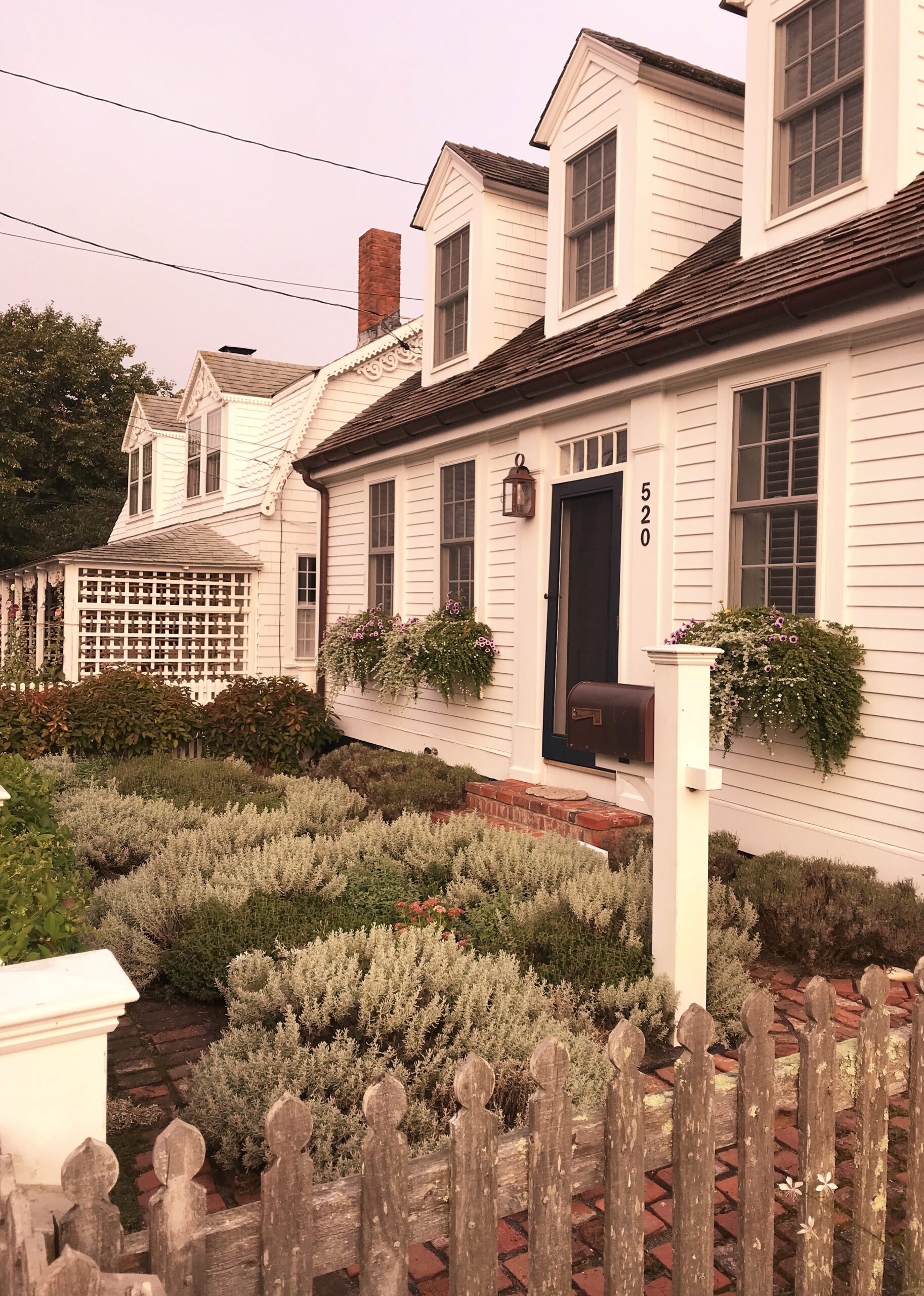
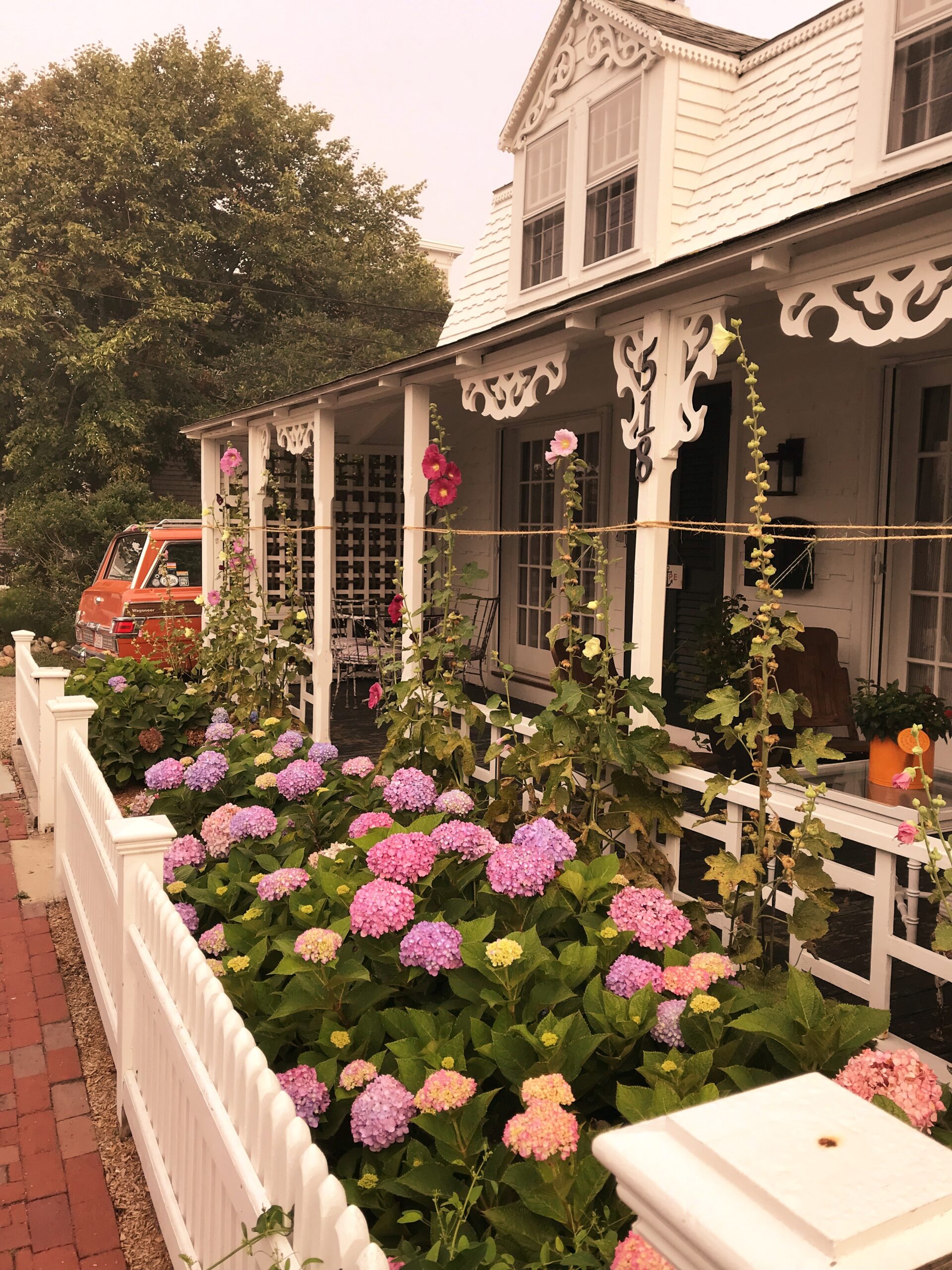
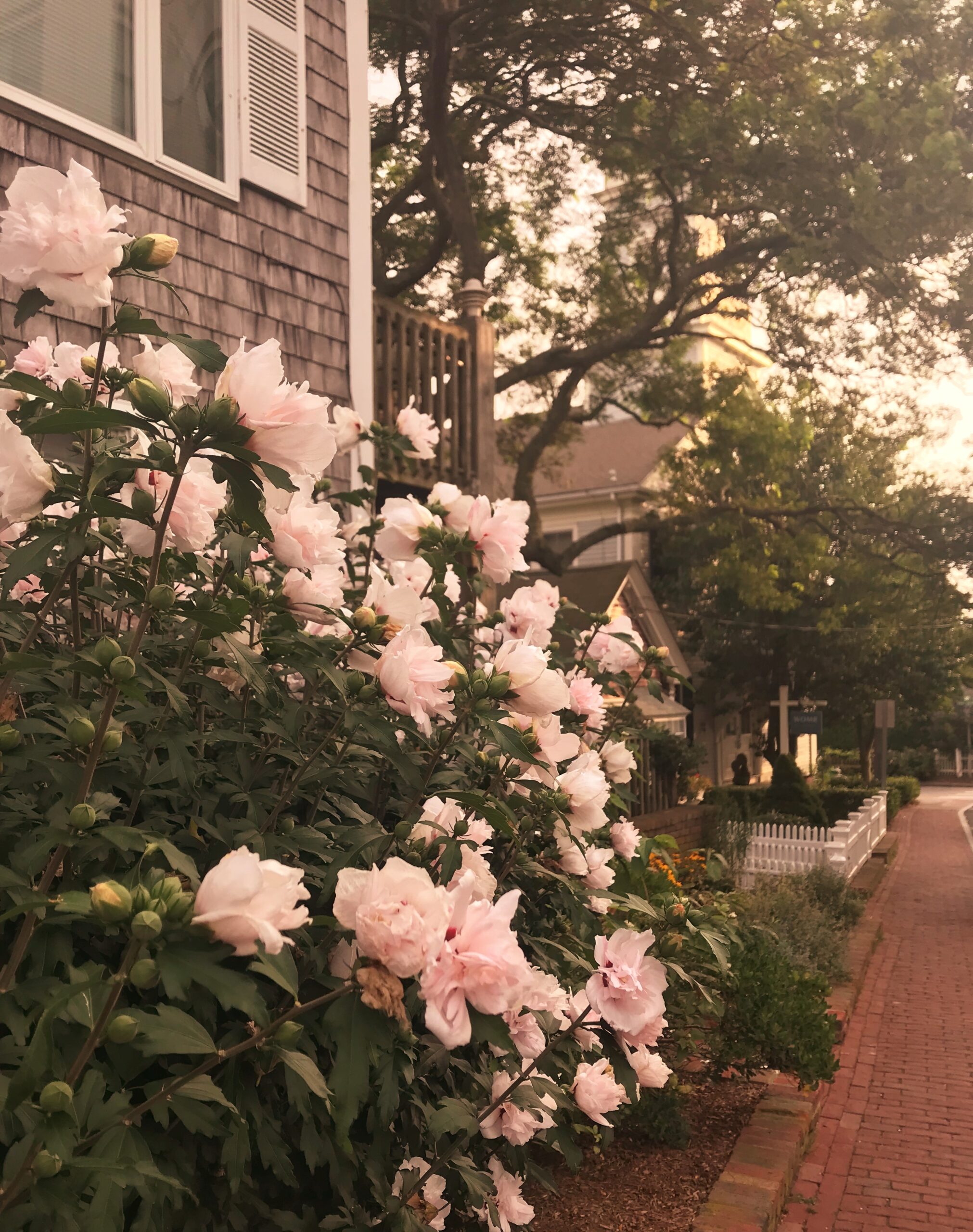
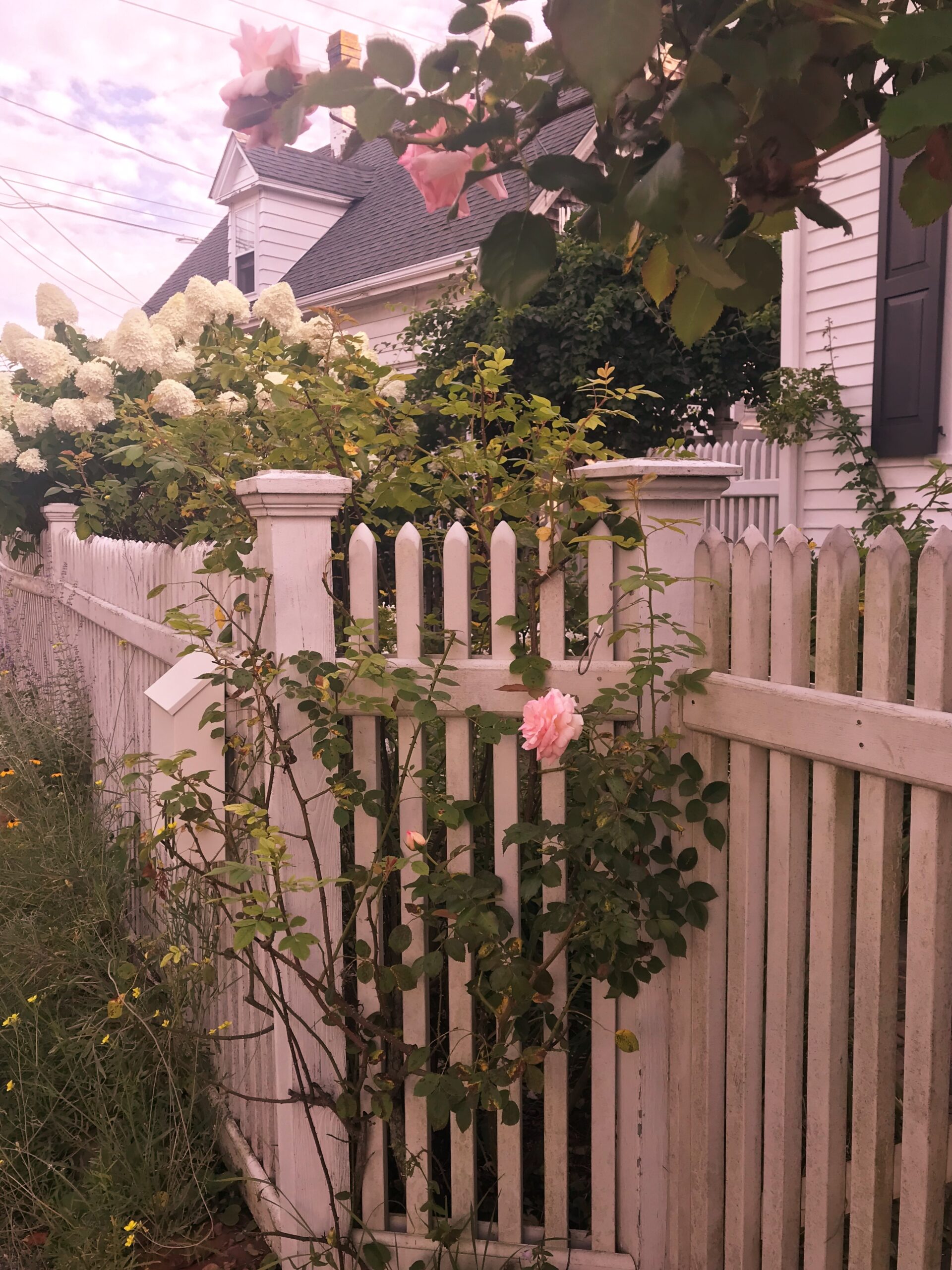
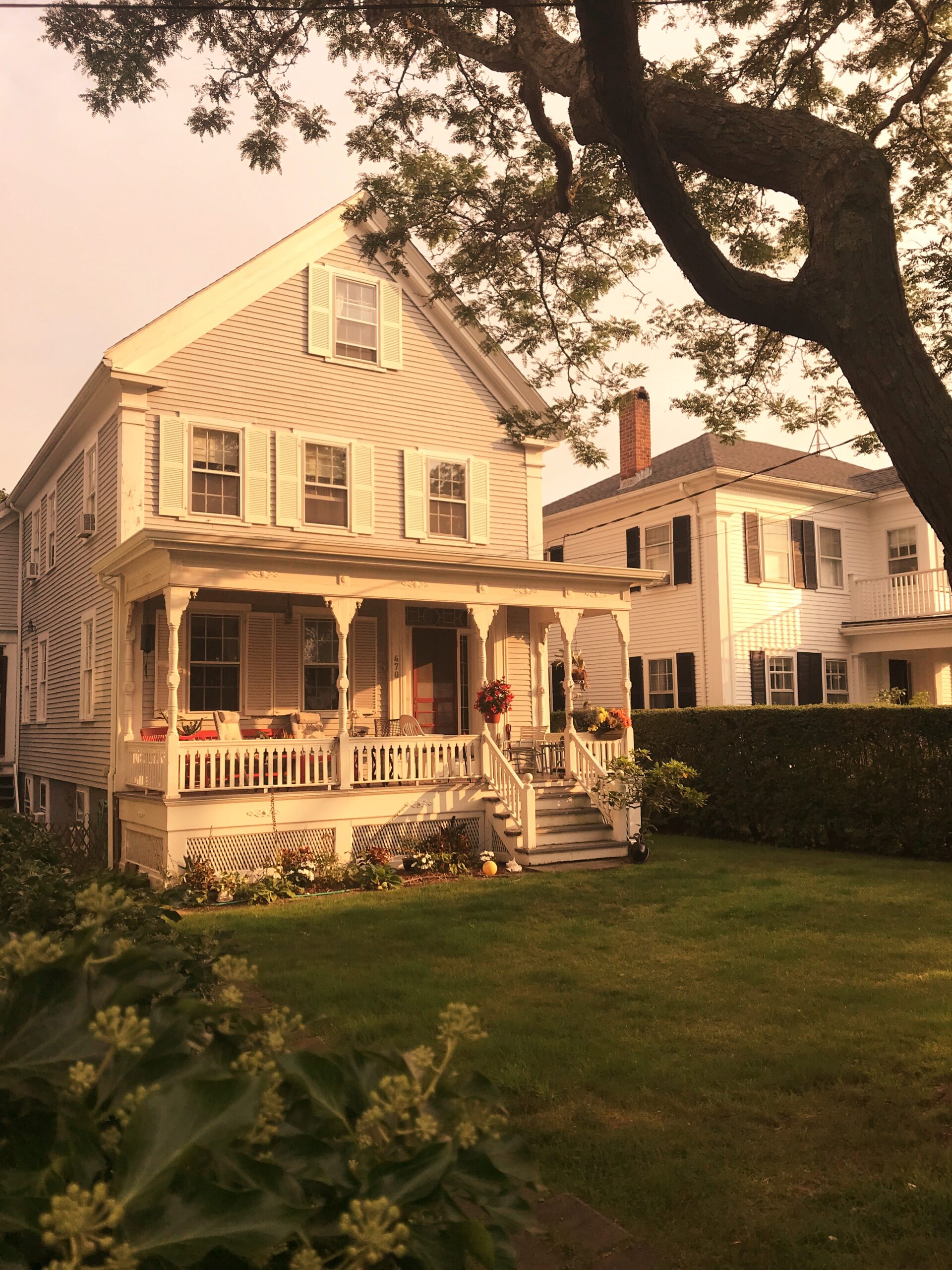
Provincetown has the typical resort town’s share of tee shirt and knick-knack shops. But even most of these are enclosed in architecturally charming exteriors, and clustered primarily in the busy central section. After passing the white Colonial house, I’m in the largely residential East End, a contrast to the touristy bustle of the town center. The front yard pocket gardens along this peaceful stretch of Commercial Street are often color-coordinated and carefully tended. They offer proof that small, thoughtfully planted spaces can pack an outsized visual punch. Many art galleries are mixed in among the East End homes.
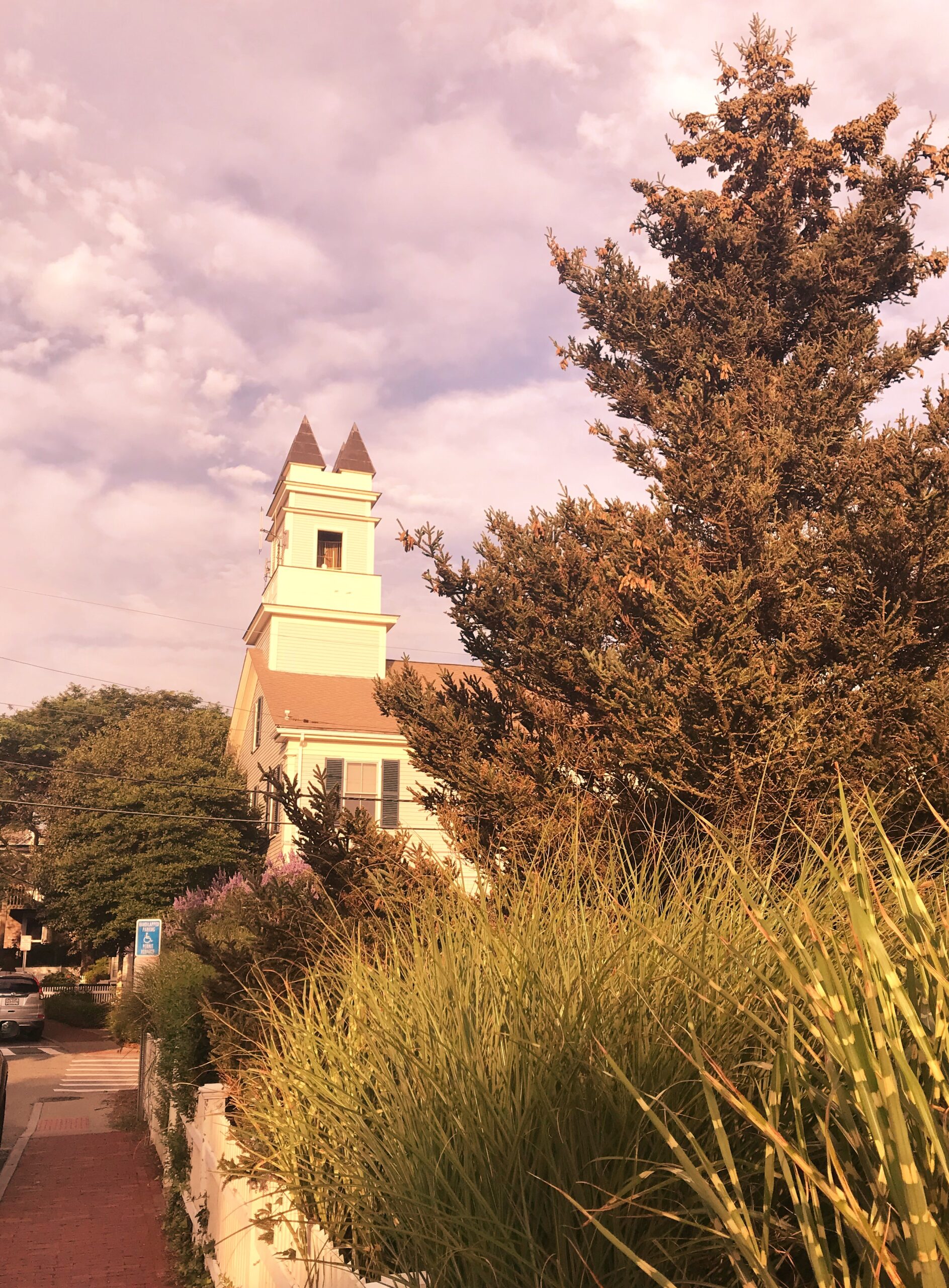
Originally the Eastern School, the towered structure above, like many historic Provincetown buildings, has seen several uses. It’s currently the home of art galleries and WOMR-FM (Outermost Community Radio).
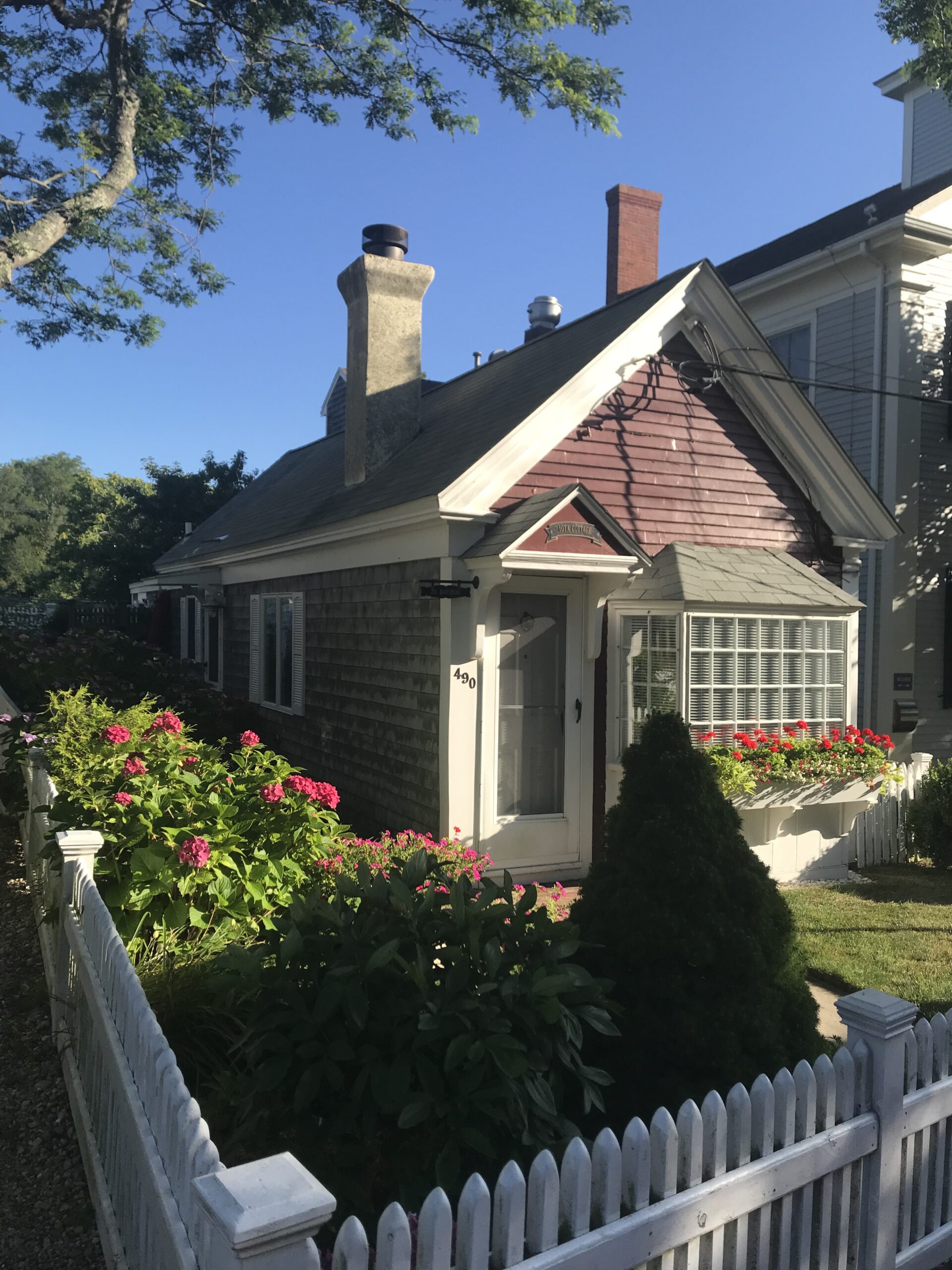
Teeny tiny Iota Cottage, above, got its name from a former owner, Jonathan “Jot” Small, who somehow managed to run a restaurant here in the 1930s.
A few homes, like this one on the land side of Commercial Street, stand out for their luxuriously expansive lawns, rare in beach communities.
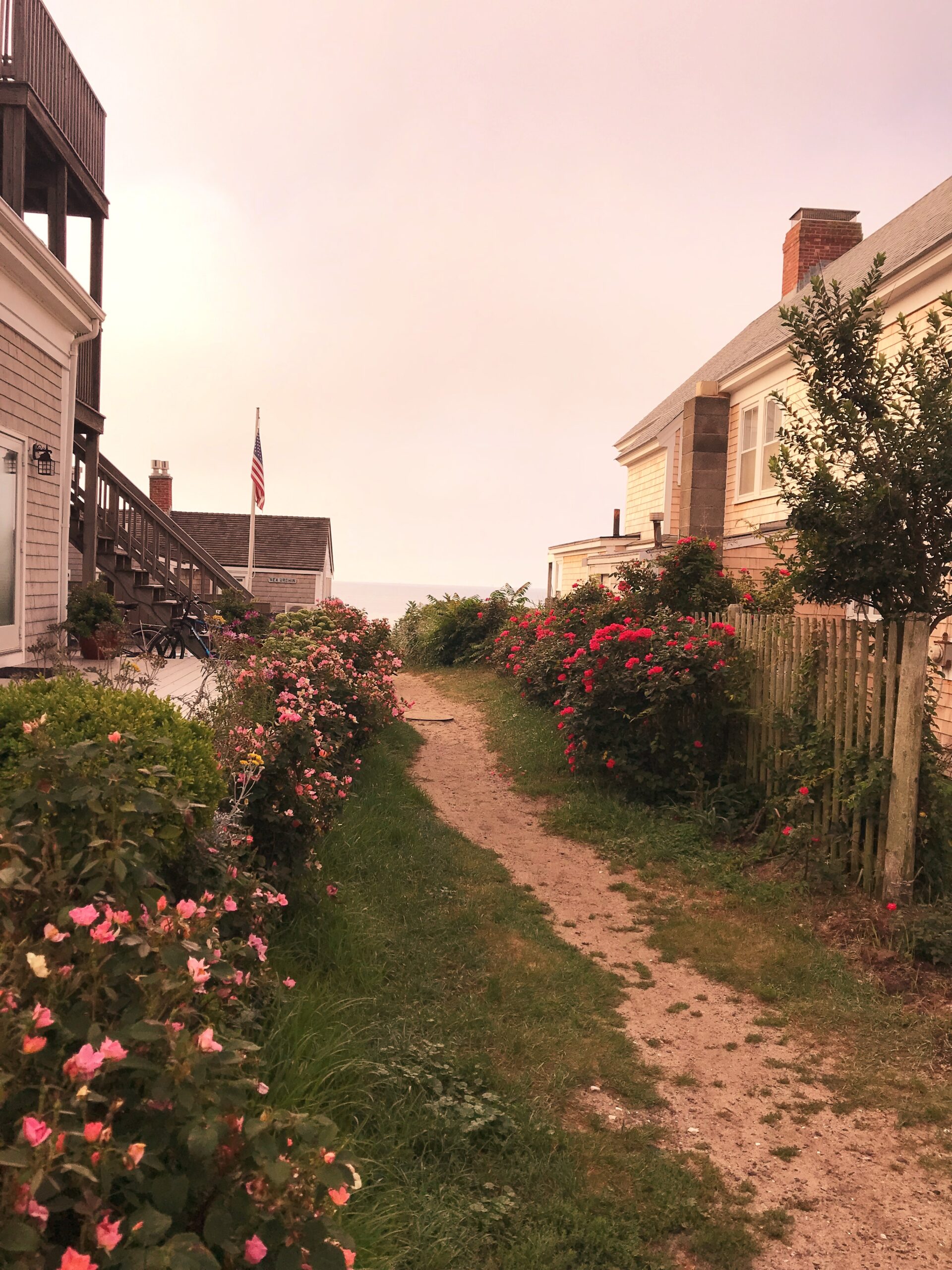
I find it hard to imagine a more pleasant low-key approach to the water than this narrow, rose-bordered sandy lane.
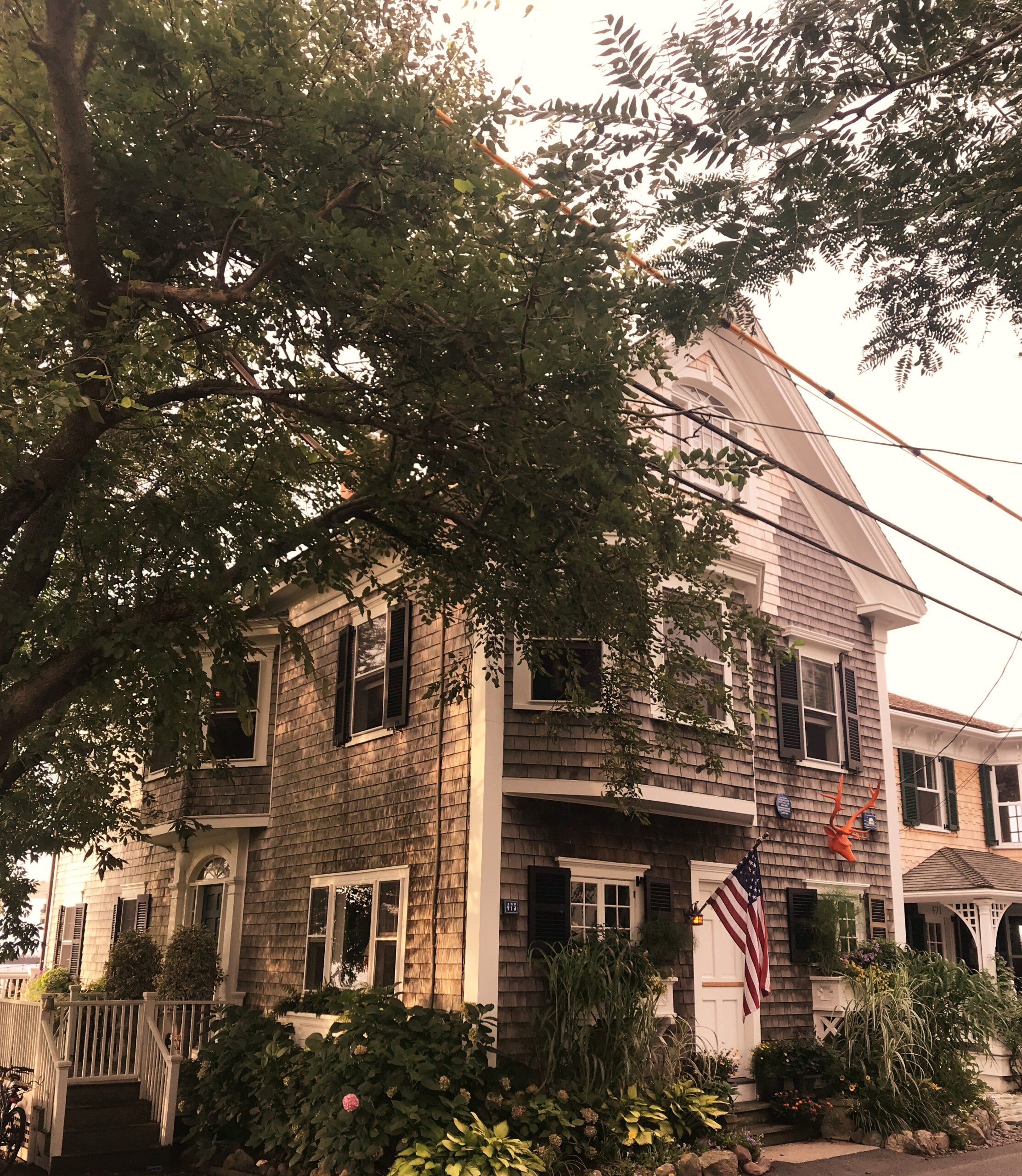
Small blue plaques on many Provincetown buildings indicate points of historical importance and associations with well-known people. The house above was the home of Donald MacMillan (1874-1970), for whom MacMillan Wharf, in the town center, is named. The influential Arctic explorer, scientist, sailor and teacher lived here as an adult; he was born a few doors down on Commercial Street.
The current owners clearly delight in their unique and historic home. I often notice what appears to be a dog puppet perched, as though to welcome guests and greet passersby, in the upper, open half of the Dutch door. I see this happy puppet, accompanied by seasonal decorations, as a manifestation of Provincetown’s jovial, quirky hospitality. Look closely, and you’ll see similar expressions all over town. It’s just that kind of place.
Check back next week, as the Provincetown tour continues into the center of town and out onto Bradford Street.
After a two-year absence, I was eager to get back to my early morning walks along Shore Road in Truro this August. The section that we’d seen upon arrival appeared largely unchanged, much to our relief. As I’ve written previously, it’s this persistent sameness, this enduring sense of place, that our family has come to treasure so dearly.
This view is from Route 6A looking across Route 6 to a sliver of Pilgrim Lake.
My first Shore Road walk this summer reassured me that my favorite ribbon of land was much as I remembered it. No unexpected new structures intruded. Stretches of semi-wild landscape patches remained between buildings. Hearty, low-growing roses and juniper continued to thrive along the fence rows.
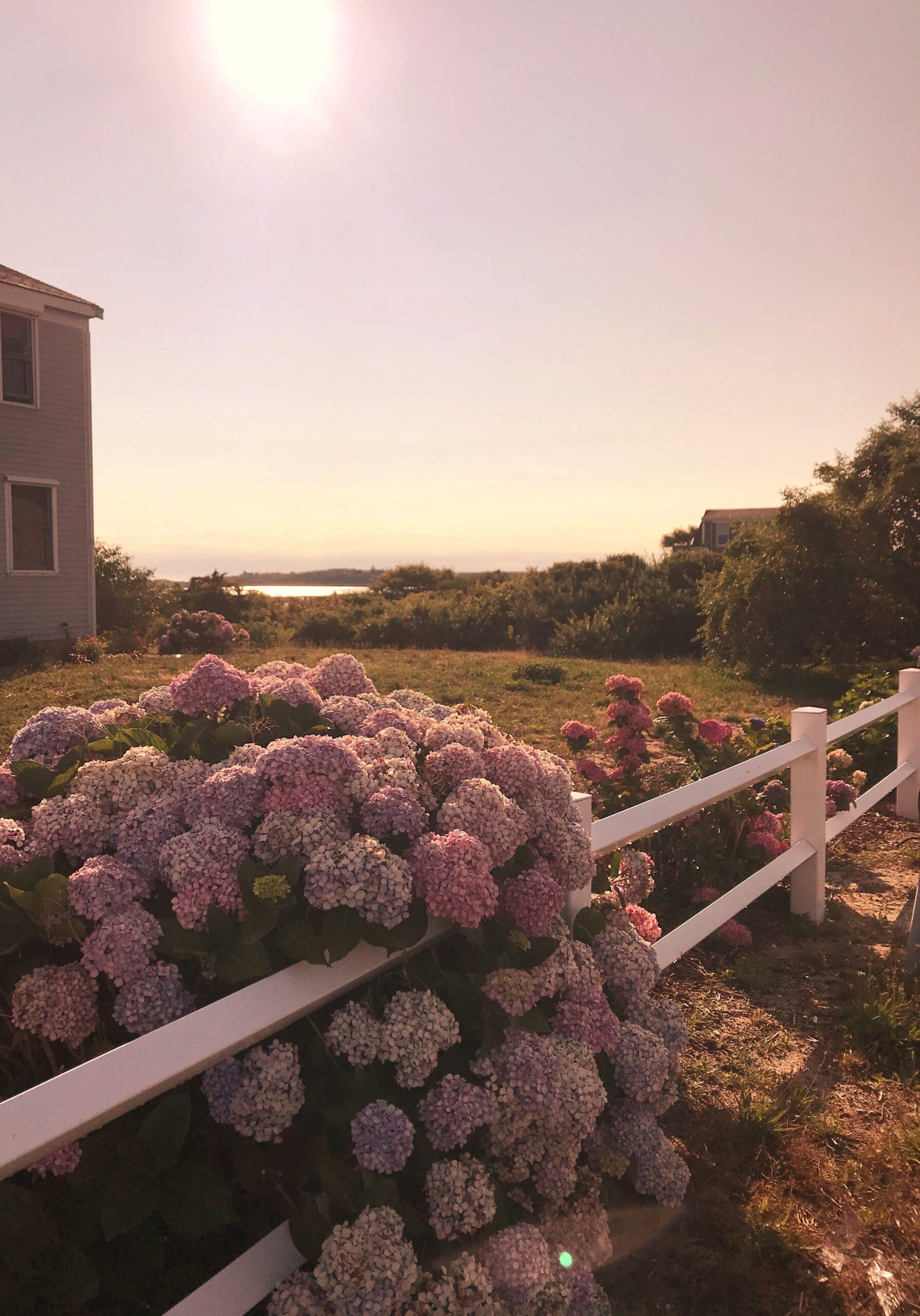
As hoped for, as anticipated, the familiar elements, like old buddies, were there: the glorious Cape hydrangeas that flourish in the salty sea air. . .
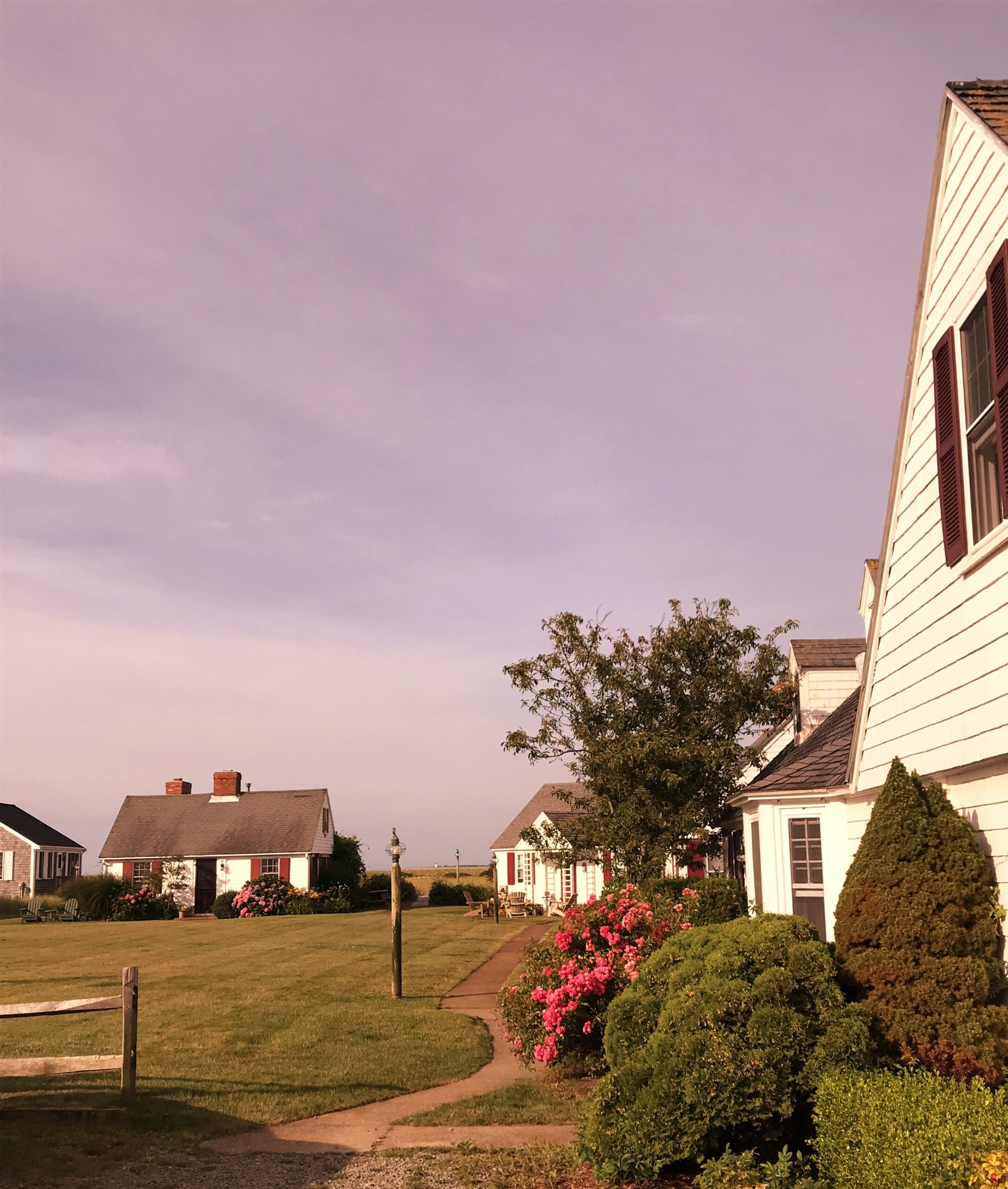
. . .the simple white cottages of Pilgrim Colony, grouped around a neatly manicured central green. . .
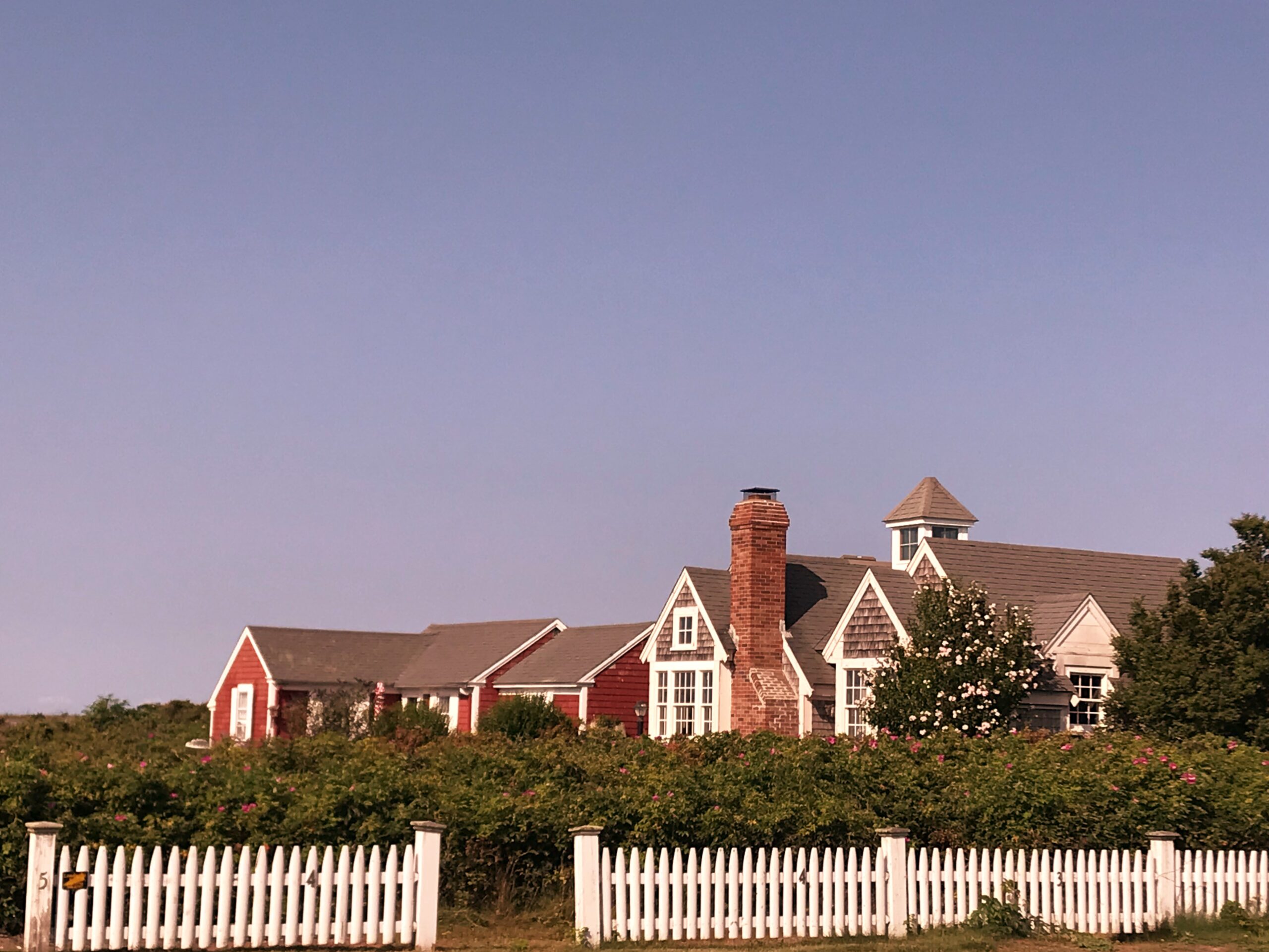
. . .and the tidy, picturesque homes of Bay Colony, set off from the road by a white picket fence and a thick hedge of well-tended roses.
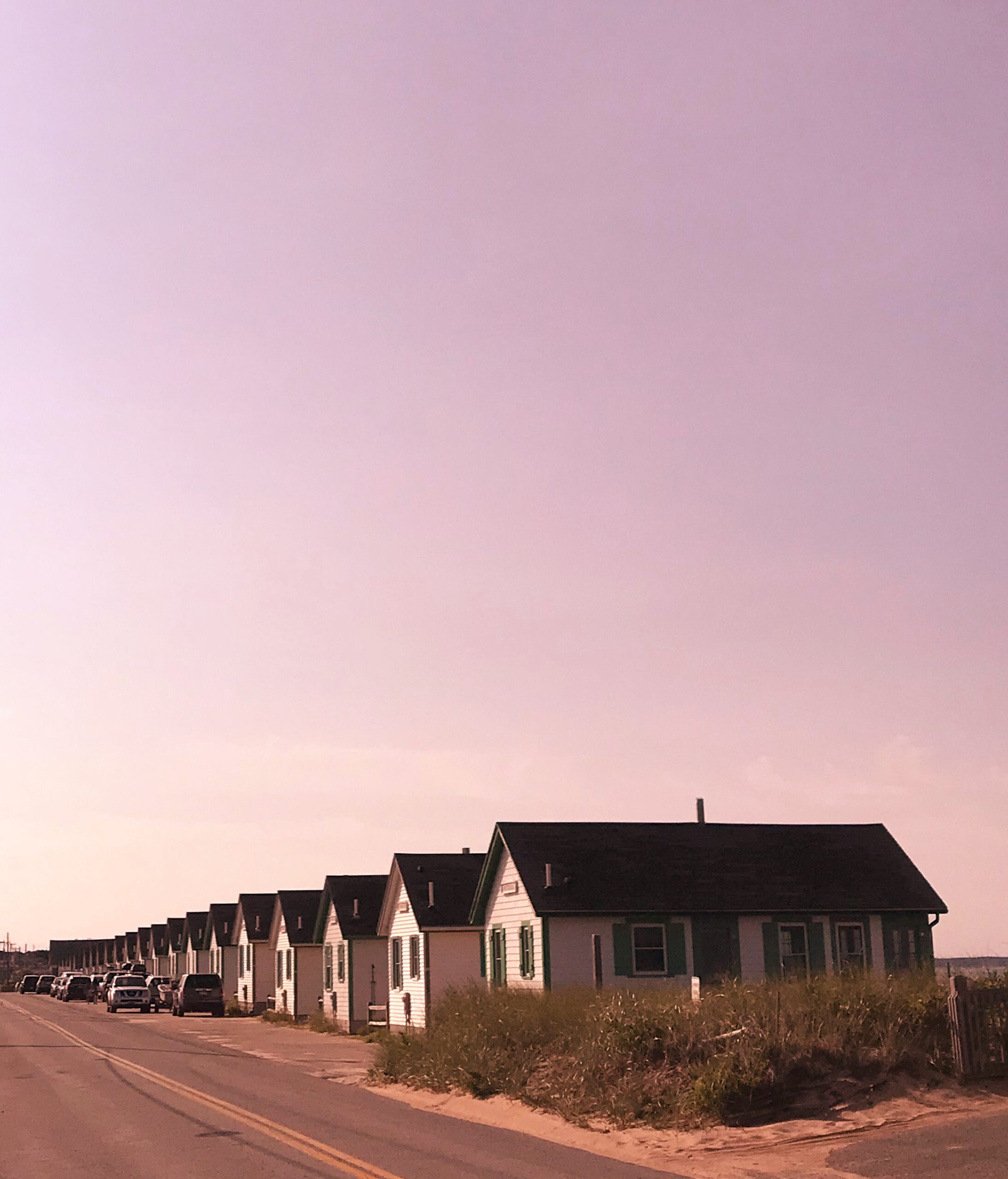
Days Cottages, those identical little white boxes set in a long line, looked exactly the same. Each tiny, green-shuttered house bears the name of a flower: Bluebell, Peony, Dahlia. They’ve changed very little since they were built, beginning in 1931. The land is particularly narrow here, so that at high tide, the bay is but a few short steps from the front of each cottage, and Shore Road a few steps from the back.
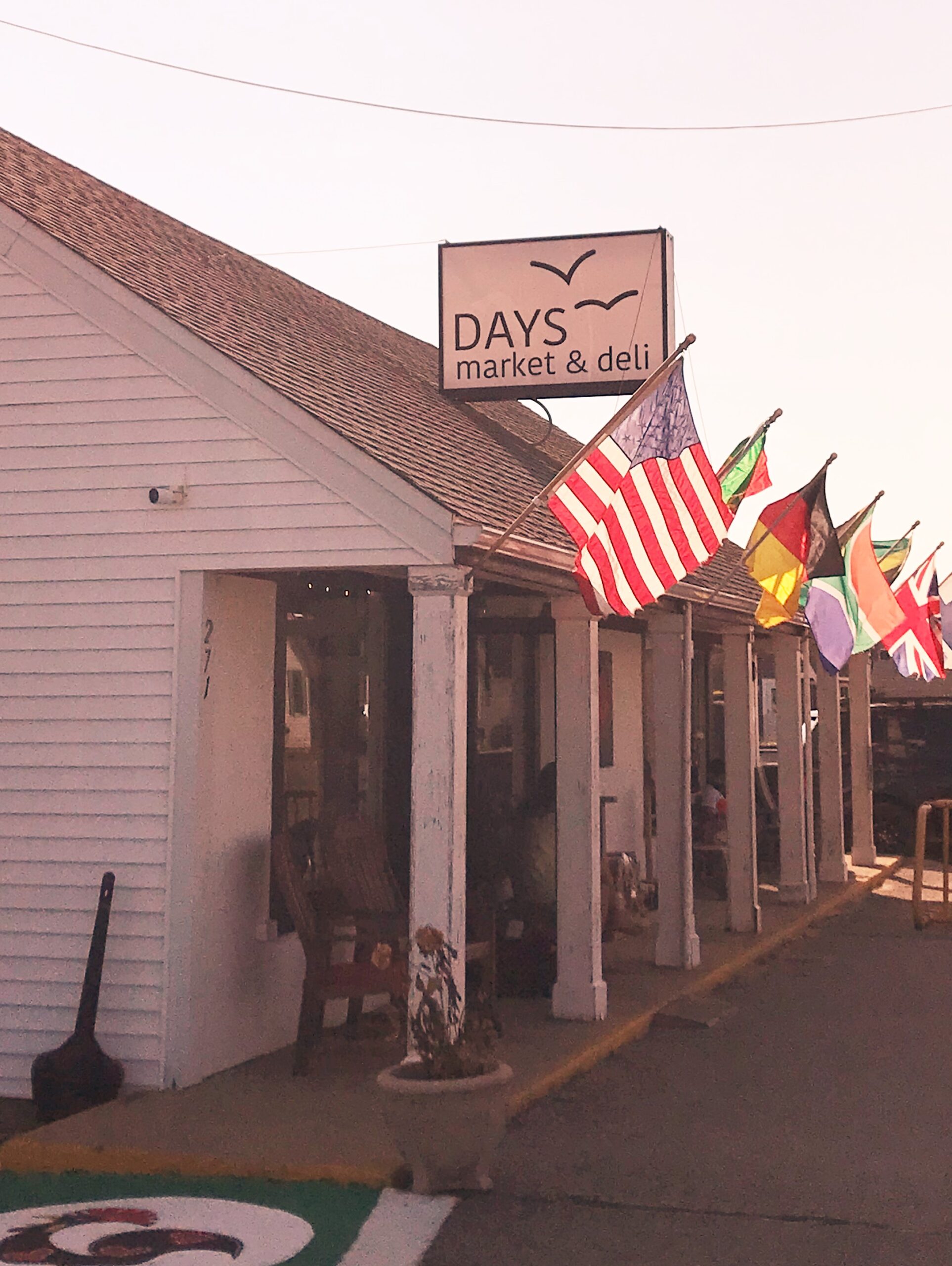
Several years ago, the Days family sold off the last of the units to individual buyers and retired to Florida. The exceptionally well-stocked grocery/news stand/all-purpose beach store associated with the cottages was closed and shuttered during our visit in 2018. We feared it would be razed and the land developed. Instead, it was sold to a new family, who runs it as Days Market and Deli. An upscale specialty grocery and cafe, it’s a popular spot for coffee, pastries, soups and lobster rolls.
The threat of big change on Shore Road was satisfactorily averted.
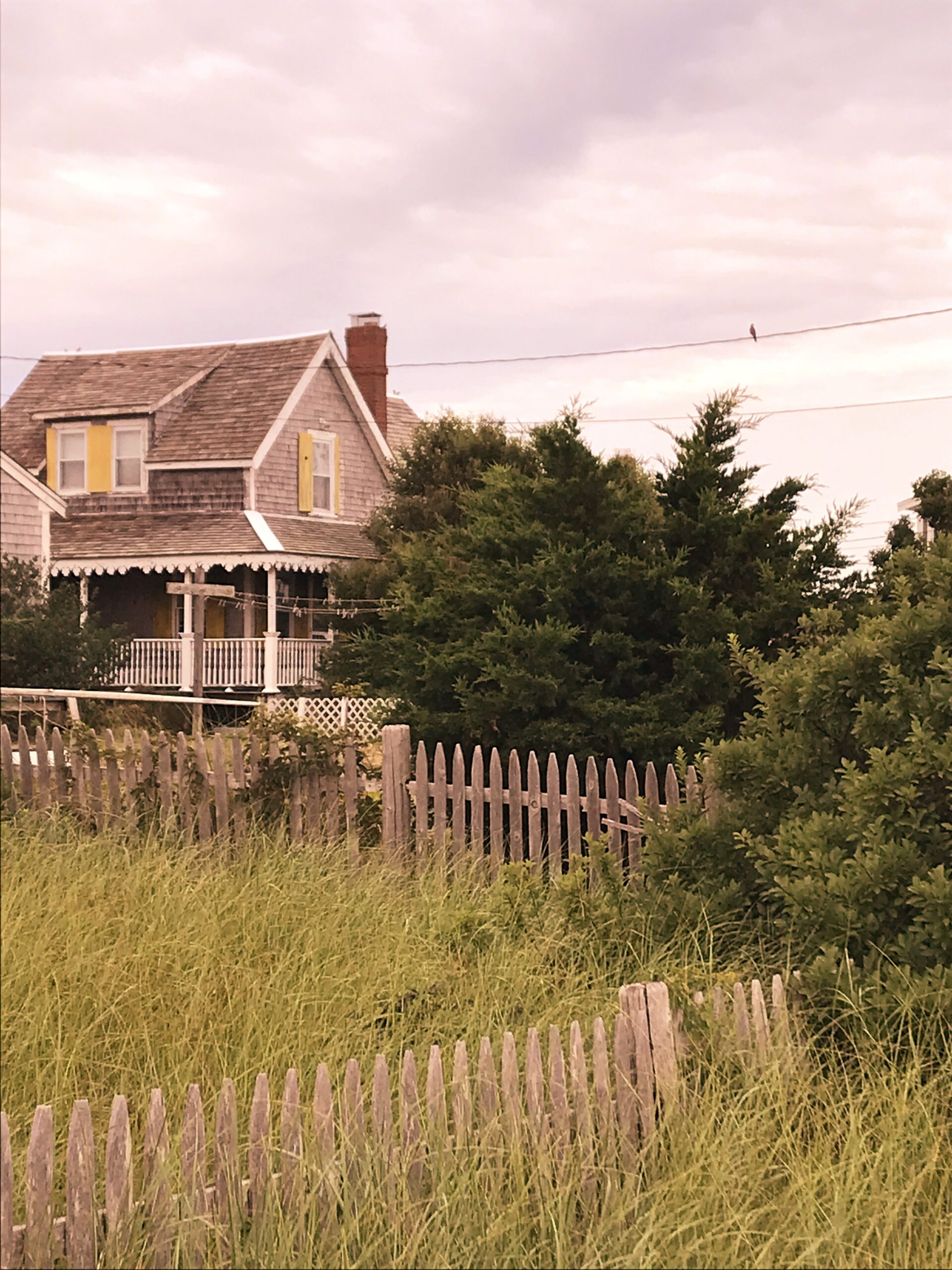
My favorite homes continued to endure, like this weathered Victorian cottage, with its yellow shutters and white gingerbread trim. On a somewhat overcast day, a solitary mourning dove sat on the telephone line out front.
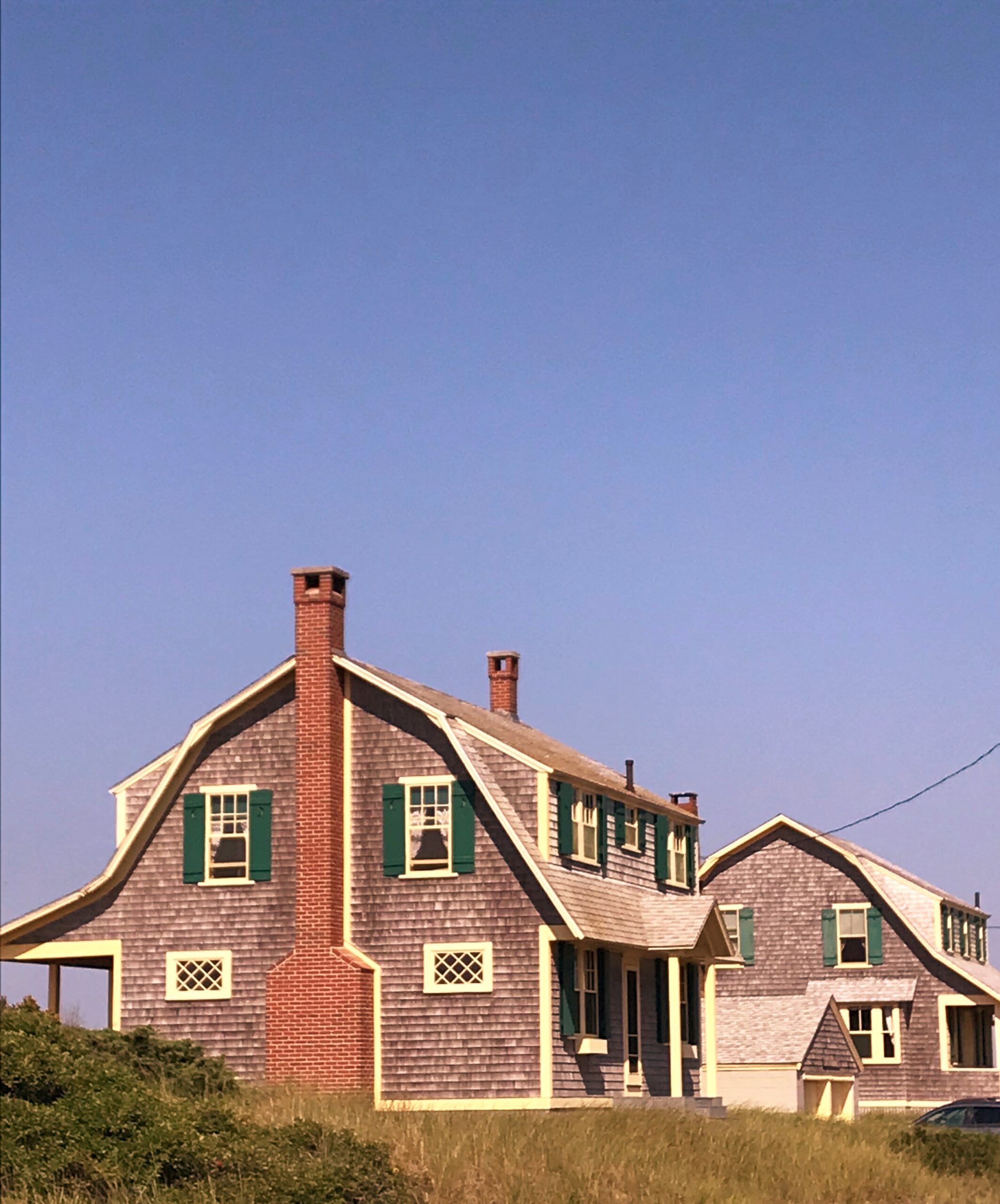
This pair of very similar Dutch Colonial houses appeared just as I remembered them. They sit close together on a bit of high ground, with few other structures nearby. Like Days Cottages, they’re a frequent subject for Cape artists.
The most significant transformation along Shore road was one that had been long anticipated, and therefore didn’t seem especially dramatic. On the site of the old motel that sat empty and decaying for over twenty years, two sizable, but not overly large residences are nearing completion. For photos of the property as nature took its course in years past, as well as other Shore Road locales, see my posts from 2012 and 2013.
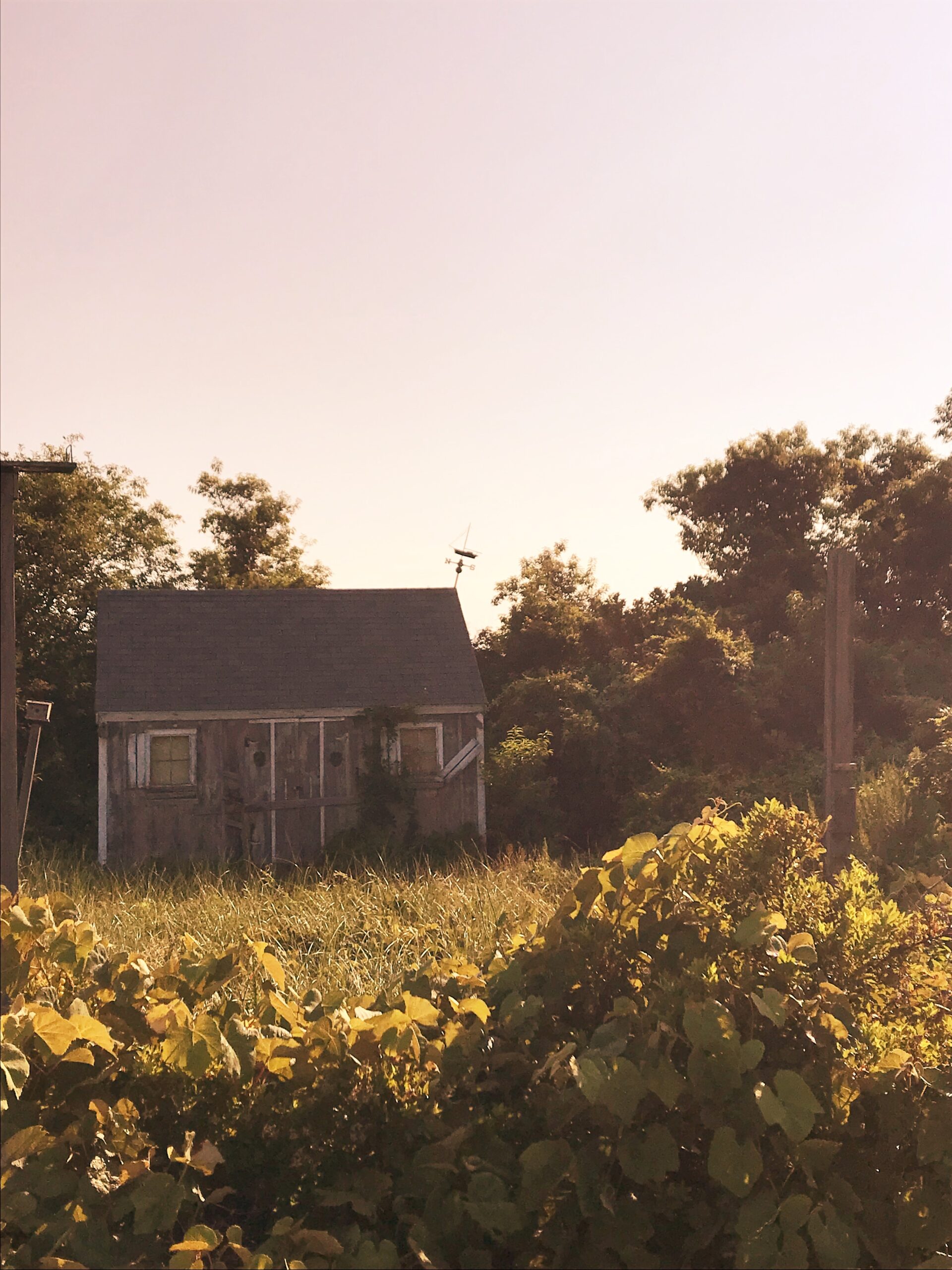
Most other changes on Shore Road involved the gradual yielding of the built environment to nature’s determined advances. For as long as I can remember, the expansive lot above has been occupied by a single small, gradually deteriorating cottage and several decorative birdhouses. See That Satisfying Sameness on Shore Road, September 18, 2018. There were some years when considerable effort had been made to keep the ever-encroaching foliage at bay. This August, nature was winning. The grape vines along the remains of the old fence were wild and thick, the grass was tall, and only a couple of birdhouses remained. The little building was more dilapidated than ever, but its sailboat weather vane still protruded at an angle from the corner of the roof line.
Before long, only the cupola and weather vane of this small cottage may be visible above the growing tangle of plant life. The building, like a humble Sleeping Beauty cabin, has been in slow decline for two decades.
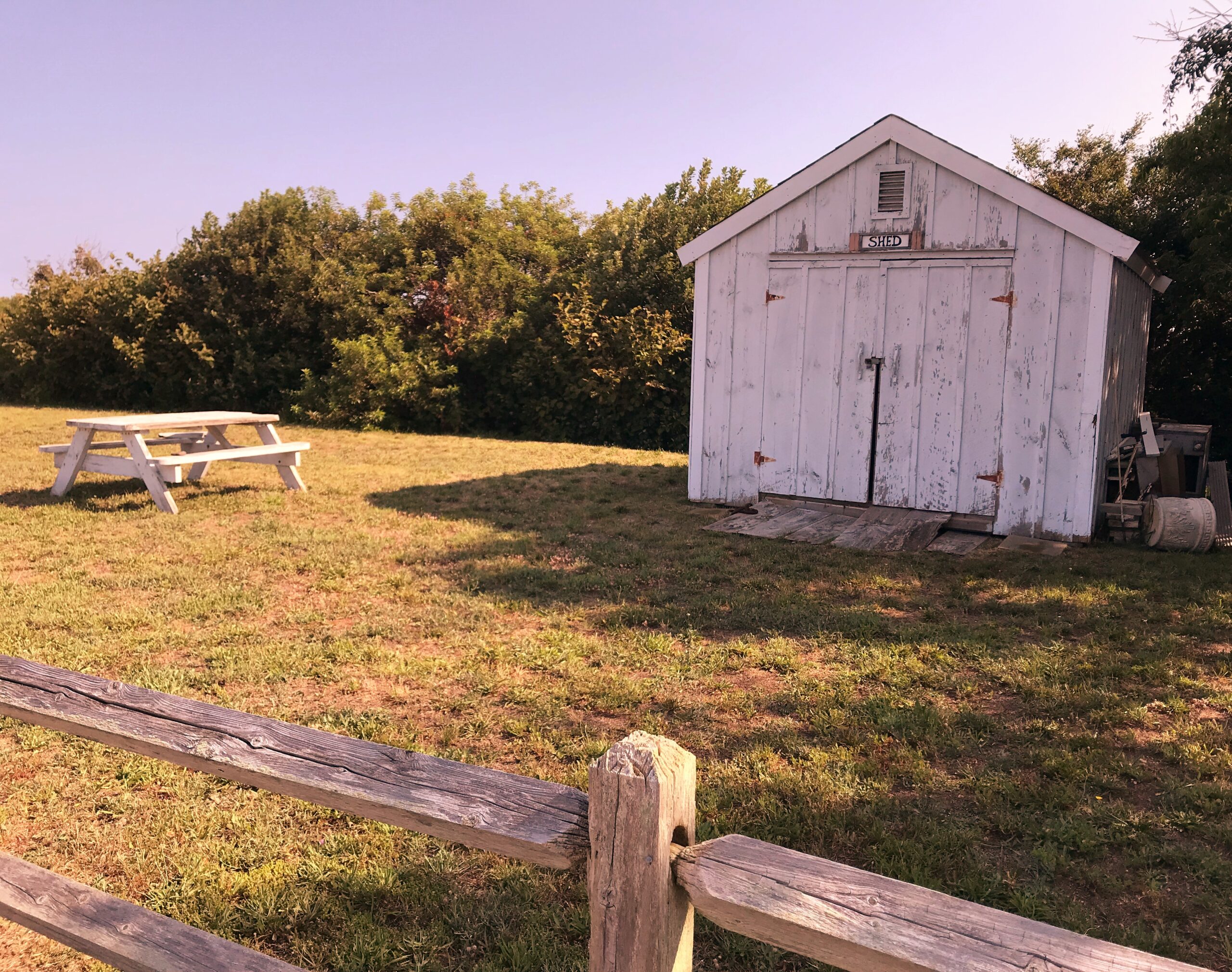
The small structure above, along with the picnic table, has occupied an otherwise empty lot for many years. This summer, there was one minor modification to the building. It received a hand-painted sign bearing an identifying label, or perhaps a name: SHED. On Shore Road, my comfortable, beloved old friend, that’s the kind of subtle change I can support and appreciate.
A blog about motherhood, marriage and life: the joys and frustrations, beauty and absurdity, blessings and pain. It's about looking back, looking ahead, and walking the dog.